%20%20--%3E%0A%3Csvg%20version%3D%221.1%22%20id%3D%22Layer_1%22%20xmlns%3D%22http%3A%2F%2Fwww.w3.org%2F2000%2Fsvg%22%20xmlns%3Axlink%3D%22http%3A%2F%2Fwww.w3.org%2F1999%2Fxlink%22%20x%3D%220px%22%20y%3D%220px%22%0A%09%20width%3D%2239px%22%20height%3D%2240px%22%20viewBox%3D%220%200%2039%2040%22%20enable-background%3D%22new%200%200%2039%2040%22%20xml%3Aspace%3D%22preserve%22%3E%0A%3Cpath%20fill%3D%22%23FFFFFF%22%20d%3D%22M38.5%2C7H28.2v26h10.3V7z%22%2F%3E%0A%3Cpath%20fill-rule%3D%22evenodd%22%20clip-rule%3D%22evenodd%22%20fill%3D%22%23FFFFFF%22%20d%3D%22M26.1%2C25.5c0%2C5.8-4.1%2C7.5-12.9%2C7.5C3.9%2C33%2C0%2C31.2%2C0%2C25.2v-1.1h11.6%0A%09v2.4c0%2C0.7%2C0.1%2C1.4%2C1.2%2C1.4c1%2C0%2C1.2-0.4%2C1.2-1.3v-0.9c0-1.6-0.9-1.6-3.5-2.2C2.2%2C21.7%2C0%2C19.7%2C0%2C15.3v-0.9C0%2C9.3%2C5.5%2C7%2C12.9%2C7%0A%09c10.2%2C0%2C12.8%2C2.6%2C12.8%2C7.4v1.8h-11v-2.9c0-0.6-0.4-1.1-1.2-1.1c-0.6%2C0-1.2%2C0.4-1.2%2C1.1v0.9c0%2C1.5%2C0.9%2C2%2C3.3%2C2.5%0A%09c8%2C1.6%2C10.5%2C3.3%2C10.5%2C7.5V25.5z%22%2F%3E%0A%3C%2Fsvg%3E%0A)
Why the Connecticut Sun's Move to Houston Has Raised Questions From WNBA World
In this story:
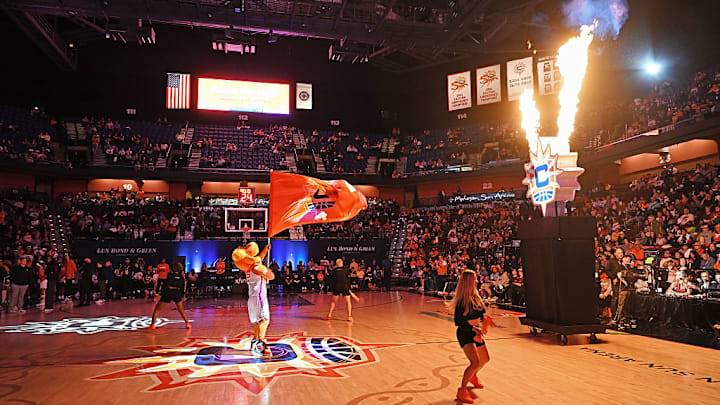
The Mohegan Tribe, owners of the WNBA's Connecticut Sun, announced Monday that they had reached an agreement to sell to the Fertitta family and relocate the team to Houston, pending approval from the W.
Once the deal goes through, it will mark the end of a 23-year run for the Sun, which played to much success in the Connecticut area. And, following one final season in 2026, it will also mean the end of the WNBA's presence in the New England region ... much to the dismay of local officials and stakeholders.
Let's take a look at why:
Tell me about the deal.
Approximately a year after first putting the team up for sale, the Mohegan Tribe will sell the Sun to Rockets owner Tilman Fertitta for a record $300 million, pending approval from the WNBA board of governors. Fertitta will then move the team to Houston in 2027 and reboot the franchise as the Houston Comets. The Comets were one of the original WNBA teams, but disbanded after the 2008 season.
But why has this arrangement raised some eyebrows?
Fetitta's $300 million offer is considerably less than two separate $325 million bids levied by Boston Celtics minority owner Steve Pagliuca and Milwaukee Bucks co-owner Marc Lasry, both of whom would have kept the team in New England (though Pagliuca wanted to move it to Boston and Lasry wanted to move it to Hartford). The league refused to approve either bid—Reports as far back as August suggested Houston was always its "preferred landing spot"—even though at least Lasry's offer was also supported by state officials, including Gov. Ned Lamont and Sen. Richard Blumenthal.
"The outcome here clearly seems to have resulted from the WNBA favoring one bidder," Blumenthal told CT Insider's Dan Haar. "The WNBA put its thumb on the scale and exercised its power for its own interests."
Why might the league opt for Fettita's bid?
On Saturday, Sports Business Journal's Tom Friend reported that the league would have allowed Pagliuca or Lasry to purchase the Sun had they been willing to keep the team in Uncasville. "But—once those buyers maintained that they wanted to relocate the franchise to Boston or Hartford, respectively—the Mohegan Tribe's sale to [Fertitta] became a foregone conclusion," Friend wrote.
Moreover, Pagliuca and Lasry only offered such a high value (i.e., $25 million over the asking price) "for the sole purpose of a relocation," Friend added. "To both groups, the value of the Sun if it remained in Uncasville was much lower, perhaps $250M."
That right there seems to be the main piece of the puzzle—the league office wanted to control the strings on relocation, and, to that end, believed previously approved expansion cities had priority over Boston or Hartford. Additionally, although Houston was not one of the three cities to receive a bid last June, commissioner Cathy Engelbert said at the time that "Houston would be up next, for sure" in the future. In short: the league didn't want franchises controlling relocation, and Houston was already on the horizon.
Moreover, per SBJ, the WNBA also liked that Fertitta already had an NBA franchise and venue, which naturally bodes well for the success of a women's team in the area. Boston has both, as well, but the W was reportedly fine passing on it for now with the expectation that an expansion team would come to the area in early 2030 (when the league could probably get more for a franchise, too).
"They have every right to sell the team in their market,” NBA commissioner Adam Silver said of the situation in September. “But then we started to be contacted by people in Boston and elsewhere saying that there was a suggestion that they could buy a team in one market and take it to another. That’s sort of black-letter law in sports leagues: You can’t do that. You’re buying that market. Teams have different values in different markets, and we view those other markets as expansion markets."
What have Connecticut stakeholders said about this?
Although the efforts have since died down, local officials and stakeholders at least initially lobbied to keep the team in the New England area. Attorney General William Tong, for instance, argued that the WNBA's interference was possibly in violation of antitrust laws; this weekend, he called the deal "concerning." Sen. Blumenthal, meanwhile, suggested in a recent post on X that the "DOJ should investigate and stop such anticompetitive interference."
"I would have loved to remain in the region for our fan base and for the fact that I think this region deserves a women's basketball team," Connecticut Sun president Jen Rizzotti recently told the Associated Press. "At the same time, it wasn't my decision and I'm at a point now where my focus turns to making this the best season we can have and a memorable one for our fans. It's an opportunity to say thank you to them."
Speaking at the women's NCAA tournament over the weekend, UConn coach Geno Auriemma also mourned the loss of the franchise.
“The people at Mohegan Sun, they stepped up when they were needed and brought a team to Connecticut," the coach said, per ESPN's Alexa Phillippou. "Connecticut deserves to have a team because we’re a proven [place] where people would support women’s basketball. Now [with the team] moving, I think it leaves a void."
More WNBA from Sports Illustrated
 Add us as a preferred source on Google
Brigid Kennedy is a writer for the Features and Franchises team at Sports Illustrated. Before joining SI in November 2024, she covered political news, sporting news and culture at TheWeek.com before moving to Livingetc, an interior design magazine. She is a graduate of Syracuse University, dual majoring in television, radio and film (from the Newhouse School of Public Communications) and marketing managment (from the Whitman School of Management). Offline, she enjoys going to the movies, reading and watching the Steelers.