%20%20--%3E%0A%3Csvg%20version%3D%221.1%22%20id%3D%22Layer_1%22%20xmlns%3D%22http%3A%2F%2Fwww.w3.org%2F2000%2Fsvg%22%20xmlns%3Axlink%3D%22http%3A%2F%2Fwww.w3.org%2F1999%2Fxlink%22%20x%3D%220px%22%20y%3D%220px%22%0A%09%20width%3D%2239px%22%20height%3D%2240px%22%20viewBox%3D%220%200%2039%2040%22%20enable-background%3D%22new%200%200%2039%2040%22%20xml%3Aspace%3D%22preserve%22%3E%0A%3Cpath%20fill%3D%22%23FFFFFF%22%20d%3D%22M38.5%2C7H28.2v26h10.3V7z%22%2F%3E%0A%3Cpath%20fill-rule%3D%22evenodd%22%20clip-rule%3D%22evenodd%22%20fill%3D%22%23FFFFFF%22%20d%3D%22M26.1%2C25.5c0%2C5.8-4.1%2C7.5-12.9%2C7.5C3.9%2C33%2C0%2C31.2%2C0%2C25.2v-1.1h11.6%0A%09v2.4c0%2C0.7%2C0.1%2C1.4%2C1.2%2C1.4c1%2C0%2C1.2-0.4%2C1.2-1.3v-0.9c0-1.6-0.9-1.6-3.5-2.2C2.2%2C21.7%2C0%2C19.7%2C0%2C15.3v-0.9C0%2C9.3%2C5.5%2C7%2C12.9%2C7%0A%09c10.2%2C0%2C12.8%2C2.6%2C12.8%2C7.4v1.8h-11v-2.9c0-0.6-0.4-1.1-1.2-1.1c-0.6%2C0-1.2%2C0.4-1.2%2C1.1v0.9c0%2C1.5%2C0.9%2C2%2C3.3%2C2.5%0A%09c8%2C1.6%2C10.5%2C3.3%2C10.5%2C7.5V25.5z%22%2F%3E%0A%3C%2Fsvg%3E%0A)
Sports Gambling 101: What Is Hedging A Bet? The Complete Guide and How To
Definition of Hedging a Bet
Simply stated, hedge betting is placing a wager on the opposite side of an existing bet, usually to guarantee a profit or reduce the risk of a big loss. There are multiple strategies and reasons to hedge a bet that bettors can use to collect a payout or mitigate big losses.
Why Bettors Use Hedging Strategies
Played regularly by some, and rarely by others, the value of hedge bets differs from player to player. There are a few reasons to hedge bet and players can find opportunities to do so with easy access to live wagering platforms. Players place hedge bets to reduce original risk, set up guaranteed returns or create an opportunity to cash in on both sides of a betting option.
What is Hedging a Bet?
Hedging a bet is part of a solid bankroll management system for recreational bettors. That includes reducing risk on active wagers when warranted or securing a profit no matter the outcome of the event.
After placing a first bet, the second bet on the other side of the original bet counteracts your initial wager, thus either securing you a profit or mitigating your loss.
For instance, let's say you bet $15 on Team A at -150 odds vs Team B at +120 odds. If Team A gets off to a hot start against Team B, moving Team A's odds to -300 and Team B's odds to +250, you can bet $10 on Team B and guarantee you don't lose any money. How?
If Team A wins you get a total payout of $25. If Team B wins you also get a $25 payout. You bet $25 combined, so in this case, you neither lose nor win.
The flip side of the argument is Team A is off to a hot start, so let your bet ride. However, anyone who has watched sports there's no guarantee that hot start assures anything.
Types of Hedging Strategies
There are several different ways to hedge your bet and we'll get into all of them below. However, one important note before we go further is hedging takes skill, patience, a close eye on odds movement and quick reaction to place your secondary bet. Sometimes you'll have more time. Others you'll only take a few seconds. It's a skill that takes time to master and a complete focus on a process. Here are some examples.
Pre-Game Hedging
In the lead up to sporting events, there can be dramatic swings in odds. Most of the time this is because of an injury update or a surprise weather forecast change.
A good example of this was in 2025 when Patrick Mahomes was injured in the regular season and his status for the game wasn't known until just before kickoff. In that time, the Chiefs odds against the Texans swung wildly, from the Texans being favorites to the Chiefs being favorites when it was annouced Mahomes was playing.
In that scenario, if you had bet $10 on the Chiefs moneyline at +150 before Mahomes was confirmed playing, for example, and then bet $10 on the Texans moneyline at +150 after he was confirmed playing, you would guarantee yourself a $5 profit. Total bet = $20. Total profit on either bet = $15. Subtract the inital $10 wager you get back for winning either bet and your profit is $5.
Futures Bet Hedging
One of the most common hedge betting scenarios involves championship futures tickets. Super Bowl 54 provides a classic example. Prior to the 2019 season, San Francisco was a +4000 moneyline longshot to win the NFL title at the Westgate SuperBook in Las Vegas. Bettors who wagered $100 went into Super Bowl Sunday with a chance to earn a $4,000 profit if the 49ers won. If Kansas City won, no matter the final score, the net result was a painful $100 loss.
Bettors who wanted to kick back and just enjoy the game set up a guaranteed win by betting on Kansas City with the -120 moneyline. The math was pretty simple, as a $2200 bet on the Chiefs returned $1800 profit if the 49ers won and a $1,833 profit if Kansas City won. Bettors who didn’t hedge were left with the net $100 loss when the Chiefs posted a 31-20 come-from-behind win over the 49ers. It was a classic “A bird in the hand is worth two in the bush” scenario.
In-Play (Live) Hedging
In-play hedging, or live hedging, is another way to minimize risk or guarantee a payday. I explained in the What is Hedging a Bet section how one live betting hedge could work. Here's another:
Let's say you bet $110 on an UNDER in an NFL game where the total was set at 45.5 points with -110 odds. Your potential profit in this scenario is $100.
Great news! The teams score 13 points combined and the live total has dropped to 32.5 points with -110 odds. You can bet the OVER here for $55, where your profit would be $50. If the two teams score more than 32.5 points combined and UNDER 45.5 points, you profit $150. If they score UNDER 32.5 points, you profit $50. If they score OVER 45.5 points, you lose $50.
In this scenario, you can't guarantee a win, but you can improve your total potential win while also mitigating a potential loss.
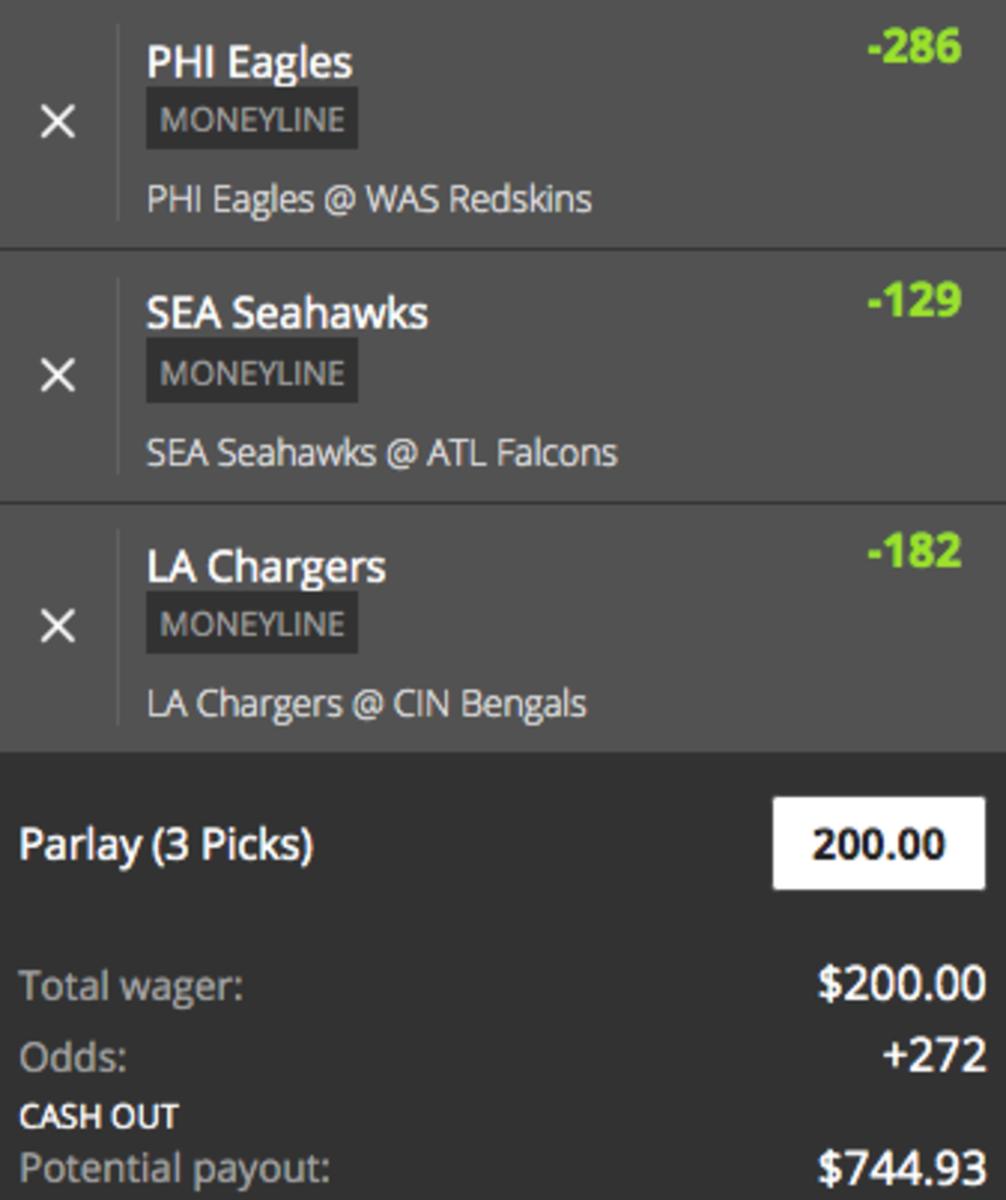
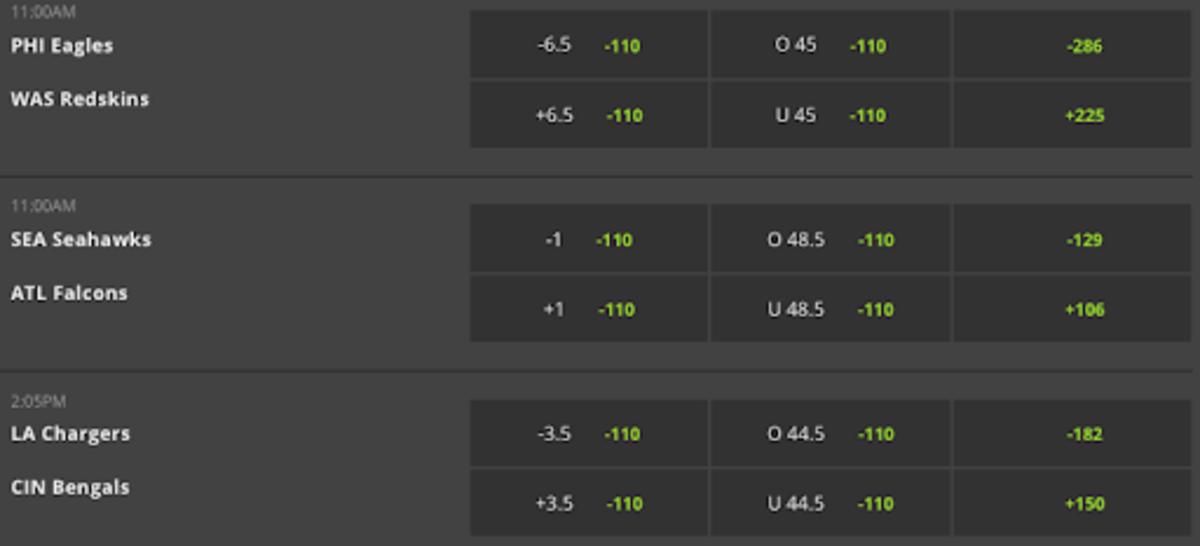
Players who use hedge betting to set up no-risk parlay profits accept a smaller return to guarantee a winning wager. In the example below, if Philadelphia and Seattle both win, bettors need a Los Angeles victory to earn a $544.93 profit. If Cincinnati wins, bettors lose the $200 original risk. A $200 wager on the Bengals (+150) sets up a $344.9 return if the Chargers win. If Cincinnati pulls off the upset, bettors get their $200 parlay investment back plus a $100 profit.
Cashing on Both Sides With Hedge Betting
Also known as a middle, cashing in on both sides of a betting option is like hitting a jackpot on a slot machine. Using the point spread odds below, NFL bettors could place a wager on Detroit with -1.5 odds at DraftKings. When Chicago +2.5 odds appeared at FanDuel, they could hedge with a bet on the Bears. If the Lions win by exactly two points, both tickets cash. This is a risky bet as any result, other than a two-point win by Detroit, costs bettors the juice on the losing wager.


How to Hedge a Bet
Step 1: Calculate Potential Outcomes: When you're considering hedging, the first step is to understand A. How much have I bet on Team A; B. How much would that bet profit if it wins; C. What are the odds on Team B; D. What would you have to bet on Team B to guarantee a profit or mitigate risk on the initial bet.
Obviously, we're trying to guarantee a win, but knowing the math is the first part of this equation.
Step 2: Assess the Current Odds: As mentioned above, knowing where the odds are on the other side of your bet is key to knowing whether you can or can't hedge a bet. You need to, agian, know what your potential profit is on Bet A to know whether Bet B is even feasible. That answer comes from the odds on Bet B.
Step 3: Place Your Hedge Bet: Once you've assessed Bet B either guarantees a win or mitigates a loss, you need to act quickly. Especially with live odds, you have to get your hedge bet in before the odds move to guarantee yourself the outcome you desire.
Hedging Formulas and Calculations
Simple Formula for Hedging a Bet
This is all about understanding odds and potential payout. If you wager $10 on +150 odds, your potential profit is $15 with a total payout of $25 (adding your initial wager to the profit). If the other side has odds of -125 odds and you wager $10, your potential profit is $8 and the total payout is $18. In this scenario, you're guaranteeing you lose no more than $2 and you could win $5.
The best scenario is when you bet on something with longer odds and things play out where that outcome's odds decrease and you bet the other side to guarnatee a profit. The 49ers-Chiefs situation above is a good example of that.
Using a Hedge Bet Calculator
Hedge bet calculators are a great tool to understand how much you need to bet in order to guarantee a profit or mitigate a loss. Action Network has a great one that's free and easy to use. Just type in the odds and bet amount from your initial bet, then put in the odds of the second bet and it will tell you how much you should bet in the "Hedge Amount" box and what your profit or losses would be.

Pros and Cons of Hedging a Bet
Pros
- Reduced Risk: When you hedge properly, you either mitigate total losses or guarantee a profit.
- Locking in Profit: In some situations, as illustrated above, you can guarantee a profit.
- Flexibility: Hedging allows you to adjust on the fly as games or seasons unfold.
- Reduced stress: When you hedge properly, you are not as stressed about the outcome of the bet because you either have locked in profit or know you're going to lose less than initially feared.
Cons
- Reduced Overall Profit: When you hedge, you cut into your potential profit. I say potential because outcomes of games or events are never guaranteed. Many times, you'll hedge and your initial bet will win. People get upset about this, thinking they shouldn't have hedged in the first place because they would have won more if they had stuck with the initial bet.
- Complexity: You need to understand odds and calculate correct hedge amounts to hedge properly. You also need to closely follow betting odds and markets. This takes time and patience.
When to Hedge a Bet
- High-Stakes Situations: When you have a lot of money on a bet, hedging offers the chance to take some of the stress off of the situation. It's a good way to take a high-stakes risk and minimize said risk.
- Uncertain Outcomes: As discussed throughout this tutorial, nothing is guaranteed in sports. When the Falcons were up 28-3 in the third quarter against the Patriots in the 2016 Super Bowl, I'm sure many bettors thought their Falcons bet was secure. It wasn't, as we now know. Hedging, again, takes the uncertainty out of the equation. Either you are guaranteed to win, or you will lose a smaller amount.
- Near the End of a Futures Bet: The 49ers Super Bowl example above is a perfect illustration of this. If you bet on a team or player to hit a longshot futures bet and they're in the final stages, betting on the other side can lock in big profit or, at minimum, some profit.
- Emotional Factors: Hedging can provide peace of mind and reduce betting anxiety because you already know the outcome of your bets before the final result of the game. This allows you to enjoy the game without the stress of fearing a big loss.
Hedge Betting Bottom Line
This is a personal betting choice. Players who are gamblers often let wagers ride and take their chances. More conservative bettors will hedge and take guaranteed money. Players should decide on which way to bet based on their desired returns.
Hedging is also part of gambling responsibly. If you stand to lose $1,000 on a bet that could win $5,000, locking in a profit of $500 is OK. It means, primarily, you don't lose the $1,000 guaranteed. You also win the $500. Other will tell you the potential payout of $5,000 is worth the risk. But a responsible gambler will understand profit is profit no matter the amount.
If you're new to hedging, you should practice in low stakes situations. Bet $1 on one side of a bet and see if you can lock in a $0.25 profit by betting on the other side. That may seem silly, but it's a great way to learn in real time without breaking the bank.
As said, this takes practice and patience and a deep understanding of betting odds and markets. It's not for everyone, but when practiced correctly it's a great tool within a responsible gambler's belt.
MORE GAMBLING TERMS YOU NEED TO KNOW
 Add us as a preferred source on Google