%20%20--%3E%0A%3Csvg%20version%3D%221.1%22%20id%3D%22Layer_1%22%20xmlns%3D%22http%3A%2F%2Fwww.w3.org%2F2000%2Fsvg%22%20xmlns%3Axlink%3D%22http%3A%2F%2Fwww.w3.org%2F1999%2Fxlink%22%20x%3D%220px%22%20y%3D%220px%22%0A%09%20width%3D%2239px%22%20height%3D%2240px%22%20viewBox%3D%220%200%2039%2040%22%20enable-background%3D%22new%200%200%2039%2040%22%20xml%3Aspace%3D%22preserve%22%3E%0A%3Cpath%20fill%3D%22%23FFFFFF%22%20d%3D%22M38.5%2C7H28.2v26h10.3V7z%22%2F%3E%0A%3Cpath%20fill-rule%3D%22evenodd%22%20clip-rule%3D%22evenodd%22%20fill%3D%22%23FFFFFF%22%20d%3D%22M26.1%2C25.5c0%2C5.8-4.1%2C7.5-12.9%2C7.5C3.9%2C33%2C0%2C31.2%2C0%2C25.2v-1.1h11.6%0A%09v2.4c0%2C0.7%2C0.1%2C1.4%2C1.2%2C1.4c1%2C0%2C1.2-0.4%2C1.2-1.3v-0.9c0-1.6-0.9-1.6-3.5-2.2C2.2%2C21.7%2C0%2C19.7%2C0%2C15.3v-0.9C0%2C9.3%2C5.5%2C7%2C12.9%2C7%0A%09c10.2%2C0%2C12.8%2C2.6%2C12.8%2C7.4v1.8h-11v-2.9c0-0.6-0.4-1.1-1.2-1.1c-0.6%2C0-1.2%2C0.4-1.2%2C1.1v0.9c0%2C1.5%2C0.9%2C2%2C3.3%2C2.5%0A%09c8%2C1.6%2C10.5%2C3.3%2C10.5%2C7.5V25.5z%22%2F%3E%0A%3C%2Fsvg%3E%0A)
A Tyson Fury Return to the Ring Feels Different
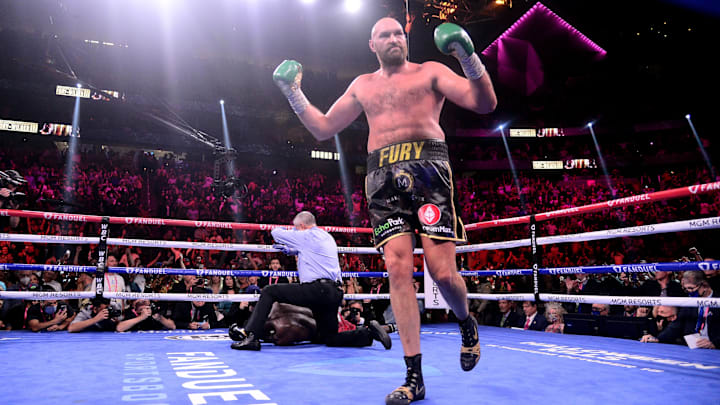
Last week, during an interview promoting the Deontay Wilder-Derek Chisora fight, promoter Kalle Sauerland let slip an interesting nugget: The long-anticipated showdown between Anthony Joshua and Tyson Fury was “done” for September in Dublin. Sauerland, of course, doesn’t promote Joshua or Fury, but he’s well-connected, so his words traveled quickly. Joshua’s promoter, Eddie Hearn, fired off a quick denial (“Absolutely no truth to that whatsoever,” said Hearn) but admitted there had been talks with Saudi Arabian officials—including Turki Alalshikh—about “the progress towards that fight.”
That an offhand comment from a rival promoter went viral underscored the obvious: Joshua-Fury, even in their diminished states, remains a boxing mega-event—and arguably the biggest fight in British boxing history. Last December, Joshua knocked out Jake Paul, breaking the YouTube star’s jaw with a devastating right hand. He recently returned to training after recovering from a tragic car accident that took the lives of two of his friends. Fury will end his 16-month layoff on Saturday when he takes on Arslanbek Makhmudov in a Netflix-streamed event.
A Fury comeback is nothing new. A quick summary: In 2016, Fury walked away from boxing months after defeating Wladimir Klitschko. After battling well-documented weight and mental health issues, Fury returned in 2018, reclaiming a piece of the heavyweight title in a thrilling trilogy with Wilder. He retired again in 2022, after knocking out Dillian Whyte. Eight months later, he was back, stopping Chisora. The most recent exit came in 2024, after his second loss to Oleksandr Usyk.
This return just feels a little different. Fury is 37, old even by today’s boxing standards. He was knocked down four times in his three fights with Wilder. He was nearly out on his feet in his first fight with Usyk and took a lot of punches over 24 hard rounds.
The losses to Usyk—the first two of his pro career—irked Fury. “I thought I won both of those fights,” Fury grumbled on a Ring Magazine podcast recently. “Clearly.” The perceived mistreatment by the judges pushed Fury out the door. He went home to Morecambe, a seaside town on the English coast. He walked his dog, shot a couple of documentaries and traveled with his family. “But it was boring,” said Fury. “The fight game is what I love to do.”
But does it still love him? What little Fury has revealed from his training camp has been uninspiring. His morning jogs, his work on the heavy bag and the shadow boxing that lands on his Instagram feed. His body, which was never chiseled, has looked doughy. He weighed a career-high 281 pounds in his last fight, when Usyk outworked him. He will likely be lighter on Saturday—though maybe not by much.
Then there is John Fury, Tyson’s father and, for most of his career, his staunchest supporter. Last month, John criticized Tyson’s decision to return, telling Playbook Boxing that Tyson was “past his best.” He said the Wilder fights “finished” Tyson and that “he has not got a leg underneath him.” The relationship between the two, John said, “is destroyed.”
“I love him, but there are too many people patting him on the back and telling him things that aren’t true,” said John. “Building him up like he’s invincible. He’s not and he hasn’t been for a while.”
Fury insists he feels fine. His flabby physique has frankly always been flabby. “I’m a big, fat b------,” said Fury. He weighed 273 pounds for his rematch with Wilder, which he finished in the seventh round. He tipped the scales at 277 pounds for the third fight, which went 11. His stamina isn’t derived from muscle, Fury often reminds people. But footwork, agility and uncommon smarts.
Not any kind of cheating, Fury said. The promotion of Wilder-Chisora gave Wilder opportunities to rehash old conspiracy theories. About Fury manipulating his gloves. About Fury loading his gloves. Wilder offered no evidence, except for vague references to a documentary he has long claimed to be working on. Fury, though, swears there is nothing to find.
“The first fight was in Los Angeles with the [California] State Boxing Commission and his trainer, Jay Deas, watched me get gloved up and wrapped up,” recounted Fury. “So not unless [Deas] was cheating as well. And the whole of L.A. was cheating. The second fight was in Las Vegas with all the people there again, all the [Nevada] State Commission. His training team, everybody. Are they all on it? I’m not sure, but at the end of the day, I’m not going to hold it against him. Like I said many, many times before, when he gets better and well down the line, then he’ll probably appreciate the fact that he shared the ring with the great Tyson Fury three times.”
Against Makhmudov, Fury will get an interesting test. Makhmudov looks the part: A menacing 6’ 6” heavyweight with a 90% knockout ratio. But he has been demystified in recent years, absorbing knockout losses to Agit Kabayel and Guido Vianello. Fury isn’t focused on that fighter. He’s thinking about the man who stopped 17 of his first 18 opponents, who earned this opportunity with a lopsided decision win over Dave Allen last fall.
“It makes me train hard,” Fury said. “It makes me respect everything because I know that Arslanbek is a big puncher. And if he lands one punch on me in the right place, knock out.”
Not that Fury expects that, of course. Fury appears energized by his return. He says boxing has been boring since his absence. “Without GK [Gypsy King], boxing is dead,” Fury said. He notes that Netflix could air whatever fight they want, “but yet they went to a fat bald guy who was retired for a year and coming off two losses.”
“This is an entertainment business,” Fury said. “This is show business. This is Hollywood. This is all eyes on me. This is not boring. This is anything but. This is the entertainment factor. And if people don’t tune in and get entertainment and value for their hard-earned money in today’s economic climate, people are doing the wrong job. And that's where I come into it. I bring a traveling circus. I bring a show. I bring a flash, razzmatazz, charisma, the gift of gab, trash talk. I bring all of that. It makes boxing great again.”
And if Fury is still great? The door is open for another chapter in a Hall of Fame career. Fury says he wants to squeeze two, even three fights into 2026. There’s Joshua, who represents another enormous payday. There’s Fabio Wardley, a recently crowned heavyweight champion. And Fury has said repeatedly he needs to settle the score with Usyk before both hang up the gloves.
All is on the table if Fury can come back one more time.
 Add us as a preferred source on Google
Chris Mannix is a senior writer at Sports Illustrated covering the NBA and boxing beats. He joined the SI staff in 2003 following his graduation from Boston College. Mannix is the host of SI’s “Open Floor” podcast and serves as a ringside analyst and reporter for DAZN Boxing. He is also a frequent contributor to NBC Sports Boston as an NBA analyst. A nominee for National Sportswriter of the Year in 2022, Mannix has won writing awards from the Boxing Writers Association of America and the Pro Basketball Writers Association, and is a longtime member of both organizations.
Follow sichrismannix