%20%20--%3E%0A%3Csvg%20version%3D%221.1%22%20id%3D%22Layer_1%22%20xmlns%3D%22http%3A%2F%2Fwww.w3.org%2F2000%2Fsvg%22%20xmlns%3Axlink%3D%22http%3A%2F%2Fwww.w3.org%2F1999%2Fxlink%22%20x%3D%220px%22%20y%3D%220px%22%0A%09%20width%3D%2239px%22%20height%3D%2240px%22%20viewBox%3D%220%200%2039%2040%22%20enable-background%3D%22new%200%200%2039%2040%22%20xml%3Aspace%3D%22preserve%22%3E%0A%3Cpath%20fill%3D%22%23FFFFFF%22%20d%3D%22M38.5%2C7H28.2v26h10.3V7z%22%2F%3E%0A%3Cpath%20fill-rule%3D%22evenodd%22%20clip-rule%3D%22evenodd%22%20fill%3D%22%23FFFFFF%22%20d%3D%22M26.1%2C25.5c0%2C5.8-4.1%2C7.5-12.9%2C7.5C3.9%2C33%2C0%2C31.2%2C0%2C25.2v-1.1h11.6%0A%09v2.4c0%2C0.7%2C0.1%2C1.4%2C1.2%2C1.4c1%2C0%2C1.2-0.4%2C1.2-1.3v-0.9c0-1.6-0.9-1.6-3.5-2.2C2.2%2C21.7%2C0%2C19.7%2C0%2C15.3v-0.9C0%2C9.3%2C5.5%2C7%2C12.9%2C7%0A%09c10.2%2C0%2C12.8%2C2.6%2C12.8%2C7.4v1.8h-11v-2.9c0-0.6-0.4-1.1-1.2-1.1c-0.6%2C0-1.2%2C0.4-1.2%2C1.1v0.9c0%2C1.5%2C0.9%2C2%2C3.3%2C2.5%0A%09c8%2C1.6%2C10.5%2C3.3%2C10.5%2C7.5V25.5z%22%2F%3E%0A%3C%2Fsvg%3E%0A)
The Senate Blew Its Chance to Get Real Answers on the Health of Boxing
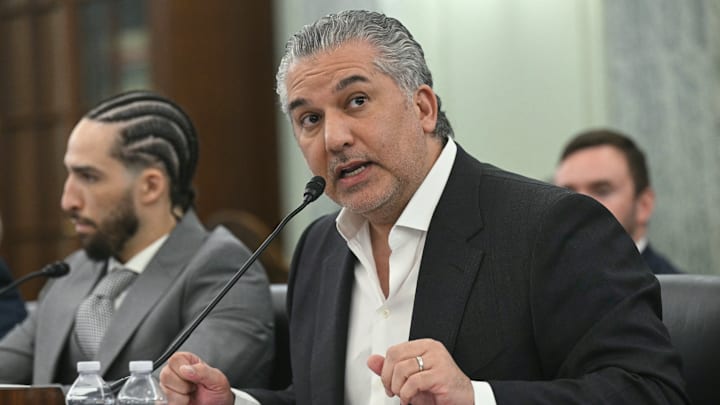
Capitol Hill is home to the corridors of power, where elected representatives horse trade over tax policy, fight over health care and, on Wednesday, plead for WWE events.
“What is it going to take,” Senator Bernie Moreno (R-Ohio) asked, “to bring WrestleMania to Cleveland?”
Sigh. Wednesday’s hearing in the Senate Commerce Committee was billed as a fact-finding opportunity. “This hearing will assess the current state of boxing under the federal Ali Act,” read a press release. Last month, the U.S. House of Representatives advanced legislation that would radically change the boxing landscape. The bill—dubbed the Muhammad Ali Boxing Revival Act—would change existing law to allow for the creation of Unified Boxing Organizations (UBOs). Advocates say it will protect fighters. Critics say it will rip them off.
Invited to testify was Oscar De La Hoya, a boxing Hall of Famer and CEO of Golden Boy Promotions; Nick Khan, president of WWE and TKO board member; Nico Ali Walsh, a professional boxer and grandson of Muhammad Ali; and Timothy Shipman, the president of the Association of Boxing Commissions. A hearing appeared to be a great opportunity for lawmakers to ask probing, specific questions to elicit answers that would inform votes.
Only it wasn’t. There are 28 Senators on the Commerce Committee. On Wednesday, three could be bothered to show up. Ted Cruz (R-Texas) opened the hearing by introducing witnesses Michael Buffer–style. Jacky Rosen (D-Nevada) seemed giddy just to be in the presence of people from Las Vegas. And Moreno really, really wanted Khan to commit to Logan Paul frog splashing someone at northeast Ohio’s soon-to-be-built suburban stadium.
“2029 or 2030?” asked Moreno. “Which one’s better for you?”
Nick Khan just testified in front of The U.S. Senate for The Muhammad Ali American Boxing Revival Act.
— BOXING n BBQ (@BOXINGnBBQ) April 22, 2026
He says the WBC recognizes too many champions (163 champions across 18 weight classes.)
Below is the full speech: pic.twitter.com/jO5MPfTiCv
Khan smiled. Why wouldn’t he? This hearing was a big win for TKO. For 90 minutes the committee served up softballs and Khan parked them. He played the hits. Boxing has no structure, Khan said. It has been corrupted by sanctioning bodies who hand out too many belts and reach far too deep into fighters’ pockets. American broadcast networks have abandoned boxing, Khan noted. This legislation can help bring them back.
He’s not wrong. Boxing is a free-for-all. Sanctioning bodies are corrupt. And in an era where live sports rights are the last remaining television magnets, boxing can’t get any U.S.-based outlet to make any kind of long-term commitment. Throw in improvements in health care—Khan championed those provisions loudly, too—and there are plenty of reasons to support Zuffa’s incursion.
“Anyone can form a UBO, any existing boxing promoter,” said Khan. “Anyone. As long as they’re willing to meet those boxer protection standards that I just articulated. It’s for safety and fair treatment of the boxers. If that disqualifies you from wanting to form a UBO, the problem is not this bill.”
But there is a dark side to this bill. Under the current version of the Ali Act, promoters are required to disclose all revenues from an event. Broadcast money, ticket sales, sponsorships—everything. The new Ali Act—let’s call it Ali Lite—does not. That information is vital to fighters. If you know how much your event generated, you know what kind of payday you can ask for next time out.
Khan argued that TKO does disclose, via quarterly earnings reports and public disclosures. He added that the old way of doing things—when HBO or Showtime would fork over a certain amount for a license fee for each event—doesn’t exist anymore in the exclusive deal landscape. Nonsense. Direct revenue from each event is easily calculated. And other sports leagues—which is what Zuffa boxing is effectively trying to be—have no problem divvying up the TV pie with the athletes in them.
TKO doesn’t want to do that. Why would they? UFC has evolved into a multibillion dollar business operating a similar model. Last year, UFC signed a seven-year, $7.7 billion deal with Paramount. Its numbered shows routinely generate seven-figure gates. Shareholders are happy. Fighters are not. In 2024, TKO settled a class-action lawsuit with former fighters for $375 million. More litigation is pending. If Zuffa starts revealing financials in boxing it won’t be long before UFC fighters demand the same.
It’s a subject that at least deserved a thorough airing. It didn’t get one. Ali Walsh landed a few jabs in his testimony. He railed against the control Zuffa’s contracts would have over fighters. “They should not control the entire marketplace of promotion, management and matchmaking,” said Ali Walsh. If the House bill is adopted, he said, they should take his grandfather’s name off of it “as it betrays the principles his act was created to protect.”
De La Hoya largely whiffed. This was a big moment for him. Senators don’t follow the day-to-day of boxing. They aren’t up to date on De La Hoya’s feud with Vergil Ortiz or his relationship with Ryan Garcia. They don’t care about his spats with Eddie Hearn or wonder why every Thursday he refers to Dana White as Uncle Fester. To them he’s the Golden Boy, the 1992 Olympic gold medalist, the six-division world champion, the man who fought wars with Julio Cesar Chavez, Fernando Vargas and Shane Mosley. When he spoke, they listened.
Except he didn’t say much. His opening statement was strong. He noted how growing up in East Los Angeles, boxing was his way out. When he won gold in 1992, promoters scrambled to sign him. After inking his first contract, “It didn’t take long to realize I had been taken advantage of.” He said Zuffa’s model “creates a closed system controlling rankings, titles and access to opportunity” and legislation supporting it “would put corporate profits first, fighters second.”
“Fighters deserve real protection and real opportunity,” said De La Hoya. “Not have to fight the system as well. If this bill passes, fighters will have fewer choices, less leverage, and less control over their careers.”
As the hearing went on, De La Hoya faded. Against Khan, he was overmatched. When Khan touted the proposed bills’ health and safety improvements, De La Hoya bizarrely declared that boxing didn’t have a problem. When Khan attacked the sanctioning bodies, De La Hoya painted them as altruistic entities. Afterwards, De La Hoya said he was going to post a video refuting Khan’s testimony. He needed to do it in the room.
Cruz suggested the House bill would get modified in the Senate. “There will be amendments to address real concerns and to make sure we design a system that operates in the best interest of everyone, the fighters, the sport, and the fans,” Cruz said. But it will pass, likely with everything TKO wants in it. Some Senators will support it. More won’t care. Wednesday’s hearing should have been about substantive ways to improve boxing. Instead, all we really learned was where to book hotel rooms for WrestleMania.
More Boxing from Sports Illustrated
 Add us as a preferred source on Google
Chris Mannix is a senior writer at Sports Illustrated covering the NBA and boxing beats. He joined the SI staff in 2003 following his graduation from Boston College. Mannix is the host of SI’s “Open Floor” podcast and serves as a ringside analyst and reporter for DAZN Boxing. He is also a frequent contributor to NBC Sports Boston as an NBA analyst. A nominee for National Sportswriter of the Year in 2022, Mannix has won writing awards from the Boxing Writers Association of America and the Pro Basketball Writers Association, and is a longtime member of both organizations.
Follow sichrismannix