%20%20--%3E%0A%3Csvg%20version%3D%221.1%22%20id%3D%22Layer_1%22%20xmlns%3D%22http%3A%2F%2Fwww.w3.org%2F2000%2Fsvg%22%20xmlns%3Axlink%3D%22http%3A%2F%2Fwww.w3.org%2F1999%2Fxlink%22%20x%3D%220px%22%20y%3D%220px%22%0A%09%20width%3D%2239px%22%20height%3D%2240px%22%20viewBox%3D%220%200%2039%2040%22%20enable-background%3D%22new%200%200%2039%2040%22%20xml%3Aspace%3D%22preserve%22%3E%0A%3Cpath%20fill%3D%22%23FFFFFF%22%20d%3D%22M38.5%2C7H28.2v26h10.3V7z%22%2F%3E%0A%3Cpath%20fill-rule%3D%22evenodd%22%20clip-rule%3D%22evenodd%22%20fill%3D%22%23FFFFFF%22%20d%3D%22M26.1%2C25.5c0%2C5.8-4.1%2C7.5-12.9%2C7.5C3.9%2C33%2C0%2C31.2%2C0%2C25.2v-1.1h11.6%0A%09v2.4c0%2C0.7%2C0.1%2C1.4%2C1.2%2C1.4c1%2C0%2C1.2-0.4%2C1.2-1.3v-0.9c0-1.6-0.9-1.6-3.5-2.2C2.2%2C21.7%2C0%2C19.7%2C0%2C15.3v-0.9C0%2C9.3%2C5.5%2C7%2C12.9%2C7%0A%09c10.2%2C0%2C12.8%2C2.6%2C12.8%2C7.4v1.8h-11v-2.9c0-0.6-0.4-1.1-1.2-1.1c-0.6%2C0-1.2%2C0.4-1.2%2C1.1v0.9c0%2C1.5%2C0.9%2C2%2C3.3%2C2.5%0A%09c8%2C1.6%2C10.5%2C3.3%2C10.5%2C7.5V25.5z%22%2F%3E%0A%3C%2Fsvg%3E%0A)
Duke Went From Lost Season to Legitimate March Madness Contender
In this story:
Duke and Baylor opened the season against one another, facing off back in November, and the first play of the game came to feel symbolic for the Blue Devils. They won the opening tip—and then turned the ball over by immediately passing into traffic. So went that first game and, indeed, much of that first month. Duke lost that day to Baylor, 58–52, and then lost five of the next eight games. A talented roster that entered the season ranked at No. 7 simply could not get out of its own way.
But much has changed since November. Duke straightened things out to win the ACC tournament and secure home court for March Madness. And it was hard to ask for a better display of all that change than a rematch with Baylor.
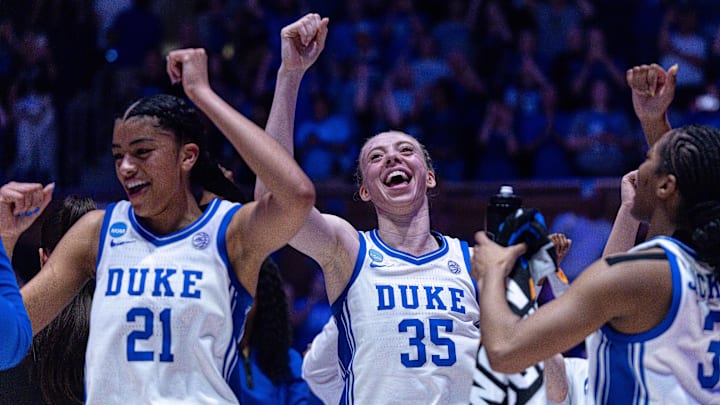
Duke won the second-round matchup handily, 69–46, to punch its ticket to the Sweet 16. The final score does not quite convey the degree of dominance: In each of the first two quarters, Duke held Baylor to just eight points, aggressively pressuring ballhandlers and sealing off passing lanes. If the second half was not quite so clearly, overwhelmingly domineering, that was only polite. These programs swung back and forth in their first matchup back in November. But there was no change in direction on Sunday. Duke got started and never turned back.
It’s a performance that underscores something that has felt obvious for some weeks now. The Blue Devils may be a No. 3 seed. But they’re a matchup nightmare who pose a serious threat for just about everyone.
A slow, grinding defense has been a signature for Duke under head coach Kara Lawson. But that has looked slightly different over the last few months. This group can play with more pace and has more options for disrupting opposing sets. (At 72.0 possessions a team per 40 minutes, it’s the fastest pace yet for a Lawson-coached team, and the first to record a pace above the 50th percentile for Division I.) That means that at its best, as it was on Sunday, there is simply nowhere for opponents to go.
“They’re a long, athletic group of girls, and they play really hard,” said Baylor forward Bella Fontleroy. “They had a lot of pressure, so it disrupted our timing and spacing on things that we usually get easier the first time around, and then also, they’re really physical, so we didn’t really get a lot of second-chance points, either.”
All of that is borne out in the box score. Duke outrebounded Baylor. It scored more in the paint and locked down the perimeter. (Baylor finished 0-for-14 from three: “I can’t sit here and take credit for them going 0-for-14,” Lawson said. “Some of those shots, they just missed. We got lucky on some of those. But… we tried to force them into challenging shots as much as possible, tried to just be there, every time we took a shot, there was a hand in their face. That’s what our goal was.”) Duke forced more turnovers and did more to capitalize on them. In short, it did just about everything it could have done, and then some.
The win sets up a Sweet 16 date with No. 2 seed LSU in Sacramento. It will be another rematch for the Blue Devils: Duke lost to LSU in December by a score of 93–77. But it feels just as dangerous to extrapolate from that result as it would have been to extrapolate from the Baylor game in November. There is no team that has changed as much over the intervening three months as has Duke.
Lawson and her players have been asked about this repeatedly over the last few weeks. They have given a response that is perfectly logical but not especially thrilling. There was no big, singular change, they say. There was no quick fix. Duke changed its fate with only the most basic ingredients. They needed more work and more time.
“The things you need to do to be successful, they don’t change,” Lawson said on Saturday. “It’s really your commitment to doing them, and then your ability to do them, that changes… I think you can see that stuff very early. You can recognize that. But my job as a coach isn’t to point it out. My job as a coach is to point it out, and help them fix it, not fix it for them.”
In December, this matchup involved an undefeated, No. 5 LSU against a struggling, unranked Duke. In March, it will be a No. 2 seed versus a No. 3 seed, the most aggressive offense in the sport against one of the staunchest defenses. It will be a rematch. But it will not be a game that we have seen before.
More March Madness from Sports Illustrated
 Add us as a preferred source on Google
Emma Baccellieri is a staff writer focused on women’s basketball for Sports Illustrated. She previously covered MLB. She has also written for Baseball Prospectus and has been honored with multiple awards from the Society of American Baseball Research. A graduate of Duke University, she lives in Washington, D.C.
Follow emmabaccellieri