%20%20--%3E%0A%3Csvg%20version%3D%221.1%22%20id%3D%22Layer_1%22%20xmlns%3D%22http%3A%2F%2Fwww.w3.org%2F2000%2Fsvg%22%20xmlns%3Axlink%3D%22http%3A%2F%2Fwww.w3.org%2F1999%2Fxlink%22%20x%3D%220px%22%20y%3D%220px%22%0A%09%20width%3D%2239px%22%20height%3D%2240px%22%20viewBox%3D%220%200%2039%2040%22%20enable-background%3D%22new%200%200%2039%2040%22%20xml%3Aspace%3D%22preserve%22%3E%0A%3Cpath%20fill%3D%22%23FFFFFF%22%20d%3D%22M38.5%2C7H28.2v26h10.3V7z%22%2F%3E%0A%3Cpath%20fill-rule%3D%22evenodd%22%20clip-rule%3D%22evenodd%22%20fill%3D%22%23FFFFFF%22%20d%3D%22M26.1%2C25.5c0%2C5.8-4.1%2C7.5-12.9%2C7.5C3.9%2C33%2C0%2C31.2%2C0%2C25.2v-1.1h11.6%0A%09v2.4c0%2C0.7%2C0.1%2C1.4%2C1.2%2C1.4c1%2C0%2C1.2-0.4%2C1.2-1.3v-0.9c0-1.6-0.9-1.6-3.5-2.2C2.2%2C21.7%2C0%2C19.7%2C0%2C15.3v-0.9C0%2C9.3%2C5.5%2C7%2C12.9%2C7%0A%09c10.2%2C0%2C12.8%2C2.6%2C12.8%2C7.4v1.8h-11v-2.9c0-0.6-0.4-1.1-1.2-1.1c-0.6%2C0-1.2%2C0.4-1.2%2C1.1v0.9c0%2C1.5%2C0.9%2C2%2C3.3%2C2.5%0A%09c8%2C1.6%2C10.5%2C3.3%2C10.5%2C7.5V25.5z%22%2F%3E%0A%3C%2Fsvg%3E%0A)
The Price of Winning: College Hoops GMs Talk Budgets, Superstar Costs Ahead of April Transfer Portal
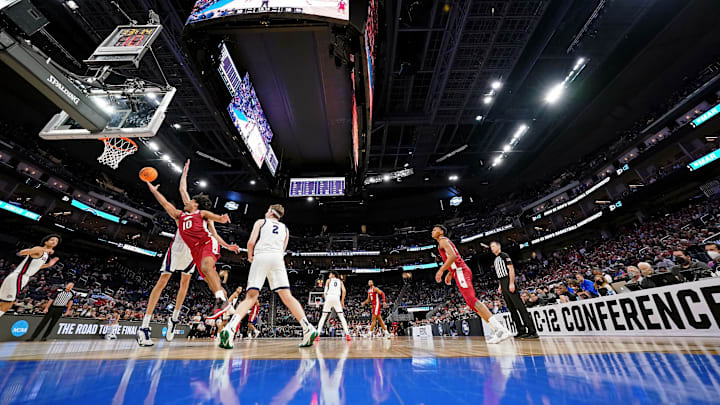
March is when college basketball games are most intense. But in the background of the sport’s postseason are the machinations of the transfer portal, with teams racing to raise money and gain roster clarity ahead of the portal officially opening on April 7. And while coaches are splitting their focus between preparing for conference tournament games and planning for the future, general managers and other new front office staffers for college teams can focus more fully on roster management.
With that in mind, Sports Illustrated granted anonymity to GMs (or those in similar roles, given the variance in titles for these staffers around the country) at three different high-major schools to speak candidly about the state of the pre-portal a month before the floodgates officially open.
Here’s what they said about roster budgets, how much stars might go for on the transfer market and how they’re managing conversations with their current roster as teams prepare for their biggest games of the season.
Roster budgets aren’t going down
Last spring, budgets for high-major teams ballooned, with at least 20 schools topping $10 million in total spend for their men’s basketball rosters, according to industry sources. At the time, it was thought to be a one-time gold rush driven by the House settlement, with schools racing to spend via their NIL collectives before enforcement of the revenue-share cap began. Instead, it appears to have set the standard for the future.
“Based on intel we’re getting now, and it’s coming in pretty rapidly, the market is not going down,” GM No. 1 says. “I think it’s either kind of staying the same or in some cases escalating.”
That sentiment was shared by GM No. 2 and No. 3. Instead of some of last year’s big spenders having to rein it in, the smaller spenders are looking to catch up. Several of the lower-budget high-majors from this season are angling to up their budget to closer to that $10 million threshold, something St. John’s coach Rick Pitino spoke about recently as several Big East teams struggle to keep up financially with the sport’s top spenders.
“Well, if I was the [Big East] commissioner, which I’m not, I would say that every school has to agree that you have to spend from $9 million to $11 million on your NIL,” Pitino said on a podcast in February. “That would set the bar. You have a minimum of $9 million to $10 million you have to spend.”
Many high-majors may not get as high as Pitino’s lofty goal for his own league, but $10 million is a fairly good marker of whether a school is serious about competing … and some top contenders plan to blow past that number when all is said and done.
Big East schools at least have the luxury of largely not being constrained by the House settlement’s $20.5 million revenue-share cap given they aren’t splitting money with powerhouse football programs. To get to $10 million or more in roster spend in basketball at football schools, teams need to navigate how to spend over the cap via “real NIL” that must be approved through NIL Go. There’s still plenty of uncertainty about how exactly schools plan to justify millions in outside NIL through the clearinghouse, but it seems to be a question more of “how” and not “if” teams will spend significantly over the cap. Some of it may require significant obligations to fulfill those outside NIL deals, more so than many of the deals brokered through collectives in recent years.
“I think one big thing that hasn’t really come to light all the way yet, but it’s going to rear its head at some point, is just the fact that these players are really gonna have to work for some of this money,” GM No. 1 said. “For schools to be competitive, and try to stay at where they were at this year, or even increase, like, there’s gonna be a bigger time commitment to be able to get to the same dollar level.”
What will stars cost?
SI polled the three GMs on what the going rate for a potential all-conference high-major player in the portal would be this spring. They each gave numbers in the $2 million to $2.5 million range. A fourth GM, reached via text, ballparked the market rate at more like $3 million.
There’s a belief among many that while the overall market may not increase substantially this spring, the market for top-tier players may, as teams study NBA operations. A common refrain from coaches is that they feel in previous roster builds, money has been spread around too widely. They’d prefer, starting this year, to spend big on two to three top-tier players and fill in around them with cheaper role players with more defined roles. In NBA terms, those are your max contracts, a few middle-market players and then a bench filled out with minimum contracts.
Where will teams look to spend? GM No. 2 pointed to the point guard and big man market as two areas that teams expect to have the most expensive, but said wings could have a softer market.
That could, in part, be driven by many of the top NBA prospects weighing to stay in school or turn pro. In particular, there’s a glut of big men with projected draft grades somewhere between the late first and mid-second round should they enter that could command monster dollar figures if they return to school. Among those: Michigan’s Morez Johnson Jr. and Aday Mara, Florida’s Alex Condon and Rueben Chinyelu, North Carolina’s Henri Veesaar, Kansas’s Flory Bidunga, Texas Tech’s JT Toppin and Arizona’s Motiejus Krivas. If you’re looking for a list of the likely highest-paid players in college basketball in 2026–27, start there.
How high could the market go for proven stars/potential All-Americans like that? Particularly at a high-demand position, some could command $4 million or even a tick above that. One high-major assistant ballparked that as many 25 players could make $4 million next season, though that number got pushback from GM No. 2, who said he’d be surprised if more than 10 hit the $4 million threshold.
“Unless you have an outlier level budget and you are at a level where you can just say, ‘Get the deal done and tell us how much it actually costs later,’ spending $4 million on a player just puts you in such a cap bind,” GM No. 2 says.
When do negotiations begin?
Among the big questions that schools face is whether to begin contract negotiations with potential returning players for next year during the season or wait until after. Some schools heavily value the certainty of locking a player into a new contract early, giving them roster certainty that informs how they attack the portal. Others fear negotiations, even if primarily being done with an agent rather than the player themselves, could impact a player’s psyche.
“These aren’t the types of conversations that you can have with some and not have with all, because it’s going to mess up your locker room,” GM No. 1 says. “It’s going to get out, so you have to be strategic about when and where you have those conversations and the safe play is to wait until that buzzer sounds.”
“Ultimately, I think the players that are going to leave know they’re going to leave … so it doesn’t really need to get talked about in my opinion,” GM No. 3 says. “And for the kids that you do want back, they would also know you want them back. It’s kind of unspoken. So to me, why would I set the market early on a kid?”
In many ways, that’s the most critical push and pull: Schools want to avoid putting their cards on the table as long as possible, while agents want to create as many options for their clients as possible at this time of year to create leverage for a stronger offer, even if they plan on returning to their current school.
“You have conversations going on and you have to know damn well that the presentation you’re getting for your own player [from his agent] is going to 10 other schools,” GM No. 2 said.
And increasingly, that leverage means that players (or their representatives) have a pretty good idea of where they’re headed well before they ever enter the portal, something that could be exacerbated by the later April 7 portal opening date. The front office staffers SI spoke to were skeptical that many if any portal deals are already done, but some could in the lead-up to the portal opening and if nothing else, players will often enter the portal with a handful of options already lined up and money discussed. This is in spite of the fact that the NCAA has attempted to crack down on tampering, sending a memo last week that reminded schools that even communicating with a player’s agent before they enter the portal is against NCAA rules.
“I think the general consensus is that, and I’m not saying this is the way it should be, but I think that most guys by the time they enter the portal will have a shortlist of three to five schools and a good market range of what those schools will offer,” GM No. 2 says.
More College Basketball on Sports Illustrated
Listen to SI’s college sports podcast, Others Receiving Votes, below or on Apple and Spotify. Watch the show on SI’s YouTube channel.
 Add us as a preferred source on Google
Kevin Sweeney is a staff writer at Sports Illustrated covering college basketball and the NBA draft. He joined the SI staff in July 2021 and also serves host and analyst for The Field of 68. Sweeney is a Naismith Trophy voter and ia member of the U.S. Basketball Writers Association. He is a graduate of Northwestern University’s Medill School of Journalism.
Follow CBB_Central