%20%20--%3E%0A%3Csvg%20version%3D%221.1%22%20id%3D%22Layer_1%22%20xmlns%3D%22http%3A%2F%2Fwww.w3.org%2F2000%2Fsvg%22%20xmlns%3Axlink%3D%22http%3A%2F%2Fwww.w3.org%2F1999%2Fxlink%22%20x%3D%220px%22%20y%3D%220px%22%0A%09%20width%3D%2239px%22%20height%3D%2240px%22%20viewBox%3D%220%200%2039%2040%22%20enable-background%3D%22new%200%200%2039%2040%22%20xml%3Aspace%3D%22preserve%22%3E%0A%3Cpath%20fill%3D%22%23FFFFFF%22%20d%3D%22M38.5%2C7H28.2v26h10.3V7z%22%2F%3E%0A%3Cpath%20fill-rule%3D%22evenodd%22%20clip-rule%3D%22evenodd%22%20fill%3D%22%23FFFFFF%22%20d%3D%22M26.1%2C25.5c0%2C5.8-4.1%2C7.5-12.9%2C7.5C3.9%2C33%2C0%2C31.2%2C0%2C25.2v-1.1h11.6%0A%09v2.4c0%2C0.7%2C0.1%2C1.4%2C1.2%2C1.4c1%2C0%2C1.2-0.4%2C1.2-1.3v-0.9c0-1.6-0.9-1.6-3.5-2.2C2.2%2C21.7%2C0%2C19.7%2C0%2C15.3v-0.9C0%2C9.3%2C5.5%2C7%2C12.9%2C7%0A%09c10.2%2C0%2C12.8%2C2.6%2C12.8%2C7.4v1.8h-11v-2.9c0-0.6-0.4-1.1-1.2-1.1c-0.6%2C0-1.2%2C0.4-1.2%2C1.1v0.9c0%2C1.5%2C0.9%2C2%2C3.3%2C2.5%0A%09c8%2C1.6%2C10.5%2C3.3%2C10.5%2C7.5V25.5z%22%2F%3E%0A%3C%2Fsvg%3E%0A)
Indiana’s Magical Title Run Has One Parallel That Foreshadows How College Football Will React
In this story:
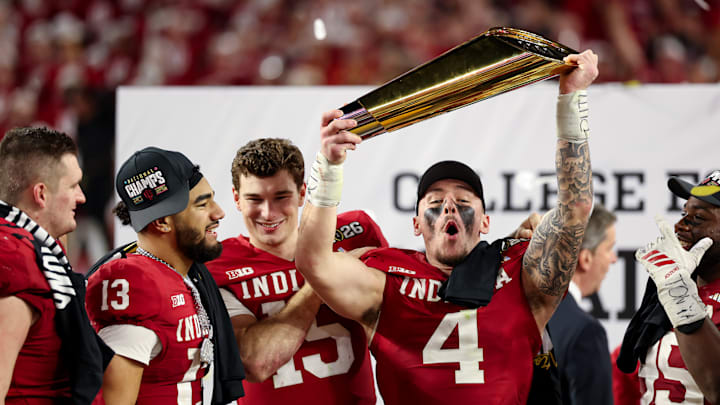
MIAMI — The greatest sports story in American history has been authored. From outhouse to penthouse, the Indiana Hoosiers are national champions.
It’s still stunning to see such a collection of facts together on the page in that order. It takes a moment to comprehend, a few more to accept.
Indi-fricken-ana, football powerhouse.
The perennial Midwestern homecoming choice has done it, summited the mountaintop first with ease, then with execution, before one final heart-pounding flourish on Monday night in South Florida in a College Football Playoff championship game classic.
“I think that’s called a paradigm shift. It’s kind of like people can cling to an old way of thinking, categorizing teams as this or that or conferences as this or that,” coach Curt Cignetti opined a few hours later. “Or they can adjust to the new world, the shift of the power balance in the way college football is today.”
Last year the doubts about the story Cignetti was authoring in Bloomington, Ind., were understandable. A die-hard basketball school has had dalliances with football success but there was always something to yank the Hoosiers back to reality—right back down to the bottom of the Big Ten standings more often than not.
The beloved Lee Corso won the program’s first bowl game in 1979, but never returned to the postseason and left three years later. Numerous coaches over the years tried and failed to show some semblance of gridiron growth, only for a mastery of middling results to surface instead. FBS’s losingest program was just that, a losing program.
Then Cig arrived and nothing else mattered as the plucky underdogs in red and white stripes became the best team the last two years, 27–2 overall, with the hardware to underscore it.
There was belief—google it if you don’t believe in retrospect—and a commitment to the process. Hard work, overlooked stars, a hunger for more, a yearning to make history, it all melded together on Monday in Miami with some local boys done well.
“Sometimes that belief has to be a little bit irrational, especially at a place that hasn’t had success like Indiana,” said center Pat Coogan, who traded the rich history of Notre Dame for the red and white last year. “When Coach Cig got here, he believed—and he got people to believe. Sometimes people laughed at him and people thought he was crazy, but that was the little irrational belief. You’ve got to get people to buy in, and you’ve got to get people to think alike, and you’ve got to get people to believe in the mission, believe in what we’re trying to do here.”

Heisman winner Fernando Mendoza did, leaving every body part exposed on a fourth-down dive scramble into the end zone that numerous teammates immediately wanted the image of emblazoned on the team facilities forever. Local kid Jamari Sharpe, nephew of infamous former Hurricane Glenn Sharpe, ended dreams of The U’s return with a late interception of the winningest active quarterback, Carson Beck, to seal the 27–21 affair at Hard Rock Stadium.
As an added measure, an overlooked former FCS recruit turned defensive MVP in Mikail Kamara helped make it all possible with a key punt block that he authored quite literally single-handedly.
“We’re 16–0, national champions,” said Kamara, shaking his head. “This is it, there’s nothing else.”
For some football programs though, believing in miracles should be limited to Lake Placid in 1980, an ice hockey upset that didn’t have anything close to it threatening its place in historic lore until the last few months.
Indiana didn’t just win it all this season, becoming the first first-time national champion since 1996 Florida. The Hoosiers didn’t simply go 16–0 as the second-ever college football team to accomplish that record. The Hoosiers were not some half-century interlopers on the football field, capturing the most recent undefeated season on the gridiron to pair with the last one on the hard court back in 1976, too.
No, Indiana broke the sport and broke what’s possible to even comprehend a program is capable of. If you don’t believe that, tell any number of coaches collecting buyouts this month or those who go into 2026 firmly on the hot seat based on proof positive in Bloomington.
“From a program that is known for losing and a culture that was in a bad spot when Coach Cig got here, it was all about changing the way people think,” linebacker Aiden Fisher said. “We described it as a sleeping giant when we got here. Indiana fans and just the culture around Indiana was just hungry for a winner, and they just needed the right coach and the right players to come in and flip this thing around.”
Indiana did so by taking no prisoners. It bludgeoned Illinois early and survived Penn State late to return to the national radar after last season’s CFP run. It kept earning more buy-in, more attention and more interest before eventually dispatching the behemoths of the last three decades both north (Ohio State) and south (Alabama) of the Mason-Dixon Line. It torpedoed the Death Star of sports spending in the last 20 years in Oregon by turning the Peach Bowl red—both with its fan base as much as it was in terms of its own brand of murderball in action.
Finally, it ended the dreams of a program who similarly came out of nowhere to wind up a sunshine blueblood in Miami.
What may be most interesting to this latest Hoosiers Hysteria, football edition, is the way the broader world of the sport reacts to it.

The closest parallel to what Indiana accomplished in 2025–26 is 5,000-to-1 long shot Leicester City winning the Premier League a decade ago. Among the elite clubs in both the United Kingdom and the rest of Europe, the reaction was swift: billions in spending on new players by historically entrenched teams along with tightened financial regulations to limit the possibility that a similar breakthrough could be had by other ambitious clubs.
The results since have been stark. The Premier League has been won by only those among the so-called Big Six powers in the 10 seasons since with nobody outside that group even finishing within the top four of the standings between 2017 and ’23. The winner of the biggest stage of European soccer, the Champions League, had a trophy regularly traded around by just six powerhouses who all were in the top spots of the Deloitte Football Money League, the accounting firm’s ranking of revenue generated.
“No one can predict the future, but I know that we [in the Big Ten] have a huge TV contract and all the institutions have a lot of money,” Cignetti said. “There will be a lot of good teams next year.”
We’ve seen that play out and not just in the Big Ten, with the reaction to Indiana’s run already easy to spot. Oregon has spent and will keep spending. Texas Tech has splashed the cash in trying to crash the party as well. All across the country, the transfer portal has spun with a number of new logos popping up beside top player names.
The most telling reaction will probably come in the SEC, which must deal with three years of Big Ten dominance to the sport it spent close to 20 years as the 600-pound gorilla. Both in the league office and across all 16 schools, none will rest between now and kickoff in August at plotting to usurp their Power 2 rival next season. It’s already started in fact, as school presidents have been saber-rattling about rules enforcement and new coaching hires are being promised with roster resources that far exceed what even Indiana and Miami have had to work with.
“Perfection’s impossible to achieve on a consistent basis,” Cignetti said. “We’ll continue to take it one day at a time, one meeting at a time, one practice at a time and just keep improving and committing to the process and showing up prepared, trying to put it on the field and see where it takes us.”
The far more interesting question, however, is where Indiana’s magical run takes everybody else.
More College Football from Sports Illustrated
Listen to SI’s college sports podcast, Others Receiving Votes, below or on Apple and Spotify. Watch the show on SI’s YouTube channel.
 Add us as a preferred source on Google
Bryan Fischer is a staff writer at Sports Illustrated covering college sports. He joined the SI staff in October 2024 after spending nearly two decades at outlets such as FOX Sports, NBC Sports and CBS Sports. A member of the Football Writers Association of America’s All-America Selection Committee and a Heisman Trophy voter, Fischer has received awards for investigative journalism from the Associated Press Sports Editors and FWAA. He has a bachelor’s in communication from USC.
Follow bryandfischer