%20%20--%3E%0A%3Csvg%20version%3D%221.1%22%20id%3D%22Layer_1%22%20xmlns%3D%22http%3A%2F%2Fwww.w3.org%2F2000%2Fsvg%22%20xmlns%3Axlink%3D%22http%3A%2F%2Fwww.w3.org%2F1999%2Fxlink%22%20x%3D%220px%22%20y%3D%220px%22%0A%09%20width%3D%2239px%22%20height%3D%2240px%22%20viewBox%3D%220%200%2039%2040%22%20enable-background%3D%22new%200%200%2039%2040%22%20xml%3Aspace%3D%22preserve%22%3E%0A%3Cpath%20fill%3D%22%23FFFFFF%22%20d%3D%22M38.5%2C7H28.2v26h10.3V7z%22%2F%3E%0A%3Cpath%20fill-rule%3D%22evenodd%22%20clip-rule%3D%22evenodd%22%20fill%3D%22%23FFFFFF%22%20d%3D%22M26.1%2C25.5c0%2C5.8-4.1%2C7.5-12.9%2C7.5C3.9%2C33%2C0%2C31.2%2C0%2C25.2v-1.1h11.6%0A%09v2.4c0%2C0.7%2C0.1%2C1.4%2C1.2%2C1.4c1%2C0%2C1.2-0.4%2C1.2-1.3v-0.9c0-1.6-0.9-1.6-3.5-2.2C2.2%2C21.7%2C0%2C19.7%2C0%2C15.3v-0.9C0%2C9.3%2C5.5%2C7%2C12.9%2C7%0A%09c10.2%2C0%2C12.8%2C2.6%2C12.8%2C7.4v1.8h-11v-2.9c0-0.6-0.4-1.1-1.2-1.1c-0.6%2C0-1.2%2C0.4-1.2%2C1.1v0.9c0%2C1.5%2C0.9%2C2%2C3.3%2C2.5%0A%09c8%2C1.6%2C10.5%2C3.3%2C10.5%2C7.5V25.5z%22%2F%3E%0A%3C%2Fsvg%3E%0A)
Impossible to Google: Indiana Completes Unlikeliest Turnaround in Sports History
MIAMI GARDENS, Fla. — To deliver a full-term football miracle, the impossible Indiana saga needed one more dramatic flourish, one more moment of divine inspiration, from its two primary authors. The greatest college football story ever told needed coach Curt Cignetti to make his bravest call and it needed quarterback Fernando Mendoza to make his bravest play.
With nine minutes and 27 seconds left in the College Football Playoff national championship game against Miami, facing a fourth-and-4 at the 12-yard line and holding a precarious 17–14 lead, Cignetti signaled timeout.
“In the huddle, we’re about to go out there with the PAT team and Cignetti comes out and he yells, ‘Get out on the field, we’re going for it!’ It got me a little pumped up,” says offensive tackle Carter Smith.
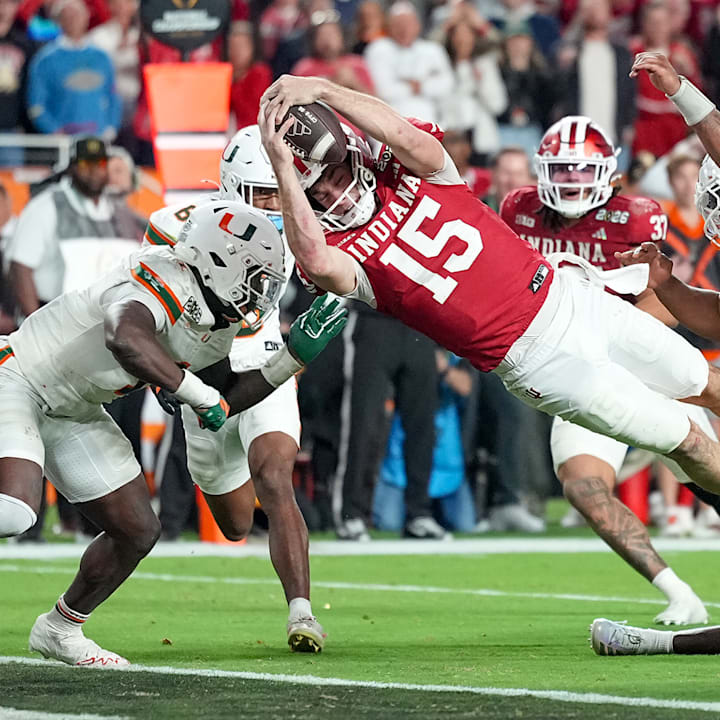
The call: a quarterback draw by Mendoza. What transpired was the most memorable play of the Hoosiers’ 16–0 season, and the most memorable play in program history.
They had run successful QB draws several times during the season, several of them in the red zone. But the decision not to rely on the arm of the most efficient passer in the nation, and his elite receiving corps, came with considerable risk. Getting five yards on the ground against the brutal Hurricanes defense was hardly a given. Come up short, and it’s a field goal game against an opponent that had gained all the offensive momentum.
No fear from Indiana. No hesitation from the offensive unit.

“A big constant that we’ve really had this year is always bet on ourselves,” Mendoza said. “They called that play, we knew, hey, we’re going to bet on ourselves one more time at the biggest stage of the game.”
Cignetti’s endless attention to detail led him and his offensive staff to believe the call would work against Miami’s defense. How the Hoosiers would block that particular play was a 45-minute staff discussion in the days leading up to the game. They lined up with four wide receivers to spread the defense, plus running back Kaelon Black in the backfield to serve as a lead blocker. Miami had four down linemen and another five defenders arrayed across the first-down line at the 8-yard-line.
The ball was snapped. All of Indiana’s raucous, rejuvenated fan base—which took over more than half of Hard Rock Stadium, Miami’s home base—held its collective breath.
Mendoza took the snap in the shotgun, set his right foot on the 20-yard line to present a passing threat, then took off up the middle, ball in his left arm. The 6' 5" Mendoza has an unorthodox running style—often effective but never fluid, legs all over the place, the anti–Vince Young. Think baby giraffe trying to escape lions. “Everybody on the team, including coach, makes fun of my running style,” Mendoza said.
Never again.

The play started smoothly before devolving into an alley fight. Black burst through the middle of the line of scrimmage and delivered the first of multiple bruising shots to luckless linebacker Wesley Bissainthe. While three of Miami’s linemen surged upfield, running themselves out of the play, center Pat Coogan tied up interior lineman Justin Scott. Mendoza nimbly cut right and hopped over Coogan’s legs. The first down was secure, but Mendoza had his eyes on the end zone.
His deceptive speed carried him past defensive back Zechariah Poyser and Jakobe Thomas, the latter of whom delivered a glancing blow to Mendoza’s right side. Then it was time to run through Bissainthe, who had bounced off the blocks from Black and lineman Drew Evans to impede Mendoza’s path.
Mendoza and Bissainthe collided at the 4. The 230-pound Bissainthe wound up on his rear end at the 2. “Fernando trucked the linebacker,” Cignetti noted admiringly.
But the collision also spun Mendoza around, nearly taking him to the ground. He reached down to steady himself for an instant with his right hand, then pivoted and made a lunge for the end zone. At the 2, he launched himself like John Elway going for a key first down in Super Bowl XXXII against Green Bay, taking a hit that helicoptered the Hall of Famer to the turf. As Mendoza stretched and dove, holding the ball out toward the goal line, he absorbed a wicked shot in the back from linebacker Mohamed Toure.
Too late. Touchdown. The last of Mendoza’s 48 touchdowns in this magical Heisman Trophy–winning season paved the way for a 27–21 triumph. Mendoza’s run unveiled the iron will that resides beneath his Mr. Nice Guy persona.

“I know he’s great in interviews and comes off as the All-American guy, but he has the heart of a lion when it comes to competition,” Cignetti said. “That guy competes like a warrior.”
The warrior quarterback with a heart of gold and the genius coach with a mien of stone have made for a combination unlike anything seen in college football. Mendoza, the No. 134 quarterback in the recruiting class of 2022, is a font of enthusiasm and positivity. Cignetti, who didn’t get his shot at a power-conference job until he was 62, can out-Saban his former boss, Nick Saban, when it comes to repressed emotion and relentless drive.
Their supporting cast is populated with lightly recruited players who followed Cignetti from James Madison two years ago—among them defensive end Mikail Kamara, who blocked a punt for a massive touchdown in the third quarter, undersized cornerback D’Angelo Ponds, who broke up three passes, and linebacker Aiden Fisher, who recorded the only sack of Miami quarterback Carson Beck.
They all came together at a Midwest football flophouse, the historically worst program in FBS history.
“We’re 16–0, national champions at Indiana University, which I know a lot of people thought was never possible,” Cignetti said. “It probably is one of the greatest sports stories of all time.”
Probably? Please. The Hoosiers stand alone.

On Oct. 15, 1887, Indiana made its intercollegiate football debut with a loss to Franklin College, 10–8. The program’s tone was set from the start.
The Hoosiers won just four of their first 23 games and didn’t nudge their all-time record above .500 until 1898. They muddled along in mediocrity for decades thereafter, bobbing above and below that line, until Bo McMillin had a flurry of success during World War II, highlighted by a 9-0-1 record in 1945. Then he left after the 1947 season to coach the Detroit Lions, and the losing really began.
Clyde B. Smith. Bernie Crimmins. Bob Hicks. Phil Dickens. John Pont. Lee Corso. Sam Wyche. Bill Mallory. Cam Cameron. Gerry DiNardo. Terry Hoeppner. Bill Lynch. Kevin Wilson. Tom Allen. Fourteen straight coaches were hired with high hopes, and they all left with losing records. This was the definition of a coaching graveyard.
There were 26 losing seasons out of 29 from 1995 to 2023. The misery seemed permanent and irrevocable, embedded in the limestone-rich hills that surround Bloomington, Ind. “Never daunted,” as the fight song says? The Hoosiers were perma-daunted for decades.
Fans love a winner, and the state has basketball in its DNA, so they stayed away from Memorial Stadium while packing Assembly Hall to support a men’s program that has won five national titles. Indiana students became infamous for packing the pregame football tailgates and never entering the stadium, or leaving at halftime for the party and not returning. When Ohio State, Michigan or Penn State came to town, the crowd split was often close to 50-50.
Then, Curt Cignetti happened. Google, get me rewrite.

With virtually nobody excited about his arrival in December 2023, Cignetti went about waking up the fan base with a series of bombastic comments. The most famous: “I win. Google me.”
Everyone laughed at that for a few months. Then he backed it up to an astonishing degree.
“I know a lot of people were like, who’s this f---ing guy?” Cignetti said in October 2024 with a Yinzer accent, his Pittsburgh-area roots slipping out one curled vowel at a time. “I didn’t care. I’m 62, 63 now. I didn’t give a f---.
“I could just detect how downtrodden everybody was, you know what I mean? So I said what I said, because I had to get a reaction from them. And the rest is history.”
Indiana football had 713 losses entering the Cignetti era, the most of any FBS team in history. Heading into the 2025 season, the Hoosiers stood at 715—still the most in history. They still are at 715. Nearly 140 years of habitual, ritual losing just screeched to a halt.
Programs that bad don’t get to be this good. Not this quickly. Not this dramatically. Indiana was 7–22 in the 29 games before Cignetti arrived, and is now 27–2 after. There is no comparable turnaround.
Indiana likes to tout itself as having the largest living alumni base in the country, with more than 800,000. That mob has caught football fever in a hurry. Eight of the 11 largest home crowds in school history have come in 2024 and ’25, and the overtaking of three stadiums during this College Football Playoff run has been breathtaking.

A team that averaged a school-record 51,000 fans for home games this season—the most in school history—had many more than that show up at the Rose Bowl and the Peach Bowl. And then, amid what might be the most expensive ticket market in playoff history, the Hoosiers outnumbered the Hurricanes in Miami’s own stadium Monday night.
The Sunday night scene at the Indiana team hotel, The InterContinental, was raucous and festive. Hundreds of fans in their cream-and-crimson gear filled the entryway and mobbed Toro Toro, the lobby bar, swamping the wait staff. Beer taps kept blowing out as the demand for alcohol overwhelmed the supply of suds.
They came for the most unlikely coronation in college football history. But they had to endure a tension-filled brawl to get it.
The Miami game plan was evident quickly—unleash its ferocious front seven to hit Mendoza early, and hit him often. And hit him late, too. One shot produced a bloody lip. None of them produced penalty flags.
“There should have been two roughing the quarterbacks [penalties] and one high hit to the head that weren’t called,” Cignetti said. “I’m all for letting them play, but when they cross the line you’ve got to call them.”
Mendoza never flinched. This was not going to be a third straight blowout, like the Rose Bowl against Alabama and the Peach Bowl against Oregon. This was going to be a methodical battle that required calm in the face of pressure. The quarterback was up for that challenge in his hometown.

Mendoza’s full-circle Miami journey has captivated the country. He grew up a Hurricanes fan but went unrecruited by The U, at first committing to Yale before being discovered by California. After two solid seasons there, he was expected to be a quality Big Ten starter this season. Instead, he blew up into a superstar.
When this game was finally secured by a Jamari Sharpe interception in the final minute—adding one more takeaway to Indiana’s nation-leading turnover margin of 21—Cignetti stayed in stoic character while Mendoza surprisingly fell out.
“I first want to give all the glory to God,” Mendoza said on TV on the field, his customary preamble. “There’s no better group of guys I’d want to do it with. This is the most special moment of my life. This is such a great group of guys, I love you guys. Great job. Let’s f---ing go!”
So he knows at least one cussword, and was willing to use it. The two priests from his IU parish, Saint Paul, who were on the field after the game can offer him absolution for that.
“I’d say overall my emotion and it’s the pinnacle peak,” Mendoza explained later. “All season—sometimes I’ve had these cookie-cutter responses, media-trained responses, on to the next game, on to the next play and now we did it. At that point I think it was only fitting to open the floodgates, per se, break my stereotype.”

They did it. Indiana, of all schools, won a football national championship.
“A lot of people thought what we were doing was a fairy tale and a Cinderella story. It was all reality. We put it on the grass,” Coogan said. “I’m just really happy for this university. Everybody that’s poured their heart and soul and went through some really dark times. We reached a mountaintop.”
Whether that opens the floodgates for others remains to be seen. It’s tantalizing for 50 other schools to aspire to it—if the Hoosiers can do it, why not us? But they have to find a unicorn coach and an uber-clutch quarterback to build on.
Google the greatest miracles in football history, and Curt Cignetti will come up. So will Fernando Mendoza. They have reframed what’s possible.
More College Football from Sports Illustrated
Listen to SI’s college sports podcast, Others Receiving Votes, below or on Apple and Spotify. Watch the show on SI’s YouTube channel.
 Add us as a preferred source on Google
Pat Forde is a senior writer for Sports Illustrated who covers college football and college basketball as well as the Olympics and horse racing. He cohosts the Others Receiving Votes podcast for SI and is a regular contributor to the Tony Kornheiser Show podcast. He previously worked for Yahoo Sports, ESPN and The (Louisville) Courier-Journal. Forde has won 28 Associated Press Sports Editors writing contest awards, has been published three times in the Best American Sports Writing book series, and was nominated for the 1990 Pulitzer Prize. A past president of the U.S. Basketball Writers Association and member of the Football Writers Association of America, he lives in Louisville with his wife. They have three children, all of whom were collegiate swimmers.
Follow ByPatForde