%20%20--%3E%0A%3Csvg%20version%3D%221.1%22%20id%3D%22Layer_1%22%20xmlns%3D%22http%3A%2F%2Fwww.w3.org%2F2000%2Fsvg%22%20xmlns%3Axlink%3D%22http%3A%2F%2Fwww.w3.org%2F1999%2Fxlink%22%20x%3D%220px%22%20y%3D%220px%22%0A%09%20width%3D%2239px%22%20height%3D%2240px%22%20viewBox%3D%220%200%2039%2040%22%20enable-background%3D%22new%200%200%2039%2040%22%20xml%3Aspace%3D%22preserve%22%3E%0A%3Cpath%20fill%3D%22%23FFFFFF%22%20d%3D%22M38.5%2C7H28.2v26h10.3V7z%22%2F%3E%0A%3Cpath%20fill-rule%3D%22evenodd%22%20clip-rule%3D%22evenodd%22%20fill%3D%22%23FFFFFF%22%20d%3D%22M26.1%2C25.5c0%2C5.8-4.1%2C7.5-12.9%2C7.5C3.9%2C33%2C0%2C31.2%2C0%2C25.2v-1.1h11.6%0A%09v2.4c0%2C0.7%2C0.1%2C1.4%2C1.2%2C1.4c1%2C0%2C1.2-0.4%2C1.2-1.3v-0.9c0-1.6-0.9-1.6-3.5-2.2C2.2%2C21.7%2C0%2C19.7%2C0%2C15.3v-0.9C0%2C9.3%2C5.5%2C7%2C12.9%2C7%0A%09c10.2%2C0%2C12.8%2C2.6%2C12.8%2C7.4v1.8h-11v-2.9c0-0.6-0.4-1.1-1.2-1.1c-0.6%2C0-1.2%2C0.4-1.2%2C1.1v0.9c0%2C1.5%2C0.9%2C2%2C3.3%2C2.5%0A%09c8%2C1.6%2C10.5%2C3.3%2C10.5%2C7.5V25.5z%22%2F%3E%0A%3C%2Fsvg%3E%0A)
Is There Any Truth to Bret Bielema’s Jab at Greg Sankey and the SEC?
In this story:
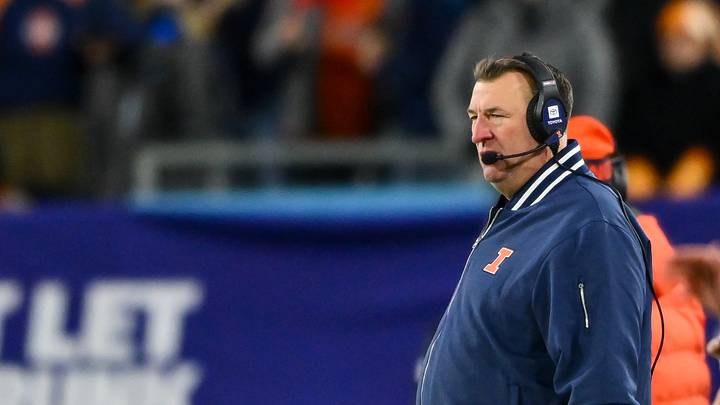
Illinois coach Bret Bielema is on the short list of coaches this century who have come to know both the Big Ten and SEC well.
From 2006 to ‘12, Bielema put in seven years as Wisconsin’s head coach, leading the Badgers to a 68–24 record and a trio of Rose Bowls. He then shocked the Big Ten by departing for Arkansas—a gross miscalculation that ended with his firing immediately after a loss in 2017.
From there, he rehabilitated his career in the NFL, working with the Patriots and Giants before resurfacing at Illinois in 2021. He’s 37–26 there, and finished No. 16 in the country in 2024. On Tuesday, he had some words for his old league at the Big Ten’s media days in Chicago.
Bielema declared the SEC stuck in the past
“They kind of want to live in 2005 forever, but I think the forward thinking of where we are in college football is an awesome thing,” Bielema said of the SEC broadly and commissioner Greg Sankey more specifically.
Bielema was serving as the Badgers’ offensive coordinator in ‘05. When asked to clarify, Bielema insinuated that ‘05 was a stand-in for days gone by in college football.
“When [the transfer portal and NIL] came into college football, the whole world changed. It's overly obvious to say that, but I think anything that predates that is just a different time in college football. It just is,” Bielema said.
Is Bielema right? Is the SEC stuck in 2005?
Let’s examine the statement on both a literal and symbolic level.
The 2005 season did not end with an SEC team lifting the national championship trophy—Texas, then a member of the Big 12, did the honors after its classic 41–38 win over USC in the Rose Bowl. However, the roots of the SEC’s decade of dominance were beginning to take hold. Of the top 15 teams in the final AP Poll, five—No. 6 LSU, No. 8 Alabama, No. 10 Georgia, No. 12 Florida and No. 14 Auburn—hailed from the SEC. No other conference produced more than three. In that vein, the next eight national championships would go to SEC squads.
National championships did not tell the true story of the SEC’s dominance in that era, however. Part of Bielema’s stated reasoning for leaving Wisconsin for the Razorbacks was his belief that the Badgers were underpaying his assistants. The Big Ten was pinching pennies; the SEC was spreading them around liberally. The difference between the two leagues’ mid-tier teams tended to show.
In the last decade, the college football world has changed. A number of factors—transfer and NIL liberalization, conference realignment, a bifurcated economic recovery from the COVID-19 pandemic that has given wealthy boosters dollars to spare—have empowered actors around the Big Ten to throw money where they wouldn’t a decade ago. That’s how Bielema’s Fighting Illini have taken two solid SEC teams by surprise in back-to-back bowl games, beating South Carolina in the Citrus Bowl to close 2024 and Tennessee in the Music City Bowl to end ‘25.
The SEC, at least publicly, has refused to acknowledg college sports’s new reality. Even if its depth remains on par with the Big Ten’s, it can no longer turn on the football national championship faucet at will, as evidenced by Michigan, Ohio State and Indiana’s national title hat trick. The SEC is hardly in a dark age—the league has built a formidable presence it didn’t always have in other sports, most notably men’s basketball—but, to steal from Fleetwood Mac, yesterday’s gone.
Long a polarizing figure, Bielema is a difficult messenger for a fact the SEC certainly already knows. But he’s preaching to the choir in Big Ten country, where the 2020s have made even the league’s most historically forlorn fanbases (read: the Hoosiers’) feel like they have a chance.
More College Football From Sports Illustrated
Listen to SI’s college sports podcast, Others Receiving Votes, below or on Apple and Spotify. Watch the show on SI’s College YouTube channel.
 Add us as a preferred source on Google
Patrick Andres is a staff writer on the Breaking and Trending News team at Sports Illustrated. He joined SI in December 2022, having worked for The Blade, Athlon Sports, Fear the Sword and Diamond Digest. Andres has covered everything from zero-attendance Big Ten basketball to a seven-overtime college football game. He is a graduate of Northwestern University's Medill School of Journalism with a double major in history .
Follow PAndres2001