%20%20--%3E%0A%3Csvg%20version%3D%221.1%22%20id%3D%22Layer_1%22%20xmlns%3D%22http%3A%2F%2Fwww.w3.org%2F2000%2Fsvg%22%20xmlns%3Axlink%3D%22http%3A%2F%2Fwww.w3.org%2F1999%2Fxlink%22%20x%3D%220px%22%20y%3D%220px%22%0A%09%20width%3D%2239px%22%20height%3D%2240px%22%20viewBox%3D%220%200%2039%2040%22%20enable-background%3D%22new%200%200%2039%2040%22%20xml%3Aspace%3D%22preserve%22%3E%0A%3Cpath%20fill%3D%22%23FFFFFF%22%20d%3D%22M38.5%2C7H28.2v26h10.3V7z%22%2F%3E%0A%3Cpath%20fill-rule%3D%22evenodd%22%20clip-rule%3D%22evenodd%22%20fill%3D%22%23FFFFFF%22%20d%3D%22M26.1%2C25.5c0%2C5.8-4.1%2C7.5-12.9%2C7.5C3.9%2C33%2C0%2C31.2%2C0%2C25.2v-1.1h11.6%0A%09v2.4c0%2C0.7%2C0.1%2C1.4%2C1.2%2C1.4c1%2C0%2C1.2-0.4%2C1.2-1.3v-0.9c0-1.6-0.9-1.6-3.5-2.2C2.2%2C21.7%2C0%2C19.7%2C0%2C15.3v-0.9C0%2C9.3%2C5.5%2C7%2C12.9%2C7%0A%09c10.2%2C0%2C12.8%2C2.6%2C12.8%2C7.4v1.8h-11v-2.9c0-0.6-0.4-1.1-1.2-1.1c-0.6%2C0-1.2%2C0.4-1.2%2C1.1v0.9c0%2C1.5%2C0.9%2C2%2C3.3%2C2.5%0A%09c8%2C1.6%2C10.5%2C3.3%2C10.5%2C7.5V25.5z%22%2F%3E%0A%3C%2Fsvg%3E%0A)
Pat Forde: Why an SEC Breakaway Would Be Catastrophic for College Sports
In this story:
He who got the finger on the war button
Talkin’ loud and sayin’ nothin’
— Chuck D, Public Enemy, 1992.
MIRAMAR BEACH, Fla. — University of Georgia leaders have chosen May as Fake Nuclear Option Month in college athletics.
President Jere Morehead told The Athletic last week that College Football Playoff issues could prompt the Southeastern Conference to have its own playoff. “I think that would be fantastic,” Morehead said. “I can’t imagine the ratings if that happened. I think we’d have tremendous interest in a situation of that nature.” Morehead also told On3 that if the persistent flouting of NIL rules isn’t reined in, he’s “ready to vote on creating an SEC mechanism and SEC rules. That’s what we have to do.”
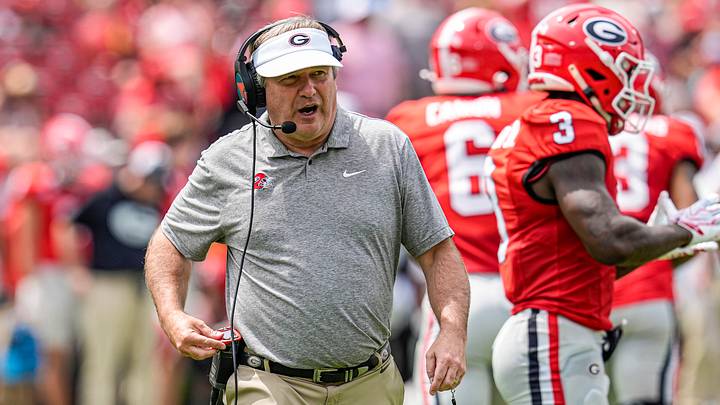
Two-time national champion football coach Kirby Smart backed up his boss this week, doubling down on breakaway talk.
“I’ve been a huge advocate that if we can’t find rules that everybody plays by, then we should play our own,” Smart said. “I’m not afraid of that. I’m not afraid to break away and say that our conference is strong enough to go out and play.”
Smart may not be afraid, but in this case a proper sense of fear is required. Because a breakaway to form an SEC-only ecosystem would be the death of college sports in general—and the SEC along with it. They aren’t that stupid, which makes all this smell suspiciously like false bravado.
“They sound like North Korea,” says one scoffing official from another SEC school, referring to the ballistic test missiles that the country keeps firing into the sea.
But before Dear Leader Morehead could further rattle his saber, Georgia athletic director Josh Brooks offered a less radical viewpoint Wednesday. He wants to see whether the 138-member FBS group can align behind agreed-upon revenue sharing and NIL rules enforced by the College Sports Commission, as dictated the 2025 House v. NCAA settlement. Goal time for that: before the transfer portal reopens during the winter, and the next round of football player acquisition bidding begins.
“We can debate how the CSC is implemented and the intricacies of a deal being approved and not approved,” Brooks said. “That’s fine. That’s like me and you arguing over filing taxes. I have a much bigger problem with those that aren’t even filing taxes, right? Let’s stop that first. And I think if we can’t even get to that base level, then I would rather just coalesce in our own conference and govern 16 [schools] on that issue alone. Not saying that’s a full breakaway or whatever you want to call it.”
This week has laid bare the extent of the tumult in college sports, a part imagined and part real. Seismic change tends to break things, including brains. Some people are riding out the jolts better than others.
With the system in upheaval, the basest instincts of the competitors have come to the fore. Everyone is cheating, or accusing someone else of cheating, or both. Congress is giving game-changing legislation the old college try one more time. If that bill shows some actual promise, that might silence the breakaway talk.
Meanwhile, smart, capable, well-meaning transplants to the college sports space, like NCAA president Charlie Baker (from politics) and CSC CEO Bryan Seeley (from Major League Baseball) are gobsmacked by the unruly world they’ve entered. Wednesday, it was Seeley’s turn to express some culture shock over what he’s encountered in 11 months on the job.
“The power in college sports is with the schools,” Seeley said. “If you compare this to MLB, where the commissioner’s office has a lot of power where I used to work, it’s nothing like that in college sports. The power is with the schools and that’s O.K., and maybe the schools like that and want that. But an outcome of that is that central rules enforcement becomes much more challenging.
“When I talk in these rooms, the feedback I get from people is that they want to be governed. Some of the behavior sometimes that we see out in the marketplace doesn’t suggest that, but I think in general people want a working enforcement system.”
That remains the essence of the current angst. Those who say they want rules, and rules enforcement, default to a whatever-it-takes mentality when their competition gets an inch ahead. End up on the wrong side of a Seeley investigation, and the priorities switch from compliance to defiance.
“If you’re an AD or a coach and you’re not sure this enforcement’s going to stand up … why would you be the one following the rules?” Seeley said. “A lot of people are having those conversations in their head and it makes sense.”
Which brings us to the ultimate fallacy of an SEC breakaway ecosystem—one that not only competes against itself, but successfully governs itself. There is no way that happens.
There was a time when conferences policed themselves and administered their own penalties for rules violations. They eventually got out of that role because it was bad for business. With a massive self-interest in competitive success, applying sanctions to the teams that make money and win trophies for the leagues was counterintuitive.
Enforcement became the sole province of the NCAA, which conveniently became the faceless, bad-guy bureaucracy. No conference in its right mind wants that role back—and the SEC would seem especially ill-suited for it.
Part of self-governance is a basic agreement on the spirit and intent of the rules, and a belief in basic fairness. For decades, the SEC has been a fractious place, full of infighting and accusations of malfeasance. Currently, Mississippi and LSU are engaged in a blood feud thanks to Lane Kiffin’s relocation from Oxford to Baton Rouge. Texas coach Steve Sarkisian took a shot at Ole Miss’s academics. The basketball furor directed at Alabama for trying to scam an NBA player onto the roster last season has shifted cleanly to LSU, which is trying to pull multiple fast ones for 2026–27 under renowned scofflaw Will Wade.
By next week, there will be more festering disagreement.
“We’re going to self-govern?” asks one incredulous SEC official. “How is that going to work?”
It’s not. There will be no breakaways that are anything less than ruinous to all involved. Which is why the SEC—and every other conference—needs Seeley on that wall.
“There are certainly days where you wonder whether you’re going to be able to do the job you were hired to do,” Seeley said. “And whether you should have faith. But ultimately I know people want to get to a better place. People should not give up hope.”
More College Football From Sports Illustrated
Listen to SI’s college sports podcast, Others Receiving Votes, below or on Apple and Spotify. Watch the show on SI’s College YouTube channel.
 Add us as a preferred source on Google
Pat Forde is a senior writer for Sports Illustrated who covers college football and college basketball as well as the Olympics and horse racing. He cohosts the Others Receiving Votes podcast for SI and is a regular contributor to the Tony Kornheiser Show podcast. He previously worked for Yahoo Sports, ESPN and The (Louisville) Courier-Journal. Forde has won 28 Associated Press Sports Editors writing contest awards, has been published three times in the Best American Sports Writing book series, and was nominated for the 1990 Pulitzer Prize. A past president of the U.S. Basketball Writers Association and member of the Football Writers Association of America, he lives in Louisville with his wife. They have three children, all of whom were collegiate swimmers.
Follow ByPatForde