%20%20--%3E%0A%3Csvg%20version%3D%221.1%22%20id%3D%22Layer_1%22%20xmlns%3D%22http%3A%2F%2Fwww.w3.org%2F2000%2Fsvg%22%20xmlns%3Axlink%3D%22http%3A%2F%2Fwww.w3.org%2F1999%2Fxlink%22%20x%3D%220px%22%20y%3D%220px%22%0A%09%20width%3D%2239px%22%20height%3D%2240px%22%20viewBox%3D%220%200%2039%2040%22%20enable-background%3D%22new%200%200%2039%2040%22%20xml%3Aspace%3D%22preserve%22%3E%0A%3Cpath%20fill%3D%22%23FFFFFF%22%20d%3D%22M38.5%2C7H28.2v26h10.3V7z%22%2F%3E%0A%3Cpath%20fill-rule%3D%22evenodd%22%20clip-rule%3D%22evenodd%22%20fill%3D%22%23FFFFFF%22%20d%3D%22M26.1%2C25.5c0%2C5.8-4.1%2C7.5-12.9%2C7.5C3.9%2C33%2C0%2C31.2%2C0%2C25.2v-1.1h11.6%0A%09v2.4c0%2C0.7%2C0.1%2C1.4%2C1.2%2C1.4c1%2C0%2C1.2-0.4%2C1.2-1.3v-0.9c0-1.6-0.9-1.6-3.5-2.2C2.2%2C21.7%2C0%2C19.7%2C0%2C15.3v-0.9C0%2C9.3%2C5.5%2C7%2C12.9%2C7%0A%09c10.2%2C0%2C12.8%2C2.6%2C12.8%2C7.4v1.8h-11v-2.9c0-0.6-0.4-1.1-1.2-1.1c-0.6%2C0-1.2%2C0.4-1.2%2C1.1v0.9c0%2C1.5%2C0.9%2C2%2C3.3%2C2.5%0A%09c8%2C1.6%2C10.5%2C3.3%2C10.5%2C7.5V25.5z%22%2F%3E%0A%3C%2Fsvg%3E%0A)
Where Kirk Ferentz Is Wrong About College Football Getting ‘Back to the ‘70s’
In this story:
If you leaf through the history of college football, you’ll find a decade where stratification ran rampant. Where a privileged class of four to eight teams ruled the roost every year. Where potential usurpers didn’t show up if they knew what was good for them.
That decade was the 1970s. Or was it the mid-to-late 2010s?
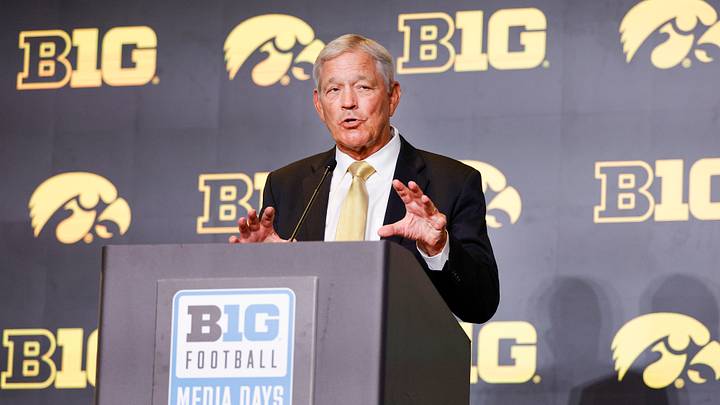
On Wednesday, Iowa coach Kirk Ferentz spoke to Max Olson of ESPN at Big Ten media days in Chicago, and compared the current climate in college football to its state when he entered coaching as a UConn graduate assistant in 1977.
"When we [the Hawkeyes] went to the Rose Bowl in 1981, the 13 years prior to that there were two teams that went to the Rose Bowl from the Big Ten,” Ferentz told Olson. “So basically, everybody was lining up in August for third place. If we're not careful, we're going to get that kind of imbalance in college football. That's just how I see it.”
Where Ferentz is right: a dramatic gulf between the haves and have-nots seems to be opening, not unlike in the 1970s
With a handful of exceptions, the Big Ten and SEC have raced ahead of the other conferences in recent years—both in intangible stature and tangible results. The Big Ten has won each of the last three national championships, and the SEC annually dominates the sport’s television ratings—and television oxygen.
This is, Ferentz seems smart enough to realize, an unhealthy arrangement. To a degree, it does resemble the ‘70s, a decade dominated by Alabama, Michigan, Nebraska, Notre Dame, Ohio State, Oklahoma, Texas, USC and several other teams immortalized as the sport’s blue bloods by the Baby Boomers who watched them as they attended college in record numbers.
The ‘70s, however became the 1980s. New population centers—hello, Florida—and schematic ways of thinking shook the foundations of the sport. The door was open for Iowa to replicate past glories with its first Rose Bowl appearance since the 1958 season. Ferentz is trying to make sure that door is still ajar.
“If we’re not careful, we’re going to get back to the ‘70s where there’s going to be eight, 10, 15 teams that are really well-funded,” Ferentz said. “If that’s what we want, great. But I’m not sure that’s what everybody wants.”
Where Ferentz is wrong: the 2020s have been fairly competitive compared to the late 2010s, as he should know intimately

It’s true that, to a degree, FBS is splitting in three parts—a wealthy Big Ten and SEC, a middle-class ACC and Big 12, and a lower-class Group of 6. The upper-middle and lower-middle classes that once lent the sport excitement are in trouble.
However, this is nothing compared to the completely broken competitive dynamic college football endured in the 2010s. Ferentz should know this because he saw that era begin and end from the top of college football.
Flash back to 2015. That year, Ferentz led the Hawkeyes to an undefeated regular season. Iowa came within an eyelash of the CFP, losing 16–13 to Michigan State in the Big Ten championship. Had the Hawkeyes won, they’d have run into one of Alabama, Clemson or Oklahoma—three teams that would take their giant CFP checks and return for many CFPs to come.
Now, flash forward to 2021—the first year after the legalization of NIL earnings. Opening the season No. 18, Iowa took two weeks to catapult into the top five and eventually rose all the way to No. 3. That was thanks partially to late-2010s powers like Alabama, Clemson and Ohio State losing early as the sport felt the effects of NIL and pandemic upheaval in tandem. The Hawkeyes couldn’t take advantage of it, but in a sense the four-team CFP era was beginning to draw to a close.
We don’t live in that world anymore, and unless you’re future-shocked Tigers coach Dabo Swinney, that’s a good thing. Commercialism and playoff expansion may be creating a bifurcated system crying out for regulation, but Indiana’s 2025 national championship proved miracles are still possible within that system. Even for Iowa.
More College Football From Sports Illustrated
Listen to SI’s college sports podcast, Others Receiving Votes, below or on Apple and Spotify. Watch the show on SI’s College YouTube channel.
 Add us as a preferred source on Google
Patrick Andres is a staff writer on the Breaking and Trending News team at Sports Illustrated. He joined SI in December 2022, having worked for The Blade, Athlon Sports, Fear the Sword and Diamond Digest. Andres has covered everything from zero-attendance Big Ten basketball to a seven-overtime college football game. He is a graduate of Northwestern University's Medill School of Journalism with a double major in history .
Follow PAndres2001