%20%20--%3E%0A%3Csvg%20version%3D%221.1%22%20id%3D%22Layer_1%22%20xmlns%3D%22http%3A%2F%2Fwww.w3.org%2F2000%2Fsvg%22%20xmlns%3Axlink%3D%22http%3A%2F%2Fwww.w3.org%2F1999%2Fxlink%22%20x%3D%220px%22%20y%3D%220px%22%0A%09%20width%3D%2239px%22%20height%3D%2240px%22%20viewBox%3D%220%200%2039%2040%22%20enable-background%3D%22new%200%200%2039%2040%22%20xml%3Aspace%3D%22preserve%22%3E%0A%3Cpath%20fill%3D%22%23FFFFFF%22%20d%3D%22M38.5%2C7H28.2v26h10.3V7z%22%2F%3E%0A%3Cpath%20fill-rule%3D%22evenodd%22%20clip-rule%3D%22evenodd%22%20fill%3D%22%23FFFFFF%22%20d%3D%22M26.1%2C25.5c0%2C5.8-4.1%2C7.5-12.9%2C7.5C3.9%2C33%2C0%2C31.2%2C0%2C25.2v-1.1h11.6%0A%09v2.4c0%2C0.7%2C0.1%2C1.4%2C1.2%2C1.4c1%2C0%2C1.2-0.4%2C1.2-1.3v-0.9c0-1.6-0.9-1.6-3.5-2.2C2.2%2C21.7%2C0%2C19.7%2C0%2C15.3v-0.9C0%2C9.3%2C5.5%2C7%2C12.9%2C7%0A%09c10.2%2C0%2C12.8%2C2.6%2C12.8%2C7.4v1.8h-11v-2.9c0-0.6-0.4-1.1-1.2-1.1c-0.6%2C0-1.2%2C0.4-1.2%2C1.1v0.9c0%2C1.5%2C0.9%2C2%2C3.3%2C2.5%0A%09c8%2C1.6%2C10.5%2C3.3%2C10.5%2C7.5V25.5z%22%2F%3E%0A%3C%2Fsvg%3E%0A)
Why North Dakota State Joined the Mountain West and Made the Jump to FBS
In this story:
One of legendary UCLA men’s basketball coach John Wooden’s most famous adages was, “Be quick, but don’t hurry.”
It’s an appropriate philosophy in the ever-changing world of college athletics, but is particularly apt in the tumultuous aspect of conference realignment. Often, decisions need to be made in a matter of weeks and yet carry ramifications half a century or longer.
That was in the back of many people’s minds when the Mountain West announced it was adding perennial FCS power North Dakota State, starting play this fall.
On the surface it was a surprise that transitioned from early news reports to a formal invitation in the span of just a few days. Behind the scenes, it was a marriage that was years in the making and the byproduct of months worth of discussions to arrive at a point of mutual reinvention.
“We’ve been moving a lot quicker than tradition has dictated, but that is kind of what you have to do in this new environment. And we certainly pride ourselves on being innovative and moving efficiently, but not foolishly,” says commissioner Gloria Nevarez. “While we did move quickly, we did the deep dives and we feel very good about the decision and the addition.”
The feeling is mutual.
“When I first got here 11 and a half years ago, we had just won three national championships and the fan base said, ‘Hey, when are we going to FBS?’ That’s all well and good, but there’s so many things that we just didn’t have in place,” Bison athletic director Matt Larsen says. “We zeroed in on the Mountain West being a good fit—whether it’s geographic, whether it’s institutional profile, whether it’s success in the league top to bottom—it just seemed like the best fit for us. So we really started to focus all of our financial planning towards that.”
Now it’s real, with new interlocking logos sewn onto polo shirts and football schedules constructed to include the most successful football program of the past 15 years—one no longer wearing the label of an FCS powerhouse. As much as the move has reaffirmed the rise of North Dakota State only two decades after last reclassifying in the NCAA hierarchy, it’s also a testament to the suddenly solid ground the Mountain West finds itself on.
That’s not always been the case after getting caught in the vortex of realignment moves beyond the Mississippi River tracing back to Texas and Oklahoma jumping to the SEC in the summer of 2021. Just two years ago there were open questions about the ultimate fate of the Mountain West after Boise State, Colorado State, Fresno State, San Diego State and Utah State decamped for the Pac-12. The league faced losing access to NCAA championships given the dwindling state of its membership and was approaching a critical juncture with its media rights deals expiring.
“We’ve been very strategic and been thinking about this for years. We would have discussions about what are possible universities out there that we might want to add to the conference,” says Wyoming president Ed Seidel, the MWC board chair. “When the [Pac-12] departures occurred, we were kind of already geared up to add new institutions. I’m really proud of it.
“It’s not just adding teams. We think a lot about, do we have the same kind of DNA? It’s not just an athletics conference, we have similar values across the league and that makes a big difference to us.”
Grand Canyon was added to the ranks last year, while UTEP comes on board this summer from Conference USA. The Miners will be joined by Hawai’i as an all-sports member after years of being football only. UC Davis will remain an FCS football school but is transitioning the rest of its sports to the reimagined league on July 1, just as Northern Illinois does the opposite in leaving the MAC to become a football-only member of the Mountain West and parking its nonrevenue sports in the Horizon League.
The buzziest move though, the one that signaled a statement of intent far more than just survival, came in February by way of one of the smallest states in the union.
“They look a lot like us. We just went and visited Fargo and as we were getting off the plane, we’re like this feels so much like a lot of our institutions. Only show in town, a heavy [agriculture] presence, just a lot of influence of the campus into the town. You see the school colors and the mascot in the local retail businesses and the bars and restaurants,” Nevarez says of NDSU. “Coming off the announcement of our new media rights, which was super positive, the time was right. I think it felt like the stars were aligning.”
That didn’t always seem to be the case as parallel tracks slowly shifted into intersecting ones.
The Bison had exploratory conversations about a potential move well before 2025, but the MWC was initially hesitant about similar schools moving up amid a larger NCAA membership review in progress and an uncertain future when it came to College Football Playoff revenue distribution. “We just didn’t want to invest in a school that would have to go through a transition and then have the goalposts move on both of us in the future,” Nevarez notes.
That didn’t discourage North Dakota State, which remained steadfast even as the bar shifted from $5,000 to $5 million simply to make the FCS-to-FBS jump. It continued to build up resources in the football program while maintaining encouraging discussions with donors about what it would take to follow former rivals like James Madison and Appalachian State up the ladder.
Aided by a consultant, talks between school brass and the conference became more serious in November 2025 and accelerated early in ’26. Eventually, a formal invitation (and acceptance) looked close to a foregone conclusion following plenty of late nights hammering out specific details like a football budget that will roughly double for the Bison to even remain comparable to the average of the rest of the Mountain West’s programs.
“I think there was always hope. But philosophically at NDSU, wherever we went from Division II to Division I, or we had a new sport, it was always that we wanted to be able to compete for championships and be able to have success,” Larsen says. “I felt like, maybe I could open a door for us, but also felt if we’re going to walk through that door, we need to be in a position to compete right away. That’s what the last four years have really prepared us for.”
It’s backstopped by a notable financial commitment. The Bison are paying a $12.5 million entry fee (NIU forked over $2 million to come on board), with $7 million set to be wired upon officially joining. They are currently not slated to receive any money from the league’s recently signed broadcast deals with Fox, CBS and The CW that run until 2032 either—though there is an avenue for that to change—and will be accounting for the addition of at least 22 more scholarships before even getting to any further facilities upgrades or additional staffers beyond what were already in the works.
“They have been looking forward to this transition for a long time. This isn’t a decision of the moment for them. They’ve been building toward this. They have the facilities they have, the infrastructure they have, the track record against FBS when they have squared off against them,” adds Nevarez. “From our perspective, you couldn’t ask for a better program that had done all of the right things to be ready for this.”
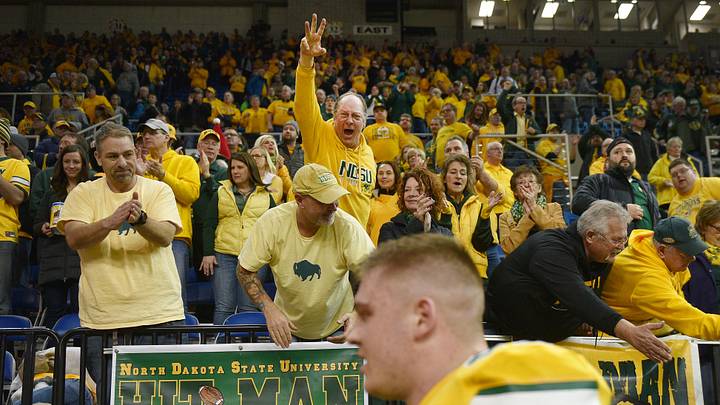
In most respects, the Bison are a perfect candidate. They train in a $54 million practice facility and regularly produce more NFL draft picks than many Power 4 schools. They are one of just two FCS teams to ever receive votes in the AP poll and an impressive 9–5 overall against FBS programs since 2004. They were so good that most schools didn’t even bother playing them in nonconference games, particularly after upsetting a No. 13-ranked Iowa team in 2016. It got to a point where you could pretty much set your watch to fans clad in green and yellow travelling en masse each January from Fargo to Frisco, Texas (the longtime home of the NCAA championship game).
Yet as much as winning begets more winning for NDSU, assuming it to be the case also led to a bit of apathy. Attendance at the Fargodome has declined noticeably since the pandemic and even home playoff games were not close to the packed houses that made it one of the most intimidating places in the country to play. In Illinois State’s stunning upset last December, the program’s final game as an FCS member, just 10,464 fans were announced at the nearly 19,000-seat venue.
Will it be worth it to trade in the opportunity to play for everything you can at one level all for the right to go to the New Mexico Bowl one season? Signs are, at least initially, pointing toward yes.
“Over a 14-year stretch, we had over 32 home playoff games, which is unheard of. The numbers are gaudy and crazy,” says Larsen. “It’s not us saying that we’re going to walk in and win an FBS national championship, but the opportunity, the access [to the CFP], I think was critically important to us as a program and our fan base. It’s a new challenge, it’s new destinations, it’s new schools, it’s hopefully new rivalries. Those are the things that really excite a fan base.”
NDSU launched a “Climb the Mountain” fundraising campaign and has not stopped answering calls since, with Larsen crossing the country several times to meet with excited donors. New avenues for corporate sponsorship dollars have opened up, too. Season-ticket renewals are tracking to be the best NDSU has seen in years, and the expectation is they’ll hit a previously set cap of 12,000.
The timing was also fortuitous because the MWC talks spun up right before head coach Tim Polasek received interest from several high-profile jobs late last season. He agreed to a seven-year contract extension in late November and has been a key proponent of the move even though it will be on his shoulders to see that the winning doesn’t slow down in the new division.
“I said to [Polasek], ‘I want you to be the person who leads us to FBS.’ I think he wanted that, too. I said at this time next year, if we’re still in FCS, I’ll do whatever I can to get you to the FBS. I would support you in any job opportunity that makes sense for you,” Larsen says. “That’s the type of relationship that Tim and I have, where I think we both want to see this through at NDSU. He wants to be the coach here for the long term, but he wants to compete at the highest level.”
That’s something that the MWC continually talks about, too, as it pulls itself up by the bootstraps in a league that has reinvented itself every few years due to conference realignment. Though it must replace some of its most historically successful programs, including 11 of the last 12 conference title game winners, there’s hope that adding one of the most well-known non–Power 4 brands in the country to the table can help it remain in the yearly race to nab the Group of 6 bid to the playoff.
Interestingly, the league has also left open the door for North Dakota State to eventually be an even bigger part of the MWC’s story, should it want to move the rest of its sports further west to encourage those rivalries and bonds to grow.
“It provides the ability to flex into a nine-game schedule sooner rather than later. As we know, a lot of the other leagues are doing a nine-game schedule and so it really was, let’s focus on football at the moment. Definitely open to that conversation [for other sports] in the future, but we haven’t gotten there yet,” says Nevarez. “I don’t have a timeline, but I do think we’re open to continuing to look at expansion in our future. I wouldn’t say we’re actively on the market right now. But I do think given the size of other leagues that heft is one thing you have to think about in future proofing.”
For now, NDSU maintains that it has the best of both worlds while acknowledging the desire to one day have all sports under the same umbrella.
The impetus, however, flows from what the Bison are known for and continue to focus on. While there were plenty of considerations behind the move, perhaps the biggest remained having a seat at the slightly larger FBS table for whatever transpires next in college athletics.
“I’ve been fortunate, we’ve all been fortunate, that if you’re at NDSU, you’ve been a part of some unbelievable moments in time,” says Larsen. “This decision is so much bigger than football. It’s about all the people who made it possible over the years. To me, being able to soak in that first game—where hopefully it’s a home game in the Fargodome and that place will be rocking—that’s going to be pretty surreal. I’m pretty sure I’ll have a smile on my face.”
After years of careful planning to even be in such a position, Larsen surely won’t be alone in that.
More College Football From Sports Illustrated
Listen to SI’s college sports podcast, Others Receiving Votes, below or on Apple and Spotify. Watch the show on SI’s College YouTube channel.
 Add us as a preferred source on Google
Bryan Fischer is a staff writer at Sports Illustrated covering college sports. He joined the SI staff in October 2024 after spending nearly two decades at outlets such as FOX Sports, NBC Sports and CBS Sports. A member of the Football Writers Association of America’s All-America Selection Committee and a Heisman Trophy voter, Fischer has received awards for investigative journalism from the Associated Press Sports Editors and FWAA. He has a bachelor’s in communication from USC.
Follow bryandfischer