%20%20--%3E%0A%3Csvg%20version%3D%221.1%22%20id%3D%22Layer_1%22%20xmlns%3D%22http%3A%2F%2Fwww.w3.org%2F2000%2Fsvg%22%20xmlns%3Axlink%3D%22http%3A%2F%2Fwww.w3.org%2F1999%2Fxlink%22%20x%3D%220px%22%20y%3D%220px%22%0A%09%20width%3D%2239px%22%20height%3D%2240px%22%20viewBox%3D%220%200%2039%2040%22%20enable-background%3D%22new%200%200%2039%2040%22%20xml%3Aspace%3D%22preserve%22%3E%0A%3Cpath%20fill%3D%22%23FFFFFF%22%20d%3D%22M38.5%2C7H28.2v26h10.3V7z%22%2F%3E%0A%3Cpath%20fill-rule%3D%22evenodd%22%20clip-rule%3D%22evenodd%22%20fill%3D%22%23FFFFFF%22%20d%3D%22M26.1%2C25.5c0%2C5.8-4.1%2C7.5-12.9%2C7.5C3.9%2C33%2C0%2C31.2%2C0%2C25.2v-1.1h11.6%0A%09v2.4c0%2C0.7%2C0.1%2C1.4%2C1.2%2C1.4c1%2C0%2C1.2-0.4%2C1.2-1.3v-0.9c0-1.6-0.9-1.6-3.5-2.2C2.2%2C21.7%2C0%2C19.7%2C0%2C15.3v-0.9C0%2C9.3%2C5.5%2C7%2C12.9%2C7%0A%09c10.2%2C0%2C12.8%2C2.6%2C12.8%2C7.4v1.8h-11v-2.9c0-0.6-0.4-1.1-1.2-1.1c-0.6%2C0-1.2%2C0.4-1.2%2C1.1v0.9c0%2C1.5%2C0.9%2C2%2C3.3%2C2.5%0A%09c8%2C1.6%2C10.5%2C3.3%2C10.5%2C7.5V25.5z%22%2F%3E%0A%3C%2Fsvg%3E%0A)
The Last Days of Matthews Arena, Boston’s Overlooked Sports Cathedral
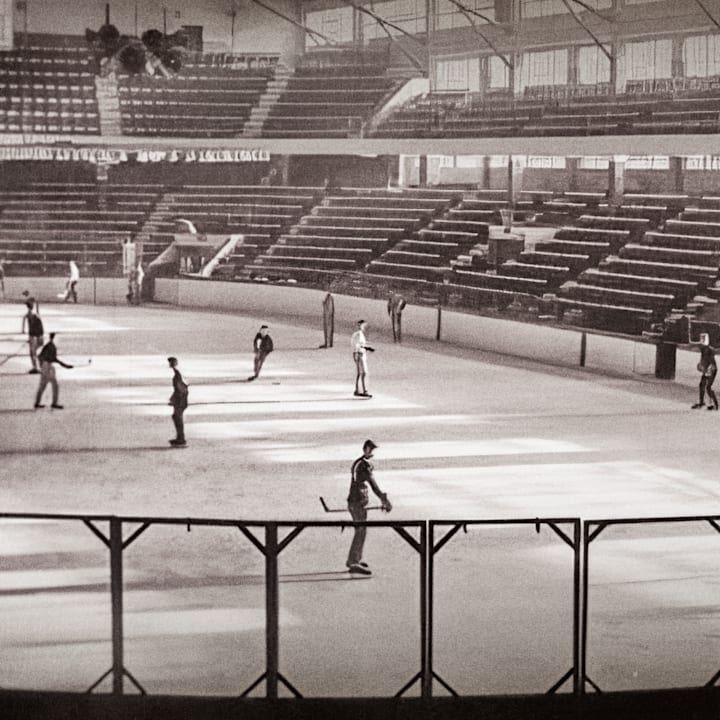
An era of Boston sports history will come to a close Saturday when Northeastern University’s men’s hockey team plays the final game at Matthews Arena.
Built in 1910, the arena is the oldest hockey and basketball arena in the NCAA and the oldest multipurpose athletic building in the world. It was the original home of the Bruins and Celtics, hosted the inaugural edition of the city’s iconic Beanpot college hockey tournament, saw speeches from multiple United States presidents and concerts by world-famous acts such as Bob Dylan, The Doors and Johnny Cash. But after 115 years, Northeastern has made the difficult decision to tear the building down and replace it with a new facility that is expected to open in September 2028. Demolition is set to begin at the start of the new year.

Jim Madigan knows Matthews Arena as well as anyone alive. Madigan has been associated with the Northeastern hockey program for the better part of 40 years, first as a player, later as a coach and now as the school’s athletic director. When Sports Illustrated traveled to Boston in November to see Matthews in the flesh for the latest in our Stadium Wonders video series, we couldn’t have asked for a better tour guide than Madigan, who is not just knowledgeable about the arena, but also deeply passionate about its history.
“It’s sad to see the building go because of all the history,” Madigan says. “We still own the memories and the moments. Those don’t go away. That’s in us. That’s part of our soul. That’s part of us.”
When the Boston Arena, as it was then known, opened in April 1910, the Titanic was still under construction, the U.S. had only 46 states and Babe Ruth was a 15-year-old living in an orphanage in Baltimore. Fenway Park had yet to be built, so the Red Sox played a quarter-mile from the arena at the Huntington Avenue Grounds. It should come as no surprise, then, that Matthews has seen all sorts of Boston sports history.
The arena was Boston’s first indoor ice rink and quickly became the city’s hockey epicenter, hosting many local college and high school games, as well as occasional visits from professional teams from other cities. On occasion, Ruth would play hockey with an amateur club that used the arena. Boston finally got its own pro hockey team in 1924 when the Bruins became the NHL’s first American franchise and called Boston Arena home. The Bruins left in ’28 when the Boston Garden opened two miles to the north. The Garden became Boston’s premier indoor sports venue, but the Arena still held many college hockey games, figure skating events, track meets, boxing matches and concerts. When the Basketball Association of America (the precursor to the NBA) was founded in ’46, the Celtics played their first home game at the Boston Arena and continued to split time between the Arena and the Garden until ’55. The third major pro franchise to begin its life at the Boston Arena was the WHA’s New England Whalers (now the NHL’s Carolina Hurricanes) in ’72.
The Arena’s location was key to it becoming an integral part of the city of Boston. At the time of its construction, the city’s two major league ballparks, the Museum of Fine Arts, Symphony Hall (home of the renowned Boston Pops), the New England Conservatory of Music and the Huntington Avenue Theatre were all located within a half-mile radius of the Arena. The neighborhood was a center for Boston culture and entertainment—and hockey became an increasingly popular pastime for Bostonians.
The new rink played a major role in Boston becoming a hotbed for American hockey. While other North American cities like New York and Montreal built their first indoor ice rinks decades earlier, hockey was an exclusively outdoor sport in Boston until Matthews opened in 1910. The ability to play indoors led to an explosion of the sport’s popularity, and today the Boston area boasts one of the strongest hockey cultures of any place in the U.S. There have been 229 NHL players born in Massachusetts, the second most of any state behind only Minnesota (308).
“Prior to the Arena, Boston really was not much of anything with hockey,” says Stephen Hardy, an author and Boston-area native who played high school and college hockey at the venue. “And that’s because when the first artificial ice rinks came down into America, New York got three of them. There was nothing in Boston. [Hockey] was either on the Charles River frozen or some other pond frozen. Harvard flooded Harvard Stadium [to play hockey]. It was natural ice. Well, what happens in the January thaw? Goodbye, sayonara.”

For a long time, Boston Arena was one of the only places in the area where public school students could play hockey.
“I’m of the age where other than the colleges and the prep schools, there really were like three rinks,” says Joe Bertagna, 74, a native of Arlington, Mass., who played goalie at Harvard and later served as the Bruins’ goalie coach and the first head coach of the Harvard women’s team. “There was one on the North Shore of Boston in Lynn, Mass. There was one, the Boston Skating Club, that produced some of our best national championship figure skaters. And then there was the Arena.”
Ice time was at such a premium at that time that the Arena would be double-booked for high school games.
“Massachusetts high school hockey back then brought four teams in at the same time. So you’d have Arlington against Newton. We’d play our first period and then two other schools would play their first period,” Bertagna explains. “Then we’d play our second period and then they’d make ice. And then the other team would come out for their second, our third, and then their third. And that format, which I don't know anybody else that's ever done it, carried on all the way into the Boston Garden when you had the state semifinals. You’d have the two semifinal games that would intertwine.”
Boston’s hockey culture is felt most strongly on the college side, though. The city’s four Division I hockey schools (Boston University, Boston College, Harvard and Northeastern) compete in the annual Beanpot tournament—a competition many sports fans outside New England might not be familiar with but one so storied that it sells out TD Garden every year. And where did this classic Boston sports tradition begin? At Matthews Arena, of course. The first edition of the tournament was held there in 1952 before moving to the old Boston Garden and later its replacement. Northeastern has won five of the last seven men’s tournaments and each of the past three women’s events.
“I have so many friends who played and have stories about playing hockey in here through the ’40s and the ’50s and the ’60s, or [in their] high school years and then went on to play college,” Madigan says. “So this was the Mecca, this building, of high school hockey. And then it translated to college. At one point, all four [Boston-area] college teams—Northeastern, Harvard, BU, BC—played hockey here in this building.”
Northeastern purchased the arena in 1979 and renamed it Matthews Arena three years later, in honor of former university chairman George J. Matthews. Since then, the building has hosted the school’s men’s and women’s varsity hockey teams and the men’s basketball team, as well as the men’s and women’s club hockey teams and club figure skating team. It also hosts large university gatherings, like orientation and graduation events, and there is time set aside for free skating for students and faculty.

Most D-I universities can be categorized as either football or basketball schools. Northeastern, though, is undoubtedly a hockey school. The men’s program has produced 34 NHL players, including 17 active players, while the women’s program won six straight Hockey East conference tournaments from 2018 to ’23 and reached three consecutive Frozen Fours from ’21 to ’23.
All that success has bred rabid support for the programs. The student section is known as the DogHouse and is as passionate as any fan group you’ll see on any campus. The students have coordinated dances for certain songs the pep band plays and cover the railing of the upper deck with hand-drawn signs with puns inspired by the names of each player on the team (“The Hunger James” for forward James Fisher, “Sheriff Lawton” for goalie Lawton Zacher and so on).
“What happens when you’re a player in this building and you’re on the bench, because the balcony overhangs—you can see how it cantilevers over almost to the fourth row of the first loge area—it’s really loud,” Madigan says, explaining how the building’s construction and the fans’ passion combines to create a hostile environment for visitors. “The fans are loud. You look to the DogHouse, they’re already sitting on top of the goaltender there. So there’s a lot of noise coming from there. It’s just loud in here because of the confines of the building. So when our hockey teams, men’s and women’s, get it going, and when men’s basketball gets it going with momentum, it becomes really loud and exciting.”
The decision to tear the building down was a difficult but necessary one. After standing on St. Botolph Street in Boston’s South End for more than a century, the arena is beginning to feel the effects of its advanced age. In 2024, large steel supports were added to the exterior of the southwest side to address concerns about the building’s structural integrity. The seats in the upper deck on that side of the arena were roped off, chopping the fabled DogHouse in half. A reason for concern is the fact that the area around the arena is built on what was originally water before centuries of massive land reclamation projects throughout the city of Boston.
“There were some structural issues and some of the integrity was compromised,” Madigan says of the conditions that led the school to decide demolition was the most prudent path forward. “As the university and its facilities group and outside institutions looked at it, it wasn’t feasible to continue to try and invest dollars into a 115-year-old facility that was being somewhat compromised.”

Matthews Arena really shows its age—for better and for worse. The first thing you notice when you approach from the adjacent parking garage is the scaffolding that was installed to extend the building’s lifespan. Inside there are other signs of age like the ancient radiators along the walls (which, judging by how cold I was during the Huskies’ final basketball game there on Nov. 15, don’t do very much) and the fact that a single cramped lobby area serves as the closest thing to a concourse. But there are other ways in which the signs of age are more charming. Watching a game there is a fun opportunity to transport yourself back in time to a point in history that has long since passed.
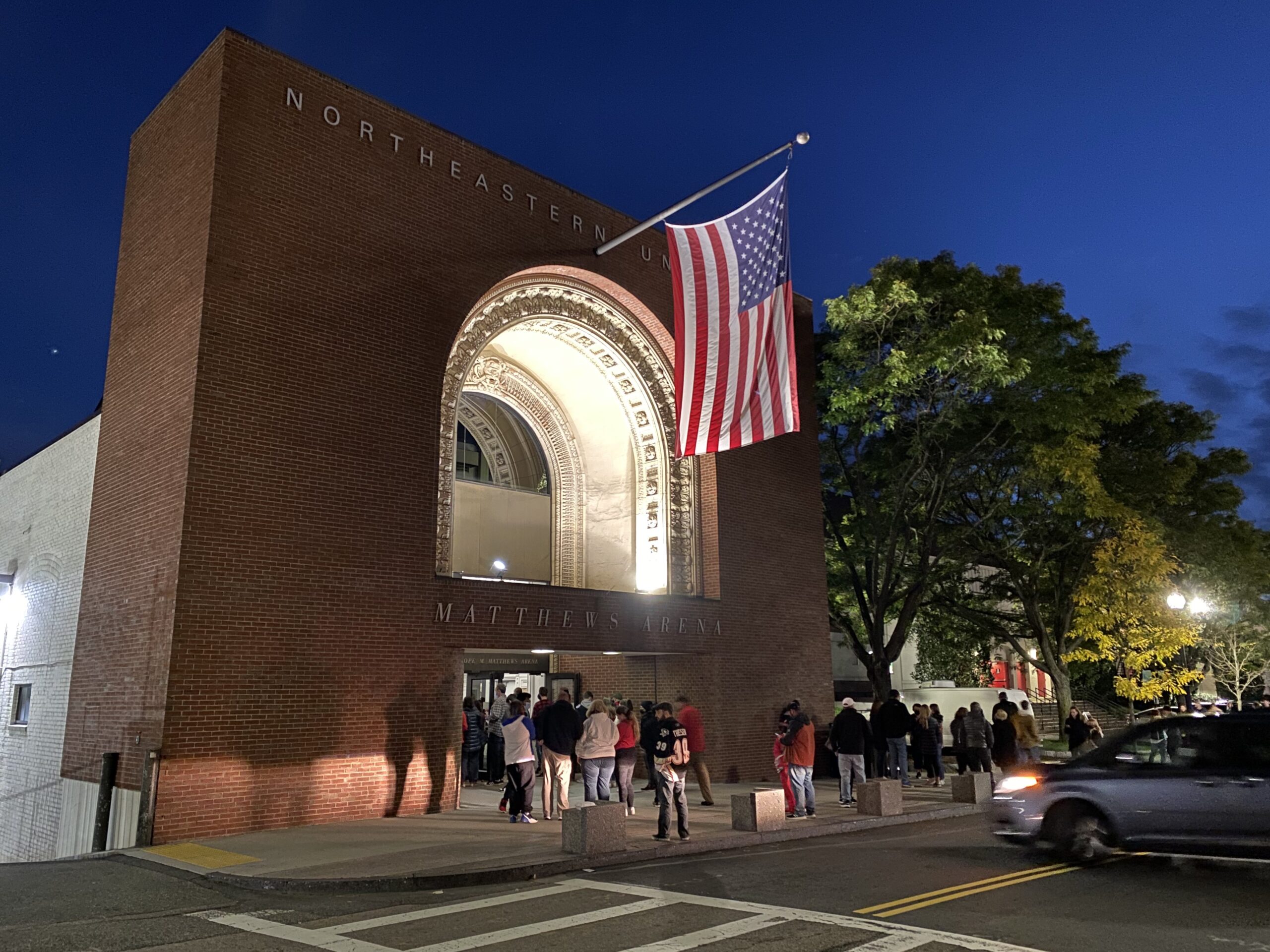
Matthews looks unassuming from the exterior. The ornate terracotta ornamental arch that once stood at the entryway has since been mostly encased by bricks. (The school plans to preserve the iconic arch as part of the new arena.) The rest of the outside is a mixture of exposed brick and off-white paint, except for a mural covering the doors that lead to a disused box office. The inside, though, is a different story. The history of the place is immediately evident from the moment you walk through the front entryway and into the throwback lobby. Its vaulted ceilings and hanging light fixtures are more reminiscent of an old theater than a hockey rink. Step through the doors into the seating area, though, and it’s pure, old-school hockey. The ice surface is recessed below street level and the ceiling is constructed of wooden planks, making it easy to see why old rinks are commonly known as barns.
The lobby also features a large window between two of the entrances to the seating area that offers views of the ice from the comfort of the heated lobby.
“That’s a brilliant design,” Hardy says. “It’s a proto skybox. So the lobby, the foyer, it was technically called—the bigger space—was an area where people could look out at the game and stay warm or have whatever they wanted to drink in the foyer. Brilliant, brilliant.”
It’s a stunning feature that had spent decades under wraps. As the arena deteriorated in the years before it was purchased and subsequently refurbished by Northeastern, a previous owner had made the questionable decision to cover the window with plywood and later sheet rock. Madigan was working in the school’s facilities department in 1995 when the school decided to renovate the lobby and expose the window once again.
“Northeastern University has been the most important owner of the Boston Arena,” Hardy says. “It’s not even close, not even close. They’re not the oldest, but they have put the time in to carefully bring it back.”

The arena is a fascinating mix of new and old. (But mostly old.) The locker rooms are tight, as you might expect, but far from antiquated. The same goes for the weight room, which sits between the men’s and women’s hockey locker rooms. The seats in the stands are comfortable, and mostly offer good sightlines, although fans in the upper balcony seating area might struggle to see the puck if it goes into the near corner. (The balcony, added in 1926, wasn’t part of the original arena, which explains why getting from the upper sections to the lower seating bowl can feel like navigating a maze.) The arena’s most modern feature is an enormous 50-foot scoreboard that hangs above center ice. Its most antiquated is probably the cramped media seating area. Getting to my place in the press section required me to suck my stomach in and squeeze behind the chairs of my fellow reporters.
Presumably that won’t be an issue at the new arena that will replace the departed landmark. The school has released plans for a new 310,000-square-foot, multistory arena with 4,050 seats for hockey and 5,300 for basketball. It will also feature practice and training facilities for other Huskies teams and space for intramural sports.
“[Matthews] is a one-activity building right now where you can play either hockey or basketball, [or] you can have an event on the floor,” Madigan says. “This new facility will allow us to have multiple activities going on at the same time.”
Construction of the new facility will force Northeastern’s hockey teams into a temporary state of transience. While the men’s basketball team will move into the 1,500 seat Cabot Center, the home of the women’s basketball program, the hockey teams will play “home” games all over the Boston area. To finish out the 2025–26 season, the men will play one game each at the home rinks of UMass-Lowell, BU and Bentley, as well as two designated home games at Harvard’s rink. They even have a “home” game in Portland, Maine. The women will play three designated home games at BU and two at Bentley. Both teams are set to practice in Dedham, Mass., about 20 miles from campus, for the duration of the construction.
It’s a difficult situation for the players and fans, who will spend the next two seasons doing the hockey equivalent of couch surfing while they wait for their new home to be built. A new-and-improved home arena will make the brief period of uncertainty worth it, but there will undoubtedly be some difficult moments in the interim.
Before it’s gone, though, Matthews is getting a grand sendoff. The final basketball game there on Nov. 15 included a halftime ceremony featuring more than 50 men’s basketball alumni taking to the court one last time. I watched as generations of fans posed for final photos in the balcony and as they lingered on the court for as long as possible before security ushered them off so the changeover to the hockey setup could begin. On Monday, roughly 50 members of the Boston hockey community met at Matthews for one last skate, organized by Madigan. Bertagna was there with his 78-year-old brother and 89-year-old father-in-law, all three of whom had played hockey at Arlington High School under the legendary coach Ed Burns during his 50-year run in charge of the program.

“Whether we were assembled in the lobby or the dozen of us who actually skated, [we were] going around saying, ‘Well, in this spot, this happened. I remember getting a goal from this spot. I gave up a goal here,’ ” Bertagna says. “The earliest [I’d been at the arena] would have been probably 13 years old, and yesterday, at age 74, the last time.”
The new building will be something for the wider Northeastern community to look forward to—a gleaming, modern facility that will be more useful to a larger number of people. But Matthews is also a place that will be worth looking back on long after it’s gone, and not just for Northeastern fans.
“I guess I’d hope that people will remember the joy that it gave to so many people, whether you were inside as a participant or outside as a spectator, it was a site where so much joy was felt,” Bertagna says. “And obviously, in every game, there’s a winner and a loser and somebody’s not walking out happy. But overall, the big picture of things, it really entertained and gave just great joy to so many generations.”
While the farewell to the Arena has been gradual, from the initial demolition request in 2024 to last month’s final basketball game, to Monday’s last skate, Saturday’s game against BU will put a period at the end of this chapter of Boston history. The school has plans for a ceremony featuring at least two current NHL players (the Penguins’ Ryan Shea and the Bruins’ Jordan Harris). After the game, preparations will begin for the tearing down of the structure. The demolition will begin in February and is expected to take two to three months. After that, the building will be gone but the memories will remain.
“I would hope that Matthews would be remembered as this iconic building that was much greater than bricks and mortar,” Madigan says. “It was about bringing communities together.”
 Add us as a preferred source on Google
Dan Gartland writes Sports Illustrated’s flagship daily newsletter, SI:AM, and is the host of the “Stadium Wonders” video series. He joined the SI staff in 2014, having previously been published on Deadspin and Slate. Gartland, a graduate of Fordham University, is a former Sports Jeopardy! champion (Season 1, Episode 5).
Follow Dan_Gartland