%20%20--%3E%0A%3Csvg%20version%3D%221.1%22%20id%3D%22Layer_1%22%20xmlns%3D%22http%3A%2F%2Fwww.w3.org%2F2000%2Fsvg%22%20xmlns%3Axlink%3D%22http%3A%2F%2Fwww.w3.org%2F1999%2Fxlink%22%20x%3D%220px%22%20y%3D%220px%22%0A%09%20width%3D%2239px%22%20height%3D%2240px%22%20viewBox%3D%220%200%2039%2040%22%20enable-background%3D%22new%200%200%2039%2040%22%20xml%3Aspace%3D%22preserve%22%3E%0A%3Cpath%20fill%3D%22%23FFFFFF%22%20d%3D%22M38.5%2C7H28.2v26h10.3V7z%22%2F%3E%0A%3Cpath%20fill-rule%3D%22evenodd%22%20clip-rule%3D%22evenodd%22%20fill%3D%22%23FFFFFF%22%20d%3D%22M26.1%2C25.5c0%2C5.8-4.1%2C7.5-12.9%2C7.5C3.9%2C33%2C0%2C31.2%2C0%2C25.2v-1.1h11.6%0A%09v2.4c0%2C0.7%2C0.1%2C1.4%2C1.2%2C1.4c1%2C0%2C1.2-0.4%2C1.2-1.3v-0.9c0-1.6-0.9-1.6-3.5-2.2C2.2%2C21.7%2C0%2C19.7%2C0%2C15.3v-0.9C0%2C9.3%2C5.5%2C7%2C12.9%2C7%0A%09c10.2%2C0%2C12.8%2C2.6%2C12.8%2C7.4v1.8h-11v-2.9c0-0.6-0.4-1.1-1.2-1.1c-0.6%2C0-1.2%2C0.4-1.2%2C1.1v0.9c0%2C1.5%2C0.9%2C2%2C3.3%2C2.5%0A%09c8%2C1.6%2C10.5%2C3.3%2C10.5%2C7.5V25.5z%22%2F%3E%0A%3C%2Fsvg%3E%0A)
One Year Later, Rory McIlroy Relives the Emotions of an All-Time Masters Sunday
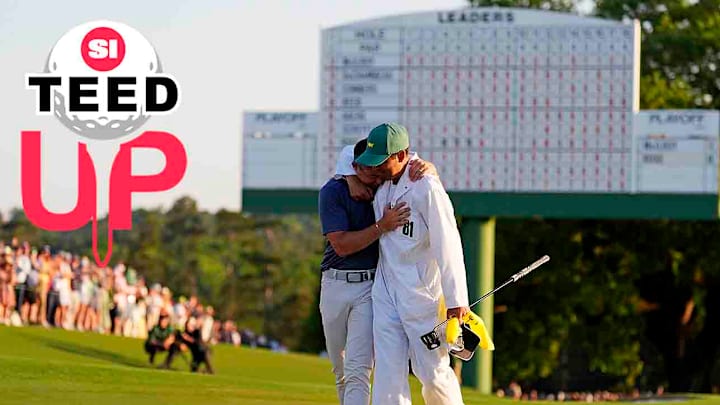
AUGUSTA — The back nine at Augusta National almost always delivers. It’s as if the golf gods conspire to make sure there is some drama over the final nine holes of the Masters, regardless of the participants.
The emotional ups and downs match the hilly terrain, taking your breath away as you go along for the ride.
There can be no better example than last year’s Masters, when Rory McIlroy took his fans—and himself—on an emotional journey that saw him seemingly in command, then seemingly doomed, then in position to win, and then letting it slip away, and then finally prevailing in a sudden-death playoff.
It was a remarkable back-nine expedition that in the end was all but fitting for McIlroy, who ended an 11-year quest to complete the career Grand Slam and win his first Masters.
“As much as I had had chances before, whether it be at the Open in St. Andrews in ’22, the two U.S. Opens in ’23 or ’24 ... I don’t think there was any round of golf that I’d played before that can compare to the feelings and the emotions I went through that Sunday,” McIlroy said.
It is fair to wonder how he did it. McIlroy made four double bogeys in the tournament—two that could have ruined it during the first round, two that should have ruined it during the final round.
He made an egregious error at the par-5 13th, where he had an easy pitch that turned into disaster. He made a bogey at the 14th, missed a makeable birdie putt at the 16th and couldn’t close out the tournament with a par putt at the 18th. All after mixing two of the best iron shots imaginable under the pressure.
Rory's third shot on No. 13 finds the water. pic.twitter.com/yoS1x5dk5H
— Golf on CBS ⛳ (@GolfonCBS) April 13, 2025
Now a year later, McIlroy is asked how he did it. For all of his major success, he really had not given himself many chances at the Masters since his final-round 80 in 2011 after holding the 54-hole lead.
He had won the U.S. Open and the PGA Championship twice and the British Open at Royal Liverpool—all by 2014. That meant he had come to Augusta 10 times previously with a chance to become just the sixth player to win all four major championships, and never really given himself a chance.
There were shots at other majors, the aforementioned Open at St. Andrews and the U.S. Opens at Los Angeles Country Club and Pinehurst, a total of 21 top-10s since his last major title at the 2014. That included 11 top-5 finishes.
But the Masters high finishes were more of the back-door variety, moving up the leaderboard while not really being in contention. In 2018, McIlroy played in the final pairing with eventual champion Patrick Reed, but fell out of contention early. His second-place finish to Scottie Scheffler in 2022 came with a hole-out birdie on the 18th to finish four shots back.
So last year became his best chance, especially after a strong stretch during the third round that saw him make six consecutive 3s to start the round. His 66 gave him a two-shot advantage over Bryson DeChambeau and a final-round pairing with the 2024 U.S. Open champion.
Then he started the final round with a double bogey at the first. And by the time he stepped on the 3rd tee, he trailed.
“I think Augusta over the years has made me quite tentative at times, especially with approach play, and I think once you get tentative, you can start leaving yourself in some really bad spots, and it’s hard to get up-and-down,” McIlroy said. “I played a practice round with [three-time Masters winner] Phil Mickelson ... probably closer to 15 years ago, and I always remember he said to me, ‘Rory, one of the reasons I love Augusta National is because I feel I can be so aggressive here.’
“I remember thinking, ‘What does he mean?’ I feel the opposite. I feel I can't be aggressive here because there’s so many bad places to miss. But Phil had so much—still has, probably, so much faith in his short game that if he does miss an approach shot by being aggressive, he still feels he can get that ball up-and-down.”
And that served McIlroy well after he got behind. He played aggressively at the 3rd hole and made a birdie. He followed with a birdie at the tough par-3 4th. He made another at the 9th and then the 10th. And when he got to the 13th tee, he had a three-shot lead and was six holes away from glory.
Agony soon followed. A smart layup shot on the par-5 left him just 82 yards to the pin and seemingly all of Georgia to the left of the flagstick. But McIlroy inexplicably aimed farther right than intended, saw the pitch shot squirt to the right and into the creek that fronts the green.

That double-bogey 7 was followed by a bogey at the 14th and with a surging Justin Rose ahead, McIlroy was reeling.
And yet he somehow pulled it together.
“I think when I look back at the round, when I was aggressive and when I played aggressively, I was rewarded and I played well,” he said. “When I made double at the first, I played pretty aggressively [at the third], hit driver to the front of the green and made birdie. Aggressive with my 5-iron on 4 and made birdie. Went at the pin on 9. Made birdie. ... 10, made birdie. So like I was being rewarded for being aggressive, and then I obviously got the lead.
“And then the first time that my mindset or my tactics went a little bit defensive, like trying to protect the lead, that’s when I got into trouble. Obviously what happened on 13 and on 14, and when I got to 15 again, I needed to be aggressive. I needed to make a birdie again, and I was able to do it.”
McIlroy hit what many will regard as the shot of the tournament, a sweeping 7-iron at the par-5 15th that would have been even more special if he converted the eagle putt. But the birdie got him back tied for the lead, and when he knocked his 8-iron approach to a few feet at the 17th, he had a one-shot lead again and was just a par away from winning.
Poised to make eagle. Rory McIlroy goes for glory on No. 15. #themasters pic.twitter.com/hAM0zxnkM7
— The Masters (@TheMasters) April 13, 2025
And then from the middle of the fairway ... a wedge shot dumped into the bunker, a blast to 5 feet and a miss. Playoff.
It took a few simple words from his caddie, Harry Diamond, for McIlroy to regroup.
“That was an easy reset,” McIlroy said. “He basically said to me, look, you would have given your right arm to be in a playoff at the start of the week. So that sort of reframed it a little bit for me.”
McIlroy then hit a drive in the near identical spot on the 18th hole to where he hit it in regulation and knocked his sand wedge approach to 4 feet. After Rose missed his birdie putt from 20 feet, McIlroy had a 4-footer for the win, capping a wild tournament.
“It made me feel incredibly grateful for everything that's happened in my life,” McIlroy said. “And I think that’s been the overwhelming feeling of having this jacket for a year is just how honored and grateful I am that I was able to do it, and how grateful I am that I’ve had so much great support along the way.
“I talk about the morning after getting the world No. 1 and having this sort of empty feeling, I didn’t have that with this. I think I was chasing it for so long.”
How the top players stand coming to Augusta
As Masters week begins, it’s interesting to note the form of some of the players you might expect to be in contention and the oddity that several of them have not played in the past three weeks. Only two players in the previous 89 Masters have won after not playing in the two weeks prior.
> Scottie Scheffler: The No. 1-ranked player in the world has not played since the Players Championship due to the birth of a second child. He posted back-to-back finishes outside of the top 20 and has three in a row outside of the top 10, which is a veritable calamity for Scheffler.

> Rory McIlroy: The defending champion hasn’t played since the Players, where he tied for 46th in a tepid return following withdrawing the week prior at the Arnold Palmer Invitational with a back issue. Prior to that, McIlroy tied for second at the Genesis Invitational, which was six weeks ago.
> Cam Young: Ranked third in the world, he comes into the Masters off three consecutive top-10 finishes, including his victory at the Players, which was his last start.
> Tommy Fleetwood: Ranked fourth in the world, the Englishman comes in with plenty of golf this year, having played in seven events, including the Valero Texas Open over the weekend. Fleetwood has just a single top-10 at the Masters, a tie for third in 2024.
> Matt Fitzpatrick: The Englishman moved up to No. 5 in the world following his runner-up at the Players and victory at the Valspar. The 2022 U.S. Open champ has two Masters top-10s.
> Xander Schauffele: The two-time major winner is showing good form after a tough 2025 with strong performances at the Players and the Valspar. He has five top-10s at the Masters including a tie for eighth last year.
> Justin Rose: The two-time Masters runner-up via playoff won at Torrey Pines in January and also hasn’t played since a tie for 13th at the Players. Rose has made 20 Masters starts with seven top-10s but has missed the cut in three of his last seven appearances.

> Collin Morikawa: The two-time major winner won at Pebble Beach and saw a return to form before a troubling back injury surfaced at the Players where he withdrew after just one hole. And then he withdrew prior to the pro-am last week at the Valero Texas Open.
> Bryson DeChambeau: The two-U.S. Open winner is coming off consecutive victories on the LIV Golf League in Singapore and South Africa. He’s also seemingly solved the Augusta National riddle with consecutive top-six finishes including getting into the final group with McIlroy last year.
> Jon Rahm: The 2023 Masters champ who also won the U.S. Open in 2021 has really not had a bad tournament in more than a year. He’s won once this year on LIV Golf and has three seconds and a fifth. He has five Masters top-10s including his victory, and tied for 14th last year.
The three who got to Augusta via the “win-and-you’re in” ticket
There are 26 different Masters invitation qualifications ranging from past winners of the tournament to winner’s of the U.S. Amateur. Of the 26, Scottie Scheffler qualifies via 11 of them, including for his own Masters victories but as well as for having won on the PGA Tour in the past year and for having won major championships in the past year, among other things.
As it played out, only three players made their way into the Masters field via Category 17, which is for winners of PGA Tour events since last year’s Masters that have a full-point allocation applied toward the season-ending Tour Championship. That means players who win opposite-field or fall events do not get that invite.
The only players who qualified via that category are Brian Campbell (John Deere Classic), Aldrich Potgeiter (Rocket Mortgage) and Gary Woodland (Houston Open).
To be fair, some of the players who qualified in other ways such as the top 30 in FedEx Cup points or the top 50 in the Official World Golf Ranking might not have earned those other invite categories had they not won.
More Masters Coverage from Sports Illustrated
 Add us as a preferred source on Google
Bob Harig was a senior writer covering golf for Sports Illustrated. He has more than 25 years experience on the beat, including 15 at ESPN. Harig is a regular guest on Sirius XM PGA Tour Radio and has written two books, “DRIVE: The Lasting Legacy of Tiger Woods” and “Tiger and Phil: Golf’s Most Fascinating Rivalry.” He graduated from Indiana University where he earned an Evans Scholarship, named in honor of the great amateur golfer Charles (Chick) Evans Jr. Harig, a former president of the Golf Writers Association of America, lives in Clearwater, Fla.
Follow bobharig