%20%20--%3E%0A%3Csvg%20version%3D%221.1%22%20id%3D%22Layer_1%22%20xmlns%3D%22http%3A%2F%2Fwww.w3.org%2F2000%2Fsvg%22%20xmlns%3Axlink%3D%22http%3A%2F%2Fwww.w3.org%2F1999%2Fxlink%22%20x%3D%220px%22%20y%3D%220px%22%0A%09%20width%3D%2239px%22%20height%3D%2240px%22%20viewBox%3D%220%200%2039%2040%22%20enable-background%3D%22new%200%200%2039%2040%22%20xml%3Aspace%3D%22preserve%22%3E%0A%3Cpath%20fill%3D%22%23FFFFFF%22%20d%3D%22M38.5%2C7H28.2v26h10.3V7z%22%2F%3E%0A%3Cpath%20fill-rule%3D%22evenodd%22%20clip-rule%3D%22evenodd%22%20fill%3D%22%23FFFFFF%22%20d%3D%22M26.1%2C25.5c0%2C5.8-4.1%2C7.5-12.9%2C7.5C3.9%2C33%2C0%2C31.2%2C0%2C25.2v-1.1h11.6%0A%09v2.4c0%2C0.7%2C0.1%2C1.4%2C1.2%2C1.4c1%2C0%2C1.2-0.4%2C1.2-1.3v-0.9c0-1.6-0.9-1.6-3.5-2.2C2.2%2C21.7%2C0%2C19.7%2C0%2C15.3v-0.9C0%2C9.3%2C5.5%2C7%2C12.9%2C7%0A%09c10.2%2C0%2C12.8%2C2.6%2C12.8%2C7.4v1.8h-11v-2.9c0-0.6-0.4-1.1-1.2-1.1c-0.6%2C0-1.2%2C0.4-1.2%2C1.1v0.9c0%2C1.5%2C0.9%2C2%2C3.3%2C2.5%0A%09c8%2C1.6%2C10.5%2C3.3%2C10.5%2C7.5V25.5z%22%2F%3E%0A%3C%2Fsvg%3E%0A)
Three Masters Legends Talk Tiger Woods, Ball Rollback and More After Their Tee Shots
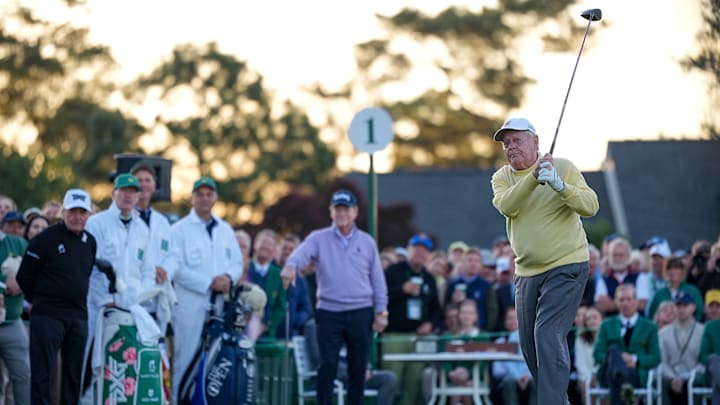
AUGUSTA — It’s perhaps the unofficial start to spring.
With the morning dew fresh on the ground and the sun barely risen over Augusta National Golf Club, three aging icons of the sport—Jack Nicklaus, 86, Tom Watson, 76, and Gary Player, 90—start the Masters Tournament, and thus, the major championship golf season, with their annual ceremonial tee shots.
It’s been 40 years since Nicklaus’s triumphant final Masters title. Forty-five since Watson’s. And 48 since Player’s.
Yet seeing them swing a club is a sight to behold. Player knocked his drive down the middle, with an ensuing leg kick. Nicklaus hooked his (but, as the GOAT, gets all the leeway in the world) and Watson showed he can still whip it.
Afterward, per usual, they’re trotted to the media center, ready to face the scribes—many of whom weren’t even born when they had a green jacket draped over their shoulders—who are eager to gather their thoughts on the sport’s hottest topics, while also soaking in the friendly, comical banter between three that have come from a lifetime of golf.
Here are the highlights.
Talking Tiger
Nicklaus, Watson and Player are among the greatest living golfers, along with, of course, Tiger Woods.
Woods, however, isn’t in Augusta this year—still, his presence hovers over the tournament.
When Nicklaus was asked what his message to Woods, who is currently seeking treatment after he was charged with a DUI following a car crash two weeks ago, the 18-time major champion was straightforward.
“Just whatever you need to help you and get back,” Nicklaus said, “because I think golf needs him, and we’d love to have him back.”
The 90th Masters Tournament begins with ceremonial tee shots from Jack Nicklaus, Gary Player and Tom Watson. #themasters https://t.co/5WMvw0UeKz
— The Masters (@TheMasters) April 9, 2026
Player, as expected, had a more long-winded response.
“The human being is so critical of everything,” the South African said. “If I or any of you in this room had the pain that Tiger Woods had—think of the excruciating pain that this man has been going through for a long time. I personally think in my opinion—if I’m right or wrong, I’m sorry—but he was trying to be a Navy SEAL scout for a while. Funny enough, I had a friend who was a Navy SEAL scout. He said this long ago. He said Tiger will really suffer in the future with his back and with his legs.
“Look what’s happened? I think it’s 20 operations on either the back or the legs, but many, many operations on his leg and his back. So he’s in pain. Do I blame him for taking medicine? Hell, no. He has sleep deprivation. Do I blame him for taking something to help him sleep? No.”
But Player doesn’t feel that’s an excuse for Woods’s recent actions.
“I don’t think he should drive a car,” he said. “When you’re taking that medicine, it’s dangerous when you’re driving a car, same as it’s dangerous when you look at your cell phone in the car. There’s 6,000 accidents a day in motor cars.”
Player added: “My heart goes out for him. There’s nothing worse than living in pain every day of your life. You can’t think of anything worse. I just hope he can get it all sorted out because he's such an asset to golf and has done so much for the game.”
Fixing golf’s distance problem
In Nicklaus’s prime, the sport’s leaders in driving distance hovered around 270 yards.
Today, that’d be last on Tour.
In recent years, there have been initiatives to combat that, most notably with rollback. The USGA and R&A announced a plan in 2023 that would see testing of golf balls at a higher speed of 125 mph, which would reduce driving distance by 15 to 20 yards for professionals.
“I know when we started playing on the Tour with the balata and wound golf balls, many of them are like eggs,” Watson said. “You’d hit a golf ball, and it would waver in the air. Today’s modern golf balls, they’re all good. With the invention of Titleist's Pro V1 in 2001, the game changed because everybody then produced golf balls that conformed to the USGA standards but went further. You add the equipment, the large-headed drivers, and you also have to add the fact that the players are stronger, and they work out, and they create more club head speed.”
Nicklaus recalls when he went to the USGA in 1977 after Titleist introduced a new ball that went further, concerned it would harm the game. He was told, “You don't know what you're talking about.”
Two decades later, things proceeded.
“In 1995, when they first brought out the composite golf balls—the golf ball from 1930 to about 1995, the golf ball probably increased maybe 5 or 6 yards just through the skill of the manufacturer to make it more consistent and better. From 1995 to 2005, the ball increased about 50 yards. That was just through them being able to circumvent the rules and what they are and allow the ball to go further.”
Now, regarding golf’s distance problem, Nicklaus says, “The golf ball needs to be reined in. What they’re doing right now is throwing a deck chair off the Titanic, and it’s not getting enough done. It needs to really come back.”
Player echoes those sentiments.
“I believe the ball should be cut back 60 yards, only for professional golf,” Player said. “Leave everyone to golf as it is. They’re the heart of the game, but professional golf is not. With regard to professional golf, cut the ball back 60 yards. It’s a tragedy. We got away from the concept of golf when it started originally, a par-5, a par-4, and a par-3. There is no such thing as a par-5 in the world today. We saw Rory with a 7-iron [on the par-5 15th] last year when he won the Masters; they’re hitting 8-irons and 7-irons to par-5s.”

As a result, golf courses are being regularly lengthened. And when Player puts everything in perspective, he feels the line needs to be drawn.
“Here’s the crucial thing,” Player said, “the amount of money that we’re spending around the world probably rates to $100 million. Whatever the figure is, it’s exorbitant. They’re putting that money into making golf courses longer. We’re running out of water in the world, fertilization, machinery is so expensive, labor, oil, whatever cost you want to put in there. Where are we going? That money is being wasted, or if they cut the ball back, we don't have to make these changes. Look what they’ve done here. It’s amazing when you think what this golf course used to play and what it plays now. That money could be allocated to African American areas where they need to be able to play golf and encourage them to play golf, for schools, for hospitals. We’re just wasting the money.”
Tweaking the schedule
With the PGA Championship having moved from August to May in 2023, all four majors are contested within a four-month period.
And new PGA Tour CEO Brian Rolapp, in the upcoming years, is introducing changes to the PGA Tour’s schedule. He aims to double the number of signature events, but it remains to be seen if the Tour’s calendar will become more condensed or spaced out to appease the sport’s top stars.
Nicklaus believes there’s pros and cons to both.
“I don’t like [the four majors] that short, but I’ll tell you what has happened, if you look at the four tournaments, the Masters weather always plays a factor—wind, cold, whatever it might be,” he said. “You went to the U.S. Open in June, generally speaking, weather always played a factor. You went to the Open Championship in Scotland or England, the weather always played a factor. You came back to the PGA Championship in August, and the weather was very benign.
“By moving the PGA Championship to May, all of a sudden we have weather becoming part of that, too. So all four championships can be determined a large time by whatever can happen with the weather. I think that’s a good thing.
“However, I’d love to see them spread a little bit more only because it really concentrates too much emphasis on too short a period of time, and there’s too many other tournaments that are good tournaments that can sort of get shut out because of that.”
Player, however, wants to see the antipathy towards playing so much subside.
“[My father] said, ‘Son, remember this, it’s in the mind.’ He said, ‘If I could play golf every week of my life, I wouldn't take a week off, compared to what I’m doing now.’ So we do get spoiled. I think we get spoiled to a great degree. How many people in the world can have the opportunity of making tens of millions of dollars and being fussy about it?”
The final hurrah?
The ceremonial opening tee shot has been a tradition for decades—but Father Time is undefeated.
Byron Nelson, at 89 years old, did it for the last time in 2001, feeling it was too difficult for him to prepare for it. He walked to the tee box that year with a cane. Sam Snead, though, went as long as he could. In 2002, at age 89, he struck a patron with his shot, a month before Snead died.
How much longer will Nicklaus, who, at this point in his life, plays golf only once a year, participate?
“I don’t know,” he said. “I think that I was a little worried I had—I had carpal tunnel surgery about five, six weeks ago, and I was worried about being able to hold onto the golf club and hurt somebody. That was my issue today. I’m fortunate that I got it over somebody's head. I didn’t hit it very well, but I got it over their heads and didn't hurt anybody.
“As long as I can still hit the golf ball … It's such a nice ceremony, and it’s a real honor to be invited. I hope to be able to do it as long as I can not kill anybody.”
More Masters Coverage from Sports Illustrated
 Add us as a preferred source on Google
Max Schreiber is a contributor to the Breaking and Trending News team at Sports Illustrated, covering golf. Before joining SI in October 2024, the Mahwah, N.J., native, worked as an associate editor for the Golf Channel and wrote for RyderCup.com and FanSided. He is a multiplatform producer for Newsday and has a bachelor's in communications and journalism from Quinnipiac University. In his free time, you can find him doing anything regarding the Yankees, Giants, Knicks and Islanders.