%20%20--%3E%0A%3Csvg%20version%3D%221.1%22%20id%3D%22Layer_1%22%20xmlns%3D%22http%3A%2F%2Fwww.w3.org%2F2000%2Fsvg%22%20xmlns%3Axlink%3D%22http%3A%2F%2Fwww.w3.org%2F1999%2Fxlink%22%20x%3D%220px%22%20y%3D%220px%22%0A%09%20width%3D%2239px%22%20height%3D%2240px%22%20viewBox%3D%220%200%2039%2040%22%20enable-background%3D%22new%200%200%2039%2040%22%20xml%3Aspace%3D%22preserve%22%3E%0A%3Cpath%20fill%3D%22%23FFFFFF%22%20d%3D%22M38.5%2C7H28.2v26h10.3V7z%22%2F%3E%0A%3Cpath%20fill-rule%3D%22evenodd%22%20clip-rule%3D%22evenodd%22%20fill%3D%22%23FFFFFF%22%20d%3D%22M26.1%2C25.5c0%2C5.8-4.1%2C7.5-12.9%2C7.5C3.9%2C33%2C0%2C31.2%2C0%2C25.2v-1.1h11.6%0A%09v2.4c0%2C0.7%2C0.1%2C1.4%2C1.2%2C1.4c1%2C0%2C1.2-0.4%2C1.2-1.3v-0.9c0-1.6-0.9-1.6-3.5-2.2C2.2%2C21.7%2C0%2C19.7%2C0%2C15.3v-0.9C0%2C9.3%2C5.5%2C7%2C12.9%2C7%0A%09c10.2%2C0%2C12.8%2C2.6%2C12.8%2C7.4v1.8h-11v-2.9c0-0.6-0.4-1.1-1.2-1.1c-0.6%2C0-1.2%2C0.4-1.2%2C1.1v0.9c0%2C1.5%2C0.9%2C2%2C3.3%2C2.5%0A%09c8%2C1.6%2C10.5%2C3.3%2C10.5%2C7.5V25.5z%22%2F%3E%0A%3C%2Fsvg%3E%0A)
The Windmill, the U.S. Open and Two Trailblazing Women Who Shaped Shinnecock
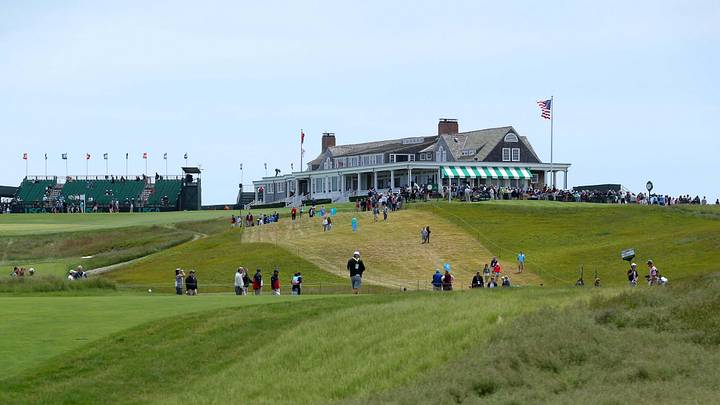
SOUTHAMPTON, N.Y. – The walk from Shinnecock Hills Golf Club to the Shinnecock Windmill took 26 minutes and 7 seconds to make on this sunny Tuesday before the U.S. Open. There were many obstacles and “Restricted Area” signs along the way.
Men in powder blue golf polos and women in floral summer dresses marched along the concrete path and over the pedestrian walkway, oblivious to the golf history they tread on. They don’t know who Janet “Nettie” Hoyt and her daughter, Beatrix, are. It’s O.K. to admit, you don’t either.
You can’t write the history of Shinnecock Hills Golf Club or the USGA or golf in America without the Hoyts. You can’t write the history of Southampton without the windmill. The windmill doesn’t exist without Nettie.
“Do you think we got enough?” one man wearing a white Shinnecock U.S. Open polo asked his female companion as they hastily walked to the ride share pick up area with two bags of merchandise in his hands.
“We’re not going back now,” was her response.
They missed the giant windmill on the hill looming over them. In fairness, the windmill is currently missing its sails.

Inventing Southampton
Janet Hoyt’s obituary was published in the New York Times on November 20, 1925. It is 38 words long.
HOYT Janet Ralston Chase, on Nov. 19, at Thomasville, Ga., wife of the late William Sprague Hoyt and daughter of the late Chief Justice Salmon Portland Chase. Funeral services at St. Thomas's Church, Thomasville, on Saturday, Nov. 21.
Her late husband’s last name comes first. Nearly half the words are dedicated to her father and husband. She had a complicated relationship with both.
No mention of her being a founding member of Shinnecock Hills Golf Club. Nothing about her art or making Southampton a destination for wealthy New Yorkers to summer. Nothing about the windmill.
Such were the times. Women were considered inferior to men. Their accomplishments often went overlooked. They were introduced in formal settings by their husband’s name rather than their own.
“The Credit of inventing Southampton should properly be given to Mrs. William S. Hoyt, that original daughter of the late Chief Justice Chase, whom chance and a love for pure air and freedom first attracted to the Spot.” —The Sea-Side Times, July 21, 1889.
The train tracks we walked over on the pedestrian bridge initiated Southampton’s rise as a summer destination for wealthy New Yorkers starting in 1870. Before then, it was a backwater town with little fanfare.
Nettie, a talented artist who trained in Dresden, Germany, made her first impression on the sleepy hamlet by building the first mansion in Southampton, “Windy Barn,” around 1880. This property was under her husband’s name. As they became estranged over the years, with William eventually dying alone and penniless in Puerto Rico, she purchased land under her own name and built a financially successful career as an early developer of the Shinnecock Hills.
“It wasn't common for women to buy and sell property at that time. She was an exception,” Southampton Village historian Mary Cummings says. “She designed the houses. They got a lot of attention from the local people. She wasn't universally admired in Southampton. She was unconventional.”
Nettie founded the first open air art school in the United States in 1891, the Shinnecock Hills Summer School of Art. Among those who financially backed it were Mrs. Andrew Carnegie and Mrs. William Kissam Vanderbilt. Nettie knew if she could lure wealthy people to Southampton, they would fall in love with the natural landscape as she did. That property values increased was a bonus to her enterprise.
“She was very independent,” Cummings says. “She had a lot of drive and she went after what she wanted.”
While golf had grown as a leisure activity for affluent women of the time, there was no guarantee Shinnecock Hill Golf Club would allow women to play when it was incorporated in 1891. Nettie helped ensure it would, purchasing one or possibly two of the initial shares under her name. She advocated for women to play the game and played a role in Shinnecock building a nine-hole course for women.
“The ladies’ links, which are traced out and ready for business, lie beyond the railroad and extend for about a mile,” an article from the New York Herald in 1891 reports. “Mrs. Ed S. Mead, Mrs. Charles T. Barney, Mrs. William S. Hoyt and Mrs. William P. Douglass are taking the liveliest sort of interest in this feature of the golfing scheme.”
Soon, it would be Miss. Beatrix Hoyt’s name gracing newspapers nationwide.
Eyes of a Windmill
The Shinnecock Windmill sits on the highest point of a hill on Stony Brook’s Southampton campus. It’s been condemned since 2023. The sails were removed after that. Termites.
Touching the cedar shingles splattered with moss, one can’t help but wonder what it’s seen in its 312 years in this area. Surely it felt loved in those early days of 1714 when it was built by Dutch settlers. Now, it doesn’t get a glance as people rush by looking down at their phones.
“It’s been years since anyone was allowed in there,” a Southampton police officer informs me. "Hopefully they fix it."
Originally located on the intersection of Windmill Lane and Hill Street, the mill served the practical purpose of grinding flour in those early days. It was also a gathering place for gossip, trade and bartering.
Nettie found it in disrepair and on the verge of being demolished in 1888. She purchased the windmill and relocated it to a new home she developed, aptly named, "Mill House." The home was about a half mile from Shinnecock Hills Golf Club. The mill still sits where she put it. The house was demolished.

Beatrix started playing golf at 15 years old in 1895. She was instructed by Willie Dunn, the head professional at Shinnecock, who the New York Times called, “one of the most celebrated Scotch professionals that has ever come to America.” He extended the course from 12 holes to 18 in 1916.
Beatrix practiced more than other women. She hit balls into a hanging sheet under the guise of the windmill. She wore unobtrusive clothing. She didn’t want her swing impeded by the tight, heavy clothing women typically wore while golfing. She didn’t wear ornate hats, either.
“She really was a trailblazer,” Elizabeth Beeck, Exhibitions Curator of the USGA Golf Museum, said of Beatrix. “Golf was in its infancy in the United States at this time. It was predominantly men playing, but it did become very popular among women. There was a notion of women wanting to exercise but not overexert themselves. More like you’re going to the club and you're going to hit around with your friends and that's it. Beatrix was different. She was incredibly competitive.”
One year after picking up the sport, Beatrix was the medalist in her debut at the second U.S. Women’s Amateur in 1896. She won the event in match play. She was 16 years old.
She changed her swing to add power to her drive ahead of the 1897 U.S. Women’s Amateur at Essex County Club in Manchester-by-the-Sea, Mass. Again, she was the medalist. Again, she won the event.
After another swing tweak, she claimed a third straight medalist honor at the U.S. Women’s Am in 1898. She won the final match 5-and-3.
Her dominant play and youthful exuberance garnered national attention. Olympic gold medalist and writer James B. Connolly referred to her as, “the best woman golfer the American public has ever seen,” in 1897. In a 1934 issue of Golf Illustrated, she was called, “the invincible wonder woman who swept all before her.”
“She was a big deal for women's golf,” Beeck says. “It was deeply covered in the newspapers and the various golf journals. The USGA championships were really new at the time. To have a repeat winner was unique. We weren't seeing that repetition on the men's side. A lot of people noticed.”
Fast Farewell
Beatrix played two more years of competitive golf. She was the medalist in the 1899 and 1900 U.S. Women’s Amateur, making it five straight years as medalist. She lost in the first round of the 1899 match play and in the semifinals in 1900 at Shinnecock. She retired from competitive golf after the 1900 U.S. Women’s Amateur.
The Hoyts left Southampton and gave up their membership at Shinnecock around that same time. Affluent merchant A.B. Claflin purchased “Mill House” from Hoyt and built “Heathermere” as a summer retreat for his family. The windmill was transformed into a playhouse for his daughter. It later served as a townhouse for rent.
Tennessee Williams, the Pulitzer Prize-winning playwright, lived in the windmill in the summer of 1957 and composed the play The Day on Which a Man Dies there. It was written about his friend, painter Jackson Pollock, who died the previous year.
There is a plaque dedicated to Williams and the play he wrote on the windmill. Above that, there’s one for Lou Spero “for dedicated service and commitment to excellence.” There’s another plaque for “The Southampton Campus Windmill Restoration Project 1990-91.”
There is nothing about Nettie or Beatrix. No bronze remembrance for the person who saved the windmill or the one who became a champion under it.
The state got a $3 million grant to restore the windmill. Perhaps a sign for the trailblazing women will be there when the U.S. Open returns to Shinnecock in 2036. The U.S. Women's Open is being held here the same year. That feels like a fitting end to this journey.
More Golf from Sports Illustrated
 Add us as a preferred source on Google
Brian Giuffra is the VP of Betting Content at Minute Media and has been with the company since 2016. He's a fan of the Knicks, Giants, wine and bourbon, usually consuming them in that order.
Follow brian_giuffra