
Meet 'Torta Power': Mexican-Born Football Star Mario Luna Is Making His Mark at Orange Lutheran
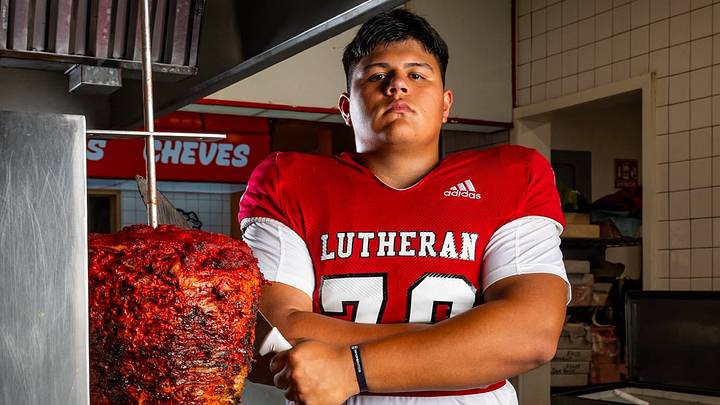
Mario Luna remembers playing football on dirt and gravel fields in Mexico, sometimes wearing helmets he jokes looked more like buckets.
These days, the Orange Lutheran sophomore lines up under the Friday night lights of the Trinity League, where the player across from him could be a future Power Four defensive lineman.
The surroundings have changed dramatically.
The mentality has not.
“At the end of the day, you could give me the nicest helmet or an old bucket, I’m just happy to play football,” Luna said.
That journey has helped turn the 6-foot-2, 295-pound offensive lineman into one of the more recognizable young personalities in Southern California high school football. Luna, better known across social media as “Torta Power,” recently added another distinction: three-star recruit.
Rivals currently lists the Orange Lutheran Class of 2029 lineman as a three-star prospect. For Luna, the recognition represented another step in a journey that began with the Rosarito Rangers in Mexico and eventually took him across the border and into arguably the most unforgiving league in high school football.
“I was actually at practice when my dad called me, and just from his voice I knew something good had happened,” Luna said. “He said, ‘Guess what, son? You’re a ranked player now!’”
Luna immediately told the offensive linemen sitting around him.
“Bro, I just got ranked! I’m a three-star!” he recalled.
Then he checked his phone to make sure.
“There it was,” Luna said. “Torta Power was officially a three-star recruit!”
A Rating He Says He Earned
The distinction arrives at an interesting time in the recruiting industry.
Rivals recently introduced a program allowing athletes and their families to purchase access to a professional evaluation of their film. The service has drawn attention because the same scouting operation contributes to Rivals’ player ratings and rankings.
Rivals is now charging high school athletes $500 for an evaluation, grade, and consideration for its recruiting rankings
— Dexerto (@Dexerto) September 24, 2026
It has drawn criticism from parents because paying does not guarantee a ranking pic.twitter.com/noaQmw4fvR
Rivals, however, makes a distinction between paying to be evaluated and paying to be rated. The company says athletes cannot purchase stars, a ranking or a predetermined result; its stated policy is that those distinctions must still be earned.
Luna says his three-star rating wasn't something his family paid to obtain.
For him, that's important.
The stars are recognition. The resume behind them is what he wants people to notice.
And few proving grounds offer a quicker reality check than the Trinity League.
Luna was already taking varsity snaps for Orange Lutheran as a freshman, putting a 14-year-old offensive lineman across from players several years older and, in some cases, already coveted by major college programs.
“Looking back at my freshman year, it’s crazy to think I was lining up against some of the top players in the nation as a freshman,” Luna said. “I’m not gonna lie, my freshman year wasn’t always pretty. I had some rough games, but I had to adjust fast and learn what it really takes to compete in the Trinity League.”
Playing up wasn't entirely foreign to him.
Luna had been selected to Baja California's U17 team at 14, requiring his parents to sign a waiver allowing him to compete against older players. His size helped him survive. He believes his technique allowed him to compete.
The Trinity League presented another level.
“Even now, my teammates laugh when they see our current freshmen and say, ‘Man, Mario had it worse!’” Luna said. “But I’m grateful for it. Those tough games taught me what I needed to improve.”
His response was to work.
Luna said his freshman season eliminated some of the excuses that naturally come with being one of the youngest players on the field. If an older player beat him, he could tell himself he was only a freshman.
That wasn't going to work forever.
“Going into this past offseason, I told myself I needed to be better than everybody I lined up against,” Luna said. “I didn’t want to get embarrassed on the field or be scared to go back and watch my own film.”
Before Torta Power, There Was Rosarito
Luna's football education began far from Orange County.
He started with the Rosarito Rangers in Mexico. The practices were difficult enough that he remembers occasionally leaving in tears.
He kept coming back.
“Nobody forced me to play,” Luna said. “I wanted this. I would even wake up at 5 in the morning to train because I wanted to get better.”
His father recognized the obsession and began searching for coaching and camps in the United States, despite the family initially knowing little about the American football recruiting ecosystem.
They crossed the border, learned what they could and brought it home.
Eventually, Luna said he became so dominant in his league that some opposing coaches didn't want him playing. He moved on to the San Diego Bolts.
But the fields in Mexico left something with him that no recruiting ranking could measure.
“We played on dirt and gravel, sometimes with old helmets that looked like buckets, and we were just happy to have a helmet,” Luna said. “Nobody cared about having the newest gear. We just wanted to play.”
His family's willingness to cross the border for football would become a defining part of his story.
“I’m the kid who would cross the border every day just to practice and play football,” Luna said. “That’s how much this game means to me.”
How Pancakes Became Tortas
Then there is the other Mario Luna.
Or, more accurately, Torta Power.
The nickname wasn't developed by a marketing agency. It started during a car ride home from practice in Ensenada.
Luna and his father were trying to find a funny Spanish-language equivalent for the pancake blocks offensive linemen celebrate.
They started naming Mexican foods.
Then they landed on torta.
“It was perfect because in Mexico a torta is a sandwich, but in other countries it’s a cake,” Luna said. “And what do you do to a cake? You smash it!”
Pancake blocks became tortas. Tortas required power.
Torta Power was born.
Luna's videos combined football with comedy and a personality that was distinctly his own. The audience grew. Merchandise followed. Eventually, Luna began seeing people from Mexico, Chile, Colombia and elsewhere embracing the phrase.
For a player at a position that rarely produces high school social media stars, Luna had found a way to make people pay attention.
He also understood why that could matter.
At 6-2, Luna knows he doesn't fit the prototype some college recruiters envision when searching for offensive linemen.
“Let’s be real, when college coaches look at offensive linemen, they’re usually looking for guys who are 6’4”, 6’5”, or even 6’8”,” Luna said. “I’m 6’2”, so I knew I had to find a way to stand out and get people to actually watch me play.”
Social media could get them to click.
Football still had to give them a reason to stay.
“The brand might get someone’s attention,” Luna said, “but my performance on the field is what has to back it up.”
That's where the Trinity League becomes such an important part of the Torta Power story.
Luna isn't simply producing clips against overmatched competition. He practices alongside high-level prospects at Orange Lutheran and spends league play facing some of Southern California's most talented defensive fronts.
He credits Orange Lutheran offensive line coach Chris Ward, who played at UCLA, along with veteran teammates for accelerating his development.
“At OLU you’re competing against some of the best players in the country every single day, not just on Fridays,” Luna said. “Then you add the Trinity League, where you’re facing some of the best defensive linemen in the nation, and you have no choice but to get better.”
Bigger Than Mario
Torta Power has also evolved beyond recruiting.
Luna said some of his favorite reactions come from young athletes — particularly bigger kids who might not see themselves represented in sports — embracing the persona themselves.
“I’ve seen kids taking pictures with tortas, holding plates, or taking a bite instead of doing the traditional pancakes and syrup thing,” Luna said.
That's when the joke between father and son became something different.
“What really means the most to me is seeing kids, especially gorditos who might not see themselves fitting into sports, connect with my videos and feel inspired,” Luna said. “That’s when I realized Torta Power isn’t just about me anymore. It has a purpose.”
There is Mario the student, too.
Luna said he has maintained a 3.9 GPA or better after encountering people who doubted him academically. Away from football, he's a gamer who loves cooking, trying restaurants with his father, spending time with friends and wearing sandals whenever possible.
At home, his family doesn't even call him Torta Power.
He's “Tito.”
A sports mental coach from Ensenada helped Luna envision those identities as three switches: Torta Power, the football player and public personality; Mario, the student; and Tito, the kid at home.
Learning when to flip each switch has become part of his development.
“Football is a huge part of my life,” Luna said, “but it’s not my whole life.”
‘I Wanted to Build My Own’
Luna still has more than two years remaining at Orange Lutheran.
He wants championships. He wants individual honors. He wants more scholarship offers. Eventually, he wants to play Division I football, earn a degree and give himself a chance to reach the NFL.
He also wants more stars.
But after receiving three, Luna knows the same principle applies to earning a fourth.
Talking won't do it.
“My film and how I play on Friday nights will,” Luna said.
His journey is already an unusual one: Rosarito to Orange Lutheran, dirt fields to the Trinity League, pancake blocks turned into tortas and a family joke turned into a brand recognizable enough that college coaches sometimes greet him as Torta instead of Mario.
There were other schools Luna could have attended. Some carried bigger names.
He chose Orange Lutheran because he believed he could play early and create something of his own.
“I didn’t want to chase somebody else’s legacy,” Luna said. “I wanted to build my own.”
Two years into high school, he's already started. There will be many more tortas (pancakes) to be had by Luna as he is already on a great early trajectory
 Add us as a preferred source on Google

Roland Padilla is a high school sports journalist, NIL specialist, and analytics strategist covering primarily West Coast track and field, basketball, and football for High School On SI. He began his career in 2015 reporting on Kevin Durant and Russell Westbrook’s Thunder era for ClutchPoints before moving into full NBA coverage. He later worked directly with the founder/CEO of Ballervisions, shortly leading programming and cross-platform social strategy during its viral 2016 rise covering the Ball brothers—a run that helped propel the brand toward its eventual ESPN acquisition and evolution into SportsCenter NEXT. A three-sport alumnus and current throwing coach at Damien High School, and a former NCAA track athlete at UC San Diego, Roland blends athlete-development knowledge with advanced analytics in his role as a Senior Analyst at DAZN and Team Whistle. He has supported content strategy for major global and U.S. sports properties including World Rugby, FIFA Club World Cup, the New York Mets, MLS, X Games, the Premier League, the NFL, and the Downs2Business podcast. With a strong background in NIL rules, athlete branding, and recruiting, Roland helps families, athletes, and readers navigate the rapidly changing high school sports landscape—bringing national-level storytelling and clarity to the next generation of athletes.