%20%20--%3E%0A%3Csvg%20version%3D%221.1%22%20id%3D%22Layer_1%22%20xmlns%3D%22http%3A%2F%2Fwww.w3.org%2F2000%2Fsvg%22%20xmlns%3Axlink%3D%22http%3A%2F%2Fwww.w3.org%2F1999%2Fxlink%22%20x%3D%220px%22%20y%3D%220px%22%0A%09%20width%3D%2239px%22%20height%3D%2240px%22%20viewBox%3D%220%200%2039%2040%22%20enable-background%3D%22new%200%200%2039%2040%22%20xml%3Aspace%3D%22preserve%22%3E%0A%3Cpath%20fill%3D%22%23FFFFFF%22%20d%3D%22M38.5%2C7H28.2v26h10.3V7z%22%2F%3E%0A%3Cpath%20fill-rule%3D%22evenodd%22%20clip-rule%3D%22evenodd%22%20fill%3D%22%23FFFFFF%22%20d%3D%22M26.1%2C25.5c0%2C5.8-4.1%2C7.5-12.9%2C7.5C3.9%2C33%2C0%2C31.2%2C0%2C25.2v-1.1h11.6%0A%09v2.4c0%2C0.7%2C0.1%2C1.4%2C1.2%2C1.4c1%2C0%2C1.2-0.4%2C1.2-1.3v-0.9c0-1.6-0.9-1.6-3.5-2.2C2.2%2C21.7%2C0%2C19.7%2C0%2C15.3v-0.9C0%2C9.3%2C5.5%2C7%2C12.9%2C7%0A%09c10.2%2C0%2C12.8%2C2.6%2C12.8%2C7.4v1.8h-11v-2.9c0-0.6-0.4-1.1-1.2-1.1c-0.6%2C0-1.2%2C0.4-1.2%2C1.1v0.9c0%2C1.5%2C0.9%2C2%2C3.3%2C2.5%0A%09c8%2C1.6%2C10.5%2C3.3%2C10.5%2C7.5V25.5z%22%2F%3E%0A%3C%2Fsvg%3E%0A)
Golden Tempo’s Preakness Decision Proves the Triple Crown Is Failing Its Stars
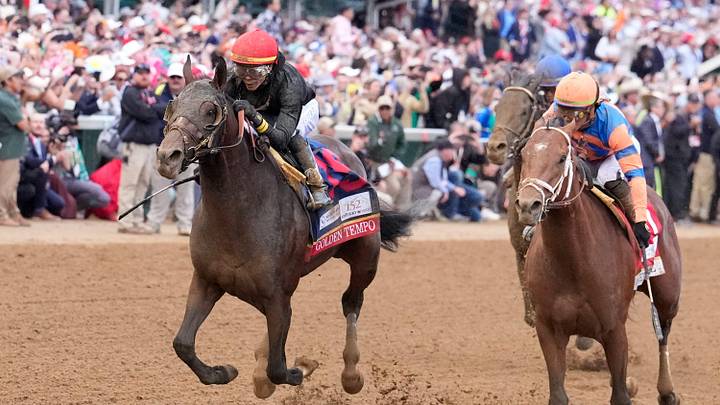
The Preakness, and by extension the entire thoroughbred racing Triple Crown, has officially been put on notice: adapt or die.
The decision Wednesday by the human connections to Kentucky Derby winner Golden Tempo to bypass the second leg of the Triple Crown was another blow to an archaic calendar that contests the Derby, Preakness and Belmont Stakes in a five-week span. This is now two consecutive Derby winners who haven’t even bothered to run in the Preakness, following Sovereignty last year. It’s also the third healthy scratch in the last five years, with 81–1 long shot Rich Strike bypassing Baltimore as well.
Rich Strike was such a fluky Derby winner that the Preakness snub was taken somewhat in stride—sure enough, the horse never won another race. But when Sovereignty trainer Bill Mott made that call last year, it fractured the Triple Crown. The decision this year, with the feel-good story of a come-from-behind horse trained by a pioneering woman, should finish the demolition job.
The dates must be changed, and assuredly will be changed. Momentum was already building toward it, and now there is no recourse.
Don’t blame Cherie DeVaux, the first woman to win the Derby, for taking the Triple Crown out of play. Don’t blame Golden Tempo’s joint owners, Phipps Stable and St. Elias Stable. They’re jointly making the progressively easier and more commonplace decision with a 3-year-old coming out of the grueling, 1 1/4-mile Derby.
“Golden gave us the race of a lifetime in the Kentucky Derby, and we believe the best decision for him moving forward is to give him a little more time following such a tremendous effort,” DeVaux said in an announcement on social media Wednesday. “His health, happiness and long-term future will always remain our top priority. We are looking forward to pointing him toward the Belmont Stakes and are excited to see what lies ahead with this very special horse.”
Preakness announcement pic.twitter.com/8JQu7VZlRC
— Cherie DeVaux (@reredevaux) May 6, 2026
DeVaux has been praised for her astute handling and development of Golden Tempo, bringing him along for an apex performance on the first Saturday in May. This is the spacing of the colt’s five lifetime races: 28 days; 25 days; 35 days; and 42 days. Saddling up again in 14 days, after running the longest race of his young career, runs counter to everything she’s done with him.
(Truth be told, after recording a 95 Beyer Speed Figure in the Derby—the slowest Beyer for any Derby winner since those analytics came into popular use in the 1990s—Golden Tempo does not have the résumé of a Triple Crown winner anyway. His late-running style is also less conducive to the Preakness than the other two races. So skipping the second leg not only makes sense for the horse’s well-being, but perhaps in protecting his eventual breeding value as well.)
The rest of the Derby field has all but bailed on this year’s Preakness anyway, which is another sign of how unappealing this turnaround is. Of the 18 horses who ran for the roses in Louisville, surprising third-place finisher Ocelli (a 70–1 bomb shot) appears to be the only one headed to Maryland.
Provided Ocelli actually makes it to the starting gate for the Preakness, that will make just nine Derby horses that have run back in that race in the last five years. The most avid proponent of that was a trainer from the old days, the late D. Wayne Lukas, who pushed horses hard to compete in the Triple Crown—and often didn’t have much left to work with thereafter.

So, it’s time to do what has been suggested for years, including many times under this byline: push back the Preakness, and in turn push back the Belmont. The Derby stays where it is. The second leg of the Triple Crown is run on the first Saturday in June or on Memorial Day weekend. The Belmont is contested on the first Saturday in July or on the Fourth of July.
The pressure has been mounting to push back the Preakness, and now is the time with its television contract up after this year’s race. (Which, by the way, won’t even be run at Pimlico Race Course, which is being gutted and refurbished after years in trashy disrepair. Laurel Park Race Track will be the site.) Speculation has centered on moving it back just a week, but prominent horsemen believe that’s a Band-Aid approach that doesn’t actually fix anything.
“It’s not enough,” trainer Brad Cox said last month. “You would like more than three weeks.”
The New York Racing Association understandably isn’t excited about having its signature Belmont Park race date dictated by the Preakness, but that’s how this predicament needs to be resolved. Early June tends to be a lovely time in New York, but early July will work just fine. In a sports content desert populated by midseason baseball and hot dog eating contests, there would be an audience for the Belmont.
Here’s what shouldn’t change as part of a Triple Crown overhaul: the distance of the races. Leave the Derby at 1 1/4 miles; leave the Preakness at 1 3/16; leave the Belmont at 1 1/2. There is nothing wrong with the last race remaining the greatest test of stamina.
This year’s Belmont, like the Preakness, is not being contested in its traditional home. The race is being run at Saratoga in upstate New York, and at 1 1/4 miles, while Belmont Park is also being renovated. With this much flux in the Triple Crown, it’s an appropriate time to break some eggs and make a new omelette.
As for Golden Tempo? Hopefully he’s ready to go in the Saratoga Belmont. That would be a homecoming for DeVaux, who was raised in Saratoga Springs, N.Y. There won’t be a Triple Crown on the line, but that’s the price horse racing has to pay for sticking with a calendar that no longer suits its star athletes.
Don’t blame Golden Tempo. Don’t blame DeVaux. Don’t blame the owners. Their decisions have simply underscored the flaws in an outdated system that now must adapt or die.
More Horse Racing From Sports Illustrated
 Add us as a preferred source on Google
Pat Forde is a senior writer for Sports Illustrated who covers college football and college basketball as well as the Olympics and horse racing. He cohosts the Others Receiving Votes podcast for SI and is a regular contributor to the Tony Kornheiser Show podcast. He previously worked for Yahoo Sports, ESPN and The (Louisville) Courier-Journal. Forde has won 28 Associated Press Sports Editors writing contest awards, has been published three times in the Best American Sports Writing book series, and was nominated for the 1990 Pulitzer Prize. A past president of the U.S. Basketball Writers Association and member of the Football Writers Association of America, he lives in Louisville with his wife. They have three children, all of whom were collegiate swimmers.
Follow ByPatForde