%20%20--%3E%0A%3Csvg%20version%3D%221.1%22%20id%3D%22Layer_1%22%20xmlns%3D%22http%3A%2F%2Fwww.w3.org%2F2000%2Fsvg%22%20xmlns%3Axlink%3D%22http%3A%2F%2Fwww.w3.org%2F1999%2Fxlink%22%20x%3D%220px%22%20y%3D%220px%22%0A%09%20width%3D%2239px%22%20height%3D%2240px%22%20viewBox%3D%220%200%2039%2040%22%20enable-background%3D%22new%200%200%2039%2040%22%20xml%3Aspace%3D%22preserve%22%3E%0A%3Cpath%20fill%3D%22%23FFFFFF%22%20d%3D%22M38.5%2C7H28.2v26h10.3V7z%22%2F%3E%0A%3Cpath%20fill-rule%3D%22evenodd%22%20clip-rule%3D%22evenodd%22%20fill%3D%22%23FFFFFF%22%20d%3D%22M26.1%2C25.5c0%2C5.8-4.1%2C7.5-12.9%2C7.5C3.9%2C33%2C0%2C31.2%2C0%2C25.2v-1.1h11.6%0A%09v2.4c0%2C0.7%2C0.1%2C1.4%2C1.2%2C1.4c1%2C0%2C1.2-0.4%2C1.2-1.3v-0.9c0-1.6-0.9-1.6-3.5-2.2C2.2%2C21.7%2C0%2C19.7%2C0%2C15.3v-0.9C0%2C9.3%2C5.5%2C7%2C12.9%2C7%0A%09c10.2%2C0%2C12.8%2C2.6%2C12.8%2C7.4v1.8h-11v-2.9c0-0.6-0.4-1.1-1.2-1.1c-0.6%2C0-1.2%2C0.4-1.2%2C1.1v0.9c0%2C1.5%2C0.9%2C2%2C3.3%2C2.5%0A%09c8%2C1.6%2C10.5%2C3.3%2C10.5%2C7.5V25.5z%22%2F%3E%0A%3C%2Fsvg%3E%0A)
The Triple Crown Is at a Crossroads Between a Modern Calendar and Tradition
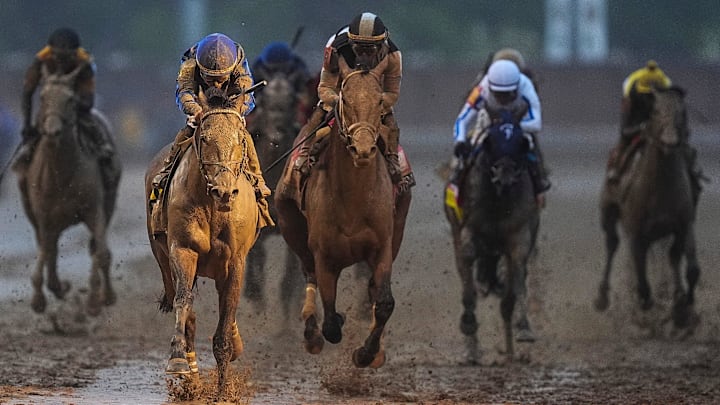
LOUISVILLE — Thoroughbred trainer Bill Mott doesn’t want to go down in history as the guy who broke the Triple Crown. That wasn’t his goal last year when he skipped the Preakness with his Kentucky Derby winner, Sovereignty. He did not intentionally swing a sledgehammer into the walls of horse racing tradition.
“The Triple Crown, I think it’s fine the way it is,” Mott says. “But there’s so many things after. You’ve got some big purses, you’ve got some important races. And I think if you use those horses up in the Triple Crown, a lot of times they can’t make it to the end of the year.”
Regardless of intent, the decision to not even attempt to win all three of the biggest 3-year-old races in North America reverberated. In doing what Mott believed was best for his horse, his Preakness snub has reheated the simmering debate about the spacing of the Triple Crown. What has been an immovable fixture on the racing calendar might finally be subject to change, with television interests and racetrack ownership groups factoring into the equation.
The Derby-Preakness-Belmont calendar, with all three contested within five weeks in May and early June, was created in a time far removed from the modern realities of the sport. The original Triple Crown winner, Sir Barton, won all three legs in 1919 in a span of 32 days—and threw in a fourth victory in between the Preakness and Belmont. Horses don’t do anything remotely similar now.
The workload decline is even more pronounced than starting pitchers in MLB. Only three entrants in this year’s 20-horse Derby field have even run back on three weeks’ rest; none have done so in two weeks. The Preakness has followed the Derby by two weeks for 70 years, but that timeline looks increasingly anachronistic.
With the Derby firmly anchored on the first Saturday in May, the allure of wheeling back for the Preakness in Baltimore on the third Saturday of the month is dwindling over time. Beyond the Derby winner, not many have recently felt compelled to contest both—and lately, even the winners are optional.
When 2022 Derby winner Rich Strike skipped the Preakness, it was a buzzkill for the sport but also understandable. The 81-1 stunner in Louisville had virtually no chance of replicating that miracle. (In fact, Rich Strike never won another race, cementing his place as the worst horse to ever win the Run for the Roses.) Sovereignty was another matter.

His subsequent victory in the Belmont underscored the fact he very well might have won all three races. Mott is unmoved by any lamentations about cheating the sport out of a historic 14th Triple Crown.
“It wasn’t that we dismissed the Preakness or were even talking about the spacing of the Preakness,” Mott says. “I think it was just that’s the races we picked out and we stuck to it and it worked out.”
It has worked out extremely well. Sovereignty won two big stakes races at Saratoga later last summer, the Jim Dandy and the Travers, and is still racing at age 4. He’s been a looming, magisterial presence at Churchill during Derby training hours the last week, looking fully ready to run some more big races. That might not have happened if the colt contested the full Triple Crown gauntlet.
Against that backdrop, a couple of recent news items hint at potential changes in the schedule.
Earlier this month, Sports Business Journal reported the Preakness was “set to make a historic shift to one week later in May” while the race’s TV rights will be up for grabs after this year’s race. Then last week, news broke that Churchill Downs Inc., had acquired the “intellectual property rights” to the Preakness for $85 million.
Churchill’s release announcing the purchase gave rise to speculation that the Louisville-based track had gained control over Pimlico Race Course’s racing dates, and that shuffling the Preakness back in the calendar was fait accompli. But the Maryland Jockey Club subsequently said that it will retain control of its dates. Churchill’s role has been further clarified—the industry leader in putting on massively profitable racing dates will help Pimlico maximize its revenue from both the Preakness and the Black-Eyed Susan, the filly race the day before.
Meanwhile, Belmont is left twisting a bit at the back end of the Triple Crown. Its TV partner, Fox, is believed to be interested in wresting the Preakness away from its traditional NBC home. Regardless whether NBC or Fox gets the second leg of the Crown, the best way to rejuvenate its place on the sporting calendar would be to move it back and ensure the best possible field—which in turn would push the Belmont later in the summer than its traditional early June date. While that might benefit the sport as a whole, the New York Racing Association would be forced into a move it doesn’t necessarily want to make.
At this point, the only thing written in stone on the calendar is the Derby. My longstanding favored schedule would move the Preakness to Memorial Day weekend or the first Saturday in June, with the Belmont on the first Saturday of July or the Fourth of July. That would essentially put a month between all three. Many prominent trainers are ready for changes as well.
“I’m all for moving [the Preakness],” said Brad Cox, who won the 2021 Derby by disqualification with Mandaloun. “I get history, and I’m a big fan of history, but I think the health and welfare of the horse comes first before tradition. You’ve got to get some longevity out of them. Running them back in two weeks is not necessarily going to help their longevity.”
Count Cox among those who would like to see the Preakness pushed back more than one week.
“It’s not enough,” he said. “You would like more than three weeks.”

Chad Brown has won the Preakness twice with horses that did not run in the Derby (Cloud Computing and Early Voting). His view on the spacing of the Triple Crown races “has evolved,” he said, after initially standing alongside tradition.
“It’s obvious the horses benefit from more time between the races,” Brown said. “Most change is uncomfortable, but is it better for the health of the horse? I’m more open to it now. I don’t see how we can’t change at some point.”
Doug O’Neill, two-time Derby winner with I’ll Have Another in 2012 and Nyquist in ’16, is another convert to an altered calendar.
“To try to squeeze three tough races in five weeks is just not realistic, right?” he said. “So I know the historians are rolling in their graves, but I think at the same time, it’s just different. ... And so I think that eventually, probably sooner than later, we’ll see that for sure.”
Will that cheapen the accomplishment if/when a horse wins a Triple Crown under what would be considered a more lenient format? To some traditionalists, sure. But in a sport fighting to maintain a niche in the American hierarchy, changing to maximize its showcase events seems not just prudent but necessary.
Star racehorses have even shorter shelf lives. Making it harder for them to run to their full potential and extend their careers is counterintuitive.
The sight of 2025 Kentucky Derby winner Sovereignty still on the track and in training at Churchill might not exist if Mott allowed the cramped 3-year-old calendar to dictate the horse’s course. Mott did not intend to break the Triple Crown, but if he did, the sport could end up better because of it.
More Horse Racing From Sports Illustrated
 Add us as a preferred source on Google
Pat Forde is a senior writer for Sports Illustrated who covers college football and college basketball as well as the Olympics and horse racing. He cohosts the Others Receiving Votes podcast for SI and is a regular contributor to the Tony Kornheiser Show podcast. He previously worked for Yahoo Sports, ESPN and The (Louisville) Courier-Journal. Forde has won 28 Associated Press Sports Editors writing contest awards, has been published three times in the Best American Sports Writing book series, and was nominated for the 1990 Pulitzer Prize. A past president of the U.S. Basketball Writers Association and member of the Football Writers Association of America, he lives in Louisville with his wife. They have three children, all of whom were collegiate swimmers.
Follow ByPatForde