%20%20--%3E%0A%3Csvg%20version%3D%221.1%22%20id%3D%22Layer_1%22%20xmlns%3D%22http%3A%2F%2Fwww.w3.org%2F2000%2Fsvg%22%20xmlns%3Axlink%3D%22http%3A%2F%2Fwww.w3.org%2F1999%2Fxlink%22%20x%3D%220px%22%20y%3D%220px%22%0A%09%20width%3D%2239px%22%20height%3D%2240px%22%20viewBox%3D%220%200%2039%2040%22%20enable-background%3D%22new%200%200%2039%2040%22%20xml%3Aspace%3D%22preserve%22%3E%0A%3Cpath%20fill%3D%22%23FFFFFF%22%20d%3D%22M38.5%2C7H28.2v26h10.3V7z%22%2F%3E%0A%3Cpath%20fill-rule%3D%22evenodd%22%20clip-rule%3D%22evenodd%22%20fill%3D%22%23FFFFFF%22%20d%3D%22M26.1%2C25.5c0%2C5.8-4.1%2C7.5-12.9%2C7.5C3.9%2C33%2C0%2C31.2%2C0%2C25.2v-1.1h11.6%0A%09v2.4c0%2C0.7%2C0.1%2C1.4%2C1.2%2C1.4c1%2C0%2C1.2-0.4%2C1.2-1.3v-0.9c0-1.6-0.9-1.6-3.5-2.2C2.2%2C21.7%2C0%2C19.7%2C0%2C15.3v-0.9C0%2C9.3%2C5.5%2C7%2C12.9%2C7%0A%09c10.2%2C0%2C12.8%2C2.6%2C12.8%2C7.4v1.8h-11v-2.9c0-0.6-0.4-1.1-1.2-1.1c-0.6%2C0-1.2%2C0.4-1.2%2C1.1v0.9c0%2C1.5%2C0.9%2C2%2C3.3%2C2.5%0A%09c8%2C1.6%2C10.5%2C3.3%2C10.5%2C7.5V25.5z%22%2F%3E%0A%3C%2Fsvg%3E%0A)
Meet the Promiscuous Stud Building a Kentucky Derby Legacy
LEXINGTON, Ky. — At 2:08 p.m. last Wednesday, the heavy wooden door to one of the two breeding sheds at Spendthrift Farm rolls open. In walks a bay-colored, boxy horse with a prominent white blaze on his face and white markings on two of his feet. Into Mischief has arrived, ready to live up to his name and promiscuous reputation.
The shed is modern and spacious. The floor is covered in a deep layer of dark wood chips, springy underfoot (and hoof). The walls are padded and the ceiling is vaulted. As equine bachelor pads go, this is swanky. “It’s a little grand for horse sex,” quips Spendthrift CEO and general manager Ned Toffey. “But the boss [late Spendthrift owner B. Wayne Hughes] wanted it to have some ‘wow’ factor.”

The current object of Into Mischief’s ardor, a 16-year-old mare in heat named Street Beauty, arrived by van from another farm a while earlier. She was prepped for her date in another part of the breeding facility, interacting with what’s called a “tease pony” to get her in the mood. Loud whinnying and neighing ensued. (Once the mare is deemed ready to breed, the tease pony is sent back to his stall unfulfilled. “The world’s worst job,” Toffey says. “I tell people, if you’re a bad enough person in this life you’re coming back as a teaser.”)
In the breeding shed, Street Beauty is facing something that resembles a padded pommel horse, which helps keep her in place without crowding her against the wall. Workers stand on either side of her hind quarters, there to ensure that the coupling (literally) does not go sideways. A third worker, wearing a latex glove up to his shoulder, also assists with the physics of the coupling. Toffey, his daughter, Megan, and stallion manager Wayne Howard observe from a control room.
Into Mischief, an old pro, knows the drill. “He’s always one jump,” Howard says admiringly. The 21-year-old is up on his hind legs and in position, then down and done, before anyone has dimmed the lights, lit candles or played some Barry White. Elapsed time from the moment he entered the shed to the time he finished his work: 86 seconds. Wham, bam, thank you mare.
Was a Kentucky Derby horse created in that quickie? Check back in 2030. Or he might have sired a Derby runner earlier in the day, during a morning mating with a different mare. Or a later one, with a third trip to the shed often scheduled for the evening.
Seven days a week, multiple times a day, from early February until late spring, the most important thoroughbred in North America gets into mischief and procreates. This breeding season, he will cover about 185 mares; in many other years he’s done more than 200. Even at a relatively advanced age, he’s ready to do his job.
“His libido and fertility are very strong, very consistent,” says Toffey, a genial former tight end at Massachusetts in the late 1980s.
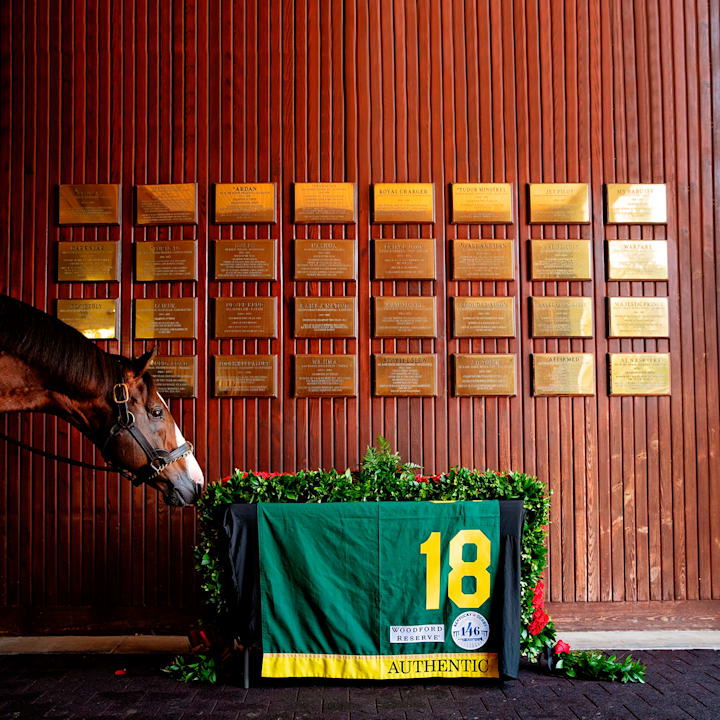
No horse is having a more profound impact on the racing industry than Into Mischief, an unremarkable runner himself. He never ran in the Kentucky Derby but has sired a record-tying three Derby winners, all of them capturing the roses in the last six years: Authentic in 2020, Mandaloun (via disqualification) in ’21, and Sovereignty last year. He’s also the grandsire of 2024 Derby champion Mystik Dan. America’s most prestigious horse race has been owned by Into Mischief’s DNA of late.
The chances of a record fourth Derby-winning progeny are strong for Saturday. Favorite Renegade (4–1 morning line) is Into Mischief’s son, as are co-second choice Commandment (6–1) and Bob Baffert trainee Potente (20–1). After a relatively short racing tenure and a modest start at stud, Into Mischief is firing golden breeding bullets. His 2025 3-year-old crop was his best yet, unless it’s surpassed by this year’s.
“You’re always waiting to see what that next foal crop has to offer, but it’s a tough game,” Toffey says. “There’s a high rate of failure. But for people who want a Derby horse, I think there’d be very few that wouldn’t want an Into Mischief [son] at this point.”
He is a four-legged cash machine for Spendthrift, an idyllic and historic farm that stands 30 stallions in the rolling bluegrass country just north of Lexington. His stud fee is tied for the highest in North America: $250,000 per live foal that is able to stand and nurse. He’s fathered more than 2,100 foals over 16 years, paying for the ongoing expansion of Spendthrift’s visitors center—much of which is a monument to himself—several times over.

Mating with Into Mischief has been worth the hefty price tag. His offspring have won more than $34 million in prize money, and he’s been the leading sire in North America for seven straight years—that ties the great Bold Ruler’s streak from 1963 to ’69. If he does it again in 2026, it will be the longest successive run since the legendary Lexington in the 19th century.
Odds are long that any coupling is going to produce a Derby horse, and longer still to produce a Derby winner—roughly one in 17,000 for the latter. But when Into Mischief is the daddy, there is a better chance of it happening than anywhere else.
“He’s a phenomenal sire,” says trainer Todd Pletcher, who will saddle Renegade on Saturday. “His longevity, he seems like he’s stronger than ever.”
In the hit-and-miss game of racing, where nothing is guaranteed for even the high-end breeding operations like Spendthrift, Into Mischief’s hit rate remains astonishingly high. A record-tying nine Breeders’ Cup winners, 29 Grade 1 Stakes winners and 99 graded stakes winners speak for themselves.
“There’s such a large percentage of [his offspring] that can run,” says trainer Bill Mott, who conditions Sovereignty. “No matter what they look like—if you’ve got four of them, two of them are going to be able to run. He’s an amazing sire.”
Human history offers many examples of elite athletic traits handed down across generations: Archie Manning to Peyton and Eli; Barry Bonds to Bobby; Randall Cunningham to Olympic high jumper Vashti; Dennis Rodman to professional soccer star Trinity; etc. But nurture intertwines with nature in the development of gifted humans, blurring the line between “good genes” and all the other attributes necessary to succeed.

In thoroughbreds, pedigree is regarded with utmost importance—particularly the sires and grandsires on the dam’s side. Some racehorses can outrun an undistinguished family tree, but bloodlines tend to be a strong indicator of future performance. The ability to pass down speed, stamina, size and even comportment is highly sought.
Thus a cottage industry has evolved around pedigree study. Analyzing which sire traits will match with certain dams (and their forebears) to produce runners is a business unto itself.
But none of the pedigree experts knew what Into Mischief was going to become when he retired from racing after just six starts and three wins. The breeding world was so blasé about him that his original stud fee was all of $7,500—not much more than the proverbial “bale of hay and a jug of whiskey” for a bargain coupling.
“We never know what’s going to work out when they go to stud,” says Alan Porter, a pedigree consultant to numerous prominent breeding operations worldwide. “When he retired, he didn’t jump off the page, but he had a lot better credentials than we recognized at first. A lot of perception has to do with expectation.”
With the benefit of hindsight, Porter peels back the layers of Into Mischief’s racing career and bloodlines and identifies the overlooked promise.
His sire was Harlan’s Holiday, the 2002 Florida Derby winner who contested the Kentucky Derby and Breeders’ Cup Classic that year—his own stallion career was taking off when he died suddenly at age 14. His dam, Leslie’s Lady, won four races, including a stakes race in a fast time. As for Into Mischief’s three career wins, one was the Grade 1 Cash Call Futurity as a 2-year-old, and he captured another stakes race at 3.

“When you look back at those things, you’ve actually got a very fashionable stallion,” Porter says. “He produced speed early on after being bred to cheaper mares, but now he’s producing horses that can go the distance [in longer races].
“Biomechanical efficiency is the key to success in athletic performance. He puts biomechanical efficiency across a wide variety of mares. He’s absolutely one of the great sires. He’s a unique force.”
That’s perhaps the best indicator of Into Mischief’s greatness. He’s produced fillies who won high-caliber sprints (Covfefe), colts who won at a mile (Goldencents, Citizen Bull) and horses who can run all day (Sovereignty is the most recent example, winning both the 1 1/4-mile Derby and the 1 1/2-mile Belmont with great closing stamina). He’s all things to all mares.
“He’s going to go down as one of the all-time greats,” says Baffert, who won the Derby with Authentic and many other big races with other Into Mischief progeny. “He was just a freaky horse. I don’t think we saw his full potential as a racehorse because they retired him early and he only got to run on synthetic [surfaces]. We didn’t know. But it’s amazing. They’re just good horses. He just put so much speed [into his progeny]. He’s like Northern Dancer.”
Northern Dancer was a Canadian horse who won the first two legs of the 1964 Triple Crown, then retired to stud and became one of the most influential sires in racing history. He was especially impactful on racing in Europe, where his offspring Nijinsky was one of the greats. In the 1980s, one of his sons became the first $10 million purchase at a public auction (Snaafi Dancer).

Time will tell what Into Mischief’s full impact becomes on American racing. More data is needed. When his offspring’s offspring begin to make their mark, we’ll know more. For now, he’s helped tilt an old breeding argument about the most influential North American sires of the 1990s and early 2000s in favor of Storm Cat and away from AP Indy—Into Mischief is a great-grandson of Storm Cat.
At Spendthrift, the picturesque, 1,200-acre farm framed by black split-rail fencing, Into Mischief is part of a regal tradition. The farm was founded in 1937 and was the stallion residence of Triple Crown winners Seattle Slew and Affirmed for a time. A statue of Nashua, a champion from the 1950s, is the centerpiece of a courtyard that fronts a large stallion barn. Beholder, one of the great distaff racers of the 21st century, was campaigned by Spendthrift. Among the notable visitors to the farm: Queen Elizabeth II.
Hughes, a prominent USC athletics donor who made his fortune as the owner of Public Storage, bought Spendthrift in 2004 and returned it to prominence after a downturn in previous decades. Since his death in 2021, daughter Tamara Hughes Gustavson and her husband, Eric, have owned the farm. Even with considerable success over the past two decades, times have never been better than they are this week. Spendthrift’s fingerprints are all over this Derby.
In addition to Into Mischief’s three sons running for the roses, Spendthrift stallions sired Derby contestants Albus (by Yaupon) and Incredibolt (by Bolt d’Oro). But the biggest excitement centers on Spendthrift’s own Derby entrant, Further Ado, who is the co-second choice at 6–1 after a dominant win in the Blue Grass Stakes.
Further Ado can give Spendthrift a second Derby trophy to place alongside the one won by Authentic. When the starting gate springs open around 7 p.m. ET Saturday, the farm employees’ eyes will be on their orange-and-purple silks, worn by Further Ado jockey John Velazquez.
“There’s nothing like winning the Derby,” Toffey says. “That was a pretty surreal experience to be in the winner’s circle with Authentic. There’s no question that Further Ado will be the rooting interest, but it would definitely soften the blow if he’s beaten by one from Into Mischief. It would be neat to see him cement his place in history, alone at the top.”
More Horse Racing from Sports Illustrated
 Add us as a preferred source on Google
Pat Forde is a senior writer for Sports Illustrated who covers college football and college basketball as well as the Olympics and horse racing. He cohosts the Others Receiving Votes podcast for SI and is a regular contributor to the Tony Kornheiser Show podcast. He previously worked for Yahoo Sports, ESPN and The (Louisville) Courier-Journal. Forde has won 28 Associated Press Sports Editors writing contest awards, has been published three times in the Best American Sports Writing book series, and was nominated for the 1990 Pulitzer Prize. A past president of the U.S. Basketball Writers Association and member of the Football Writers Association of America, he lives in Louisville with his wife. They have three children, all of whom were collegiate swimmers.
Follow ByPatForde