%20%20--%3E%0A%3Csvg%20version%3D%221.1%22%20id%3D%22Layer_1%22%20xmlns%3D%22http%3A%2F%2Fwww.w3.org%2F2000%2Fsvg%22%20xmlns%3Axlink%3D%22http%3A%2F%2Fwww.w3.org%2F1999%2Fxlink%22%20x%3D%220px%22%20y%3D%220px%22%0A%09%20width%3D%2239px%22%20height%3D%2240px%22%20viewBox%3D%220%200%2039%2040%22%20enable-background%3D%22new%200%200%2039%2040%22%20xml%3Aspace%3D%22preserve%22%3E%0A%3Cpath%20fill%3D%22%23FFFFFF%22%20d%3D%22M38.5%2C7H28.2v26h10.3V7z%22%2F%3E%0A%3Cpath%20fill-rule%3D%22evenodd%22%20clip-rule%3D%22evenodd%22%20fill%3D%22%23FFFFFF%22%20d%3D%22M26.1%2C25.5c0%2C5.8-4.1%2C7.5-12.9%2C7.5C3.9%2C33%2C0%2C31.2%2C0%2C25.2v-1.1h11.6%0A%09v2.4c0%2C0.7%2C0.1%2C1.4%2C1.2%2C1.4c1%2C0%2C1.2-0.4%2C1.2-1.3v-0.9c0-1.6-0.9-1.6-3.5-2.2C2.2%2C21.7%2C0%2C19.7%2C0%2C15.3v-0.9C0%2C9.3%2C5.5%2C7%2C12.9%2C7%0A%09c10.2%2C0%2C12.8%2C2.6%2C12.8%2C7.4v1.8h-11v-2.9c0-0.6-0.4-1.1-1.2-1.1c-0.6%2C0-1.2%2C0.4-1.2%2C1.1v0.9c0%2C1.5%2C0.9%2C2%2C3.3%2C2.5%0A%09c8%2C1.6%2C10.5%2C3.3%2C10.5%2C7.5V25.5z%22%2F%3E%0A%3C%2Fsvg%3E%0A)
There’s a New Contender for the Best Pitch in the Majors
In this story:
Welcome to Verducci’s View, a new weekly baseball newsletter from Sports Illustrated senior writer Tom Verducci. Every Monday, Tom will empty out his notebook over email and cover MLB’s hottest topics, provide in-depth analysis through both text and video breakdowns, look forward to what’s worth watching during the week and more. This week, we’re focusing on early NL Cy Young favorite Cristopher Sánchez, another contender in Shohei Ohtani and more.
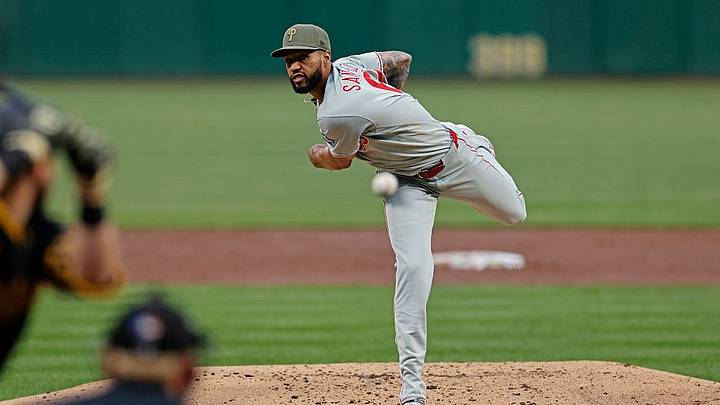
What is the best pitch of any starter in the majors? Step aside, Tarik Skubal changeup, Dylan Cease slider, Logan Webb changeup and Gerrit Cole four-seamer, all of which have had the highest annual run value the previous four seasons. It’s the changeup of Phillies lefthander Cristopher Sánchez, who is bringing back bread-and-butter pitching at a time when pitch menus run as long as those of a 24-hour diner.
There are 140 pitchers who have thrown 500 pitches or more this season. Only three of them rely on as few as three pitches: Sánchez, Roki Sasaki of the Dodgers and Kevin Gausman of the Blue Jays. Only 16 others use four pitches, which means 86% of pitchers use five or more pitches. The chase for pitch shapes of all sorts has overtaken pitching.
And then there is Sánchez, content to keep it beautifully simple. He throws a sinker (44%), changeup (38%) and slider (18%). That’s it. All the rage today is the three-fastball arsenal (four-seamer, sinker, cutter). Among the 124 starters who throw a sinker, only Sánchez and Steven Matz do not throw a four-seamer.
What makes Sánchez’s changeup so nasty? The average changeup has a spin rate of 1,745 rpm. Sánchez spins his changeup at 2,009 rpm, so it’s on the faster side of spin. But the key is that it looks so similar to his sinker in terms of spin rate (2,134), spin axis (off the side of the baseball, or on a clock, 10 o’clock and 9:30) and release point (the difference is an imperceptible 7/10 of an inch).
Add to all that the sick two-plane movement on the pitch. Sánchez has the only changeup with elite vertical and horizontal movement (minimum 75 changeups). His changeup is so great that Sánchez has:
- Thrown 364 changeups, 30% more than the next most (Bailey Ober of the Twins).
- Allowed just 16 hits on those 364 changeups, leading to a .148 batting average and .167 slug.
- Thrown 46 changeups in each of his past two starts, the most by any pitcher in a game this year. There have been eight games over the past two years in which a pitcher threw 45 changeups. All of them have been thrown by Sánchez.
- Thrown 417 consecutive changeups without giving up a home run, since Sept. 17 when Enrique Hernandez got him.
Sánchez (and the scorching home run bat of Kyle Schwarber) are at the heart of how Philadelphia has saved its season. The Phillies have won his past four starts in which he has posted a 0.59 ERA with four walks and 37 strikeouts.
Never better was Sánchez than in his start Saturday at Pittsburgh, in which he threw a shutout with no walks and 13 strikeouts. Sánchez became only the 11th pitcher to throw a road shutout with no walks and at least 13 strikeouts, the first since Erik Bedard in 2007. Sánchez did it with fewer pitches (108) than all of them.
“Possessed” Ohtani and the Cy Young Race

It’s silly to talk about who has the edge in the NL Cy Young Award race with more than two-thirds of the season to play. But it’s not too early to be wowed by the depth and star power of the early contenders. You’ve got FIP leader Sánchez, WHIP leader Paul Skenes, strikeout leader Jacob Misiorowski, WAR leader Chase Burns, ERA leader Bryce Elder and ... Shohei Ohtani, who is one inning short of qualifying to leapfrog some of those pitchers in various categories.
Ohtani (0.82 ERA) is only the sixth pitcher to begin a season with an ERA under 0.90 through seven starts with at least 50 strikeouts. The others are Fernando Valenzuela (0.29 in 1981), Zack Greinke (0.51 in 2009), Johan Santana (0.78 in 2009), Jacob deGrom (0.80 in 2021) and Frank Viola (0.87 in 1990). Mind you, this is also the leadoff hitter for the Dodgers.
Ohtani is better than ever on the mound after what essentially was a rehab season last year after a second elbow procedure.
“For Shohei in particular, the second year has been different because he now has the command and feel he didn’t have before,” Dodgers manager Dave Roberts says. “And he has all his weapons at his disposal. Now he has a lot of different weapons to attack. He can go fastball glove side all day long and then throw a two-seamer in there and then go sweeper. He didn’t even use his split much [in his last start]. And if he needs the split he can go to that.
“Last year it was like trying to get his command good and then get the feel for stuff, in which he added the sweeper. Now it’s like, ‘I can do anything I want with the baseball.’
“This Shohei pitching? It’s like he’s possessed right now.”
Your Ohtani Wow Factors of the Week
Ohtani reached 200 career doubles on Friday in career game 1,077. He became only the sixth player with 275 homers and 200 doubles that quickly:
275 HR and 200 Doubles Through 1,077 Games | Home Runs | Doubles |
|---|---|---|
Juan Gonzalez | 293 | 230 |
Giancarlo Stanton | 289 | 219 |
Shohei Ohtani | 286 | 200 |
Alex Rodriguez | 283 | 251 |
Albert Pujols | 280 | 291 |
Babe Ruth | 280 | 263 |
Let this roll around your head a bit: Ohtani to this point of his two-way career is in the top 10 all time in home runs hit and strikeouts on the mound. He is a combination of Babe Ruth and Roger Clemens. Ruth had 280 homers through 1,077 games hitting; Ohtani has 286 (seventh all time). Clemens had 714 strikeouts through 107 games pitching; Ohtani has 720 (10th all time).
Verducci Breakdown
Baltimore Orioles shortstop Gunnar Henderson was the Rookie of the Year just three years ago. In the very short time he has been in the major leagues, pitching has changed drastically.
“Yes,” says his manager, Craig Albernaz, “it has happened that fast.”
Henderson was hitting just .202 through 44 games. The tell-tale signs of his struggles are career high rates of pulling the baseball (46.6%) and chasing pitches out of the zone (34.4%). There has been a mechanical breakdown in his swing, caused by overeagerness trying to hit the ball too far out front. You can check out that flaw here.
Albernaz calls it an “over-rotation” in which the hips, torso and hands are turning without the necessary separation in timing.
But there is something else at play here. Pitchers are defeating him with the wider medley of pitches—especially with how spin and off-speed are replacing a chunk of fastballs—that is redefining modern pitching.
When Henderson won his Rookie of the Year Award, he could count on seeing a four-seam fastball one out of every three pitches (32.6%). Now he sees a four-seamer a little more than once out of every five pitches (22.4%) — 10.2% fewer four-seamers in just three years! And he is doing less with them:
Henderson vs. Four-Seam Fastballs | Percentage | Batting Average |
|---|---|---|
2023 | 32.6% | .248 |
2024 | 32.5% | .242 |
2025 | 29.9% | .328 |
2026 | 22.4% | .143 |
The decline in four-seamers means a surge in non-fastballs, with the biggest increase coming in off-speed pitches he sees.
Henderson vs. Non-Fastballs | Percentage | Batting Average |
|---|---|---|
2023 | 44.9% | .239 |
2024 | 42.9% | .288 |
2025 | 44.5% | .239 |
2026 | 52.5% | .173 |
The four-seam fastball, once the meat in the meat-and-potatoes world of pitching, is becoming just another appetizer. In the 19 seasons of pitch tracking, four-seam fastballs this year have reached their lowest usage (30.1%) with the second lowest batting average (.248)—while average velocity has reached an all-time high (94.6). And that’s all four-seamers. If you’re talking challenge fastballs—just four-seamers in the strike zone—they have declined from 18% to 16% just since last year.
Look how much four-seam metrics have changed in only the past 10 years, including a jump in perceived velocity. Because of advances in training and technology, which have led to more extension and lower release points, the perceived velocity of four-seamers is higher than the actual velocity, a change that began in 2020.
Four-Seam Fastballs | 2016 | 2026 |
|---|---|---|
Usage | 36.1% | 30.1% |
Batting Average | .272 | .248 |
Slugging | .461 | .425 |
Velocity | 93.2 | 94.6 |
Perceived Velocity | 92.9 | 94.8 |
Seen and Heard
Weird but true: the Texas Rangers have not made an out on the bases this year. Every other team has at least five. Good baserunning teams typically don’t mind outs on the bases because it’s the sign of an aggressive mindset. In this case, Texas is a middle-of-the-pack baserunning team. It’s just an anomaly that nobody has been caught on the bases (not including steal attempts) ... Heavenly: In a Guardians-Angels game, a player named Angel (Martinez) hit a leadoff homer for Cleveland. Martinez has been picking up some slack due to the prolonged slump of Steven Kwan. Martinez has a sky-high chase rate, and he’s too caught up with pulling the ball, but he’s made some adjustments in his setup and swing path to be making interesting strides ... Orioles third baseman Coby Mayo has some serious thunder in his bat. On Friday he had the second hardest-hit single of the season, 116.5 mph, behind only a 116.9 mph bolt from Junior Caminero. Like a lot of young power hitters, he needs to keep his bat in the zone longer to stay on breaking and off-speed pitches away ... The Orioles are the worst team in MLB at hitting breaking pitches (.183) and they see the fifth most. Sunday marked the anniversary of the sacking of manager Brandon Hyde. The Orioles are 80–85 since then and the power they thought they built into this lineup has not shown up. They are 21st in slugging without the pitching to compensate for it ... The Nationals have enough offense, especially from the left side, to become a team to watch this summer. They are the best baserunning team in the league, they pound out extra-base hits (only the Yankees and Braves have more) and they do it with an aggressive mindset (third fewest pitches per plate appearance). Add it up and they have scored more runs than every team but Atlanta.
Tom's TV Desk
Monday, May 18: Guardians @ Tigers, 6:30 p.m. (FS1)
Wednesday, May 20: Blue Jays @ Yankees, 7 p.m. (MLB Network)
Thursday, May 21: Blue Jays @ Yankees, 7 p.m. (MLB Network)
Saturday, May 23: Cardinals @ Reds, 7 p.m. (Fox)
The heartbeat of the Blue Jays, Vlad Guerrero Jr., has managed just nine extra-base hits. After Guerrero’s huge postseason, teams are pitching him differently. The percentage of pitches he sees in the strike zone has dropped from 50.6% to 44.7%. Most telling to explain his down year, pitchers are pounding him with more spin and he’s doing little with all those breaking pitches:
Guerrero vs. Breaking Pitches | Pct. | BA | SLG | HR |
|---|---|---|---|---|
2025 | 27.2% | .256 | .436 | 8* |
2026 | 30.8% | .196* | .235* | 0* |
*Career low
Best of SI Baseball
- Tom Verducci: Six Reasons Why the Giants' Season Is Likely Already Lost
- Ryan Phillips: 2026 MLB Mock Draft 1.0: Roch Cholowsky, Brady Emerson Battle to Go No. 1
- Karl Rasmussen, Tim Capurso: The Wildest Moments From MLB's Rivalry Weekend
- Nick Selbe: The Nine Watchability Tiers for All 30 Teams
- Tim Capurso: Phillies Are Surging, but We're About to Find Out If It's Real
- SI Staff: Ranking MLB's Top 10 Shortstops
 Add us as a preferred source on Google
Tom Verducci is a senior writer for Sports Illustrated who has covered Major League Baseball since 1981. He also serves as an analyst for FOX Sports and the MLB Network; is a New York Times best-selling author; and cohosts The Book of Joe podcast with Joe Maddon. A five-time Emmy Award winner across three categories (studio analyst, reporter, short form writing) and nominated in a fourth (game analyst), he is a three-time National Sportswriter of the Year winner, two-time National Magazine Award finalist, and a Penn State Distinguished Alumnus Award recipient. Verducci is a member of the National Sports Media Hall of Fame, Baseball Writers Association of America (including past New York chapter chairman) and a Baseball Hall of Fame voter since 1993. He also is the only writer to be a game analyst for World Series telecasts. He lives in New Jersey with his wife, with whom he has two children.