%20%20--%3E%0A%3Csvg%20version%3D%221.1%22%20id%3D%22Layer_1%22%20xmlns%3D%22http%3A%2F%2Fwww.w3.org%2F2000%2Fsvg%22%20xmlns%3Axlink%3D%22http%3A%2F%2Fwww.w3.org%2F1999%2Fxlink%22%20x%3D%220px%22%20y%3D%220px%22%0A%09%20width%3D%2239px%22%20height%3D%2240px%22%20viewBox%3D%220%200%2039%2040%22%20enable-background%3D%22new%200%200%2039%2040%22%20xml%3Aspace%3D%22preserve%22%3E%0A%3Cpath%20fill%3D%22%23FFFFFF%22%20d%3D%22M38.5%2C7H28.2v26h10.3V7z%22%2F%3E%0A%3Cpath%20fill-rule%3D%22evenodd%22%20clip-rule%3D%22evenodd%22%20fill%3D%22%23FFFFFF%22%20d%3D%22M26.1%2C25.5c0%2C5.8-4.1%2C7.5-12.9%2C7.5C3.9%2C33%2C0%2C31.2%2C0%2C25.2v-1.1h11.6%0A%09v2.4c0%2C0.7%2C0.1%2C1.4%2C1.2%2C1.4c1%2C0%2C1.2-0.4%2C1.2-1.3v-0.9c0-1.6-0.9-1.6-3.5-2.2C2.2%2C21.7%2C0%2C19.7%2C0%2C15.3v-0.9C0%2C9.3%2C5.5%2C7%2C12.9%2C7%0A%09c10.2%2C0%2C12.8%2C2.6%2C12.8%2C7.4v1.8h-11v-2.9c0-0.6-0.4-1.1-1.2-1.1c-0.6%2C0-1.2%2C0.4-1.2%2C1.1v0.9c0%2C1.5%2C0.9%2C2%2C3.3%2C2.5%0A%09c8%2C1.6%2C10.5%2C3.3%2C10.5%2C7.5V25.5z%22%2F%3E%0A%3C%2Fsvg%3E%0A)
Aaron Boone Isn’t Falling for the 'Bulls---' With Yankees Fans
In this story:
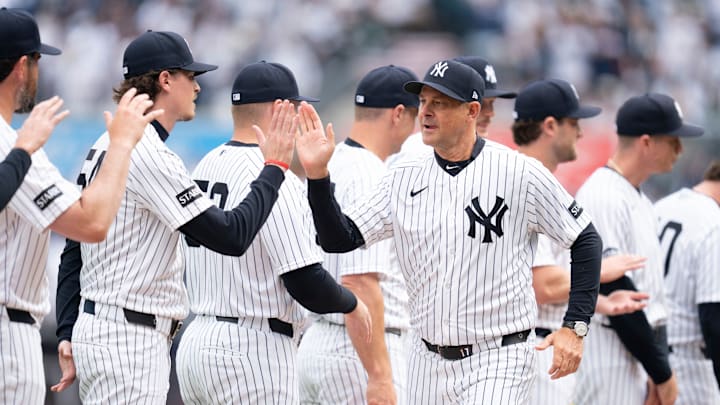
NEW YORK — Yes, Aaron Boone has scolded his players. No, he is not going to tell you about it.
When the Yankees lose five games in a row, as they did before a thrilling Monday win over the Angels improved their record to 9–7, fans tend to begin criticizing the manager’s lack of criticism. In the past week, second baseman Jazz Chisholm Jr. told reporters he did not know whether a runner can score during a double play if one of the outs comes on a tag; third baseman Ryan McMahon dropped his season OPS to .376; and the team combined for a .156 batting average. New Yorkers were ready to light fires. In his press conferences, Boone tried to snuff them out.
On Chisholm: “He’s not confused.” On McMahon: “He’ll get it rolling.”
And on the lineup: “We know we gotta get it going offensively, and we trust we will.”
As a lifelong Philadelphia Eagles fan, Boone is intimately familiar with a fan base’s capacity—and desire—for overreaction. But he believes his job as manager is to avoid giving into that impulse.
“I say plenty behind closed doors,” he tells SI, standing on the field during batting practice, a few minutes after a press conference whose theme was: We’ll be fine. “Me going out and saying [‘There’s a problem’] is not leadership. [Appeasing] the critics is not leadership—it’s bulls–t, it’s weakness, in my opinion.”
And what about the people in the bleachers who want to see him throw a chair or two? Well, bluntly, he does not work for them. His job is to win games for the Yankees, and he believes that blowing up the players does not help them do that.
“One of the things I pride our culture on is consistency,” he says. “I want you to, if you were to drop into our surroundings out of nowhere, to have a hard time knowing if we’d won eight in a row or lost five in a row. I think it’s an important component for successful teams that do this successfully.”
Still, no matter how successful, no other team faces quite the same pressure as the Yankees. Even the Dodgers—a team with ballooning payrolls and international appeal, a team Yankees owner Hal Steinbrenner said was “difficult” to compete with, a team that has won the last two World Series—lack the binary measure of success of the Yankees. Any season that does not end in a championship, captain Aaron Judge often says, is a failure. Incidents that might register only as blips on another team’s radar can become season- and even career-defining in New York.
It does not help that the Yankees have a tendency to lose ugly. You can set your watch by their summer swoon. They are good for a few games a year in which they seem to be unsure which direction to run the bases. Last season they forgot how many strikes there were (Jasson Domínguez got himself thrown out at third base to end the seventh inning of a two-run game when he thought the hitter faced a 2–2 count), how many outs there were (Austin Wells was doubled off second to end the ninth inning of a tie game when he thought the frame was already over), even how many feet there were between bases (Jorbit Vívas got thrown out at third base without sliding to end the third inning of a three-run game). In each instance, Boone said he addressed the mistake with the player. Fans wanted the manager to bench them, denounce them, pull out each one of their fingernails at home plate. Instead, again and again, he sat at a table at a press conference and repeated his favorite line after a gaffe: “Can’t happen.”
Boone disagrees with the idea that he blindly insists everything will be fine. “I don’t always project that,” he says. “I trend towards that.”
But other than the time he pounded the table, launching a plastic water bottle, after the team’s 14th loss in 17 games in 2022, he has limited his forward-facing outbursts. That means that every time the team performs poorly and Boone does not publicly excoriate the players, some fans will accuse him of not caring enough—even, perhaps, at the same moment he is taking players to task privately. Does he ever wish he could correct people’s impression of him?
“Sometimes,” he acknowledges. “But again, that’s not leadership. That’s weakness.”
And what would he say if he got candid with Yankees fans? We can only guess. Much to their consternation, he’s keeping that to himself.
More MLB from Sports Illustrated
 Add us as a preferred source on Google
Stephanie Apstein was a senior writer covering baseball and Olympic sports for Sports Illustrated, where she started as an intern in 2011 and has since covered a dozen World Series and three Olympics. She has twice won top honors from the Associated Press Sports Editors, and her work has been included in the Best American Sports Writing book series. She graduated from Trinity College with a bachelor’s in French and Italian, and has a master’s in journalism from Columbia University.
Follow stephapstein