
After Struggling at Home, is J.T. Ginn a Trade or a Bounceback Candidate?
In this story:
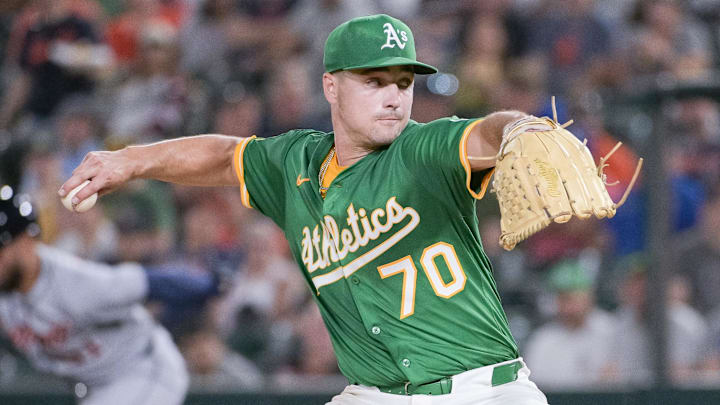
The Athletics have an interesting decision on their hands when it comes to the starting rotation. They have a number of intriguing young arms, but they're also hoping to add another veteran to the rotation this winter. That would make it even more difficult for some of those inexperienced pitchers, like J.T. Ginn, to crack the rotation to begin the season.
Still, Ginn's underlying numbers were quite interesting this past season. While he held a 5.08 ERA overall, he also notched a slightly better 4.62 FIP, induced grounders at an impressive 52.7% clip (89th percentile), and was seemingly unlucky with the long ball, giving up 17 big blasts in 90 1/3 innings of work.
Ginn's expected ERA was also just 3.77, which could be indicative of the kind of pitcher he could be on a different team, or in a different home ballpark. It could also be a reason for the A's to figure out how to get his home stats to improve, because he could also be a terrific weapon for his current team.
Should the A's trade Ginn?
Those underlying stats are surely tantalizing for teams interested in taking a flier on a pitcher that isn't quite established as a big leaguer just yet. If the A's decided to move him, they could actually be selling low on him, since he has plenty of team control remaining.
Ginn's home numbers were also much worse than his road ones, as he boasted a 6.85 ERA at home and a 3.14 on the road. He's like a younger, less expensive version of Luis Severino. Here is how his home and road numbers ended up shaking out.
IP | ERA | FIP | HR | K% | BB% | AVG | OBP | |
|---|---|---|---|---|---|---|---|---|
Home | 47.1 | 6.85 | 5.92 | 12 | 24.4% | 10.4% | .280 | .371 |
Road | 43 | 3.14 | 3.18 | 5 | 26.3% | 4.7% | .236 | .275 |
It's fairly obvious to see why he struggled so much more at home when looking at these stats. He had an abundance of baserunners in his home appearances, and he was also giving up the long ball over twice as often at Sutter Health Park. The question the A's have to figure out here is whether this is a ballpark factor that they can overcome, or if it's a mental hurdle they need to work on.
It has to be tough going from being selected by the Mets, imagining yourself pitching in New York, to being traded to the A's. Not only that, but he was also the starting pitcher for the green and gold in the team's farewell from Oakland, so he was able to see the Coliseum at its best. To go from those two scenarios to pitching in a minor-league park has to be rough for veterans and rookies alike.
Of course, this is all just speculation, but it would make sense for that to be the human reaction in that scenario. If this is somewhat the case, then the A's would have to figure out if they'd be able to get the most out of him in the coming years, or if it's best to move him now.
Keeping him could solve another problem

If the A's believe that holding onto him is the right play, that could solve one of a couple of problems, if he ends up pitching like his stats suggest he is able.
The first option would be to have him take over as the fourth of fifth starter, joining a rotation that already holds Luis Severino, Jeffrey Springs, Jacob Lopez and Luis Morales. The key here would be that Ginn would be in the rotation, while hard-throwing righty Jack Perkins would be moved to the bullpen.
The A's don't currently have a solidified closer. While they would love to key Perkins in the rotation for as long as they can, if some of their pursuits in free agency and the trade market stall out, then they may have to just reshuffle the roster they currently have. That could lead Perkins into a late-inning role with the club in 2026.
Given the upside that Ginn has, he could be the one to end up in the rotation, with his main competition for that spot being Gunnar Hoglund, or perhaps Ken Waldichuk, if he's recovered some of his velocity on his way back from injury. The A's could also decide to use Ginn in the bullpen himself, given his ability to keep the ball on the ground. That could be handy in some big spots.
The way the A's roster sits right now, the decision could end up being a coin flip. But if the A's need to go to the trade market to find a pitching upgrade, there aren't many teams that would reject a 26-year-old pitcher with some big-league experience and a good bit of upside as part of the return package.
Given the upside potential, it's also hard to see the A's flipping Ginn for someone that has limited team control. In other words, the A's would want at least two years with the player they're after—if they end up moving Ginn at all. There are plenty of avenues for the A's to consider when it comes to this intriguing righty.
Recommended Articles:
 Add us as a preferred source on Google
Jason has been covering the A’s at various sites for over a decade, and was the original host of the Locked on A’s podcast. Mason Miller once said he likes Jason's content.
Follow byjasonb