
Bernie Sanders Introduces Bill That Would Have Kept the A's in Oakland
In this story:
A's fans have had a hard time falling truly in love with the green and gold, because of two main factors. The first was that for two decades they would trade away all of their stars for prospects that seldomly panned out to the degree that had been hoped. The second reason was the constant looming threat of relocation.
When John Fisher and Lew Wolff bought the A's in 2005, their focus was immediately on finding a site for a new ballpark for the franchise. In 2006, they found their spot—in Fremont. Cisco Field had plenty of plans, including an early adoption of digital tickets with the team heading to Silicon Valley.
In 2009, those plans were abandoned, and San Jose would swoop in to try and court the A's for a downtown ballpark there. At the same time, Oakland city officials proposed a ballpark on the water near Jack London Square. Two years later, Oakland would shift their focus to a redevelopment of the Coliseum site.
In 2013, after a long battle, Major League Baseball declined the A's request to move to San Jose due to the San Francisco Giants' territory rights. It was a huge waste of time that isn't talked about nearly enough.
In 2014, the A's signed a 10-year lease to stay at the Coliseum, giving them a bit of a deadline to have a new place lined up. This is the first move the A's make in nearly a decade to show that they could potentially stay in Oakland.
In 2016 Wolff resigned, and Fisher hired Dave Kaval as the A's new team president. Kaval would become the face of the A's ballpark project. The following year, he would announce the team's preferred choice for a ballpark site in Oakland to be the Peralta college site.
This idea would fall apart just months later and showed some of the thought and effort the A's were putting into this ballpark search.
When 2018 rolled around, the A's finally had a legitimate quest to stay in Oakland, as the team announced plans for a privately financed ballpark at Howard Terminal. The project would not end up being privately financed, and the city of Oakland was asked to come up with hundreds of millions of dollars to help pay for the project.
After years of wasting time, the A's hit a snag in the road with opposition forces, as well as a global pandemic that shut things down. In 2021, the A's received MLB's blessing to start exploring relocation sites, and in 2023, they announced that they would be leaving Oakland for Las Vegas. At that point, Oakland had gathered nearly $1 billion for on-and-off-site infrastructure funding.
Through this entire process, Oakland wasn't in the foreground very much, getting roughly a two-year span for the Howard Terminal project before the pandemic hit. As the world began to recover in '21, they shifted their focus to the vaunted "parallel paths" that would land them in Vegas.
On Thursday, senator Bernie Sanders (I-Vt.) introduced the Home Team Act, which is "legislation to require owners of professional sports teams to give local communities the chance to buy teams before relocating them."
How this would have helped Oakland
The key points for this new legislation brought forth by Sanders and Rep. Greg Casar (D-Texas) are pretty straightforward, and the overall goal is to make sports teams a community entity rather than a way for billionaires to make as much money as possible.
The first bullet point of the bill: "Requires sports franchise owners to provide notice a year before moving the team to a new community, defined by crossing state lines or moving to a new Metropolitan Statistical Area."
In other words, they don't want teams leaving for Baltimore in the middle of the night. This point also sets up the second one.
"During that year, it gives communities the chance to purchase the team at a fair price, including through the sort of successful community ownership model used by the Green Bay Packers. Teams could also be purchased by a government entity, a nonprofit or public partnership, or a private person, group, or company."
In other words, if someone wants to give up on the community they're in, then they have to see if someone else in the area (like Joe Lacob) would be willing to purchase the franchise from them for a fair price (market value?). This would make it so that the current owner still gets a fair price for their asset, but the community gets to keep their team.
This would also presumably lead to a new owner to invest more into the fans and the experience, which is a win-win-win situation for all involved.
The final point: "Enforces a penalty for franchise owners who do not comply and provides a right of action for state and local governments."
It's also important to point out that this legislation would not stop teams from ever relocating again. If a community or ownership group was unable to meet the market price of the franchise within that year, the team trying to move would then be allowed to do so.
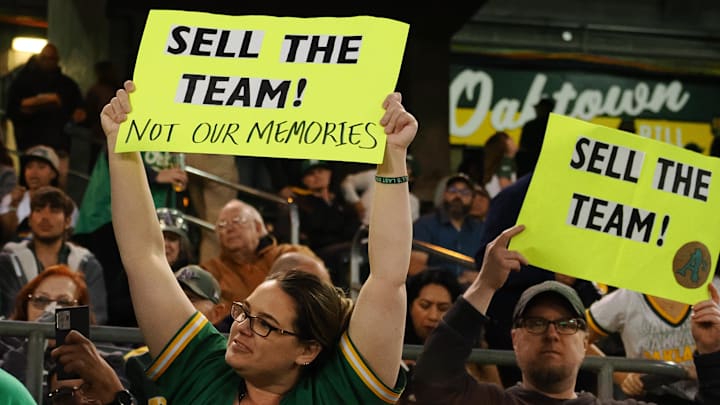
While the "Sell the Team" movement in Oakland didn't stop the A's from leaving for Las Vegas, the bill is attempting to stop teams like the Chicago Bears from pitting communities against one another in a battle to see which city can give up more in public subsidies.
It will be interesting to see what kind of support this bill receives, because it could be fairly bipartisan. Nobody wants their teams to relocate. The question could become how hard the leagues will end up fighting this legislation, as the threat of relocation is one way of getting municipalities to pay up for a new stadium or improvements to the current one.
With the A's out of Oakland, it wouldn't be terribly surprising to see Oakland become the new boogeyman of relocation, much the same way that Las Vegas and Nashville have been for years.
The full bill is available online, and a summary of the bill is also available for those interested.
For more A's news and insights, follow Jason @ByJasonB on X, or the site @InsideTheAs!
 Add us as a preferred source on Google
Jason has been covering the A’s at various sites for over a decade, and was the original host of the Locked on A’s podcast. Mason Miller once said he likes Jason's content.
Follow byjasonb