%20%20--%3E%0A%3Csvg%20version%3D%221.1%22%20id%3D%22Layer_1%22%20xmlns%3D%22http%3A%2F%2Fwww.w3.org%2F2000%2Fsvg%22%20xmlns%3Axlink%3D%22http%3A%2F%2Fwww.w3.org%2F1999%2Fxlink%22%20x%3D%220px%22%20y%3D%220px%22%0A%09%20width%3D%2239px%22%20height%3D%2240px%22%20viewBox%3D%220%200%2039%2040%22%20enable-background%3D%22new%200%200%2039%2040%22%20xml%3Aspace%3D%22preserve%22%3E%0A%3Cpath%20fill%3D%22%23FFFFFF%22%20d%3D%22M38.5%2C7H28.2v26h10.3V7z%22%2F%3E%0A%3Cpath%20fill-rule%3D%22evenodd%22%20clip-rule%3D%22evenodd%22%20fill%3D%22%23FFFFFF%22%20d%3D%22M26.1%2C25.5c0%2C5.8-4.1%2C7.5-12.9%2C7.5C3.9%2C33%2C0%2C31.2%2C0%2C25.2v-1.1h11.6%0A%09v2.4c0%2C0.7%2C0.1%2C1.4%2C1.2%2C1.4c1%2C0%2C1.2-0.4%2C1.2-1.3v-0.9c0-1.6-0.9-1.6-3.5-2.2C2.2%2C21.7%2C0%2C19.7%2C0%2C15.3v-0.9C0%2C9.3%2C5.5%2C7%2C12.9%2C7%0A%09c10.2%2C0%2C12.8%2C2.6%2C12.8%2C7.4v1.8h-11v-2.9c0-0.6-0.4-1.1-1.2-1.1c-0.6%2C0-1.2%2C0.4-1.2%2C1.1v0.9c0%2C1.5%2C0.9%2C2%2C3.3%2C2.5%0A%09c8%2C1.6%2C10.5%2C3.3%2C10.5%2C7.5V25.5z%22%2F%3E%0A%3C%2Fsvg%3E%0A)
The Yankees Have Found Themselves A New Ace in Cam Schlittler
In this story:
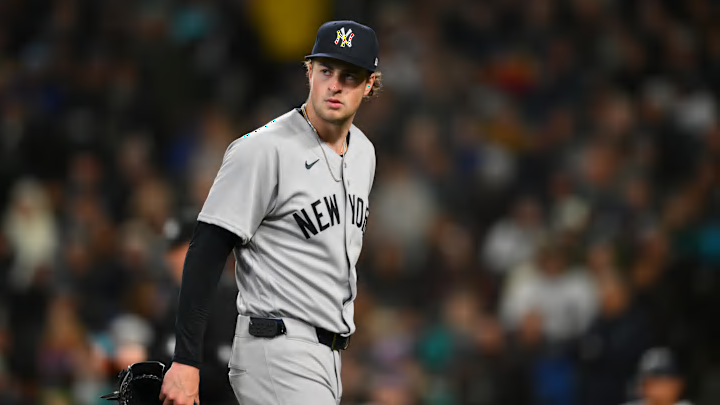
NEW YORK — With every toss ‘n catch play, every rep in the gym, every pitch off the bullpen mound, Yankees righty Cam Schlittler focuses on his goal. He wants to win the World Series, he wants to win every game he pitches, he wants to be the best, sure. But first, he wants to walk as few people as possible.
When Schlittler reflected on his rookie season—including his signature outing, a dominant performance against his hometown Red Sox in the American League Wild Card Series—the next step was obvious. “The contact quality was great,” he says. “Getting strikeouts, getting weak contact, getting deeper into games at the end of the season when it mattered most, velo was still holding. Just limit the walks. Coming into spring training, my goal was just: not walk guys.”
So far, that’s going pretty well. He issued a walk in the first inning of his first spring training start, and another in the fourth inning of his third … and nothing since. Even in his most recent start, a five-inning, three-run day against the A’s that left him annoyed with himself, he could at least point to the zero in the most important section of the box score. He has even limited three-ball counts: Only 6% of his pitches have come in that circumstance, sixth best among starters.
That A’s start increased his ERA to 1.62, which is actually only the second best figure in the rotation—pretty impressive given that New York is missing two of its top three starters. Lefty Carlos Rodón is due back in May from offseason bone spur surgery, and ace Gerrit Cole, who had his right elbow reconstructed last March, shouldn’t be far behind. In the meantime, lefty Max Fried (whose 1.35 ERA leads the team), Schlittler, righty Will Warren and lefty Ryan Weathers combined through the first six games for a 0.53 ERA, the best since the invention of the statistic in 1913. Through 12 games, that figure has ballooned to a 2.14 ERA, easily the best in the sport. With nearly half a billion dollars in arms on the injured list, New York tops the AL with an 8–4 record.
“It’s incredible what we’re watching,” says backup catcher J.C. Escarra.
Why Cam Schlittler's 3 Variations of Fastballs are a problem for hitters.
— Rob Friedman (@PitchingNinja) March 28, 2026
99 mph Sinker
96 mph Cutter
98 mph Elevated Four Seam Fastball
Individual Pitches + Overlay pic.twitter.com/1JyAs2dJjk
Schlittler attributes the dominance to an increased attention to detail. “I do think we have put a lot more effort into setting goals for one another and holding each other accountable and making sure we’re doing the little things right,” he says. He can already point to two games he believes last year’s team would have lost that this year’s won—comeback victories against the Marlins and the A’s.
“I think last year was frustrating,” he says, referring to the Yankees’ loss in four games in the AL Division Series to the Blue Jays, who went on to win the pennant. “I don’t think it should’ve ended that way. I think we’ve made some additions, people left, we’re in a better spot as a team. It’s just going out there and playing to our full potential and limiting the small things that last year cost us a ton of games.”
For the pitchers, that starts with the first pitch.
“Our No. 1 priority is getting that first-pitch strike,” says Escarra. “There’s a whatever percent chance to win that at-bat and get that out.” Indeed, the numbers are dramatic: This season, league OPS after a 1–0 count is .773. After an 0–1 count, it’s .575.
They also try to limit free bases, both by curbing walks and by holding runners. Escarra shakes his head at teams who tell their pitchers just to focus on the hitter, pointing to the recent series against the Marlins, when DH Giancarlo Stanton, who ranks No. 239 out of 244 qualified players in sprint speed, stole second base and scored on a passed ball. (That moment made the next Yankees pitchers’ advance meeting.)
But it’s one thing to say you don’t want to give up walks; indeed, no pitcher does. It’s another thing to stand out there, alone on the mound, with 50,000 people screaming at you and a guy who hits the ball 110 mph wagging his bat at you, and actually pump a fastball down the pipe.
Schlittler used to struggle with those moments. “I’d get too nitpicky,” he says. “I’d get to 0–2, 1–2 and try to make the perfect pitch, and then it’d be 3–2 and I'd try to make another perfect pitch, and then there were a couple foul balls—that’s wasting eight pitches an at-bat.”
It comes down, he says, to being brave. “Just pound the zone, get ahead,” he says. “I’m super confident that I can throw any of my four pitches in the zone and see what they do with it.” So far, they have mostly swung and missed.
More MLB from Sports Illustrated
 Add us as a preferred source on Google
Stephanie Apstein was a senior writer covering baseball and Olympic sports for Sports Illustrated, where she started as an intern in 2011 and has since covered a dozen World Series and three Olympics. She has twice won top honors from the Associated Press Sports Editors, and her work has been included in the Best American Sports Writing book series. She graduated from Trinity College with a bachelor’s in French and Italian, and has a master’s in journalism from Columbia University.
Follow stephapstein