%20%20--%3E%0A%3Csvg%20version%3D%221.1%22%20id%3D%22Layer_1%22%20xmlns%3D%22http%3A%2F%2Fwww.w3.org%2F2000%2Fsvg%22%20xmlns%3Axlink%3D%22http%3A%2F%2Fwww.w3.org%2F1999%2Fxlink%22%20x%3D%220px%22%20y%3D%220px%22%0A%09%20width%3D%2239px%22%20height%3D%2240px%22%20viewBox%3D%220%200%2039%2040%22%20enable-background%3D%22new%200%200%2039%2040%22%20xml%3Aspace%3D%22preserve%22%3E%0A%3Cpath%20fill%3D%22%23FFFFFF%22%20d%3D%22M38.5%2C7H28.2v26h10.3V7z%22%2F%3E%0A%3Cpath%20fill-rule%3D%22evenodd%22%20clip-rule%3D%22evenodd%22%20fill%3D%22%23FFFFFF%22%20d%3D%22M26.1%2C25.5c0%2C5.8-4.1%2C7.5-12.9%2C7.5C3.9%2C33%2C0%2C31.2%2C0%2C25.2v-1.1h11.6%0A%09v2.4c0%2C0.7%2C0.1%2C1.4%2C1.2%2C1.4c1%2C0%2C1.2-0.4%2C1.2-1.3v-0.9c0-1.6-0.9-1.6-3.5-2.2C2.2%2C21.7%2C0%2C19.7%2C0%2C15.3v-0.9C0%2C9.3%2C5.5%2C7%2C12.9%2C7%0A%09c10.2%2C0%2C12.8%2C2.6%2C12.8%2C7.4v1.8h-11v-2.9c0-0.6-0.4-1.1-1.2-1.1c-0.6%2C0-1.2%2C0.4-1.2%2C1.1v0.9c0%2C1.5%2C0.9%2C2%2C3.3%2C2.5%0A%09c8%2C1.6%2C10.5%2C3.3%2C10.5%2C7.5V25.5z%22%2F%3E%0A%3C%2Fsvg%3E%0A)
Three Reasons the Cubs Can Turn Their Crisis Around—and Three Why They May Not
In this story:
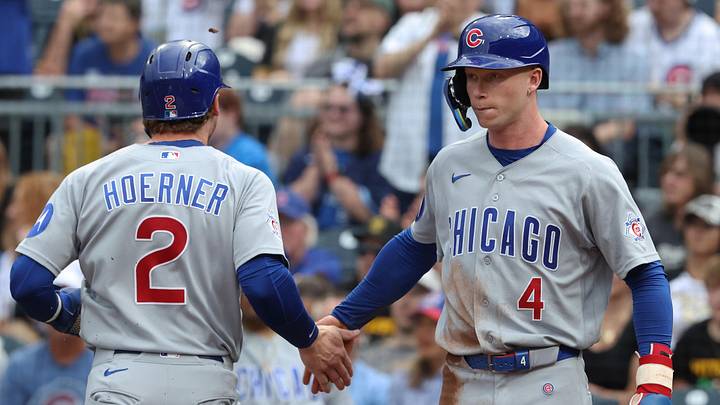
If there was any solace to be had for the Cubs in the aftermath of Tuesday’s 12–1 defeat to the Pirates, it at least put them in good company.
The lopsided loss was Chicago’s 10th in a row, giving the Cubs the rare distinction of having a double-digit losing streak and two double-digit winning streaks on the season. The only other team to do that in AL/NL history? The 2017 Dodgers, who won 104 games and advanced to the World Series.
It will take a lot of improvement for the 2026 Cubs to reach those heights.
A team that was 2 1/2 games clear in first place on the day the losing streak began entered play Wednesday tied for last. Their playoff odds, according to FanGraphs, had plummeted from 91.2% on May 7 to 45.2%. All that while facing an uphill climb in the toughest division in baseball.
That sojourn up the mountain got off to an encouraging start with Wednesday’s 10–4 win over the Pirates, though tough sledding remains ahead. Is this the kind of tailspin that’s reversible? Or one that spells doom for the season? Here are three reasons to believe Chicago can turn this around—and three more that should be of greatest concern to the North Siders.
Reason for hope No. 1: Sluggish bats heating up
While Cubs fans have spent most of May watching their offense scuffle, the month has seen some much-needed signs of positive regression for two key figures: Pete Crow-Armstrong and Michael Busch.
The pair had combined for 65 homers in 2025, but through the end of April had totaled just five, putting together a composite .217/.301/.321 slash line that was well below preseason expectations. While the rest of the lineup was plenty productive, this was a duo that the team needed more from.
Since the start of May, though, the fortunes have flipped. The Cubs have the second-worst batting average this month (.203), while Busch and Crow-Armstrong have picked up the pace. Busch has hit .284/.438/.543 with four homers, while Crow-Armstrong has hit three homers with six stolen bases. And though the center fielder has still managed just a .200 batting average this month, he’s cut his strikeout rate way down to 18.8% (compared to 29.7% in March and April).
Though it hasn’t looked like it for much of this month, this is a deep lineup with plenty of established hitters who have had success at this level for a long time. Through May 8, the day the Cubs completed their second 10-game winning streak, the team led the majors in runs scored per game (5.5), walk rate (11.9%), on-base percentage (.354) and wRC+ (124). That group didn’t just forget how to hit, and with Busch and Crow-Armstrong finding their stride, the team’s light-hitting ways shouldn’t persist much longer.
Reason to panic No. 1: Alex Bregman’s decline

This is not a lineup overly dependent on just one hitter to produce. But there’s reasons to pay particular attention to Bregman—now in his age-32 season and fresh off signing a five-year, $175 million contract this winter—as he starts to show some wear in what’s now his 11th year in the big leagues.
The three-time All-Star is showing some concerning signs that his age is creeping up on him. Entering Wednesday, his 17.1% strikeout rate, while well below league average (22.1%), is his highest since his rookie season. What’s most concerning is that it’s being fueled by a decrease in zone swing rate, an increase in chase rate and an uptick in swinging strike rate. That decline in swing decision-making and contact rate has not come as part of a tradeoff for more power—Bregman’s slugging percentage (.356) and ISO (.097) are both easily career lows.
Anchoring all of this is the fact that Bregman’s average bat speed has dwindled beneath 70 mph for the first time in his career. At his age, it’s hard to envision him being able to scrape any of it back. While he still gets on base enough and plays solid defense, Bregman’s days as a middle-of-the-order impact bat look like they’re behind him, which is a concern not just for the rest of 2026 but for the duration of his half-decade contract.
Reason for hope No. 2: Pitching reinforcements are coming
The Cubs’ starting rotation has been an absolute mess during the past month.
Chicago starters have posted a 5.30 ERA in May, and are tied with the Braves in giving up the most home runs (27). Strong starts to the season by Shota Imanaga and Jameson Taillon are fading quickly, and Edward Cabrera—who’s also struggled this month—just went on the injured list with a blister. Jordan Wicks, making his season debut on Tuesday, surrendered eight runs and couldn’t make it out of the fifth inning—wait, wasn’t this supposed to be a reason for optimism?
Yes, and there are positive signs here, too. Ben Brown’s transition from the bullpen to the rotation has been seamless, and he looks to have the potential of becoming an impact arm the rest of the way. Veteran Matthew Boyd, who had turned in his best outing of the season before landing on the injured list, is slated to make a rehab start this weekend and should be back in the big-league rotation soon. And Cabrera’s blister isn’t expected to keep him on the shelf for much longer than the minimum 10 days.
Any of those three can make a huge difference in the months ahead. But they might not be enough, because …
Reason for panic No. 2: None of those reinforcements has top-of-the-rotation stuff
Based on the Stuff+ metric—FanGraphs’s measure of pitch characteristics like velocity, horizontal and vertical movement, spin rate and release point—the Cubs’ rotation is severely lacking in ace potential. With the exception of Brown, who’s made just four starts on the season, none of Chicago’s other starters grade out above average (100) by Stuff+.
Cubs starters Stuff+ (min. 5 GS)
Pitcher | Stuff+ |
|---|---|
Shota Imanaga | 92 |
Jameson Taillon | 93 |
Edward Cabrera | 93 |
Colin Rea | 94 |
Matthew Boyd | 97 |
Stuff isn’t everything, of course. Good command or a wide arsenal can help compensate for middling stuff, and most of the pitchers mentioned have demonstrated at least some track record of being able to succeed without it. But having an entire staff operating with below-average juice shrinks the margin for error, especially come playoff time (if Chicago is able to make it that far).
The Cubs spent a hefty prospect toll to land Cabrera in a trade with the Marlins this offseason, and while they’re an obvious candidate to be shopping for an impact starter at this year’s trade deadline, they might not have the trade capital necessary to land, say, someone like Tarik Skubal.
Reason for hope No. 3: Elite team defense

One of the most well-worn sayings in baseball is that defense never slumps. For the Cubs, that’s good news, because few teams flash the leather as well as they do.
They lead the league in FanGraphs’s defensive rating and Statcast’s Outs Above Average. While Chicago’s pitchers keep tinkering to figure out effective strategies, they’ll do so with game-changing defenders behind them at most positions. All they really need to do is keep the ball in the park to give themselves a chance to minimize the damage from opposing hitters (that’s been no small task, though, as noted above).
Reason for panic No. 3: The competition isn’t getting easier
The NL Central is proving to be the best division in baseball by a wide margin. Consider that all five teams in the division are above .500, while only two other divisions (the NL East and NL West) had three such teams. The entire AL has just three teams above .500.
The Brewers look once again to be one of the toughest teams in baseball, with MLB’s fourth-highest run differential (+78) and fresh off sweeping Chicago at Wrigley Field this month. The Cardinals are among the biggest surprises of the young season, while the Reds are keeping pace despite dealing with a rash of injuries themselves. And the Pirates look like a far more complete team than they’ve been in years thanks to a revamped offense.
Even with upgrades in the weeks and months ahead leading up to the trade deadline, the Cubs will have their hands full trying to climb out of the cellar. They got back to their winning ways on Wednesday. Will nine more follow once again? Given how the first two months of the season have gone, we shouldn’t rule anything out.
More MLB from Sports Illustrated
 Add us as a preferred source on Google
Nick Selbe is a programming editor at Sports Illustrated who frequently writes about baseball. Before joining SI in March 2020 as a Breaking and Trending News writer, he worked for the Orange County Register, MLB Advanced Media, Graphiq and Bleacher Report. Selbe received a bachelor’s in communication from the University of Southern California.
Follow NickSelbe