%20%20--%3E%0A%3Csvg%20version%3D%221.1%22%20id%3D%22Layer_1%22%20xmlns%3D%22http%3A%2F%2Fwww.w3.org%2F2000%2Fsvg%22%20xmlns%3Axlink%3D%22http%3A%2F%2Fwww.w3.org%2F1999%2Fxlink%22%20x%3D%220px%22%20y%3D%220px%22%0A%09%20width%3D%2239px%22%20height%3D%2240px%22%20viewBox%3D%220%200%2039%2040%22%20enable-background%3D%22new%200%200%2039%2040%22%20xml%3Aspace%3D%22preserve%22%3E%0A%3Cpath%20fill%3D%22%23FFFFFF%22%20d%3D%22M38.5%2C7H28.2v26h10.3V7z%22%2F%3E%0A%3Cpath%20fill-rule%3D%22evenodd%22%20clip-rule%3D%22evenodd%22%20fill%3D%22%23FFFFFF%22%20d%3D%22M26.1%2C25.5c0%2C5.8-4.1%2C7.5-12.9%2C7.5C3.9%2C33%2C0%2C31.2%2C0%2C25.2v-1.1h11.6%0A%09v2.4c0%2C0.7%2C0.1%2C1.4%2C1.2%2C1.4c1%2C0%2C1.2-0.4%2C1.2-1.3v-0.9c0-1.6-0.9-1.6-3.5-2.2C2.2%2C21.7%2C0%2C19.7%2C0%2C15.3v-0.9C0%2C9.3%2C5.5%2C7%2C12.9%2C7%0A%09c10.2%2C0%2C12.8%2C2.6%2C12.8%2C7.4v1.8h-11v-2.9c0-0.6-0.4-1.1-1.2-1.1c-0.6%2C0-1.2%2C0.4-1.2%2C1.1v0.9c0%2C1.5%2C0.9%2C2%2C3.3%2C2.5%0A%09c8%2C1.6%2C10.5%2C3.3%2C10.5%2C7.5V25.5z%22%2F%3E%0A%3C%2Fsvg%3E%0A)
Kyle Tucker and Edwin Díaz’s Issues Probably Aren’t Disappearing Soon
In this story:
This article is a part of Verducci’s View, a new weekly baseball newsletter from Sports Illustrated senior writer Tom Verducci. Every Monday, Tom empties out his notebook over email and covers MLB’s hottest topics, provides in-depth analysis through both text and video breakdowns, looks forward to what’s worth watching during the week and more. If you want to be featured in his new mailbag, please email newsletters@si.com with any questions about MLB or his decades in the sport.
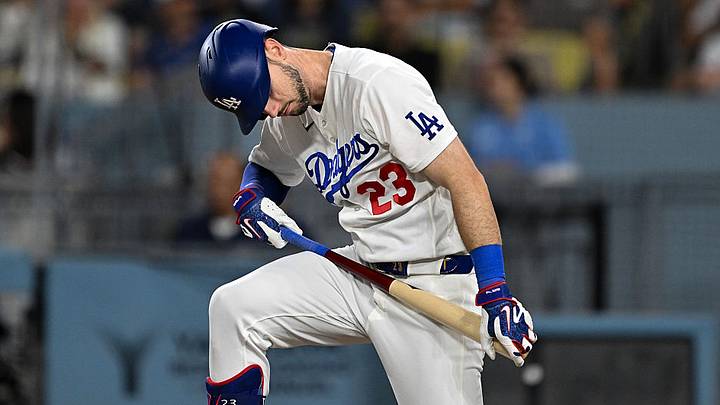
How much longer will the Dodgers ride with Tucker? The occasional run-scoring hit inevitably sparks talk about how Tucker may be “turning the corner” or that he “found something.” There is no such hard evidence.
Tucker slashed .195/.293/.310 in August. The .603 OPS makes it the worst month of his career (min. 12 games). He has hit rock bottom, which is evident in how he recently changed his swing to try to change his fortunes.
Tucker’s natural swing includes an arm bar, in which the lead arm “bars” or straightens, causing the barrel to dip behind the body. It’s not a preferred style, but Tucker is one of plenty of successful hitters to hit this way. Among them are Derek Jeter and (slightly) Ted Williams, as you can see here.

Recently, Tucker has taken to loading with his hands close to his head and the bat cocked, rather than “laying” the bat behind him. It’s a method similar to Max Muncy.

But the swing change is not working. When Tucker used his arm bar, the barrel entered the hitting zone early (or behind the contact point), giving him more time to adjust to pitches. With the new path, the barrel enters the hitting zone later. It is in-and-out of the zone faster, giving him less time to adjust with a steeper, shorter swing.
Tucker Swing Metrics
Period | Launch Angle | Tilt |
|---|---|---|
March-July | 18° | 36° |
August | 21° | 37° |
The less time the barrel is in the hitting zone, the more vulnerable a hitter becomes to changes in speed. Tucker is getting dominated by pitches at both ends of the speed spectrum, elite velocity and off-speed. His profile this year by pitch type is that of a classic “slider bat speed” hitter.
Tucker by Pitch Type
Year | 95+ mph | Off-Speed | All Others |
|---|---|---|---|
2024 | .277 | .300 | .281 |
2025 | .250 | .231 | .276 |
2026 | .210 | .198 | .244 |
Moreover, though Tucker is primarily a pull, fly ball hitter, he has lost the ability to cover pitches by driving them the other way, an indication of staying on the ball. Look at his hit spray charts from the past three seasons to see how his extra-base opposite power has cratered to almost nothing.

Most mystifying of all is how Tucker’s offensive problems have bled into his entire game. The Dodgers should be alarmed how badly Tucker’s baserunning and fielding also have fallen off.
Tucker Percentiles
Year | Batting | Baserunning | Fielding | Bat Speed | Range |
|---|---|---|---|---|---|
2025 | 90 | 78 | 51 | 48 | 25 |
2026 | 27 | 49 | 5 | 35 | 2 |
You might be thinking about turning Tucker into a platoon player, but he has hit lefties better than righties (.250-.219). You should be thinking about batting him lower in the lineup. He has hit below the sixth spot only 13 starts this year. The bottom line is the Dodgers have a .228 hitter who is trying to change his swing midseason and who defensively ranks dead last among 123 outfielders in outs above average.
Breakdown of the Week: Edwin Diaz’s Arm Angle
Don’t think Edwin Diaz automatically jumps into the closer role for the Dodgers once he comes off the IL. His injury-plagued season also is troubled by mechanical issues he needs to get straightened out. As you can see in this week’s breakdown and in the following chart, his release point and his arm angle have been dropping.

The lower arm slot is doing a number on his slider. Diaz always has had a great chase slider, a pitch that looks like a strike until it dive bombs to his arm side out of the zone. But this year he is throwing too many sliders that are non-competitive—balls right out of his hand that don’t force a swing decision.
Diaz’s Slider
Year | BA | Zone% |
|---|---|---|
2025 | .179 | 55.4% |
2026 | .323 | 58.6% |
Two-pitch relievers are scary because if hitters can dismiss one pitch—well, you do the math. Diaz’s fastball is getting waffled (.333 with .778 slug) because A) his velocity is down a tick and B) his arm angle is lower and C) his slider isn’t competitive enough to get hitters off his heater.
 Add us as a preferred source on Google
Tom Verducci is a senior writer for Sports Illustrated who has covered Major League Baseball since 1981. He also serves as an analyst for FOX Sports and the MLB Network; is a New York Times best-selling author; and cohosts The Book of Joe podcast with Joe Maddon. A five-time Emmy Award winner across three categories (studio analyst, reporter, short form writing) and nominated in a fourth (game analyst), he is a three-time National Sportswriter of the Year winner, two-time National Magazine Award finalist, and a Penn State Distinguished Alumnus Award recipient. Verducci is a member of the National Sports Media Hall of Fame, Baseball Writers Association of America (including past New York chapter chairman) and a Baseball Hall of Fame voter since 1993. He also is the only writer to be a game analyst for World Series telecasts. He lives in New Jersey with his wife, with whom he has two children.