%22%3E%0A%3Cpath%20d%3D%22M0%2013.6924L2.73846%2010.4302C4.40773%2011.6958%206.3061%2012.2304%208.10629%2012.2304C9.02275%2012.2304%209.41552%2011.9904%209.41552%2011.5758V11.5321C9.41552%2011.0957%208.93547%2010.8557%207.28802%2010.5284C3.85131%209.83016%200.829177%208.84824%200.829177%205.6079V5.56426C0.829177%202.65124%203.10941%200.392822%207.33167%200.392822C10.2883%200.392822%2012.4704%201.09108%2014.2487%202.49849L11.7503%205.95703C10.3102%204.90965%208.57543%204.45142%207.1571%204.45142C6.39339%204.45142%206.04426%204.71327%206.04426%205.08421V5.12785C6.04426%205.54244%206.45885%205.80429%208.08447%206.10977C12.0012%206.82985%2014.6306%207.97542%2014.6306%2011.063V11.1067C14.6306%2014.3252%2011.9794%2016.2999%207.86627%2016.2999C4.75685%2016.2999%201.95293%2015.4271%200.0109105%2013.7142L0%2013.6924Z%22%20fill%3D%22white%22%2F%3E%0A%3Cpath%20d%3D%22M15.3076%2012.5902V12.5466C15.3076%2010.1573%2017.0751%208.82622%2019.8572%208.82622C20.8609%208.82622%2022.1592%209.04443%2022.6829%209.26263V9.06625C22.6829%207.97523%2022.0065%207.33153%2020.4681%207.33153C19.2462%207.33153%2018.2097%207.59337%2017.1624%208.00796L16.2895%204.70216C17.6642%204.17847%2019.2462%203.82935%2021.3301%203.82935C23.763%203.82935%2025.3341%204.33122%2026.3924%205.3786C27.287%206.27323%2027.6362%207.44063%2027.6362%209.16444V15.9724H22.672V14.7723C21.8428%2015.6669%2020.7191%2016.2561%2019.2353%2016.2561C16.9332%2016.2561%2015.3185%2014.9469%2015.3185%2012.5793L15.3076%2012.5902ZM22.7266%2011.5647V11.0628C22.4429%2010.9537%2022.0065%2010.8664%2021.5919%2010.8664C20.61%2010.8664%2020.0645%2011.4556%2020.0645%2012.1975V12.2411C20.0645%2012.9394%2020.5663%2013.3976%2021.1991%2013.3976C22.0719%2013.3976%2022.7266%2012.6993%2022.7266%2011.5538V11.5647Z%22%20fill%3D%22white%22%2F%3E%0A%3Cpath%20d%3D%22M29.1191%204.0366H34.0833V5.70586C34.847%204.72394%2036.058%203.75293%2037.7382%203.75293C40.2585%203.75293%2041.8295%205.42219%2041.8295%208.1061V15.9833H36.8545V9.699C36.8545%208.67344%2036.2435%208.08428%2035.5016%208.08428C34.7597%208.08428%2034.0833%208.67344%2034.0833%209.699V15.9833H29.1191V4.02569V4.0366Z%22%20fill%3D%22white%22%2F%3E%0A%3Cpath%20d%3D%22M49.1064%200.665771H61.9369V5.04077H54.2342V6.99369H61.3913V10.9759H54.2342V15.9946H49.1064V0.665771Z%22%20fill%3D%22white%22%2F%3E%0A%3Cpath%20d%3D%22M63.1045%204.03676H68.0686V6.44792C68.7451%204.83321%2069.847%203.77492%2071.8108%203.8622V9.14274H71.2871C69.1815%209.14274%2068.0686%2010.2992%2068.0686%2012.9504V15.9944H63.1045V4.03676Z%22%20fill%3D%22white%22%2F%3E%0A%3Cpath%20d%3D%22M71.7461%2012.5902V12.5466C71.7461%2010.1573%2073.5135%208.82622%2076.2957%208.82622C77.2994%208.82622%2078.5977%209.04443%2079.1214%209.26263V9.06625C79.1214%207.97523%2078.445%207.33153%2076.9066%207.33153C75.6847%207.33153%2074.6482%207.59337%2073.6008%208.00796L72.728%204.70216C74.1027%204.17847%2075.6847%203.82935%2077.7576%203.82935C80.1906%203.82935%2081.7617%204.33122%2082.82%205.3786C83.7146%206.27323%2084.0637%207.44063%2084.0637%209.16444V15.9724H79.0996V14.7723C78.2704%2015.6669%2077.1466%2016.2561%2075.6629%2016.2561C73.3608%2016.2561%2071.7461%2014.9469%2071.7461%2012.5793V12.5902ZM79.1759%2011.5647V11.0628C78.8923%2010.9537%2078.4559%2010.8664%2078.0413%2010.8664C77.0594%2010.8664%2076.5139%2011.4556%2076.5139%2012.1975V12.2411C76.5139%2012.9394%2077.0157%2013.3976%2077.6485%2013.3976C78.5213%2013.3976%2079.1759%2012.6993%2079.1759%2011.5538V11.5647Z%22%20fill%3D%22white%22%2F%3E%0A%3Cpath%20d%3D%22M85.5684%204.0366H90.5325V5.70586C91.2962%204.72394%2092.5073%203.75293%2094.1874%203.75293C96.7077%203.75293%2098.2788%205.42219%2098.2788%208.1061V15.9833H93.3037V9.699C93.3037%208.67344%2092.6927%208.08428%2091.9508%208.08428C91.2089%208.08428%2090.5325%208.67344%2090.5325%209.699V15.9833H85.5684V4.02569V4.0366Z%22%20fill%3D%22white%22%2F%3E%0A%3Cpath%20d%3D%22M99.4033%2010.07V10.0264C99.4033%206.67694%20102.033%203.76392%20105.928%203.76392C108.557%203.76392%20110.412%205.11678%20111.339%207.06971L107.771%209.0881C107.357%208.32438%20106.833%207.88798%20106.026%207.88798C104.978%207.88798%20104.182%208.80443%20104.182%209.99365V10.0373C104.182%2011.2811%20104.968%2012.1866%20105.96%2012.1866C106.833%2012.1866%20107.335%2011.7502%20107.815%2010.9865L111.426%2013.0485C110.357%2015.0451%20108.535%2016.3107%20105.688%2016.3107C102.055%2016.3107%2099.4033%2013.4413%2099.4033%2010.0918V10.07Z%22%20fill%3D%22white%22%2F%3E%0A%3Cpath%20d%3D%22M112.233%200H117.372V3.17487H112.233V0ZM112.321%204.03678H117.296V15.9944H112.321V4.03678Z%22%20fill%3D%22white%22%2F%3E%0A%3Cpath%20d%3D%22M118.06%2014.5431L119.74%2011.7174C121.18%2012.612%20122.806%2013.0484%20124.159%2013.0484C124.639%2013.0484%20124.879%2012.9393%20124.879%2012.6557V12.612C124.879%2012.372%20124.661%2012.2193%20123.46%2011.9138C120.438%2011.1719%20118.573%2010.3645%20118.573%207.8879V7.84426C118.573%205.2149%20120.678%203.75293%20123.788%203.75293C125.763%203.75293%20127.705%204.2548%20129.156%205.12762L127.574%208.08428C126.308%207.38603%20124.77%206.97144%20123.766%206.97144C123.286%206.97144%20123.068%207.10236%20123.068%207.34239V7.38603C123.068%207.62606%20123.33%207.7788%20124.53%208.08428C127.552%208.82618%20129.363%209.65536%20129.363%2012.1102V12.1538C129.363%2014.7613%20127.41%2016.2669%20124.17%2016.2669C121.846%2016.2669%20119.751%2015.6778%20118.038%2014.5322L118.06%2014.5431Z%22%20fill%3D%22white%22%2F%3E%0A%3Cpath%20d%3D%22M130.115%2010.07V10.0264C130.115%206.67694%20132.745%203.76392%20136.64%203.76392C139.269%203.76392%20141.124%205.11678%20142.051%207.06971L138.483%209.0881C138.069%208.32438%20137.545%207.88798%20136.738%207.88798C135.69%207.88798%20134.894%208.80443%20134.894%209.99365V10.0373C134.894%2011.2811%20135.679%2012.1866%20136.672%2012.1866C137.545%2012.1866%20138.047%2011.7502%20138.527%2010.9865L142.138%2013.0485C141.069%2015.0451%20139.247%2016.3107%20136.4%2016.3107C132.766%2016.3107%20130.115%2013.4413%20130.115%2010.0918V10.07Z%22%20fill%3D%22white%22%2F%3E%0A%3Cpath%20d%3D%22M142.291%2010.059V10.0154C142.291%206.64414%20145.095%203.75293%20149.034%203.75293C152.972%203.75293%20155.732%206.60049%20155.732%209.97175V10.0154C155.732%2013.3866%20152.928%2016.2779%20148.99%2016.2779C145.051%2016.2779%20142.291%2013.4303%20142.291%2010.059ZM150.965%2010.059V10.0154C150.965%208.83709%20150.092%207.8879%20148.99%207.8879C147.888%207.8879%20147.059%208.82618%20147.059%209.97175V10.0154C147.059%2011.1937%20147.932%2012.1429%20149.034%2012.1429C150.135%2012.1429%20150.965%2011.2046%20150.965%2010.059Z%22%20fill%3D%22white%22%2F%3E%0A%3Cpath%20d%3D%22M0%2028.0355V27.9919C0%2023.4205%203.61128%2020.0056%208.45542%2020.0056C11.0848%2020.0056%2013.2014%2020.8784%2014.8706%2022.3295L12.0012%2025.788C10.9975%2024.937%209.87374%2024.457%208.60816%2024.457C6.61159%2024.457%205.17145%2025.9844%205.17145%2028.0683V28.1119C5.17145%2030.283%206.67705%2031.7668%208.82636%2031.7668C9.69918%2031.7668%2010.1901%2031.6359%2010.5829%2031.4177V29.8903H7.95354V26.6063H15.3725V33.6979C13.7032%2035.0508%2011.3903%2036%208.60816%2036C3.8404%2036%200%2032.8033%200%2028.0574V28.0355Z%22%20fill%3D%22white%22%2F%3E%0A%3Cpath%20d%3D%22M16.7695%2019.6675H21.9083V22.8424H16.7695V19.6675ZM16.8677%2023.7043H21.8319V35.6619H16.8677V23.7043Z%22%20fill%3D%22white%22%2F%3E%0A%3Cpath%20d%3D%22M22.9883%2032.258V32.2143C22.9883%2029.825%2024.7667%2028.4939%2027.5379%2028.4939C28.5416%2028.4939%2029.8399%2028.7122%2030.3636%2028.9304V28.734C30.3636%2027.643%2029.6872%2026.9992%2028.1488%2026.9992C26.9269%2026.9992%2025.8904%2027.2611%2024.843%2027.6757L23.9702%2024.3699C25.3449%2023.8462%2026.9269%2023.4971%2028.9998%2023.4971C31.4328%2023.4971%2033.0039%2023.9989%2034.0622%2025.0463C34.9568%2025.941%2035.3059%2027.1084%2035.3059%2028.8322V35.6401H30.3418V34.44C29.5126%2035.3347%2028.3888%2035.9238%2026.9051%2035.9238C24.603%2035.9238%2022.9883%2034.6146%2022.9883%2032.2471V32.258ZM30.4182%2031.2324V30.7305C30.1345%2030.6214%2029.6981%2030.5342%2029.2835%2030.5342C28.3016%2030.5342%2027.7451%2031.1233%2027.7451%2031.8652V31.9088C27.7451%2032.6071%2028.247%2033.0653%2028.8798%2033.0653C29.7526%2033.0653%2030.4072%2032.3671%2030.4072%2031.2215L30.4182%2031.2324Z%22%20fill%3D%22white%22%2F%3E%0A%3Cpath%20d%3D%22M36.8115%2023.7041H41.7757V25.3733C42.5394%2024.3914%2043.7504%2023.4204%2045.4306%2023.4204C47.9508%2023.4204%2049.5219%2025.0897%2049.5219%2027.7736V35.6508H44.5578V29.3665C44.5578%2028.3409%2043.9468%2027.7518%2043.194%2027.7518C42.4412%2027.7518%2041.7757%2028.3409%2041.7757%2029.3665V35.6508H36.8115V23.6932V23.7041Z%22%20fill%3D%22white%22%2F%3E%0A%3Cpath%20d%3D%22M51.9327%2031.647V27.5339H50.5361V23.7044H51.9327V20.7041H56.8968V23.7044H59.6571V27.5339H56.8968V30.556C56.8968%2031.4507%2057.3114%2031.778%2058.0969%2031.778C58.5551%2031.778%2059.0788%2031.647%2059.6025%2031.407V35.2365C58.817%2035.6511%2057.6278%2035.9129%2056.4277%2035.9129C53.4928%2035.9129%2051.9217%2034.5492%2051.9217%2031.647H51.9327Z%22%20fill%3D%22white%22%2F%3E%0A%3Cpath%20d%3D%22M60.0168%2034.2106L61.6969%2031.3849C63.1371%2032.2795%2064.7627%2032.7159%2066.1156%2032.7159C66.5956%2032.7159%2066.8356%2032.6068%2066.8356%2032.3231V32.2795C66.8356%2032.0395%2066.6175%2031.8867%2065.4173%2031.5812C62.3952%2030.8394%2060.5405%2030.032%2060.5405%2027.5554V27.5117C60.5405%2024.8824%2062.6461%2023.4204%2065.7446%2023.4204C67.7194%2023.4204%2069.6614%2023.9223%2071.1124%2024.7951L69.5414%2027.7518C68.2758%2027.0535%2066.7375%2026.6389%2065.7337%2026.6389C65.2537%2026.6389%2065.0355%2026.7698%2065.0355%2027.0099V27.0535C65.0355%2027.2935%2065.2973%2027.4463%2066.4974%2027.7518C69.5196%2028.4937%2071.3307%2029.3228%2071.3307%2031.7776V31.8213C71.3307%2034.4288%2069.3777%2035.9344%2066.1374%2035.9344C63.8135%2035.9344%2061.7188%2035.3453%2060.0059%2034.1997L60.0168%2034.2106Z%22%20fill%3D%22white%22%2F%3E%0A%3Cpath%20fill-rule%3D%22evenodd%22%20clip-rule%3D%22evenodd%22%20d%3D%22M165.368%204.36764C171.191%20-1.45588%20180.632%20-1.45588%20186.456%204.36764C192.279%2010.1912%20192.279%2019.6324%20186.456%2025.4559L175.912%2036L165.368%2025.4559C159.544%2019.6324%20159.544%2010.1912%20165.368%204.36764ZM168.009%207.55761C167.948%207.86849%20167.916%208.39718%20167.916%209.14566V10.4189C167.916%2011.1832%20167.948%2011.7198%20168.013%2012.0267C168.078%2012.3317%20168.278%2012.6168%20168.617%2012.8762C168.956%2013.1376%20169.403%2013.3316%20169.958%2013.4623C170.512%2013.593%20171.1%2013.6584%20171.837%2013.6584C172.573%2013.6584%20173.217%2013.591%20173.769%2013.4524C174.322%2013.3158%20174.761%2013.1178%20175.086%2012.8604C175.411%2012.6029%20175.605%2012.3178%20175.666%2012.0069C175.728%2011.6961%20175.759%2011.1674%20175.759%2010.4189V9.14566C175.759%208.38134%20175.728%207.84473%20175.662%207.53781C175.597%207.23287%20175.397%206.94971%20175.058%206.68834C174.72%206.42696%20174.272%206.23291%20173.718%206.10223C173.163%205.97154%20172.536%205.90619%20171.839%205.90619C171.102%205.90619%20170.459%205.97352%20169.906%206.11213C169.352%206.24875%20168.914%206.44677%20168.589%206.70418C168.265%206.9616%20168.071%207.24673%20168.009%207.55761ZM173.276%2024.8638C176.876%2024.8638%20178.557%2024.2064%20178.557%2021.862V21.858V21.3155C178.557%2019.6581%20177.516%2018.971%20174.252%2018.3136C173.278%2018.1136%20172.908%2017.9136%20172.908%2017.3136V16.9414C172.908%2016.6543%20173.177%2016.5117%20173.413%2016.5117C173.749%2016.5117%20173.918%2016.7137%20173.918%2016.9414V18.1136H178.391V17.3988C178.391%2015.4563%20177.347%2014.4266%20173.177%2014.4266C170.15%2014.4266%20167.896%2015.3414%20167.896%2017.3711V17.7433C167.896%2019.5155%20168.805%2020.3155%20172.201%2021.0303C172.28%2021.0472%20172.355%2021.063%20172.427%2021.0781C173.329%2021.2674%20173.647%2021.3341%20173.647%2021.9174V22.2897C173.647%2022.6619%20173.546%2022.8045%20173.142%2022.8045C172.67%2022.8045%20172.637%2022.5471%20172.637%2022.262V21.2897H167.894V21.7471C167.894%2024.149%20169.476%2024.8638%20173.276%2024.8638ZM179.424%2024.5569H183.925V14.7355H179.424V24.5569ZM180.955%2013.5019H183.925V6.06064H181.092V9.411L179.193%206.06064H176.359V13.5019H179.193V10.1199L180.955%2013.5019ZM172.269%2012.152C172.204%2012.2688%20172.055%2012.3262%20171.825%2012.3262L171.827%2012.3282C171.604%2012.3282%20171.459%2012.2767%20171.398%2012.1758C171.336%2012.0748%20171.305%2011.8074%20171.305%2011.3758V7.90068C171.305%207.51852%20171.352%207.28684%20171.445%207.20962C171.538%207.13239%20171.675%207.09279%20171.851%207.09279C172.059%207.09279%20172.198%207.14031%20172.265%207.23734C172.332%207.33239%20172.366%207.55416%20172.366%207.90068V11.3203C172.366%2011.7579%20172.334%2012.0352%20172.269%2012.152Z%22%20fill%3D%22white%22%2F%3E%0A%3C%2Fg%3E%0A%3Cdefs%3E%0A%3CclipPath%20id%3D%22clip0_15232_2604%22%3E%0A%3Crect%20width%3D%22191%22%20height%3D%2236%22%20fill%3D%22white%22%2F%3E%0A%3C%2FclipPath%3E%0A%3C%2Fdefs%3E%0A%3C%2Fsvg%3E%0A)
Rising in the East: As The Diamond Era Ends, the Giants Still Remain on Their Original Coast
In this story:
In a truck pointed eastbound from Colorado toward Richmond, Blaine McCormick crossed the country in early 2020 with his father, taking the next step in his broadcasting career.
Near the end of their journey, they rolled onto Interstate 95 - the great spine of the Atlantic coast, spanning Miami to Maine. As the highway curved toward Richmond, a concrete cathedral announced its presence long before the exit sign appeared.
His eyes widened. He had seen pictures, but the scale was staggering in person.
“This is a Double-A ballpark?”
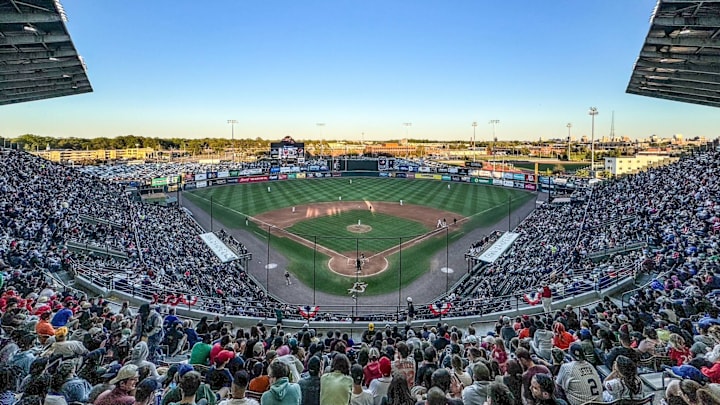
It’s a nearly universal reaction the first time someone sees The Diamond. Since it first opened in 1985, it has been many things: a hometown haven for Richmond residents, a hub for community and economic activity, and a rung on the organizational ladder for players and coaches for four decades. But for anyone arriving via I-95, its stature is the first thing that greets them.
For the San Francisco Giants, it has been a cavernous home to their Double-A affiliate - The Richmond Flying Squirrels - since 2010, and one of the last physical vestiges of the franchise’s presence on the East Coast.
That presence first shifted in 1957.
In a move that crystallized a broader geographical shift already underway, the New York Giants, - along with their crosstown rival, the Brooklyn Dodgers - announced they would trade coasts, leaving the nation’s cultural anchor for the promise of the Pacific. The decision made front-page news on both coasts.
It was received as sensational, but not shocking, as Yankees co-owner Del Webb noted earlier in the decade, “Everything is moving westward. Why not baseball?”
Yet buried deeper in those same papers a year earlier - overshadowed by box scores and pennant races - was a quieter development that would prove far more transformative to everyday American life.
That, of course, would be the passage of the Federal-Aid Highway Act of 1956. Few recognized its significance at the time, but it would become one of the most consequential public works projects in American history, reshaping how the country conducted trade and travel.
And those same highways that once carried the country - and the Giants - west now carried McCormick east, toward his first day on the Flying Squirrels’ broadcast team alongside Trey Wilson. The pair would soon be joined by crowds nearing 9,500, cramming into the ballpark to watch one of the most popular minor league teams in the country.
On his first introduction, the awe did not fade once he stepped inside.
“We were amazed by the size,” McCormick recalled. “I had never seen anything like that outside of major league ballparks. It’s distinct in size, distinct in architecture. You see this concrete behemoth that has been an icon for Richmond for so many years.”
But even icons age.
For forty years, The Diamond was the heartbeat of Richmond - a monument that echoed the multi-purpose stadiums of the era in which it was born. It carried the future of two marquee organizations on its grounds, first the Atlanta Braves, and then the San Francisco Giants. But the 2025 season was the last of its storied history.
It was fittingly closed by the Giants themselves, bringing their presence on the East Coast full circle at a ballpark that had come to mean far more than its place on the organizational ladder - a relationship shaped by the past, and one that is poised to continue toward the future.
A Presence on Each Coast
In a conversation about scale, consider this: A drive across the length of Interstate 95 - the longest north-to-south highway in the country - would add 1,905 miles on the odometer.
Point your car the same distance due west from Richmond and the end point would be somewhere near Las Vegas, nearly 1,000 miles shy of Oracle Park.
In total, there are 2,871 miles separating McCovey Cove from The Diamond. No distance is further from parent club to affiliate than the Giants’ partnership with Richmond.
If the Giants wanted an affiliate closer to home, they could have found one; three of the five National League West clubs place their own Double-A affiliates in the Texas League, a far shorter flight for players and front office staff.
And yet, for more than a decade, this unlikely pairing has endured.
In stark contrast against the Giants’ other affiliates - two in Northern California and one in Oregon - Richmond has little geographic reason to support the organization. The two markets share no borders, no media footprint, and no regional ties of any kind.
The real truth is it isn’t about convenience - it’s about trust. Long before the Giants arrived, The Diamond had already proven it could support sustained success for a Major League franchise.
As the longtime home of the Triple-A Richmond Braves, the ballpark helped develop the talent pipeline that powered Atlanta to 14 straight division titles in the 1990s and 2000s. The team moved to Gwinnett County in Georgia after the 2008 season, and for the first time, the stadium known for its size, and sound, was silent in 2009.
In 2010, baseball returned. And once again, The Diamond found itself at the center of a championship run.
That year the Giants finally won their first World Series since leaving New York. Back on their original coast, the franchise’s new Double-A club featured two future pillars of their nascent dynasty: Brandon Crawford and Brandon Belt.
Crawford and Belt were among the earliest signs that the Giants’ partnership with Richmond could succeed, offering early confidence in what the organization believed the environment at The Diamond could provide.

“What’s really special about our fan base is that fans latch onto individual players,” McCormick said. “Players who interact with them, players who were stars here - and they want those guys to succeed at the next level.”
Therein lies the serendipitous benefit of the Giants’ long-distance partnership with Richmond. In markets closely tied to their parent club, attendance often rises and falls with big-league fortunes or the arrival of a top prospect. That’s not the case in Richmond. Fans filed into The Diamond regardless of what initials appeared on the sleeve.
And because of the ballpark’s design - built at street level and looming over I-95 -, a full house created something that is difficult to replicate in the Minors: a genuine big-league feel, not just in size, but in decibels.
That presence was immediately apparent to Dennis Pelfrey, the manager of the Flying Squirrels since 2022, from his first game in the home dugout.
“One of the first things I tell players when they come through (Richmond) is that the noise and the environment here are the closest thing they’ll experience to a Major League ballpark,” Pelfrey said. “Playing in front of that kind of crowd every night helps them develop.”
Minor League managers walk a constant line between development and winning. Situations that might be second-guessed in the majors - leaving a reliever in too long, letting a hitter swing instead of bunting - are often intentional at this level, designed to test how prospects respond to adversity.
But the best Minor League managers know the line exists along the blending point between those two often diverging points of emphasis. Part of a player’s development is learning how to win in professional baseball, and in those moments, Pelfrey believes there was no better classroom than The Diamond.
“It makes it easier to play meaningful games,” Pelfrey said. When you get down to the wire, you can feel the energy of the stadium carrying you.”
With its two-tiered structure and broad overhang pressing sound back onto the playing surface like an amphitheater, Richmond has an inimitable roar, especially in the biggest moments.
“If there is a thrilling moment, your ears go numb,” McCormick said. “There’s no other ballpark in my opinion that contains that kind of noise and contains it all around the ballpark. That’s what made it special.”
But in the ballpark’s final season, it was the quieter moments that Pelfrey, the longest-tenured manager in club history, wanted to savor.
So when he joined Trey Wilson on the Flying Squirrels’ podcast, The Funnville Nine, ahead of the ballpark’s final Opening Night, the tone turned reflective.
“I’ll stand in the third base coaches box when (the opponent) makes a pitching change, and there is some extra time, and really try to soak it in,” Pelfrey told Wilson. “There are things where I will never be able to take my cell phone and take a picture of where I’m at and have that forever. It would be really cool to have some of those memories on film.”
If Pelfrey could have stepped back on a summer evening and taken that picture, what would he have seen?

On the infield, he would see the players entrusted to him, locked in competition. Beyond them, a crowd that has grown into a community over the years. And if he trained his focus behind the plate, he might find a familiar figure - a man he’s come to know personally, one who has missed just 13 Flying Squirrels games since the club’s inception.
He’d see Ray Edwards - a living bridge between the Giants’ past and their present on the east coast.
Dedication to The Diamond
Ray Edwards has a delightfully simple LinkedIn page. There is no profile picture, no posts to speak of, and no education history. All that exists on the page is a locator - Richmond, Virginia - and a headline that reads “Retired at Retired and enjoying Life.”
Joy is Edwards’ trade, and his outpost for the past four decades has been the ballpark at 3001 N Arthur Ashe Blvd, where his exports have always outweighed his imports.
“He’s a staple of the Richmond Flying Squirrels,” Pelfrey said of Edwards. “He’s always smiling. He’s the face of the fans - that’s the best way I can put it. He’s somebody who’s been a part of this team for a long time, and he’s going to be remembered as a Flying Squirrel.”
Make no mistake, the influx of joy is massive for Edwards. Yet it often manifests itself in a miniature way, with an autographed Flying Squirrels mini-helmet from just about every Flying Squirrels’ player that has passed through Richmond.
“That’s the first thing I do when a player gets here is to make sure I get that,” Edwards said. “That mini helmet is my first goal.”
It has become a ritual for fresh Flying Squirrels - arrive at The Diamond, meet with Pelfrey, receive a jersey number - and soon enough, find Edwards waiting beside the dugout, with a welcoming message and a mini helmet to sign.
Only two signatures have eluded Edwards since the club arrived in Richmond: Jeff Samardzija and Eduardo Núñez, both passing through on brief rehab stints that never brought them to The Diamond. He’s still after them - and experience suggests he’ll get there eventually.
After all, one doesn’t get just about every autograph he seeks without having a vast network of connections. If it needs to extend past state lines, so be it. Chances are Edwards knows a guy.
Take, for example, the story of how he tracked down former Flying Squirrel and brief Arizona Diamondback Tyler Graham.
It was 2012, part of Graham’s stint with Arizona, when during a postgame autograph session at Coors Field in Colorado, Graham was greeted by a friend of Edwards, brandishing a mini helmet, awaiting the stroke of a Sharpie. One swish of the wrist later and the deed was done.
A few years later, Graham was back with the Richmond team, and Edwards was able to get another signature in person. It’s just better that way.
Those helmets make up a collection in Edwards’ home so extensive it has been chronicled by local news, multiple times. Crammed in, they join Flying Squirrels’ bobbleheads, pennants, flags, pins, even the players themselves over the years.
“I let two or three (Flying Squirrels) live here at a time,” Edwards said. “That’s a part of my family.”
He’ll keep tabs on them once they’re gone, too. By Edwards count, three former roommates have made the Major Leagues, including Tyler Cyr, a relief pitcher who made Triple-A in the Giants organization before breaking through across the Bay Bridge with Oakland in 2022.
And yet, for all of Edwards’ familiarity with the team and at The Diamond, there is something that sets him apart. Unlike most of his friends in the crowd, Edwards is himself a lifelong Giants fan, with loyalties that began when the franchise was still in New York.
“My dad listened to Yankees games on the radio,” Edwards said. “But every time the Giants were on TV I would watch them.”
That’s how it started - a kid in Richmond, a flickering screen, and a team three states away. But the Giants didn’t stay distant for long.
In the 1950s, before I-95 cut through Richmond and before The Diamond, big-league teams came rolling through town after spring training up old U.S. Route 1, the original East Coast highway.
Occasionally, they would play exhibition games at Parker Field, the same patch of land where The Diamond now rises. The stars came with them, including The Say Hey Kid.
“Oh yeah,” Edwards said. “Willie Mays played here. Ted Williams played here. Roberto Clemente played here. The Giants played here. You could make a Hall of Fame team out of the guys who played on that field.”
As the Giants - and the country itself - moved west, Edwards stayed home. When The Diamond first opened, he was among the first wave of season ticket holders, settling into a seat he would fill for the next four decades.
From there, he watched another few generations of players pass through Richmond, adding to a lifetime spent in the presence of baseball’s greats.
And in staying, in returning night after night, Edwards became something else entirely. On the final day of the final season - the first 2,000 fans through the gates received a special giveaway: a Ray Edwards bobblehead, honoring the Flying Squirrels’ number one fan.

After watching so many legends come and go at The Diamond, Ray Edwards had become one himself.
The Unknown Gems
It was summertime in Richmond, and everything about this Saturday evening felt ordinary. The weather - a steamy 90 degrees at first pitch. The crowd - Edwards and 7,010 others at The Diamond for the penultimate game of a six-game homestand against New Hampshire.
The starting pitcher that night didn’t stand out, either. A sturdy, 6-foot-1, 21-year-old right-hander, unranked among the Giants’ Top 30 prospects. It was August 11, 2018, and this was his home debut in Double-A.
He threw five innings, allowed one run, and watched from the dugout as the Flying Squirrels rallied to score five unanswered after the fifth to win, 5–2.
Nearly eight years later, Logan Webb is the ace of the Giants’ staff - and a two-time All-Star.
“When he first got to Richmond, he wasn’t even a top prospect,” McCormick said. “But Double-A - Richmond - is where he really developed into a pitcher who could get outs, pitch deep into games, and handle big moments.”
What is precious about minor league baseball is the anonymity. The ballparks often lack the ostentatious suites of modern American sporting temples, so fans - whether they arrived in a weathered Tundra or a pristine Tesla - sit shoulder to shoulder, largely unaware of anything extraordinary unfolding in front of them.
To watch a future baseball superstar before fame and fortune is core minor league currency. It’s like having Harrison Ford as your carpenter, or Billy Joel as your lounge pianist. It’s gaining bragging rights in a category most coveted in conversation. It’s not about who you saw - it’s when you saw them.
It’s the quiet magic of a place like The Diamond. Over its lifespan, it offered fans a seat to watch players sand over the rough edges of their game before becoming something more.
Most of the players who passed through The Diamond did so without fanfare, their significance only becoming clear years later, once anonymity gave way to achievement.
To celebrate the ballpark’s hand in that, fans voted for the All-Diamond team prior to the 2025 season, choosing one manager - Grady Little - and 14 players:
Starting Pitcher: John Smoltz
Starting Pitcher: Tom Glavine
Starting Pitcher: Logan Webb
Relief Pitcher: Mike Stanton
Relief Pitcher: Hunter Strickland
Utility Player: Mark DeRosa
Catcher: Javy López
First Base: Ryan Klesko
Second Base: Joe Panik
Third Base: Chipper Jones
Shortstop: Brandon Crawford
Outfielder: Andruw Jones
Outfielder: David Justice
Outfielder: Deion Sanders
And those were just the guys that played for Richmond.
Throughout the final season, Wilson spoke with several members of the All-Diamond team, including Webb, as they paid tribute to a checkpoint on their way to the show.
“That’s a crazy list to be on with those two guys - two Hall of Famers,” Webb said of joining Smoltz and Glavine. “I had a blast playing (in Richmond) and loved my time there. Sad to see The Diamond going because that was a great place to pitch.”
Each notable name on the All-Diamond team carries a story tied to their time in Richmond. Some are tangible - like Deion Sanders’ tumultuous confrontation with spectators in the late 1980s, which directly led to the creation of a handicap-accessible seating section down the third-base line. Others are improbable - such as Brandon Crawford hitting not one, but two inside-the-park home runs in the same season in 2010. And some feel prophetic - like the Giants’ decision to have Joe Panik switch positions, which helped clear his path to the Majors and set the stage for an iconic World Series double play.
“I had to learn how to play second base,” Panik said, in his conversation with Wilson. “The Giants had won the World Series in 2012, and Crawford had a phenomenal season playing shortstop. That offseason, the Giants said they were going to move me from short to second. There was a lot of learning. I really learned a lot about myself, good and bad, and how to handle situations.”
The Diamond didn’t just shape champions for San Francisco or Atlanta - it produced plenty of its own in Richmond, too. The Richmond Braves won five league titles in the International League, including in 1994 under All-Diamond manager Grady Little.
That season carries special significance. Richmond has always needed baseball, but in 1994, baseball needed Richmond.
A players’ strike halted Major League play in August, silencing the sport’s biggest stages, but the sound of baseball still carried from Richmond. The R-Braves - in the midst of a strong run under Little - continued to play meaningful games into September, reaching the International League championship series.
And while it would be another 16 years before the Giants established an affiliate in Richmond, one future franchise icon was already there - in the broadcast booth. A Hall of Fame voice, calling the game for a national audience.
Over ESPN’s Sunday Night Baseball theme, Jon Miller - the soundtrack of San Francisco summers since 1997 - set the scene in front of a sellout crowd at The Diamond.
“It feels like summer. Temperatures were in the 80s in Richmond today. Welcome to The Diamond,” Miller said. “Tonight, Game 3 of the 1994 Governor’s Cup - the Syracuse Chiefs versus the Richmond Braves.”
The Diamond sparkled in its national TV moment as Miller, and his longtime ESPN partner, Joe Morgan, called a 3-0 R-Braves win that completed a three-game sweep of Carlos Delgado and the Chiefs.
“It’s really special to know this stadium has been on national television,” McCormick said. “Especially at one of the heyday moments for The Diamond and ESPN.”
After the game, a victorious Little was carried off the field by his players, placing the bow on a season in which he was named International League Manager of the Year. In 1996, he would make his Major League debut as a bullpen coach with San Diego, serving under another future Giants’ legend: Bruce Bochy.
Over three decades later, Wilson and McCormick travelled west to Arizona for Giants spring training in Scottsdale. On the agenda for their time out west: draft a list of questions, meet with Miller, and gather his memories from that night at The Diamond.
What would the 74-year-old broadcasting icon remember about his lone trip to the ballpark? As it turned out, just about everything. Miller only needed two names to unlock the entire night.
“I want you to find the starting pitcher and the closer for that game,” Miller instructed them. “That’s all I need.”
Wilson and McCormick came back the next day with the answers - Brad Woodall started, Brad Clontz closed.
“Yes, correct! Brad Woodall!” Miller declared with his unmistakable intonation.
Miller then recited his memories of Woodall’s seven scoreless innings, the side-arm delivery of Clontz, a topspinning solo home run from Jose Oliva, and a sellout crowd of over 12,000 at The Diamond.

“He’s a Hall of Famer for a reason,” McCormick said. “He’s so sharp with his memory recollection and just the way he tells a story. It’s really special for me to be in the same booth as a legend that tiptoed through here.”
Miller’s recollection of that night was so strong that by the time he had finished his answer, there was no need for a follow-up.
“I don’t think I have anything else, John,” Wilson said. “I think you covered every aspect of what we wanted to hear.”
But Miller had one last note to add.
“I’m sad to see it go, that’s for sure,” he said. “I think there are a lot of young guys who started their careers there or are early on in their development there who will be missing it as well.”
As The Diamond reached its final days, those young guys Miller mentioned took the field - some aware of the history beneath their cleats, others focused on what could be next. Among them was a Virginia native, still early in his professional journey, whose presence offered a link between what Richmond had been and what it was about to become.
The future was already standing on deck.
What Comes Next
Bryce Eldridge became the most popular man in Richmond on September 7, 2024. That night, in front of a capacity crowd of 9,560 at The Diamond - including nearly 60 family members and friends - he launched his first Double-A home run in the opening inning, giving the Flying Squirrels an early 2-0 lead. It proved to be all the offense Richmond would need in a 3-1 triumph over Akron.
There have been plenty of can’t-miss kids to pass through The Diamond over the decades, but Eldridge stood apart in several ways. At 6-foot-7 and a lean 240 pounds, he was as imposing as the ballpark itself, and at 19 years old, he was the youngest to ever homer as a Flying Squirrel.
But it wasn’t just the size or the youth, or even the local roots - born about 100 miles north up I-95 in Fairfax - that energized The Diamond. It was the swing. More specifically, the sound.
“The way he hits the ball and the way that it goes off his bat is just different,” McCormick said. “It’s different in the way that it sounds and the way that it travels.”
Edwards, seated in his usual spot, has seen every generation of slugger pass through Richmond. He knew this one was different.
“He’s got the best power I’ve seen for a young kid,” Edwards said. “I mean some of the balls he got out of the ballpark were just monsters.”
The Giants drafted Eldridge for his prodigious power, and he delivered six more home runs during a loud but brief 24-game stint at The Diamond spanning late 2024 and early 2025, becoming one of the final fan favorites in the ballpark’s storied history.
“It was really special to have a Virginia native here in this stadium, on its 40th anniversary, becoming a major star in the minor leagues,” McCormick said. “It gave the fans someone to cheer for this season, a Virginia guy on a Virginia-based team.”
And on that overcast Saturday night, as a foundational piece of the Giants’ future circled the bases at The Diamond, another foundation was being poured just across the street - the beginning of what comes next.
The night prior, the Giants and the city of Richmond had gathered next door for the groundbreaking ceremony of a new Double-A ballpark, one that should keep the franchise tied to the East Coast for the foreseeable future.
The new home will trade scale for spectacle, built with the modern expectations of today’s game in mind. It will feature the largest video board in Virginia - two in total - along with a 360-degree concourse, the first of its kind in Richmond. Previously, home runs were collected as souvenirs only after it went through someone’s windshield in The Diamond’s parking lot.
It will have better sightlines, expanded hospitality areas, additional luxury suites, this time above the concourse level. It even comes with a title sponsor: CarMax Park.

“Richmond doesn’t know how incredible this place is going to be until they walk through it for the first time,” McCormick said.
That’s just the fan experience. The Giants stand to benefit just as much.
“The (team) amenities are going to be huge,” McCormick said. “I think that’s the first thing the Giants are going to be really appreciative of. It’s got a much larger clubhouse, a much larger training room, larger weight room - all the things we can do to accommodate players.”
As the final season of The Diamond rolled along and CarMax Park began to take shape in 2025, Pelfrey crossed the street for his first look at the new ballpark. There was still plenty of work to be done, but what he saw promised to raise the standard for how the Giants develop players in Richmond.
“Just to see the space itself, it’s going to be incredible,” Pelfrey said. “I think it’s going to be overwhelming for some players. It’s going to be one of the best facilities around, if not the best. Obviously, for the Giants, we like to be the best at everything we do.”
Just as he was four decades ago at The Diamond, Ray Edwards will be part of the first group of fans to select season tickets at CarMax Park. All the bells and whistles sound impressive to Edwards, but he’s really looking forward to one key addition - or perhaps better said, subtraction, at the new ballpark.
“No steps,” he said with a laugh. “That’s the biggest difference for me.”
The Diamond was beloved, but a seat there was something you earned. Upon entry, fans had the option of climbing about 30 steps or taking an elevator up to the main concourse.
“The elevator has been there for 40 years and it’s slow as molasses,” Edwards said.
Just about everything at CarMax Park will be elevated from its predecessor - except the ballpark itself.
“Unlike The Diamond, it’s actually buried beneath street level,” McCormick said. “The stadium is a little lower. You’re not going to immediately see it when you’re driving on the interstate. That’s going to be a different experience.”
There may be no larger difference. CarMax Park will still carry a sizable capacity - 10,000 seats, slightly more than The Diamond’s listed capacity - but it won’t announce itself to I-95. It won’t rise from the roadside as a summer gathering place, a waypoint in a baseball journey, or a landmark woven into the daily rhythm of Richmond.
That visibility was the essence of The Diamond. Nearly every story about the ballpark began with the same observation: its size. How it loomed over the highway. How it made drivers slow down and glance twice just to confirm what they were seeing.
When The Diamond was constructed, there was little about it that felt unique. It was a byproduct of its own era - a utilitarian concrete structure, a half-measure relative of the multi-purpose stadiums that rose along America’s expanding interstate system. In city after city, the first impression wasn’t a skyline, but a concrete coliseum: Veterans Stadium, Fulton County Stadium, Jack Murphy Stadium and plenty others all fit the description. Those stadiums were everywhere, and then they were nowhere.
As tastes, economics, and priorities shifted, they were all summarily replaced, leaving The Diamond as a treasure - one of the last visible reminders of a time that had since passed.
The Giants once had one of those, too. From 1960 through the end of the 20th century, Candlestick Park stood as the home of Giants baseball. It was miserable. It was cold. And as Howard Cosell once described it during an ABC telecast of the Major League All-Star Game, it was “a monument to political chicanery.”
But it was unmistakably San Francisco’s, and it’s sorely missed.
Along U.S. Route 101 - one of the Pacific Coast’s echoes of I-95 - the sign is still there: Exit 429A, Candlestick Park. Except there is nothing there now, only an empty lot where a place once rose beside the highway, filled with memories and moments that refuse to disappear.
But it isn’t really gone. In the mind’s eye, Candlestick still stands for anyone old enough to have passed through its gates. That will be the case in Richmond, too. The Diamond will soon be demolished, but its shadow will linger for years to come over the place that will come next.
“It’s going to have to create its own aura,” Pelfrey said of CarMax Park. “It’s how I talk about our players, too. We lose a guy like Bryce Eldridge, we’re not looking to replace him, we’re looking for someone else to step up and become who they are supposed to be. That’s how this stadium is going to have to be. It's going to have to carry its own weight, it can’t live off The Diamond’s coattails.”
Whether it will carry its own weight remains to be seen, but one thing is certain: Richmond will be there.
“This is still a very passionate fanbase that wants to be heard, wants to have a great time,” McCormick said. “That’s something that a lot of these players will experience every day in the big leagues - so why not deliver that in the minor leagues?”
“It’s a chance to start fresh,” Pelfrey said. “To create new legacies and new legends. We talk about who came through The Diamond all those years ago - and my hope is that 20 years from now, we’re having those same conversations about CarMax Park.”
Those new legacies will begin in the new ballpark’s first game on April 7. A good percentage of the Flying Squirrels who played out the final days of The Diamond in 2025 are likely to be there to open CarMax Park.
But by midsummer the roster will thin to the point where, in the near future, no Flying Squirrel will know baseball in Richmond anywhere but at its sparkling new digs.
And when that day comes, Ray Edwards will still be there - with a Sharpie and a smile - happy his favorite franchise is still rooted in his hometown.
“The Giants definitely want to stay in Richmond because the Flying Squirrels treat you so good,” Edwards said. “It’s a great relationship.”
As it turns out, diamonds aren’t forever. But nearly seven decades after the Giants left New York for San Francisco, their presence in the East continues to live on along I-95.
Recommended Articles
 Add us as a preferred source on Google
Jack Johnson covers the San Francisco Giants for OnSI. A Bay Area native and graduate of Arizona State University’s Walter Cronkite School of Journalism, Jack combines his background in writing, reporting, and live broadcasting to deliver comprehensive coverage of Giants baseball. In addition to his work with OnSI, Jack serves as the Play-by-Play Broadcaster and Media Relations Manager for the Columbus Clingstones (Double-A, Atlanta Braves) and has called games across MiLB.TV, ESPN+, and the Arizona Fall League. He specializes in storytelling, player features, and game analysis designed to connect fans with the team on and off the field.
Follow jackjohnson25