
Mariners’ J.P. Crawford Conversation Is More Complicated Than Either Side Wants
In this story:
J.P. Crawford is becoming one of the trickiest reads on the Mariners’ roster, which feels almost wrong to say because Crawford has been one of the easiest players on this team to understand for years.
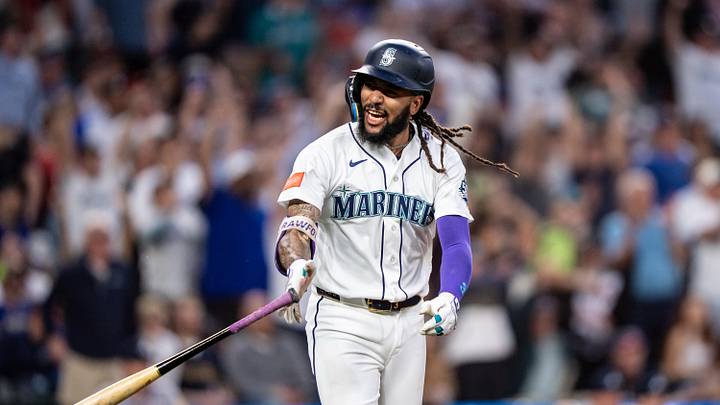
You knew what you were getting. A steady shortstop and a tone-setter who is going to give you professional at-bats. That version of Crawford still exists. We’ve especially seen it in this series against the Braves, when he launched a two-run home run that helped push the Mariners over Atlanta. And provided another the following night.
So no, this is not a piece about pushing J.P. Crawford out of the Mariners’ plans. That would be lazy, and it would miss the more interesting, slightly uncomfortable conversation.
Because Crawford’s bat might actually be in a better place than the surface production makes it look. The underlying offensive profile is not just fine. In many ways, it’s genuinely encouraging. The problem is that the defensive side of the equation has become too loud to ignore, and that makes his overall value harder to sort through than it used to be.
The Mariners don’t need to be looking for a way out of Crawford. They may, however, need to be honest about the fact that the margin around his profile has changed.
Let’s start with the good, because it matters here.
Crawford’s offensive numbers underneath the hood are giving the Mariners real reasons to believe there is more coming. This looks like a hitter who is seeing the ball, controlling counts, refusing to chase and doing more damage than usual when he gets something he can attack.
That matters because Crawford has never had to be a traditional middle-of-the-order masher to help this lineup. His best offensive value has always come from making pitchers work. When he is right, he is annoying in the best possible way. He turns a simple leadoff plate appearance into a six-pitch headache. He gets on base. He’ll do a bunny-hop on first while making starters show more of their arsenal. He gives the lineup traffic.
This year, that part of his game is screaming. An 18.3 percent walk rate paired with a 15 percent strikeout rate is excellent. That is a hitter controlling the strike zone at a high level. His chase rate, whiff rate, strikeout rate and walk rate all point in the same direction. Crawford is not getting fooled often.
And the contact quality is where things get more interesting. His expected production is outpacing his actual production, with a .378 xwOBA sitting well above his .331 wOBA. His .426 xSLG is also notable for a player whose offensive game has not usually been built around slugging. Add in a 9.1 percent barrel rate and a 32.5 percent squared-up rate, and there is a pretty clear case that Crawford is making better swing decisions and doing more with the pitches he chooses to attack.
That doesn’t mean he has suddenly become a masher. The better way to say it is that Crawford is doing something more Crawford-like, but with a little more punch attached. That is a real offensive foundation. The Mariners could absolutely use that version of Crawford for a full season.
Back-to-back nights for J.P.! #TridentsUp pic.twitter.com/yAo8MAn861
— Seattle Mariners (@Mariners) May 6, 2026
Crawford’s Defensive Decline Is Turning a Promising Bat Into a Harder Mariners Question
Here is where the conversation gets uncomfortable. For most of Crawford’s time in Seattle, any offensive bump felt like a bonus because the defense was supposed to be part of the bedrock. He did not have to carry the entire value equation with his bat. He could be a league-average-ish hitter, or better than that in the right year, because the glove, leadership and at-bat quality rounded out the rest of the package.
But if the glove is now giving value back, the offensive bar changes. Crawford’s bat looks encouraging. It might even be better than the surface numbers show. But “encouraging” and “carrying” are not the same thing.
That distinction matters a lot at shortstop. C.J. Abrams is a useful comparison, even if the players are very different. Abrams has been a rough defensive shortstop by the metrics, but his offensive value has been enormous. If a shortstop is sitting with a 15 Batting Run Value and landing in the 98th percentile, that kind of bat can help offset defensive damage. It doesn’t erase it, but it changes the equation
Crawford’s Batting Run Value sitting at 3 is good. It supports the idea that his offensive process has real value. But it’s not the kind of overwhelming offensive production that makes a team comfortable living with bottom-tier defensive metrics at shortstop.
And right now, those defensive metrics are not quiet. Crawford’s defense hasn’t simply had one weird month. The trend has been building for a while. It hasn’t been a clean year-by-year collapse, because there was a 2024 rebound in there, but the larger picture is messy enough that it no longer feels responsible to dismiss it as noise.
Back in 2020, Crawford graded like a legitimately strong defensive shortstop by Statcast, posting plus-7 Fielding Run Value and plus-6 Outs Above Average. That was the version of Crawford whose glove could stabilize the entire profile.
Since then, the numbers have been much harder to love. His Fielding Run Value went from plus-3 in 2021 to minus-5 in 2022 and minus-9 in 2023. He did bounce back to plus-1 in 2024, which deserves to be mentioned because it keeps this from being a simple “he has declined every single year” story. But then came another minus-9 in 2025, and he is already underwater again in 2026.
The Outs Above Average trend tells the same general story. But the range is probably the biggest part of it. Crawford’s range component in Fielding Run Value has gone from plus-5 in 2020 to neutral in 2021, then to minus-8 in 2022, minus-7 in 2023, plus-1 in 2024, minus-9 in 2025 and negative again early this season. That’s the area doing most of the damage.
And then there is the arm strength. Crawford’s average arm strength is down to 77.8 mph. Among shortstops, only Francisco Lindor at 76.2 mph and Colson Montgomery at 77.5 mph sit lower. The league average at the position is 86.2 mph. That is a massive gap.
Arm strength is not everything at shortstop, and this is where we have to be fair. A smart defender can compensate with footwork, release, positioning, instincts and internal clock. Crawford has a lot of those veteran qualities. He knows how to play the position.
But at shortstop, physical margin matters. Arm strength protects range. It buys time and lets a player make throws from deeper angles. When that arm strength is near the bottom of the league and the range metrics are also trending poorly, it becomes a real problem.
Crawford is tied for last among qualified shortstops in range at minus-4, alongside Willy Adames and Abrams. His Fielding Run Value sits at minus-4, only one run ahead of Abrams. And again, that is not exactly the defensive neighborhood a team wants its veteran shortstop living in.
That is the entire squeeze. The Mariners really need Crawford’s bat. But it doesn’t make the defensive numbers disappear. So what do the Mariners do if the offensive profile keeps looking promising, but the shortstop defense keeps costing them runs?
That is where things get weird. A move to third base doesn’t really make sense if the arm strength isn’t exactly there. And in theory, second base would be a cleaner fit. Crawford’s average would fall closer to the middle of the pack there.
But that’s not a clean solution either, because Cole Young is already at second base, and Young’s own arm strength sits at 73.1 mph, near the very bottom of the position. So even the theoretical escape hatch comes with another complication. Classic Mariners roster puzzle: the door opens, and somehow there is another door behind it.
Designated hitter is another thought, but that’s not simple either. DH at-bats are valuable, especially for a team still sorting through its offensive identity. If Crawford’s underlying bat keeps translating and he becomes one of the better on-base threats on the roster, maybe there are days where it makes sense. But as a regular answer? That’s a tough sell unless the production fully catches up to the process.
And shortstop? There’s no easy replacement sitting there. Colt Emerson is the obvious future name, but the Mariners are also trying to solve third base, protect development timelines and avoid forcing a prospect into a role just because the major league roster got uncomfortable. Emerson may be the long-term answer somewhere on the left side, but that doesn’t automatically make him the clean shortstop answer right now.
That’s what makes this more than a Crawford story. It is a Mariners roster-construction story. They could use Crawford’s bat. And they could use his leadership. But if the glove is costing runs at one of the most important defensive positions on the field, they cannot just pretend the rest of the profile is unchanged.
The fairest version of this conversation is not that Crawford is done at shortstop or that the Mariners need to make some dramatic move. It’s that Crawford’s value equation has become more complicated, which is probably why the conversation around him has gotten so loud, and, at times, needlessly combative, on social media.
The offensive process is real. The improved barrel rate and squared-up contact are real. The two home runs against Atlanta was a reminder. Crawford can still impact games with the bat, and the Mariners need players who can do that.
But the defensive decline is real, too. Both things can be true. Crawford still has plenty to give the Mariners. The question is whether they can find the right way to keep getting it without letting the defensive cost keep growing.
 Add us as a preferred source on Google
Tremayne Person is the Publisher for Mariners On SI and the Site Expert at Friars on Base, with additional bylines across FanSided’s MLB division. He founded the Keep It Electric podcast in 2023 and covers baseball with a blend of analysis, context, and a little well-timed side-eye just to keep things honest. Tremayne grew up a Mariners fan in Richmond, Va., and that passion ultimately led him to move to Seattle to cover the team closely and become a regular at home games. Through his writing, he connects with fans who want a deeper, more personal understanding of the game. When he’s not at T-Mobile Park, he’s with his dog, gaming, or finding the next storyline worth digging into.
Follow TremaynePerson