
Mariners’ Looming Free-Agent Class Puts Familiar Core at a Painful Crossroads
In this story:
The uncomfortable part about building a contender is that not everyone gets to come along for the next version of it. That’s where the Mariners are right now. They are trying to win the AL West, sure. But they are also playing through a season that could decide how much of this familiar core actually sticks around.
Randy Arozarena and J.P. Crawford can reach free agency after 2026. Rob Refsnyder is on a short-term deal. Víctor Robles has a $9 million club option for 2027. Luis Castillo is not in that exact group, but his contract and rotation fit still matter to the broader roster picture.
So every part of this season carries a little extra weight. The Mariners are trying to win now, yes. But they are also getting a long look at which familiar players should still be part of what comes next.
The Mariners have spent years telling us what they want to be. They want pitching, controlled talent, internal development, and to be careful with money. That approach can work. We have seen proof of concept. But it also creates moments where several familiar veterans reach the edge of the roster map at the same time.
That makes the rest of 2026 feel bigger than the standings alone. Because Seattle is not only deciding how far this group can go. It is deciding how much of this group should come back.
The Mariners’ expiring contracts are really a test of what comes next
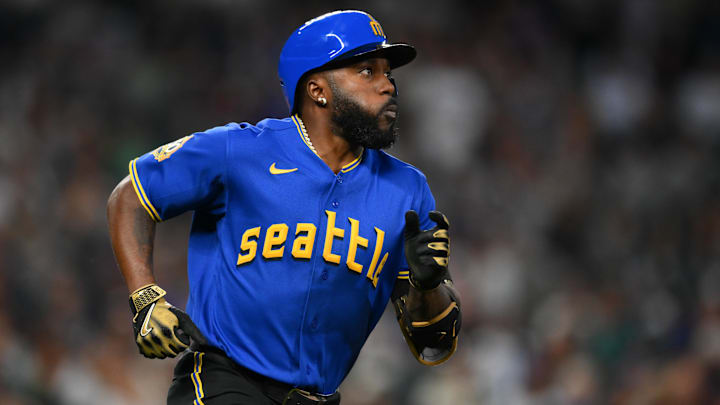
Arozarena is the biggest name here, and probably the easiest place to start because his case is not simple. Since arriving in Seattle, he carries a .242 average, with 35 home runs, 111 RBI and 44 stolen bases across 253 games, including a 27-homer, 31-steal season in 2025. Players who can threaten a 25/25 season don’t grow on trees, and the Mariners know how long they spent looking for this kind of power-speed edge in the lineup.
That’s also what makes the decision uncomfortable. If Arozarena keeps producing, he strengthens the argument that Seattle should not just let that skill set walk away. But if he plays well enough to make himself essential, he probably also plays well enough to make himself expensive. If he does not, the Mariners might have a cleaner baseball argument for moving on, but that would also mean the lineup did not get the version of him it needed during a season built to matter. There is no painless lane here. Either Seattle pays to keep the player it hoped it was getting, or it admits the fit was more temporary than transformational.
Crawford is different. His case is not just about production. It’s about identity. He has been around long enough to feel attached to this era of Mariners baseball. He’s been part of the clubhouse fabric that has spent years trying to turn promise into something sturdier. That matters, even in a sport that gets ruthless the second a younger, cheaper option starts knocking.
But sentimentality cannot be the whole argument. The Mariners have young talent coming. Colt Emerson is part of the larger conversation about how this roster evolves. Seattle also has to think about athleticism, offensive ceiling, positional flexibility and how much longer it wants to keep leaning on familiar veterans while the next wave keeps applying pressure.
That does not mean Crawford is definitely finished in Seattle, even if that outcome feels more realistic than it once did, especially after the Emerson extension. It means the decision is no longer automatic. And that’s uncomfortable, because players like Crawford do not leave cleanly in the imagination. They force fans to separate what a player has meant from what the roster needs next.
Refsnyder is the smaller name, but not a meaningless one. Teams need veteran bench bats. Not every offseason choice is about a star. Sometimes it is about whether a front office still wants to spend roster space on a steady and stable adult.
Robles is a clean decision point because of the option. The Mariners don’t have to enter a bidding war. They have to decide whether $9 million makes sense for what he gives them. Given his injury history the last two seasons, it’s likely he’ll hit free agency.
That is the theme with all of this. The Mariners are not making these decisions in a vacuum. They are making them around Julio Rodríguez, Cal Raleigh, Josh Naylor, the young core, the prospect wave and a pitching staff that still demands enough financial and roster flexibility to avoid getting boxed in.
Which brings us to Castillo. He is not a post-2026 free agent, and it would be misleading to frame him that way. But he still belongs in the conversation because his contract, age, performance and role all connect to the same larger roster reality. The Mariners’ flexibility is only as clean as the commitments already on the books, and Castillo remains one of the biggest pieces shaping what they can do next.
If the rotation squeeze keeps tightening, if Kade Anderson is truly as good as he has looked this early in his pro career, and if Seattle has to decide where its next real dollars are best spent, Castillo’s future becomes part of the same roster crossroads. That’s especially true after his rough start to the 2026 season, which has already made a once-uncomfortable question feel a lot louder: should he still be guaranteed a rotation spot right now?
That doesn’t make him the same kind of decision as Arozarena, Crawford, Refsnyder or Robles. But it does make him part of the same bigger conversation. The Mariners are not just evaluating who might leave after the season. They are evaluating how much of the current structure still fits the next version of the team.
The Mariners are reaching the stage where the roster cannot keep living halfway between eras. That does not mean Seattle should tear anything down. But it does mean this season is carrying a second scoreboard. Arozarena is playing for his next contract. Crawford is playing for his place in the next version of the infield. Robles is playing for his option. Refsnyder is playing for continued usefulness. And Castillo is pitching under the weight of a rotation picture that may only get more complicated.
By the time this season ends, Seattle might be asking whether it’s time for the next version of the Mariners to stop waiting politely in the hallway and finally walk through the door.
 Add us as a preferred source on Google
Tremayne Person is the Publisher for Mariners On SI and the Site Expert at Friars on Base, with additional bylines across FanSided’s MLB division. He founded the Keep It Electric podcast in 2023 and covers baseball with a blend of analysis, context, and a little well-timed side-eye just to keep things honest. Tremayne grew up a Mariners fan in Richmond, Va., and that passion ultimately led him to move to Seattle to cover the team closely and become a regular at home games. Through his writing, he connects with fans who want a deeper, more personal understanding of the game. When he’s not at T-Mobile Park, he’s with his dog, gaming, or finding the next storyline worth digging into.
Follow TremaynePerson