%20%20--%3E%0A%3Csvg%20version%3D%221.1%22%20id%3D%22Layer_1%22%20xmlns%3D%22http%3A%2F%2Fwww.w3.org%2F2000%2Fsvg%22%20xmlns%3Axlink%3D%22http%3A%2F%2Fwww.w3.org%2F1999%2Fxlink%22%20x%3D%220px%22%20y%3D%220px%22%0A%09%20width%3D%2239px%22%20height%3D%2240px%22%20viewBox%3D%220%200%2039%2040%22%20enable-background%3D%22new%200%200%2039%2040%22%20xml%3Aspace%3D%22preserve%22%3E%0A%3Cpath%20fill%3D%22%23FFFFFF%22%20d%3D%22M38.5%2C7H28.2v26h10.3V7z%22%2F%3E%0A%3Cpath%20fill-rule%3D%22evenodd%22%20clip-rule%3D%22evenodd%22%20fill%3D%22%23FFFFFF%22%20d%3D%22M26.1%2C25.5c0%2C5.8-4.1%2C7.5-12.9%2C7.5C3.9%2C33%2C0%2C31.2%2C0%2C25.2v-1.1h11.6%0A%09v2.4c0%2C0.7%2C0.1%2C1.4%2C1.2%2C1.4c1%2C0%2C1.2-0.4%2C1.2-1.3v-0.9c0-1.6-0.9-1.6-3.5-2.2C2.2%2C21.7%2C0%2C19.7%2C0%2C15.3v-0.9C0%2C9.3%2C5.5%2C7%2C12.9%2C7%0A%09c10.2%2C0%2C12.8%2C2.6%2C12.8%2C7.4v1.8h-11v-2.9c0-0.6-0.4-1.1-1.2-1.1c-0.6%2C0-1.2%2C0.4-1.2%2C1.1v0.9c0%2C1.5%2C0.9%2C2%2C3.3%2C2.5%0A%09c8%2C1.6%2C10.5%2C3.3%2C10.5%2C7.5V25.5z%22%2F%3E%0A%3C%2Fsvg%3E%0A)
MLB’s ABS Challenge System Has Little-Known Wrinkle That May Trip Up Hitters
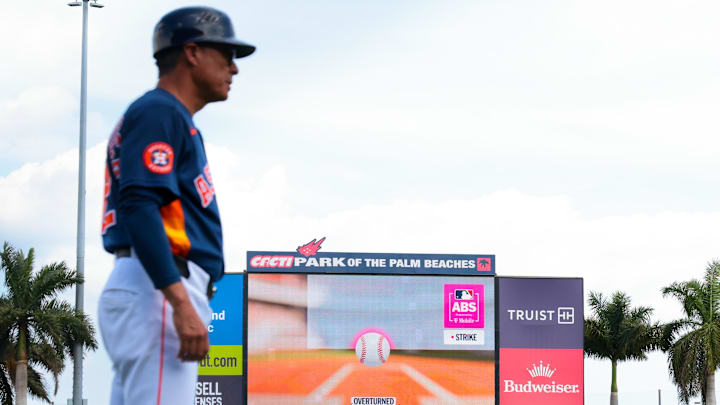
Spring training has provided a proving ground for Major League Baseball's new Automated Ball-Strike challenge system and the results have been quite positive. The entire process is short and relatively painless, allowing more of the 50-50 calls to be properly adjudicated. Actual stakes for the process begin this week with the beginning of the regular season and players are still learning some of the intricacies.
For instance, here's Cavan Biggio of the Astros finding out in real time that a challenge must be immediately instituted after he took issue with a bad called third strike during an at-bat Sunday against the Cardinals.
Biggio knew that the ball in question was well below the strike zone but he failed to properly initiate the review because he flipped his bat before touching his helmet.
#MLBenSala ⚾️ Una de las nuevas reglas del sistema ABS exige que el jugador solicite el challenge antes de hacer cualquier otro movimiento.
— LA SALA DEPORTIVA (@LaSalaDeportiva) March 23, 2026
Cavan Biggio tenía lo que parecía ser la base por bolas, pero giró el bate antes de pedir la revisión, perdiendo la oportunidad. pic.twitter.com/WMWzOuQY6n
Under the new operation, any challenges must come immediately after the umpire’s call, without assistance from the dugout or other players. In this instance, Biggio taking the time to flip his bat in frustration was deemed to be too long of a delay.
There's a good chance that players other than Biggio were unaware of just how tight the window could be before seeing it play out in real time as this clip has gone viral. But that's exactly what spring training is for.
It will be interesting to see how this plays out in the regular season, as the ruling of whether a challenge is triggered quickly enough boils down to yet another judgement from the umpire as well.
How MLB’s ABS Challenge System works
Each pitch is tracked by 12 Hawk-Eye cameras set up around the perimeter of every ballpark in MLB. If a batter, catcher or pitcher feels the home plate umpire missed a call, they request a challenge. The ABS Challenge system then compares the pitch location to the hitter’s individualized strike zone (more on that later).
The home-plate umpire will then announce the challenge to the ballpark and a graphic—produced via private 5G network from T-Mobile for Business’ Advanced Network Solutions—is displayed on the scoreboard and the television broadcast, showing the results of the challenge.
If any part of the ball touches any part of the strike zone, the pitch is considered a strike. In its entirety, the process takes roughly 15 seconds, resulting in a smooth transition back to play.
MLB’s ABS Challenge System rules
Each team receives two challenges per game and can retain a challenge if it’s ultimately successful. Challenges can only be initiated by a pitcher, catcher or batter, and the request must come immediately after the pitch.
There are two ways players can signal for a challenge, either by tapping their helmet or cap, or by vocalizing their challenge request to the home plate umpire. Players may not receive help from the coaching staff, other players or anyone else while considering whether to challenge a ball or strike call.
If a team enters extra innings and has no challenges remaining, they’ll be provided an extra challenge in each extra inning. So if a team enters the 10th inning without a challenge, they’ll be provided one and if they utilize that challenge before the 11th inning, they’ll be provided with another, and so on and so forth. Teams that enter extra innings with a challenge will not be provided with one.
A pitch may not be challenged if a position player is pitching.
Both an ABS Challenge and video replay challenge can occur on the same play. The ball-strike call will be settled first, followed by the video replay on the bases.
The outcome of a stolen base is likely to stand regardless of a ball-strike challenge, with the two exceptions being a ball-four or strike-three call that was overturned by the ABS system. In that instance, umpires will have the discretion to determine if a ball-strike ruling impacted the behavior of baserunners and defenders in the play on the field.
For example, if a catcher stopped playing and didn’t throw to a base on a stolen base attempt because he heard ball four and the call was overturned, the umpire would have the freedom to send the runner back to his original base, nullifying the stolen base attempt.
More MLB from Sports Illustrated
 Add us as a preferred source on Google
Kyle Koster is an assistant managing editor at Sports Illustrated covering the intersection of sports and media. He was formerly the editor in chief of The Big Lead, where he worked from 2011 to '24. Koster also did turns at the Chicago Sun-Times, where he created the Sports Pros(e) blog, and at Woven Digital.
Follow KyleKoster