
Nationals Monday Fastball: To Trade or Not to Trade CJ Abrams
In this story:
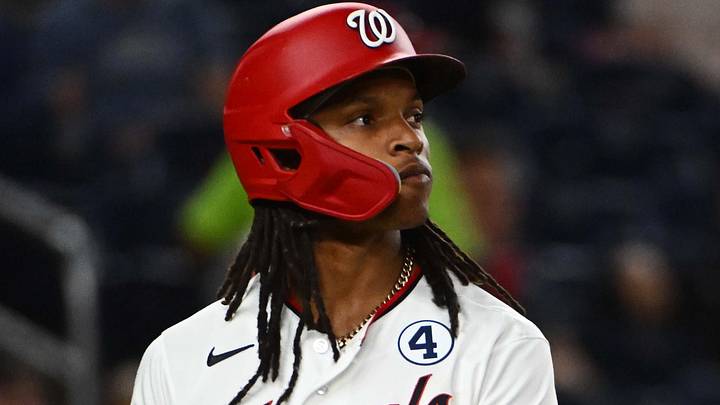
With just under two months until the trade deadline, Washington Nationals star shortstop CJ Abrams is going to be featured in just about every think piece out there until Aug. 3 passes.
That's the reality of the situation as new president of baseball operations Paul Toboni tries to get the franchise's rebuild back on track after the previous regime's stalled out. Shipping out their best trade assets for future building blocks is the best way to do that, and the Nationals have already reaped the benefit of that based on the early returns from their MacKenzie Gore blockbuster this past winter.
But what makes the conversation about Abrams difficult is just how good he's been for Washington this season. And with this young group right in the thick of the NL Wild Card race at the beginning of June, the thought of shipping their star out of town doesn't sit right with a lot of people.
Hence the conundrum: to trade Abrams or not to trade him.
Below is a look at the benefits of each decision and what short and long-term ramifications they could have on the Nationals depending on what route the front office decides to take.
Why Trading CJ Abrams Makes Sense

The most obvious benefit when it comes to trading Abrams is the return he would generate for Washington's farm system. Based on the fact they got five top 30 prospects from the Texas Rangers in exchange for Gore, one can only imagine what they might get for Abrams.
He has been one of the best offensive shortstops in the sport, and that is something every team would love to have on their roster. And while his defense continues to be an issue -- and it doesn't look like it's going to be league average at any point during his career -- he's so good at the plate that front offices around baseball would still line up to acquire him.
Whether that would result in the Nationals adding even more high-upside young prospects to their farm system or acquiring ready-made Triple-A or big league players early on in their careers isn't known, but dealing Abrams would almost assuredly net the organization multiple pieces who would benefit the franchise in the long run. And because he is 25 years old, there are questions if his timeline even matches up with what the new regime is building since he might be out of his prime by the time their current star prospects are ready to become major leaguers.
That's not even taking into account the fact that Abrams has two more seasons of club control remaining before he becomes a free agent. And because he's expected to have an asking price Washington might not be able to match when he hits the open market, they would risk losing him for nothing if they don't trade him when he's under team control.
When taking all that into account, it's easy to see why the pros could outweigh the cons when it comes to shipping the All-Star shortstop out of town. Not only would he generate a monster return that would help create one of the best farm systems in the sport, but trading him now at the peak of his value would also ensure they wouldn't lose him for nothing, which is a real possibility.
Why Holding Onto CJ Abrams Makes Sense

The other side of the coin presents just as strong of a case, though. That's because the Nationals are the team that currently has one of the best offensive shortstops in the sport, in his prime, on their roster. Because of that, it's simple to point out the fact that they should be building around him, not looking to trade him away.
Manager Blake Butera has heaped praise on Abrams this season, and it's clear the 25-year-old has turned into one of the leaders of this team. Not having him in the clubhouse anymore could hurt the growth and development of their young big league squad, which would be counterproductive to what the new front office is trying to accomplish.
In addition to that, the frustration it might cause the fanbase could also be catastrophic. There is already a massive subsect of fans who no longer follow the team after a rebuild was initiated following the World Series win in 2019 when attendance was through the roof. And as some of them start coming back based on the excitement that this current group has provided in 2026, trading one of the faces of the team would likely turn a lot of people off again, which would not be a good result.
Therefore, when combining the potential of alienating the fanbase again and the possibility that trading him away would hurt the clubhouse and overall growth of the team, the camp that believes Abrams should remain part of the franchise also has a solid argument.
Conclusion

Everyone is going to have their own opinions on the Abrams conundrum when it comes to either trading him or keeping him, and that is going to painstakingly be the case for the next few months.
But if it were up to me (and it's clearly not), then I would make the decision to hold onto him and do everything in my power to lock him into an extension that would keep him with the Nationals through his prime years.
The talent of Abrams is undeniable, and he's on pace to do something this season that would make him an All-Star contender for the foreseeable future if that's the offensive output he's going to generate on a consistent basis. That is too much for me to trade away, even if the return looks amazing on paper.
So, despite the number of up-and-coming prospects who appear like they could be the next wave of stars in Washington, I would still choose to build around Abrams and figure things out from there. Whether that's what the Nationals decide to do remains to be seen.
 Add us as a preferred source on Google
Brad Wakai graduated from Penn State University with a degree in Journalism. While an undergrad, he worked at the student radio station covering different Penn State athletic programs like football, basketball, volleyball, soccer and other sports. Brad became the Lead Contributor for Nittany Lions Wire of Gannett Media where he continued to cover Penn State athletics. Currently, Brad is the Publisher for Washington Nationals On SI and covers multiple teams across the On SI network. He is the host of the sports podcast I Said What I Said, where he and his co-host discuss topics across the NFL, College Football, the NBA and other sports. You can follow him on Twitter: @bwakai