%20%20--%3E%0A%3Csvg%20version%3D%221.1%22%20id%3D%22Layer_1%22%20xmlns%3D%22http%3A%2F%2Fwww.w3.org%2F2000%2Fsvg%22%20xmlns%3Axlink%3D%22http%3A%2F%2Fwww.w3.org%2F1999%2Fxlink%22%20x%3D%220px%22%20y%3D%220px%22%0A%09%20width%3D%2239px%22%20height%3D%2240px%22%20viewBox%3D%220%200%2039%2040%22%20enable-background%3D%22new%200%200%2039%2040%22%20xml%3Aspace%3D%22preserve%22%3E%0A%3Cpath%20fill%3D%22%23FFFFFF%22%20d%3D%22M38.5%2C7H28.2v26h10.3V7z%22%2F%3E%0A%3Cpath%20fill-rule%3D%22evenodd%22%20clip-rule%3D%22evenodd%22%20fill%3D%22%23FFFFFF%22%20d%3D%22M26.1%2C25.5c0%2C5.8-4.1%2C7.5-12.9%2C7.5C3.9%2C33%2C0%2C31.2%2C0%2C25.2v-1.1h11.6%0A%09v2.4c0%2C0.7%2C0.1%2C1.4%2C1.2%2C1.4c1%2C0%2C1.2-0.4%2C1.2-1.3v-0.9c0-1.6-0.9-1.6-3.5-2.2C2.2%2C21.7%2C0%2C19.7%2C0%2C15.3v-0.9C0%2C9.3%2C5.5%2C7%2C12.9%2C7%0A%09c10.2%2C0%2C12.8%2C2.6%2C12.8%2C7.4v1.8h-11v-2.9c0-0.6-0.4-1.1-1.2-1.1c-0.6%2C0-1.2%2C0.4-1.2%2C1.1v0.9c0%2C1.5%2C0.9%2C2%2C3.3%2C2.5%0A%09c8%2C1.6%2C10.5%2C3.3%2C10.5%2C7.5V25.5z%22%2F%3E%0A%3C%2Fsvg%3E%0A)
Mason Miller Is the Closest Thing We Have to Unhittable
In this story:
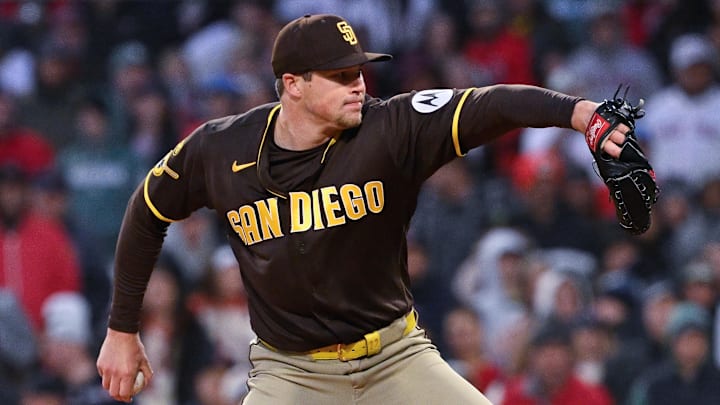
Mason Miller isn’t just dominant—he makes opposing hitters look like they’ve never picked up a bat before. Baseball’s best closer has been the sport’s most overpowering pitcher since last summer, and it’s not just his velocity that’s baffling batters.
At long last, someone finally put the ball in play off of Miller on Wednesday, and it came in the form of a weak groundout to end the Padres’ 8-2 win over Pittsburgh. Even that felt like a small victory. The 52.9 mph squibber off of Jake Mangum’s bat ended a historic run, halting Miller’s streak of 11 consecutive strikeouts. In the expansion era, only one pitcher has recorded more. His teammate Jeremiah Estrada reached 13 in a row back in 2024.
A half-swing groundout ended Miller’s strikeout streak, but it also reinforced the dominance he’s shown since early August of last year by producing easy outs off nasty pitches.
Diving into the absurd strikeout numbers
So far in 2026, Miller has made six appearances and pitched 6 1/3 innings. He has allowed no runs, one hit—to ex-teammate and contact extraordinaire Luis Arráez—one walk and struck out 16 while earning four saves. Yes, you read that right: he has faced 21 batters, and 16 of the 19 outs he’s recorded have come by way of the K, a strikeout rate of 76.2%. While that’s impressive, his absurd numbers stretch much further back.
The Athletics traded Miller to the Padres at the 2025 trade deadline. He allowed two runs in his second appearance with the team on August 5, thanks to a Lourdes Gurriel Jr. home run. I’m fairly confident Miller took that personally, because he hasn’t surrendered a run since. In fact, he hasn’t allowed much of anything.
The 27-year-old pitched in 20 games over the remainder of the season. He went 21 1/3 innings and allowed no runs, four hits and walked nine batters while striking out 42 of 74 batters. When added to the work he’s done so far this season, that’s 27 2/3 shutout innings, with five hits, 10 walks and 58 strikeouts for a sparkling 0.54 WHIP.
Miller made two appearances in the wild-card round against the Cubs in October. He went 2 2/3 innings, didn’t allow a run, hit or walk and struck out eight of the nine batters faced. We’re not done yet. We’re up to 30 1/3 innings with no runs, five hits, 10 walks and 66 strikeouts.
Miller was the closer for Team USA at the 2026 World Baseball Classic, and he was just as dominant. He pitched four innings, earning two saves, and allowed no runs and no hits, walked two and struck out 10 of the 14 batters he faced.
Since allowing that home run on Aug. 5, Miller has thrown 34 1/3 innings in all competitions and allowed no runs, five hits, 12 walks and struck out 76 of the 118 batters he has faced. That strikeout rate of 64.4% is absurd. To give a proper comparison, Garrett Crochet led MLB in strikeouts in 2025 with 255. His strikeout rate was 31.3%.

Three-pitch mix breakdown
You probably know Miller can hit 104 mph with his fastball, and it can be plain unfair to hitters, but it’s not just his velocity that makes the flamethrower hard to hit. In fact, when he has all his pitches working, there’s an argument that his four-seamer is his third-best pitch.
Since joining the Padres, Miller has leaned hard on his slider. And for good reason. It might be the nastiest pitch in baseball. While Miller threw his fastball 52.2% of the time and his slider 45.6% in 2025, things have flipped so far in 2026. He’s unleashing the slider 52.5% of the time, while he goes to the fastball on 42.5% of his windups, and his changeup pays hitters a visit on 5.0% of his offerings.
The slider is flat-out filthy. It’s not just the velocity, though a breaking pitch coming in at an average of 87.8 mph would be hard for anyone to hit. No, it’s the movement that makes the pitch one of the best in the bigs. His slider averages 10 inches of horizontal break to the glove side, while dropping 3.1 inches. It’s relatively flat, but that 10 inches of break is elite for any slider, let alone one that comes in that hard. The speed throws off a hitter’s recognition time, and when batters have to prepare for that heater Miller keeps in his back pocket, that amount of break can be impossible to judge.
Mason Miller, Devastating the Side. 😤 pic.twitter.com/oVK5QO6D6V
— Rob Friedman (@PitchingNinja) April 5, 2026
Miller has thrown 42 sliders this season, and opposing hitters have an xBA of .001 and an xSLG of .002 against it. Those are essentially zeroes for the pitch he throws the most. It is generating a Whiff% of 81.0, and only one of those 36 sliders has been put into play. In fact, he hasn’t allowed a hit on his slider since Aug. 26, a Josh Naylor single.
Let’s turn to that fastball now. Miller has some of the highest velocity we’ve ever seen on the mound, but that’s not what makes his fastball so hard to square up. The pitch is averaging 101.2 mph this season and generating 17.4 inches of induced vertical break, or ride. That means it’s staying up 17.4 inches higher than expected, and doesn’t drop like a pitch is supposed to. Not only does it seem to get on hitters faster, but it also stays above barrels. Most high-ride fastballs are pretty straight. Miller’s isn’t. The pitch also has 7.1 inches of tail, or movement to the arm side. A typical four-seamer sits between four and six inches, so Miller’s is above average. Given the pitch’s elite velocity and rise, the arm-side run is almost overkill.
During Game 2 of the wild-card round in 2025, Miller threw what was, without hyperbole, one of the best pitches in baseball history. He hit the corner at 104.5 mph to ring up Cubs catcher Carson Kelly looking.
104 MPH 🔥
— MLB (@MLB) October 1, 2025
Mason Miller is bringing the heat pitching on back-to-back days! #Postseason pic.twitter.com/S6TyC8G3iB
He’s thrown 34 fastballs this season, and opponents have produced an xBA of .220 and an xSLG of .280, but have only put it in play twice, so we should expect those numbers to drop as the season goes along.
While the fastball-slider combination gets all the attention, Miller’s changeup might be his second-best pitch, he just doesn’t throw it all that much. I’m going to make the case that he should. This season, his change is averaging 95.5 mph. Yes, you read that right. Unlike other changeups that drop significantly as they approach, Miller’s actually averages 3.4 inches of rise. The pitch also averages 17.9 inches of arm-side run, which is ridiculous. So instead of slowing and falling as it comes in, Miller’s change stays higher than it should and runs away from left-handed hitters. Given that he throws it in the mid-90s, it comes in almost like a normal pitcher’s sinker. He’s only thrown four this season, producing a .079 xBA and .096 xSLG, but the pitch has been profiling this way for a while.
Here’s a look at just how difficult it is to hit:
Mason Miller, Unfair 96.1 MPH Changeup...
— Rob Friedman (@PitchingNinja) April 4, 2026
With 20 inches of run. pic.twitter.com/epAxncQuqT
It’s clear Miller isn’t just a flamethrower. He has three plus-plus offerings that all come from the same arm slot and look identical until they don’t. That’s what makes him nearly impossible to hit.
Miller’s future as a closer
There’s little argument that Miller is currently baseball’s best closer. The run he’s on is all the proof you need. He even has a new entrance to match the dominance.
Mason Miller's new closer entrance in San Diego is pretty epic pic.twitter.com/PZwwlHqcCm
— Jomboy Media (@JomboyMedia) March 29, 2026
While he’s at the top of the game coming out of the pen, he obviously possesses the arsenal to cut it as a starter. He might be an even better fit opening games, not closing them. Yes, he’d lose a few ticks off his fastball to conserve his energy across more innings, but with his pitch shapes and movement, it might not matter.
Miller was a starter in college and through the minor leagues, and the A’s called him up in 2023 in that role. He made six starts at the MLB level before a mild elbow sprain put a stop to that. He was moved to the bullpen when he returned and has remained there ever since.
Injury is a huge concern when discussing Miller’s innings count. I’m not dismissing that, but the Padres gave up a ton to get him, including one of baseball’s best prospects in Leo De Vries. For that kind of investment, the return matters, and starters simply carry far more value than relievers.
San Diego’s pitching coach, Ruben Niebla, has successfully converted relievers into starters before. Seth Lugo and Michael King are his star success stories. There’s no reason to think he couldn’t build a plan to stretch Miller back out. The risk, of course, is health.
For now, the Padres are keeping Miller where he is, and it’s hard to dispute the decision. Miller is dominating to a degree baseball has rarely, if ever, seen. But guys with his arsenal aren’t common, and limiting him to a relief role could undercut his true value.
Since allowing that home run last August, Miller hasn’t just dominated opposing hitters—he has made them look helpless. It’s not hard to see why, given his increasingly lethal collection of pitches.
Miller isn’t just baseball’s best closer, he might be the game’s most dominant pitcher.
More MLB from Sports Illustrated
 Add us as a preferred source on Google
Ryan Phillips is a senior writer on the Breaking and Trending News team at Sports Illustrated. He has worked in digital media since 2009, spending eight years at The Big Lead before joining SI in 2024. Phillips also co-hosts The Assembly Call Podcast about Indiana Hoosiers basketball and previously worked at Bleacher Report. He is a proud San Diego native and a graduate of Indiana University’s journalism program.
Follow rumorsandrants