
What is Kansas City Royals SP/RP Daniel Lynch IV's Role going into the Future?
In this story:
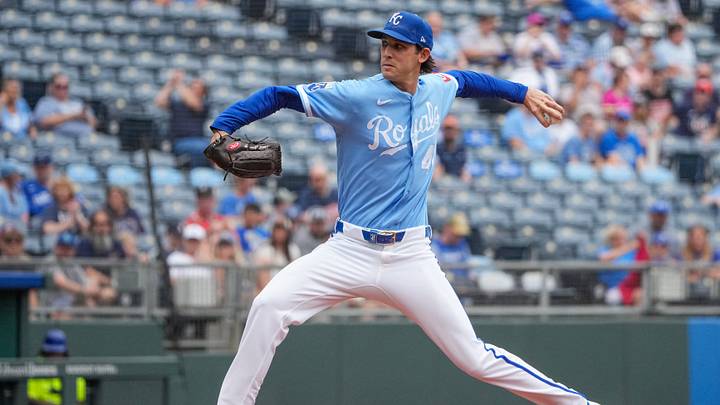
The Kansas City Royals have been hot in August, and over the past 16 games, they are 13-3. During that stretch, there was a change in roles for one player, and it hasn't quite panned out yet. On August 7, starting against the Chicago Cubs was Daniel Lynch IV. It was his first start of the season after being the best bullpen arm for the Royals in 2026. With the role change, what is Lynch's best role going forward?
Let's dive into the basics. In his first five starts, Lynch has been less than effective, with an ERA of 6.32 in 15.1 innings of work. One thing to keep in mind, however, is that with the role change, Lynch has to be stretched out to pitch deeper into games. He has had three starts last three innings or longer, all of them his last three starts, while also throwing anywhere from 45-70 pitches in each of those three starts. Let's dive a little deeper into his numbers.
Rotation Issues also Apply to Lynch as a whole
The Royals' rotation has had a couple of issues plague them this season, and those issues apply to Lynch. The rotation all have similar approaches while pitching, as they don't strike out many batters (Noah Cameron leads in K-rate with 21.0%), don't walk a ton of batters, and the long ball affects them a fair bit. Lynch, in his starts specifically, has a K-rate of 16.4%, a BB-rate of 10.4%, and a HR/9 of 1.72.
The low K-rate and high HR/9 are in line with what the rotation as a whole does, but the high walk rate is an outlier for the rotation and Lynch as a whole this season. On the year, Lynch has only walked 7.6% of batters, which has been rising due to his starts. It is safe to say, early in the role change, that it hasn't worked out yet for both Lynch and the Royals. Let's discuss what made him a good reliever.
Bullpen Ace in 2026
There are a multitude of factors that made Lynch a good bullpen arm this season, but let's dive into them. Starting with his run value chart, Lynch has four pitches that gather good results. His sinker, slider, and changeup are his plus pitches with values of six, five, and three. The knucklecurve, which he doesn't throw often, also has a run value of two. His repertoire gets outs at a solid rate, shown by all of those pitches having an opposing batting average below .250.
Another reason for his success this season is the fact that he pitches to his defense with a 49.7% ground ball rate. He also doesn't give up a ton of line drives, with 19.1% of hit balls being line drives. With that in mind, he limits hard contact and barrels which has helped him be the Royals best reliever this season.
In terms of leverage, Lynch has been put in some high-leverage outings with a 1.16 pLI (average leverage index) and has pitched well in those outings with a WPA (win probability added) of 1.48. To sum up Lynch in the pen, he is a solid to above average middle reliever who has shown to get outs in some high-leverage spots.
He has done all of this with a flawed profile, however, and that has reared its head in the switch to the rotation.
Jack of All Trades and Master of None

If you look at Lynch's Baseball Savant page, the subheader makes sense. The only things he excels at is generating ground balls compared to his peers, and he has three pitches that generate good run values. He has solid enough stuff, especially his slider and sinker, and he locates well enough to get outs a a decent rate.
His weakness, however, is his inability to generate Ks at a solid rate. Over his career, this has been an issue for Lynch, and that trend continues this year with a K-rate of 18.4%. The best way to describe his pitching style is that he is similar to Richard Bleier, who had some underappreciated seasons for someone only striking out 13.6% of batters in his career. He gets batters to ground out to his stellar infield defense and limits hard contact.
In the rotation, however, he has struggled to limit the hard contact with an average exit velocity of 90.8 mph. The ground ball rate has decreased as well in his starts to 41.7%, and his LOB% sits at 56.2% in the rotation. To put bluntly, as a starter, Lynch has not been himself and that is concerning heading into 2027 with his role in flux.
Conclusion: What Role suits Lynch Best?
As noted previously, Lynch is similar to Richard Bleier as he uses his defense and low K-rates to generate outs. Lynch has better stuff than Bleier, but the philosophy is very similar, and that approach is best suited for the bullpen going forward. He has shown to be able to handle high leverage, and his stuff gets outs at solid rates. This writer understands why they are testing him in the rotation, all the pitching injuries, but it feels like this experiment could hurt him in the long run if he does return to the arm barn.
Related Articles
 Add us as a preferred source on Google
Trey is no stranger to writing about the Royals as he has done it for 6 years now for various blogs (Kings of Kauffman, Inside The Royals, and Farm to Fountains). He is a graduate of Baker University with a degree in Mass Media with an emphasis in sports media. He enjoys watching and researching sports as well as gaming.
Follow Trey%20Donovan