%20%20--%3E%0A%3Csvg%20version%3D%221.1%22%20id%3D%22Layer_1%22%20xmlns%3D%22http%3A%2F%2Fwww.w3.org%2F2000%2Fsvg%22%20xmlns%3Axlink%3D%22http%3A%2F%2Fwww.w3.org%2F1999%2Fxlink%22%20x%3D%220px%22%20y%3D%220px%22%0A%09%20width%3D%2239px%22%20height%3D%2240px%22%20viewBox%3D%220%200%2039%2040%22%20enable-background%3D%22new%200%200%2039%2040%22%20xml%3Aspace%3D%22preserve%22%3E%0A%3Cpath%20fill%3D%22%23FFFFFF%22%20d%3D%22M38.5%2C7H28.2v26h10.3V7z%22%2F%3E%0A%3Cpath%20fill-rule%3D%22evenodd%22%20clip-rule%3D%22evenodd%22%20fill%3D%22%23FFFFFF%22%20d%3D%22M26.1%2C25.5c0%2C5.8-4.1%2C7.5-12.9%2C7.5C3.9%2C33%2C0%2C31.2%2C0%2C25.2v-1.1h11.6%0A%09v2.4c0%2C0.7%2C0.1%2C1.4%2C1.2%2C1.4c1%2C0%2C1.2-0.4%2C1.2-1.3v-0.9c0-1.6-0.9-1.6-3.5-2.2C2.2%2C21.7%2C0%2C19.7%2C0%2C15.3v-0.9C0%2C9.3%2C5.5%2C7%2C12.9%2C7%0A%09c10.2%2C0%2C12.8%2C2.6%2C12.8%2C7.4v1.8h-11v-2.9c0-0.6-0.4-1.1-1.2-1.1c-0.6%2C0-1.2%2C0.4-1.2%2C1.1v0.9c0%2C1.5%2C0.9%2C2%2C3.3%2C2.5%0A%09c8%2C1.6%2C10.5%2C3.3%2C10.5%2C7.5V25.5z%22%2F%3E%0A%3C%2Fsvg%3E%0A)
My 2026 Baseball Hall of Fame Ballot—and Why I’ve Changed My Approach to Voting
In this story:
Editor’s note: The Baseball Hall of Fame’s class of 2026 was revealed Tuesday evening, with the Baseball Writers’ Association of America voting in Carlos Beltrán and Andruw Jones.
Like the game itself, Baseball Hall of Fame voting evolves constantly. The latest evolution swings wider the door to entry. That’s not a knock. It’s a recognition of how expansion, access to advanced and more easily shared information and a more international game have influenced voting.
I’ve been voting for four decades. I was introduced to a voting ecosystem in which 300-game winners needed three to five ballots to get in (Phil Niekro, Don Sutton and Gaylord Perry). Now I hear arguments that Cole Hamels and Felix Hernandez should be in the Hall, when combined they have only eight more wins than Sutton.
Joe Torre never received more than 22% of the writers’ vote in 15 tries. Joe Mauer, with fewer hits, homers, RBI, total bases and a worse OPS+ than Torre, sails in on the first try.
I started voting when first-ballot elections were reserved for a chosen few. Players such as Rollie Fingers, Gary Carter and Carlton Fisk were made to wait their turn. Thankfully, that unofficial two-tiered system has all but died.
The rate of players elected by the BBWAA has increased dramatically in the years I’ve been voting. There have been as many players elected by the writers in the previous 12 elections (29 from 2014–25) as in the 21 elections before The Great Surge (1993–2013). The average annual rate has jumped 75% in those windows, from 1.38 to 2.42.
And that surge counts only the players elected by the BBWAA, which accounts for only 51% of all players in the Hall (142 of 279 entering Tuesday’s results).
Don’t think of the surge as a lowering of standards. Think of it as an evolution. With expansion alone we have more players to consider. And more players are putting up Hall of Fame type seasons.
The median OPS+ for a Hall of Fame hitter is 127, which happens to be Rickey Henderson’s career mark. Twenty-six players in the wild-card Era (1995–2025) have posted at least eight qualified seasons with an OPS+ of 127, up from 22 in the previous 30 years.
When I first began voting, players needed a high peak and longevity to get elected. The emphasis in today’s game on rate stats—not just by the media but also by team decision makers—has put more weight on peak and diminished the longevity value. Andruw Jones, for instance, had an impressive peak (though only two seasons of 127 OPS+) but fell off a cliff to wind up with fewer hits than Dale Murphy.
Again, I’m okay with this because I believe this has happened in the natural evolution of the game. And that’s why, as you will see below, I have opened the door wider on my own ballot, making room for three players I previously had on the wrong side of borderline.
Evolution always comes with a cost. In this case, it is the legions of players who fared poorly in voting a generation ago who see lesser players gaining traction, if not election. I do think Hamels and Hernandez, for instance, are good candidates and need a longer look. But what do you do about Tommy Bridges, Urban Shocker, Dizzy Trout and Bret Saberhagen, all of whom have more wins and higher ERA+ than both Hamels and Hernandez and never got even 8% support? If you think King Felix is a Hall of Famer, what about David Cone and Tim Hudson, who have at least 25 more wins, more innings and a higher ERA+? Luis Tiant, Babe Adams, Orel Hershiser?
If you tell me Chase Utley is a Hall of Famer, fine, but you can’t tell me he had a better peak or a better career than Don Mattingly, who debuted at 28% support and fell to 9% in his 15th and final time.
Bottom line: in the scale of peak vs. longevity, peak is getting more weight, which is leading to more players getting elected. And that’s a good thing, because it means the process continues to evolve.
Here is my 2026 Hall of Fame ballot:
Carlos Beltrán
I did not vote for him his first year on the ballot, which I recognize was a small penalty for his cheating with the 2017 Astros but a penalty, nonetheless. A vote for Beltrán is neither an endorsement nor a condoning of his behavior. He knowingly cheated, was a major mastermind behind the sign-stealing scam, did not stop when told to and lied about it even after it was revealed. The vote is recognition that his outlaw behavior falls below that of PED use, before or after testing, which involves illegal use of federally controlled substances, physical risk and such a long-established taboo in sporting culture that even to this day a generation later players will not cop to using them. Why? They know it taints their careers.
Beltrán, Andre Dawson and Willie Mays are the only players not connected to PEDs with 2,500 hits, 400 homers and 300 stolen bases. They were do-it-all stars who could beat teams in many ways. Unfortunately, Beltrán also found an unethical way to beat opponents. He will take that shame with him into Cooperstown.
VERDUCCI: Carlos Beltrán’s Hall of Fame Candidacy Presents a Complex Moral Quandary
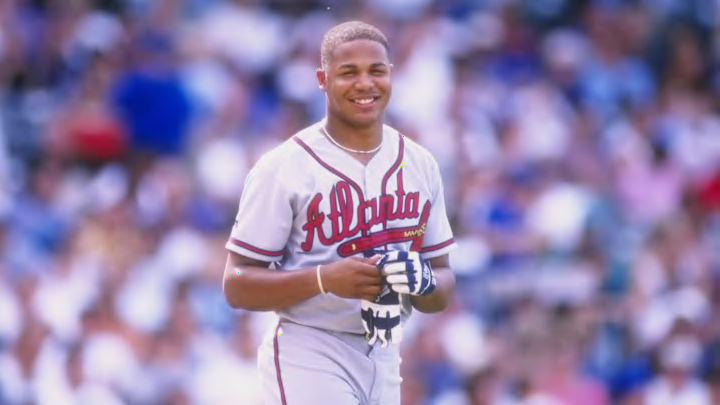
Andruw Jones
I had not voted for Jones for several reasons, most notably that he did not take care of himself, leading to a huge and long falloff (from ages 30–35: .214/.314/.420 with a OPS+ of 92); his ho-hum career OPS+ (111) and I don’t trust defensive metrics, which are a huge part of his argument. To believe in those numbers you must believe Jones was between 31% and 34% a better defender than Willie Mays (by range factor and defensive WAR). Come on.
Let’s take the metrics out. There was consensus that Jones was the best defensive center fielder of his day, perhaps even the Ozzie Smith of center fielders—who happened to have big time power. In a 10-year stretch (1998–2007), Jones won the Gold Glove every year while averaging 34.5 homers and 103 RBI. There you go. Peak, baby. That’s his case in a nutshell.
Many others apparently also have evolved on Jones. He didn’t crack even 8% until his third year on the ballot! I had him below several other center fielders who never were elected. Now with the doors swinging open wider, I hope these others, all with more hits and a far better OPS+ than Jones, are reconsidered:
Player | OPS+ | Hits | HR | RBI | Top 7 MVPs |
|---|---|---|---|---|---|
Jim Edmonds | 132 | 1,949 | 393 | 1,199 | 2 |
Bernie Williams | 125 | 2,336 | 287 | 1,257 | 1 |
Dale Murphy | 121 | 2,111 | 298 | 1,266 | 3 |
Andruw Jones | 111 | 1,933 | 434 | 1,289 | 1 |
Jimmy Rollins
According to OPS+, Rollins was a below average hitter (95) in the vein of Édgar Rentería (95). He didn’t walk very much, which partly explains his .324 OBP, a tepid mark for a guy who made 69% of his career starts in the leadoff spot. But in dwelling on what Rollins did not do well, I did not fully appreciate what he did do well: advancing bases with extra-base hits and stolen bases while grinding at a demanding position with an undersized body. Not everybody has to be an OBP darling, despite the modern value in it.
Rollins essentially traded walks for banging the ball and swiping bags, which he did at an outlier level among shortstops. Only Cal Ripken had more extra-base hits while playing shortstop—and only by three. Only Derek Jeter and Ripken had more total bases at the position. Rollins also is the only player with 200 homers and 400 steals while playing shortstop.
Only five players played more games at shortstop than Rollins, and none of them were as small as the 5' 7" Rollins.
He also checks the “fame” requirement. Rollins won an MVP award and a World Series, and owns the longest hitting streak in the past quarter century.

Chase Utley
Here is an example of how my consideration of volume has evolved. Among Hall of Fame second basemen, Jackie Robinson is the only one voted in by the writers with fewer than Ryne Sandberg’s 2,386 hits—and Utley is 501 hits short of Sandberg. No second baseman who debuted in the major leagues in the past 80 years has made the Hall of Fame with fewer than 2,000 hits. Utley had 1,885 hits. He gets little extra credit for MVP support (never finished in the top six).
But this also is true: in his six-year prime (2005–10), Utley was a rare impact bat at second base. In those six years he slashed .298/.388/.523 and made five All-Star teams. Expand the window to 10 years (2005–14) and only Albert Pujols had a higher WAR than Utley.
Now, you can’t convince me that Utley at his best was a better player than Mattingly, who still can’t get into the Hall because of the old measurements when you needed more volume. Mattingly had the better peak and the better career than Utley. In fewer games Mattingly had more hits, total bases, doubles, RBI, Gold Gloves and MVP support and a whopping edge in OPS+ (127–117). If we’re going to lower the bar for admission, as has been happening, we need to do right by many still being judged by harsher standards.
More MLB on Sports Illustrated
 Add us as a preferred source on Google
Tom Verducci is a senior writer for Sports Illustrated who has covered Major League Baseball since 1981. He also serves as an analyst for FOX Sports and the MLB Network; is a New York Times best-selling author; and cohosts The Book of Joe podcast with Joe Maddon. A five-time Emmy Award winner across three categories (studio analyst, reporter, short form writing) and nominated in a fourth (game analyst), he is a three-time National Sportswriter of the Year winner, two-time National Magazine Award finalist, and a Penn State Distinguished Alumnus Award recipient. Verducci is a member of the National Sports Media Hall of Fame, Baseball Writers Association of America (including past New York chapter chairman) and a Baseball Hall of Fame voter since 1993. He also is the only writer to be a game analyst for World Series telecasts. He lives in New Jersey with his wife, with whom he has two children.