%20%20--%3E%0A%3Csvg%20version%3D%221.1%22%20id%3D%22Layer_1%22%20xmlns%3D%22http%3A%2F%2Fwww.w3.org%2F2000%2Fsvg%22%20xmlns%3Axlink%3D%22http%3A%2F%2Fwww.w3.org%2F1999%2Fxlink%22%20x%3D%220px%22%20y%3D%220px%22%0A%09%20width%3D%2239px%22%20height%3D%2240px%22%20viewBox%3D%220%200%2039%2040%22%20enable-background%3D%22new%200%200%2039%2040%22%20xml%3Aspace%3D%22preserve%22%3E%0A%3Cpath%20fill%3D%22%23FFFFFF%22%20d%3D%22M38.5%2C7H28.2v26h10.3V7z%22%2F%3E%0A%3Cpath%20fill-rule%3D%22evenodd%22%20clip-rule%3D%22evenodd%22%20fill%3D%22%23FFFFFF%22%20d%3D%22M26.1%2C25.5c0%2C5.8-4.1%2C7.5-12.9%2C7.5C3.9%2C33%2C0%2C31.2%2C0%2C25.2v-1.1h11.6%0A%09v2.4c0%2C0.7%2C0.1%2C1.4%2C1.2%2C1.4c1%2C0%2C1.2-0.4%2C1.2-1.3v-0.9c0-1.6-0.9-1.6-3.5-2.2C2.2%2C21.7%2C0%2C19.7%2C0%2C15.3v-0.9C0%2C9.3%2C5.5%2C7%2C12.9%2C7%0A%09c10.2%2C0%2C12.8%2C2.6%2C12.8%2C7.4v1.8h-11v-2.9c0-0.6-0.4-1.1-1.2-1.1c-0.6%2C0-1.2%2C0.4-1.2%2C1.1v0.9c0%2C1.5%2C0.9%2C2%2C3.3%2C2.5%0A%09c8%2C1.6%2C10.5%2C3.3%2C10.5%2C7.5V25.5z%22%2F%3E%0A%3C%2Fsvg%3E%0A)
Winners, Losers and Question Marks of the MLB Offseason
In this story:
Spring training is finally upon us after a long and active offseason.
Looking back on the past few months, a lot has changed across the MLB landscape. Several teams improved tremendously, some fell off the pace and others more or less treaded water. Here’s how everything shook out from our perspective.
Winners
Los Angeles Dodgers
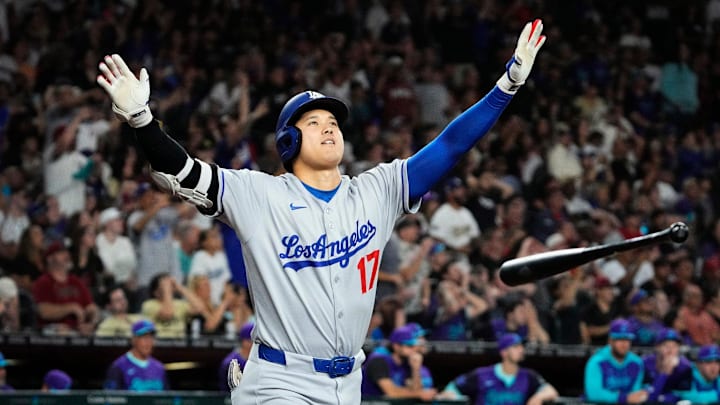
I mean, sure, they may be breaking baseball, but the Dodgers stay winning. Coming off back-to-back World Series titles, L.A. wasn’t content and instead, somehow, improved its lot and drew the ire (and envy) of opposing fans.
The Dodgers spent $326.7 million on free agents this offseason, most of that on two blockbuster deals that addressed their biggest needs. L.A. needed to find another corner outfielder after the disaster that was Michael Conforto’s 2025 campaign, and its leaky bullpen was a potential Achilles heel after Tanner Scott failed to live up to the four-year, $72 million deal he signed last winter. So what did the Dodgers do? Signed the best outfielder and best closer available, of course.
L.A. gave Kyle Tucker a four-year, $240 million contract, while also splashing out $69 million over three years to lure Edwin Díaz from the Mets. The $60 million average annual value for Tucker is the second largest in MLB history, behind new teammate Shohei Ohtani’s $70 million. The $23 million AAV on Díaz’s new deal is the largest ever for a reliever, topping his own $20.4 million mark from his last deal with New York.
The Dodgers had the best roster in the league in 2025 and got even better this offseason.
Tarik Skubal
Take that, Tigers. Detroit took the two-time reigning AL Cy Young winner to arbitration, offering a paltry $19 million, while Skubal sought a record $32 million. He didn’t budge and banked on his talent and track record to win the day. And it did. It also may have permanently damaged his relationship with the franchise.
Skubal will be a free agent at the end of this season, and every indication shows he won’t be back in Detroit. The two sides remain in different galaxies when it comes to contract numbers, which means the 29-year-old lefty who has spent his entire career with the franchise is likely gone when the season ends (if not before).
To add insult to injury, while battling Skubal over his salary, the Tigers inked Framber Valdez (more on him later) to a three-year, $115 million deal. That average annual value of $38.33 million is far more than Detroit tried to avoid giving Skubal. Make it make sense.
Skubal will rake in $32 million for this season, then hit free agency and almost certainly ink the largest contract for a pitcher in MLB history.
Chicago Cubs
The Cubs shocked me this winter by signaling they were going all-in, yet cutting bait on Kyle Tucker after their aggressive trade for him last offseason. Chicago splashed out money like it hadn’t in a long time and swung deals to get a proven veteran slugger and the kind of top-level starting pitcher it lacked.
Alex Bregman is in, as the Cubs handed him a five-year, $175 million deal with a full no-trade clause and no opt-outs to man third base for the foreseeable future. They also gave reliever Phil Maton $14.5 million and fellow bullpen arm Hunter Harvey $6 million. That’s a significant chunk of cash to improve two serious weaknesses.
Perhaps more importantly, Chicago swung a trade to land Edward Cabrera from the Marlins. The 27-year-old righty has ace stuff and is coming off his best full season. In 2025, he went 8–7 with a 3.53 ERA, 1.23 WHIP and 150 strikeouts against 48 walks in 137 2/3 innings. Cabrera features an electric fastball that can hit triple digits, plus a stellar changeup and high-spin breaking pitches. Cabrera did cost the Cubs’ top prospect, Owen Caissie, but their new hurler is under team control through the 2028 season.
It was a big offseason in Chicago, as the team pushes for a postseason return in 2026.
Lumbering sluggers

Oh, to be a power-hitting free agent this winter. Forget pure athleticism, this offseason it paid to be a big guy who could thump the baseball and not do much else.
Pete Alonso bet on himself last offseason, taking a short-term contract from the Mets with an opt-out after the 2025 season. It paid off. The 31-year-old had his best campaign in years, slashing .272/.347/.524 with 38 home runs, 126 RBIs, and a wRC+ of 141. Despite laughable fielding metrics and dial-up Internet foot speed, the Orioles gave Alonso a five-year, $155 million deal to anchor the middle of their lineup.
Similarly, Kyle Schwarber saved his best for his walk-year, as he hammered baseballs throughout 2025 before hitting free agency. The 32-year-old hit .240 with a .365 on-base percentage and career bests in home runs (56), RBIs (132), slugging (.563), wRC+ (152) and fWAR (4.9). He’s a guy who should never put on a glove, but man, can he crush a baseball. The Phillies were fine with it, and re-signed him on a five-year, $150 million deal.
It pays to have power.
Dylan Cease
Cease entered the offseason as the free agent pitcher with the best stuff on the market, and wound up getting paid like it. The seven-year, $210 million deal he got from the Blue Jays is the fifth-largest contract ever given to a pitcher. It came after a wildly disappointing season with the Padres.
In 2024, Cease went 14–11 with a 3.47 ERA, 1.07 WHIP and 224 strikeouts against 65 walks in 189 1/3 innings. He also threw a no-hitter and finished fourth in NL Cy Young voting. His showing in 2025 was a big step back. Last season, Cease went 8–12, with a 4.55 ERA, 1.33 WHIP and 215 strikeouts versus 71 walks in 168 innings. While his strikeout rate remained high, his walk rate rose, and batters hit him harder and more often. It wasn’t a great audition for free agency.
Despite those season-long struggles, the 30-year-old righty got the massive deal he was looking for. Toronto is banking on his pure stuff, which is backed by a fastball with the sixth-hardest average velocity (97.1 mph) among starters, and a wipeout slider that can be unhittable. Cease’s talent won out over his production. That’s a huge win for him.
Question marks
New York Mets
The Mets are going to look a whole lot different in 2026, and I’m not sure how to feel about it. The lineup will still boast Francisco Lindor and Juan Soto, but New York was busy making changes this offseason after shockingly missing the playoffs.
Gone are Alonso, Díaz, Brandon Nimmo, Jeff McNeil, Luisangel Acuña and Starling Marte. In an attempt to improve the team’s lackluster defense, New York added Marcus Semien and Luis Robert Jr. via trade, then solidified the front of its rotation by swinging a deal for Freddy Peralta. The Mets also spent $239 million to bring in Bo Bichette, Devin Williams, Jorge Polanco and Luke Weaver.
Bichette should help the lineup, while, on paper, Williams and Weaver should help the bullpen, but it does feel like the losses were greater than what was imported.
Will these pieces all fit together to form a better product? I have no idea. We might have our answer in a few weeks.
Framber Valdez

Valdez entered free agency as one of the best pitchers on the market, but remained a free agent until Feb. 10, when the Tigers gave him the above-mentioned three-year, $115 million deal. That’s a high AAV pact, but it isn’t the kind of long-term deal the 32-year-old was looking for. Frankly, he was probably expecting something close to the deal Cease ultimately received.
Valdez was solid in 2025 for the Astros, but didn’t have the season he wanted to heading into free agency. He finished 13–11 with a 3.66 ERA, 1.24 WHIP and 187 strikeouts against 68 walks in 192 innings. He was better in 2024 (15–7, 2.91), mostly because his sinker was punished last season, with opposing hitters producing an xBA of .304 and a xSLG of .457.
Still, Valdez is reuniting with former Astros manager A.J. Hinch and will pair with Skubal at the top of the rotation. But the two-time All-Star has a lot of pressure on him to hit the ground running in Detroit after getting a massive deal while the franchise tried to nickel and dime Skubal. It could be a great fit, or it might be a disaster waiting to happen.
Toronto Blue Jays
The Blue Jays are fresh off falling two outs shy of winning their first World Series since 1993, and it clearly motivated the franchise to continue chasing that glory. Toronto led MLB in free agent spending this offseason, pouring $336 million into contracts for four new players, and also saw Shane Bieber pick up his $16 million option for 2026.
As mentioned above, Cease got $210 million, Japanese third baseman Kazuma Okamoto inked a four-year, $60 million deal, while Tyler Rogers got $36 million over three years and Cody Ponce signed for $30 million over three. The Blue Jays also added Jesús Sánchez via trade. With all that money going to new players, there were some significant departures. Bichette went to the Mets in free agency, Chris Bassitt signed with the Orioles, while reliever Seranothony Domínguez and utility man Isiah Kiner-Falefa left as well.
On paper, the Blue Jays should be improved, but losing Bichette feels like a significant blow. He had been with the organization since 2016, when Toronto made him a second-round pick. He had the feel of a cornerstone, heart-and-soul guy. Now he’s elsewhere, and for a contract the Blue Jays likely could have matched. How will his loss impact the clubhouse? We’ll soon find out.
San Diego Padres
The Padres were uncharacteristically quiet this offseason, though they did make one key move. Re-signing Michael King to a three-year, $75 million deal helped add to a starting rotation that is still in flux. They added Korean infielder Sung-Mun Song and a righty bat in Miguel Andújar, who absolutely punishes lefties. Other than that, San Diego added at the margins while consistently being connected to big potential trades. The team also hired Craig Stammen as its manager, which was a massive bet on a well-respected guy with zero experience.
I’m burying the lede a bit here, as the Friars are also up for sale. There is reportedly a lot of interest in the franchise, which is likely to sell for the richest price in MLB history. That may have restrained general manager A.J. Preller slightly, as the team still needs pieces heading into spring training. The exit of Dylan Cease has left a hole in the rotation, and the lineup is still missing some punch.
What happens over the next few weeks with the roster and the potential sale will determine if San Diego won or lost this offseason.
Losers
New York Yankees
The Yankees fell to the Blue Jays in four games in the ALDS last fall and decided to ... not change a whole lot this offseason. New York didn’t lose much, but didn’t really improve a roster that appeared stagnant for large chunks of the 2025 season.
Cody Bellinger’s five-year, $162.5 million deal was the only piece of big business the Yankees did this winter. Worse than anything, their decision to extend Trent Grisham a qualifying offer—likely with the hope he’d decline it, giving New York a compensation draft pick—blew up in their faces when he accepted the one-year, $22 million agreement. New York re-signed Paul Goldschmidt, Amed Rosario, Paul Blackburn and Ryan Yarbrough, and traded for Ryan Weathers, but it was a quiet few months otherwise. The only notable exits came when Devin Williams and Luke Weaver both moved to Queens.
Don’t get me wrong, the Yankees have a strong roster that is still among the best in the American League. They’ll hopefully get Gerrit Cole back from his Tommy John surgery recovery mid-season, and if the rotation remains healthy, they’ll be in the mix in the AL East. But given all the talent available this offseason, it was shocking to see New York essentially sit things out.
Japanese stars
Entering the offseason, four Japanese stars were seeking big money in the U.S. and wound up being posted by their respective teams. One, pitcher Kona Takahashi, returned to Japan without a deal, while the other three signed for far less than expected.
The consensus was split, but corner infielder Munetaka Murakami was generally believed to be the best player available. A massive power threat, the 26-year-old hit 56 home runs in 2022 and had 246 over his eight seasons in the NPB. In 69 games during the 2025 season, he boasted a 1.051 OPS with 22 home runs, but he struggled against high velocity, and he carried a hefty strikeout rate. That may have scared off most suitors, as he signed a two-year, $34 million contract with the White Sox, which was far below expectations.
Another corner guy, Kazuma Okamoto, had 248 home runs in his 11 NPB seasons and a .992 OPS in 2025. The 29-year-old only received $60 million over four years from the Blue Jays. Tatsuya Imai, a 27-year-old righty starter, similarly struggled to find a megadeal despite a career 3.15 ERA in eight NPB seasons. He settled for $54 million over three years.
Teams were far less willing to spend on Japanese stars this winter, a big change from the past.
Milwaukee Brewers
By now, everyone understands the deal with the Brewers: they aren’t going to spend money, even to keep their own stars. That strategy hasn’t hurt them recently, as they’ve made the playoffs in three consecutive seasons and posted an MLB-best 97 wins in 2026. But that is bound to catch up with them at some point.
This offseason, Milwaukee traded free-agent-to-be Freddy Peralta to the Mets for prospects Jett Williams and Brandon Sproat, which fits a yearslong pattern. The Brewers did land starting pitcher Kyle Harrison and infielder David Hamilton from the Red Sox for Caleb Durbin, Andruw Monasterio, and Anthony Seigler, but they only spent $5.25 million on major league free agents, the lowest total in the league. Brandon Woodruff is also back after accepting the team’s qualifying offer, but there were no truly notable additions to the roster.
Milwaukee is a good organization that does a lot well, but eventually, they’re going to have to invest in the major league roster if they’re going to compete for championships.
The 2027 Season
This offseason delivered blockbuster deals and fascinating roster shakeups, but all that spending by the big-market franchises may have steered the sport closer to a lockout after the 2026 season. The financial inequities inherent to Major League Baseball will have to be addressed when the current collective bargaining agreement expires in December, and the upcoming fight will be ugly.
When the Dodgers, fresh off two World Series wins, gave Kyle Tucker $240 million over four years while already sporting a payroll embarrassingly far over the luxury tax threshold, the league shook its collective head. The built-in advantages the Dodgers have with their TV contract and a sweetheart, reduced revenue-sharing deal they struck back in 2012 gives them a massive edge over most other teams.
Baseball’s have-nots far outnumber the haves, and, thanks to the Dodgers, many of the latter want change as well. Owners, as always, will push for a salary cap and hang the Dodgers out as the example of all that’s wrong with the current system. The players will steadfastly refuse a cap because it would surrender their earning power. The impasse could get really nasty, so we should all settle in for a long battle.
We were already careening toward a nasty labor fight. What the Dodgers did this offseason only made missing games in 2027 more likely.
More MLB on Sports Illustrated
 Add us as a preferred source on Google
Ryan Phillips is a senior writer on the Breaking and Trending News team at Sports Illustrated. He has worked in digital media since 2009, spending eight years at The Big Lead before joining SI in 2024. Phillips also co-hosts The Assembly Call Podcast about Indiana Hoosiers basketball and previously worked at Bleacher Report. He is a proud San Diego native and a graduate of Indiana University’s journalism program.
Follow rumorsandrants