%20%20--%3E%0A%3Csvg%20version%3D%221.1%22%20id%3D%22Layer_1%22%20xmlns%3D%22http%3A%2F%2Fwww.w3.org%2F2000%2Fsvg%22%20xmlns%3Axlink%3D%22http%3A%2F%2Fwww.w3.org%2F1999%2Fxlink%22%20x%3D%220px%22%20y%3D%220px%22%0A%09%20width%3D%2239px%22%20height%3D%2240px%22%20viewBox%3D%220%200%2039%2040%22%20enable-background%3D%22new%200%200%2039%2040%22%20xml%3Aspace%3D%22preserve%22%3E%0A%3Cpath%20fill%3D%22%23FFFFFF%22%20d%3D%22M38.5%2C7H28.2v26h10.3V7z%22%2F%3E%0A%3Cpath%20fill-rule%3D%22evenodd%22%20clip-rule%3D%22evenodd%22%20fill%3D%22%23FFFFFF%22%20d%3D%22M26.1%2C25.5c0%2C5.8-4.1%2C7.5-12.9%2C7.5C3.9%2C33%2C0%2C31.2%2C0%2C25.2v-1.1h11.6%0A%09v2.4c0%2C0.7%2C0.1%2C1.4%2C1.2%2C1.4c1%2C0%2C1.2-0.4%2C1.2-1.3v-0.9c0-1.6-0.9-1.6-3.5-2.2C2.2%2C21.7%2C0%2C19.7%2C0%2C15.3v-0.9C0%2C9.3%2C5.5%2C7%2C12.9%2C7%0A%09c10.2%2C0%2C12.8%2C2.6%2C12.8%2C7.4v1.8h-11v-2.9c0-0.6-0.4-1.1-1.2-1.1c-0.6%2C0-1.2%2C0.4-1.2%2C1.1v0.9c0%2C1.5%2C0.9%2C2%2C3.3%2C2.5%0A%09c8%2C1.6%2C10.5%2C3.3%2C10.5%2C7.5V25.5z%22%2F%3E%0A%3C%2Fsvg%3E%0A)
Joe Mazzulla Won Coach of the Year by Guiding Celtics to 56 Wins—But Don’t Overlook His Most Impressive Work
In this story:
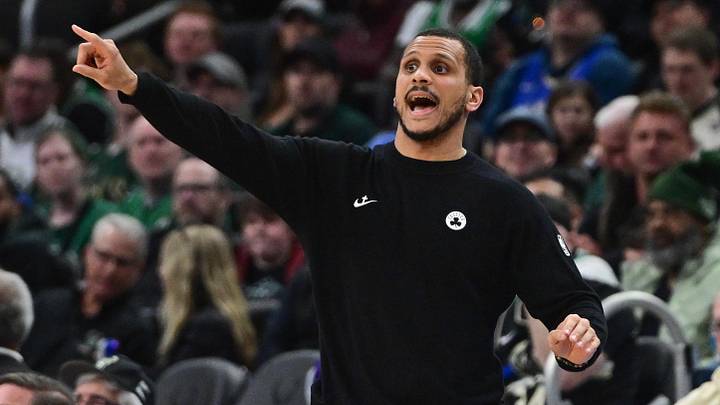
Before the end of the regular season, Celtics coach Joe Mazzulla railed against the NBA’s annual Coach of the Year award. He strongly believes it should be a staff award, not an individual, and demanded reporters never ask him about it again.
“I don’t need it,” Mazzulla said in March. “I think it’s a stupid award. They shouldn’t have it. And it’s more about the players. It’s more about the work that the staff puts in. It’s just that simple. I really don’t ever want to be asked or talk about it again. It’s just that dumb. So, the players play. It’s about them. Staff works their a-- off. I’m grateful to have them.”
Against his stated wishes, the NBA went ahead and gave the award to him anyway.
On Tuesday, Mazzulla was named the 2025–26 Coach of the Year after guiding Boston to a 56–26 season. He beat out Pistons coach J.B. Bickerstaff and Spurs boss Mitch Johnson to earn the honor. While Mazzulla has a point in that it takes the best out of everybody in the organization to produce a winning NBA season, the head coach is the conductor of the orchestra. He sets the tone every day and makes the big-picture decisions about how the team will play that trickle down throughout the roster.
This year, nobody did that to greater effect than Mazzulla. He created a new identity for the Celtics to lean into after the devastating Achilles tear Jayson Tatum suffered led to a total deconstruction of the team’s championship roster. His staff developed the young, inexperienced players who were left to replace the departing talent. Mazzulla worked constantly to mitigate the team’s inherent weaknesses and maximize their strengths on a night-to-night basis.
The result? A season that exceeded even the highest of expectations for Boston entering the year. The C’s finished with the second-most wins in the East and the statistical profile of a top-five team in the NBA. It was Mazzulla’s fourth year at the end of the bench, and his best one yet despite a severe talent discrepancy compared to his first three years at the helm.
At the heart of the matter, Mazzulla won COY because he got more out of this roster than anyone anticipated.
Mazzulla had the Celtics playing his way all season long

How the season unfolded made it easy to forget that Boston’s outlook was not pretty at all when the it all began.
Jaylen Brown, Derrick White, Sam Hauser and Payton Pritchard were all that remained of the championship foundation. The front office didn’t try to find any sort of real replacement for Tatum’s minutes, nor did they bring in any big men on the same level as the departing frontcourt of Kristaps Porziņģis, Al Horford and Luke Kornet. The only notable addition was Anfernee Simons, traded for Jrue Holiday. Otherwise Mazzulla was left with a handful of young, unproven options to replace All-Star talents and was essentially told to figure it out.
It was a very green roster (no pun intended). Worse, it was imbalanced, lacking a true power forward and strong rebounders across the board while the backcourt slanted towards small and defensively challenged. All worries about that sort of construction became reality when the Celtics went on a three-game losing streak to kick off the season. The 0–3 start, all close losses that saw Boston get pushed around on the glass, felt like confirmation that the veteran players were good enough to keep it close most nights but the C’s would lose anyway because they were overmatched.
But in a show of resiliency that would come to define the season, the Celtics bounced back and didn’t lose three straight for the rest of the regular season—thanks to Mazzulla masterfully managing the rotation and game plan from that point on.
In the big picture, the goals were clear—Boston wanted to earn as many possessions as possible and get up as many shots as possible. By avoiding turnovers and crashing the glass on both ends the Celtics just gave themselves more chances to score than their opponent most nights. And thanks to great work from the shooting coaches, every perimeter player in the rotation was enough of a threat from three that defenses had to guard them. By simply playing intentional basketball with energy and focus, Boston had a leg up on most of its competition. Those factors can wane in most NBA teams over the course of a long season, but Mazzulla found ways to keep his guys engaged throughout the campaign—as evidenced by the final numbers that show the roster did what he asked them to do.
The Celtics finished the season averaging the fewest turnovers per game in the whole league. They finished top-10 in both offensive and defensive rebounding while ranking fourth in three-point attempts per game and fourth in three-pointers made per game. As a defensive unit no other team held opponents to a worse nightly output than Boston’s 107.2 points per game. And for the advanced stats gurus out there: the C’s finished second in offensive rating and fourth in defensive rating, one of only two teams to finish top-five in both those categories.
It was remarkable collective execution.
His most impressive work? Developing the team’s rotation

But more significant were the strides nearly every player in the rotation took under his guiding hand. Each of the healthy key veterans (Brown, White and Pritchard) enjoyed career years in at least one regard while proving capable of shouldering larger responsibility. Brown averaged a career-high in points and assists per game as an MVP candidate. White made first-team All-Defense for the first time. Pritchard showed he was a legitimate offensive weapon and not just a sparkplug off the bench. These players all had proven skillsets that earned them a lot of money already but Mazzulla found ways to maximize those skillsets even further when faced with a need to recreate Tatum’s absurd talent in the aggregate.
It was far more impressive, though, that he turned a group of completely unknown names into genuinely reliable role players. Going from the end of the bench or the G League is arguably the hardest leap for an NBA player to make given the combination of talent and circumstances required to make it happen. Mazzulla did that with not just one but four players by the time the season came to a close.
Second-year forward Baylor Scheierman appeared in 31 games as a rookie. This year he played 77, started 20 and shot a hair under 40% from three. Jordan Walsh was a 2023 second-round pick who was nailed to the bench as a long-term developmental project ... until Mazzulla called on him this year to be the roster’s top perimeter defender, and he answered that call more often than not. G League mainstays Neemias Queta and Luka Garza were literally the only centers on the roster and combined for 11 career starts coming into the year. Now? Both overcame career-long problems (foul issues for Queta and a complete lack of natural defensive ability for Garza) to stake their claims as reliable options at the 5.
It may seem a given that NBA-caliber players can produce at higher levels when given greater opportunity due to injury or general roster attrition. It’s not. Producing four rotation players basically out of nowhere is stunning and is an enormous credit to Mazzulla and his staff. Brad Stevens in the front office deserves some praise for identifying the talent but these were players every other team looked at and decided they didn’t have what it took to play at this level. Mazzulla earned this praise for how he empowered those same players to succeed.
The fact that he did that while meshing his preferred style to those strengths in order to win games at a high clip is the No. 1 reason Mazzulla is this year’s Coach of the Year. He kept the ship steady through the peaks and valleys of developing four very inexperienced players into reliable contributors could absolutely appear in the Celtics’ playoff rotation for years to come, all while still winning 56 games. Nobody else struck both notes as well as he did.
It’s a campaign that absolutely deserves to be crystalized in time and remembered, which is what the COY award will do. Mazzulla might not appreciate it, but the players whose careers he launched absolutely will. It’s also the primary reason why Boston should feel so good about having him on the bench. A coach who can raise the floor of a roster is valuable. A coach who can raise the floor while turning G League talents into starters is a rarity.
A coach who did all that while missing his best player for nearly all of the season? It feels like a job only Mazzulla could have pulled off this year, and it’s now recorded as such in the NBA history books.
More NBA From Sports Illustrated
Listen to SI’s NBA podcast, Open Floor, below or on Apple and Spotify. Watch the show on SI’s YouTube channel.
 Add us as a preferred source on Google
Liam McKeone is a senior news writer for the NBA team at Sports Illustrated. He has been in the industry covering the NBA and other sports as a content creator starting in 2017. Prior to joining SI, McKeone worked for NBC Sports Boston and The Big Lead. In addition to his work as a writer, he has hosted the Press Pass Podcast covering sports media and The Big Stream covering pop culture. A graduate of Fordham University, he is always up for a good debate and enjoys loudly arguing about sports, rap music, books and video games. McKeone has been a member of the National Sports Media Association since 2020.
Follow liam_mckeone