%22%3E%0A%3Cpath%20d%3D%22M0%208.82837H10.8624C13.5545%208.82837%2015.2394%209.4402%2016.3784%2010.5697C17.0749%2011.2663%2017.5738%2012.2641%2017.5738%2013.5913V13.6478C17.5738%2015.9445%2016.1901%2017.3564%2014.1099%2018.0812C16.6043%2018.806%2018.2139%2020.1332%2018.2139%2022.7876V22.8441C18.2139%2025.9504%2015.663%2028.2189%2010.7589%2028.2189H0V8.82837ZM11.2013%2015.0597C11.2013%2014.2031%2010.5048%2013.7325%209.12107%2013.7325H6.32544V16.4434H9.1493C10.533%2016.4434%2011.2013%2015.9727%2011.2013%2015.1162V15.0597ZM9.59171%2020.4344H6.32544V23.3148H9.56347C10.9754%2023.3148%2011.7002%2022.7312%2011.7002%2021.9028V21.8464C11.7002%2021.018%2011.0036%2020.4344%209.59171%2020.4344Z%22%20fill%3D%22white%22%2F%3E%0A%3Cpath%20d%3D%22M19.0895%2020.7167V20.6603C19.0895%2016.3962%2022.6381%2012.7346%2027.6175%2012.7346C32.597%2012.7346%2036.0985%2016.3303%2036.0985%2020.6038V20.6603C36.0985%2024.9243%2032.5499%2028.5859%2027.5611%2028.5859C22.5722%2028.5859%2019.0801%2024.9808%2019.0801%2020.7167H19.0895ZM30.0649%2020.7167V20.6603C30.0649%2019.1636%2028.9542%2017.9682%2027.5705%2017.9682C26.1868%2017.9682%2025.1326%2019.1636%2025.1326%2020.6038V20.6603C25.1326%2022.1569%2026.2433%2023.3429%2027.627%2023.3429C29.0106%2023.3429%2030.0649%2022.1569%2030.0649%2020.7073V20.7167Z%22%20fill%3D%22white%22%2F%3E%0A%3Cpath%20d%3D%22M36.4092%2026.3928L38.5459%2022.8159C40.372%2023.9549%2042.424%2024.5008%2044.1466%2024.5008C44.7584%2024.5008%2045.0596%2024.3596%2045.0596%2024.002V23.9455C45.0596%2023.6443%2044.7866%2023.4466%2043.2617%2023.0607C39.4401%2022.1194%2037.0869%2021.0934%2037.0869%2017.9589V17.9024C37.0869%2014.5797%2039.7507%2012.7253%2043.6853%2012.7253C46.1797%2012.7253%2048.6459%2013.3654%2050.472%2014.4667L48.4765%2018.2036C46.8669%2017.3188%2044.9278%2016.7917%2043.6571%2016.7917C43.0452%2016.7917%2042.7723%2016.9611%2042.7723%2017.2623V17.3188C42.7723%2017.62%2043.1017%2017.8177%2044.6266%2018.2036C48.4482%2019.1449%2050.745%2020.1992%2050.745%2023.3054V23.3619C50.745%2026.6564%2048.2788%2028.5672%2044.1748%2028.5672C41.238%2028.5672%2038.5741%2027.8236%2036.4186%2026.3834L36.4092%2026.3928Z%22%20fill%3D%22white%22%2F%3E%0A%3Cpath%20d%3D%22M53.0323%2023.1547V17.9494H51.2627V13.1017H53.0323V9.30835H59.3201V13.1017H62.8123V17.9494H59.3201V21.771C59.3201%2022.9099%2059.8472%2023.3241%2060.845%2023.3241C61.4286%2023.3241%2062.0875%2023.1547%2062.7558%2022.8535V27.7011C61.758%2028.2282%2060.2614%2028.5577%2058.7365%2028.5577C55.0278%2028.5577%2053.0323%2026.8351%2053.0323%2023.1547Z%22%20fill%3D%22white%22%2F%3E%0A%3Cpath%20d%3D%22M63.4518%2020.7167V20.6603C63.4518%2016.3962%2067.0004%2012.7346%2071.9799%2012.7346C76.9593%2012.7346%2080.4608%2016.3303%2080.4608%2020.6038V20.6603C80.4608%2024.9243%2076.9122%2028.5859%2071.9234%2028.5859C66.9346%2028.5859%2063.4424%2024.9808%2063.4424%2020.7167H63.4518ZM74.4272%2020.7167V20.6603C74.4272%2019.1636%2073.3165%2017.9682%2071.9328%2017.9682C70.5491%2017.9682%2069.4949%2019.1636%2069.4949%2020.6038V20.6603C69.4949%2022.1569%2070.6056%2023.3429%2071.9893%2023.3429C73.373%2023.3429%2074.4272%2022.1569%2074.4272%2020.7073V20.7167Z%22%20fill%3D%22white%22%2F%3E%0A%3Cpath%20d%3D%22M81.9863%2013.0923H88.2741V15.2008C89.2436%2013.9583%2090.7685%2012.7346%2092.9052%2012.7346C96.0868%2012.7346%2098.0823%2014.8431%2098.0823%2018.2506V28.2282H91.7945V20.2743C91.7945%2018.9753%2091.0227%2018.2223%2090.0814%2018.2223C89.1401%2018.2223%2088.2835%2018.9659%2088.2835%2020.2743V28.2282H81.9957V13.0923H81.9863Z%22%20fill%3D%22white%22%2F%3E%0A%3Cpath%20d%3D%22M106.836%2018.58V18.5235C106.836%2012.7346%20111.354%208.41406%20117.143%208.41406C121.407%208.41406%20124.287%2010.4943%20125.925%2013.4594L120.579%2016.5938C119.854%2015.2102%20118.837%2014.2406%20117.058%2014.2406C114.875%2014.2406%20113.425%2016.1514%20113.425%2018.4764V18.5329C113.425%2021.0555%20114.922%2022.8252%20117.058%2022.8252C118.884%2022.8252%20119.91%2021.8274%20120.72%2020.3872L126.066%2023.4088C124.429%2026.2891%20121.718%2028.6423%20116.898%2028.6423C111.524%2028.6423%20106.845%2024.5948%20106.845%2018.5894L106.836%2018.58Z%22%20fill%3D%22white%22%2F%3E%0A%3Cpath%20d%3D%22M126.509%2020.745V20.6885C126.509%2016.1703%20129.747%2012.7346%20134.293%2012.7346C139.668%2012.7346%20142.162%2016.4715%20142.162%2021.0744C142.162%2021.4039%20142.162%2021.7992%20142.134%2022.1287H132.411C132.853%2023.4559%20133.907%2024.1524%20135.263%2024.1524C136.402%2024.1524%20137.343%2023.6253%20138.341%2022.5993L141.72%2025.2914C140.223%2027.2304%20138.087%2028.5859%20134.82%2028.5859C129.86%2028.5859%20126.509%2025.4514%20126.509%2020.745ZM136.43%2019.3519C136.289%2017.9117%20135.432%2017.0834%20134.321%2017.0834C133.211%2017.0834%20132.524%2017.9682%20132.326%2019.3519H136.43Z%22%20fill%3D%22white%22%2F%3E%0A%3Cpath%20d%3D%22M143.716%208H150.004V28.2282H143.716V8Z%22%20fill%3D%22white%22%2F%3E%0A%3Cpath%20d%3D%22M153.223%2023.1547V17.9494H151.453V13.1017H153.223V9.30835H159.511V13.1017H163.003V17.9494H159.511V21.771C159.511%2022.9099%20160.038%2023.3241%20161.035%2023.3241C161.619%2023.3241%20162.278%2023.1547%20162.946%2022.8535V27.7011C161.948%2028.2282%20160.452%2028.5577%20158.927%2028.5577C155.218%2028.5577%20153.223%2026.8351%20153.223%2023.1547Z%22%20fill%3D%22white%22%2F%3E%0A%3Cpath%20d%3D%22M164.471%208H170.984V12.0193H164.471V8ZM164.584%2013.0924H170.871V28.2188H164.584V13.0924Z%22%20fill%3D%22white%22%2F%3E%0A%3Cpath%20d%3D%22M172.453%2020.745V20.6886C172.453%2016.4528%20175.776%2012.7629%20180.708%2012.7629C184.031%2012.7629%20186.384%2014.4761%20187.551%2016.9423L183.033%2019.4931C182.506%2018.5236%20181.837%2017.9683%20180.811%2017.9683C179.484%2017.9683%20178.486%2019.1354%20178.486%2020.6321V20.6886C178.486%2022.2699%20179.484%2023.3995%20180.727%2023.3995C181.837%2023.3995%20182.468%2022.8441%20183.08%2021.8746L187.655%2024.482C186.299%2027.0046%20183.993%2028.6048%20180.397%2028.6048C175.794%2028.6048%20172.443%2024.9714%20172.443%2020.7356L172.453%2020.745Z%22%20fill%3D%22white%22%2F%3E%0A%3Cpath%20d%3D%22M187.664%2026.3928L189.801%2022.8159C191.627%2023.9549%20193.679%2024.5008%20195.401%2024.5008C196.013%2024.5008%20196.314%2024.3596%20196.314%2024.002V23.9455C196.314%2023.6443%20196.042%2023.4466%20194.517%2023.0607C190.695%2022.1194%20188.342%2021.0934%20188.342%2017.9589V17.9024C188.342%2014.5797%20191.006%2012.7253%20194.94%2012.7253C197.435%2012.7253%20199.901%2013.3654%20201.727%2014.4667L199.731%2018.2036C198.122%2017.3188%20196.183%2016.7917%20194.912%2016.7917C194.3%2016.7917%20194.027%2016.9611%20194.027%2017.2623V17.3188C194.027%2017.62%20194.357%2017.8177%20195.881%2018.2036C199.703%2019.1449%20202%2020.1992%20202%2023.3054V23.3619C202%2026.6564%20199.534%2028.5672%20195.439%2028.5672C192.502%2028.5672%20189.838%2027.8236%20187.683%2026.3834L187.664%2026.3928Z%22%20fill%3D%22white%22%2F%3E%0A%3Cpath%20fill-rule%3D%22evenodd%22%20clip-rule%3D%22evenodd%22%20d%3D%22M211.368%204.36764C217.191%20-1.45588%20226.632%20-1.45588%20232.456%204.36764C238.279%2010.1912%20238.279%2019.6324%20232.456%2025.4559L221.912%2036L211.368%2025.4559C205.544%2019.6324%20205.544%2010.1912%20211.368%204.36764ZM214.009%207.55761C213.948%207.86849%20213.916%208.39718%20213.916%209.14566V10.4189C213.916%2011.1832%20213.948%2011.7198%20214.013%2012.0267C214.078%2012.3317%20214.278%2012.6168%20214.617%2012.8762C214.956%2013.1376%20215.403%2013.3316%20215.958%2013.4623C216.512%2013.593%20217.1%2013.6584%20217.837%2013.6584C218.573%2013.6584%20219.217%2013.591%20219.769%2013.4524C220.322%2013.3158%20220.761%2013.1178%20221.086%2012.8604C221.411%2012.6029%20221.605%2012.3178%20221.666%2012.0069C221.728%2011.6961%20221.759%2011.1674%20221.759%2010.4189V9.14566C221.759%208.38134%20221.728%207.84473%20221.662%207.53781C221.597%207.23287%20221.397%206.94971%20221.058%206.68834C220.72%206.42696%20220.272%206.23291%20219.718%206.10223C219.163%205.97154%20218.536%205.90619%20217.839%205.90619C217.102%205.90619%20216.459%205.97352%20215.906%206.11213C215.352%206.24875%20214.914%206.44677%20214.589%206.70418C214.265%206.9616%20214.071%207.24673%20214.009%207.55761ZM219.276%2024.8638C222.876%2024.8638%20224.557%2024.2064%20224.557%2021.862V21.858V21.3155C224.557%2019.6581%20223.516%2018.971%20220.252%2018.3136C219.278%2018.1136%20218.908%2017.9136%20218.908%2017.3136V16.9414C218.908%2016.6543%20219.177%2016.5117%20219.413%2016.5117C219.749%2016.5117%20219.918%2016.7137%20219.918%2016.9414V18.1136H224.391V17.3988C224.391%2015.4563%20223.347%2014.4266%20219.177%2014.4266C216.15%2014.4266%20213.896%2015.3414%20213.896%2017.3711V17.7433C213.896%2019.5155%20214.805%2020.3155%20218.201%2021.0303C218.28%2021.0472%20218.355%2021.063%20218.427%2021.0781C219.329%2021.2674%20219.647%2021.3341%20219.647%2021.9174V22.2897C219.647%2022.6619%20219.546%2022.8045%20219.142%2022.8045C218.67%2022.8045%20218.637%2022.5471%20218.637%2022.262V21.2897H213.894V21.7471C213.894%2024.149%20215.476%2024.8638%20219.276%2024.8638ZM225.424%2024.5569H229.925V14.7355H225.424V24.5569ZM226.955%2013.5019H229.925V6.06064H227.092V9.411L225.193%206.06064H222.359V13.5019H225.193V10.1199L226.955%2013.5019ZM218.269%2012.152C218.204%2012.2688%20218.055%2012.3262%20217.825%2012.3262L217.827%2012.3282C217.604%2012.3282%20217.459%2012.2767%20217.398%2012.1758C217.336%2012.0748%20217.305%2011.8074%20217.305%2011.3758V7.90068C217.305%207.51852%20217.352%207.28684%20217.445%207.20962C217.538%207.13239%20217.675%207.09279%20217.851%207.09279C218.059%207.09279%20218.198%207.14031%20218.265%207.23734C218.332%207.33239%20218.366%207.55416%20218.366%207.90068V11.3203C218.366%2011.7579%20218.334%2012.0352%20218.269%2012.152Z%22%20fill%3D%22white%22%2F%3E%0A%3C%2Fg%3E%0A%3Cdefs%3E%0A%3CclipPath%20id%3D%22clip0_15229_1606%22%3E%0A%3Crect%20width%3D%22237%22%20height%3D%2236%22%20fill%3D%22white%22%2F%3E%0A%3C%2FclipPath%3E%0A%3C%2Fdefs%3E%0A%3C%2Fsvg%3E%0A)
Boston Celtics Mailbag: Jayson Tatum's Fit, Nikola Vucevic's Defense, and Tanking
In this story:
I’ll be doing regular Q&As here on SI and on my Locked On Celtics podcast. You can submit questions at JohnKaralis.com/mailbag, and those questions will be answered in one of those two places. Today’s mailbag will answer questions about Jayson Tatum's fit upon his return, Nikola Vucevic's defense, Luka Garza becoming Daniel Theis, developing players, and tanking in the NBA.
Questions may be edited for clarity and length.
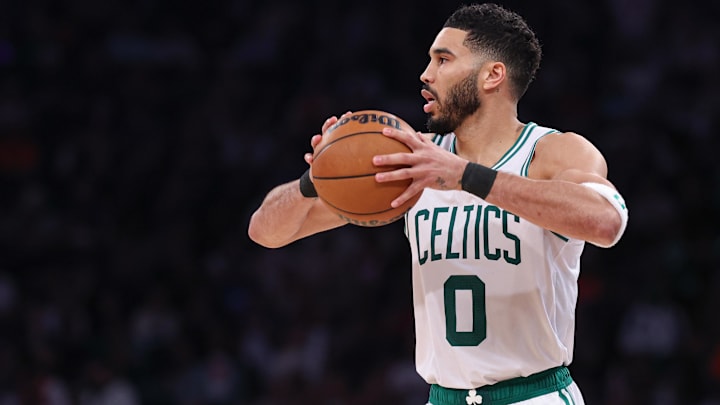
It seems like the Celtics have adopted the “do your job” mantra. Everyone has a clear role that seems to be the right one for their skillset. Is that part of why it might be tricky for Jayson Tatum to return? What will his role be, and how will it fit with everyone else who already have clear roles on this team? - Adam M-C
The reason why it will be tricky for Tatum to return is that he won’t be allowed to fill any kind of role like this. You’re right about how the Celtics have been a bit Belichickian in their approach, but Tatum’s return will not be about fitting him into that. It will be about continuing his rehab along a strict early schedule.
So instead of thinking about how he fits with the rest of the team, we have to look at it as how the team will adjust to the 20 minutes or so that Tatum is knocking off the rust and getting back to his usual self. He’s not going to hit the floor and just flow right into everything the team has been doing.
This is partly why I think bringing him off the bench is the best way to handle things. It lets Jaylen Brown still cook with the starters, gives Tatum some controlled reps against a second unit, and gives Joe Mazzulla a chance to mix and match players around Tatum along the way.
Eventually, everyone else will have to fit in around Tatum and Brown. That's going to be their job.
I’ve watched so many NBA podcasts commenting that bringing in Nikola Vucevic for the Celtics was not a good trade, as he is not good at defense, and that's their weakness. I was thinking, ‘Don't the Celtics have pretty good defense this year?’ I always thought our offense was what’s mid and needs improvement. - Stewart S
The Celtics currently have the second-best offense in the league with a rating of 120 (which means they score 120 points per 100 possessions). Their defense has climbed to 10th, with a rating of 112.7 (they allow 112.7 points per 100 possession).
So their offense has been their strength all year, carried heavily by Jaylen Brown’s efficiency. Their defense has been up-and-down a bit and is much better with Neemias Queta on the floor than not.
The Vucevic piece is interesting, though, because on one hand, he is not a good individual defender, but on the other, he’s a good defensive rebounder. One of the reasons why the Celtics have allowed as many points as they have is because they generally don’t rebound well (but it has improved).
So there's validity to worrying about Vucevic as a defender. He’s not a shot-blocking rim protector, so that will hurt. However, he can clean up rebounds, which helps end possessions, so that will help. Adding both of those to the mix might impact the defense slightly one way or another, but I’m not sure if it moves the needle too much either way. They might cancel each other out and leave Boston’s defensive rating mostly where it is.
Can Luka Garza be a Daniel Theis-type player and play alongside Jayson Tatum and Jaylen Brown the same way he is playing this year? - Kyndell M
It’s an interesting comparison, and if he gets minutes with those guys, that would be, to some degree, how he plays. He can’t go up and catch lobs like Theis could, but he’s a better three-point shooter. I can see the hustle of setting two or three screens to help get Tatum open on a drive. That might make Garza valuable enough to keep around as a third-string guy.
I think Vucevic will get the first crack at playing with these guys. I think he’s a better offensive player than Garza and can make more plays for others, but there's a world where Vucevic doesn’t work and they have to pivot.
I've been wondering if it would be beneficial for Joe Mazzulla to arrange steady, predictable minutes for Hugo Gonzalez and Jordan Walsh. At what point does their unpredictable, sporadic playing time hurt their development and confidence? - Russ L
Erik Spoelstra was asked a similar question before the Celtics-Heat game and said, “We're competing to win. You have to earn your minutes. We're not gifting minutes to anyone … we feel that players improve the quickest when there's an accountability to winning, when they're not just empty minutes that are being gifted to someone.”
So there's a balance with this. Guys need minutes to develop because it gives them real-world, unscripted scenarios they need to process. They also need to develop good habits, and that might mean that they get pulled quickly sometimes. Maybe that means they don’t play against a certain matchup because it’s not good for them.
I think there's value in a player hearing, “You're not good against this kind of player/team,” and then being forced to go into practice, individual workouts, and an offseason figuring out how to get good at it.
There's also value in playing through some mistakes, and that's where good coaching comes in. If the guy is making an honest effort and something doesn't go his way, or you see he’s trying to do the right things, then maybe he stays on the floor. The great coaching is in understanding why the mistake is made and having an appropriate reaction.
It’s also helping the young players maintain that confidence. There are conversations that have to lead to a mutual understanding. Guys have to feel like their best interests are still at heart. It can’t just be cold, callous “You sucked there, now you sit.” There has to be coaching, teaching, talking, and understanding, too. And that could come from Mazzulla, another assistant, the front office, or other players on the team. It’s why the top-to-bottom culture of a franchise is so critical to success. Good teams figure this stuff out. Bad teams watch talent fade and hopes extinguish.
With the trade deadline officially ending, many teams have officially declared their tank season, but most of these teams, coincidentally, are small market teams, such as the Pacers, Pelicans, Jazz, Grizzlies, and Wizards. Do you think there is a direct/indirect correlation between being a small market team and being bad/needing to tank? - Michelle K
I think this was more true under the old system, where major markets could be free-spending either in free agency or by back-channeling trade requests to their team. This current collective bargaining agreement will slowly change that because all teams are required to spend to a certain level (a salary floor), and the expensive teams are forced to cut salary to avoid second-apron penalties.
For now, I think we’re seeing some of the remnants of the old system still in place with smaller market teams who have struggled to generate revenue and attract free agents. At the same time, some of these teams have also been plagued by poor management and/or unfortunate circumstances.
The Wizards are egregiously tanking, but they're climbing out of a hole from the John Wall/Bradley Beal era. I’m not sure what the acquisitions of Anthony Davis and Trae Young will do, but they're doing something. The Jazz were good, but they hit a wall and had to start over.
And the Pacers, Pelicans, and Grizzlies came into the season wanting to be good. I think it’s important to understand that they didn’t set out to tank. They are now, but that wasn’t the original goal.
One more note: This is a historically good draft class, which is why we’re seeing historically egregious tanking. There's a lot of hand-wringing and wild solutions being thrown around, but I don’t think it will be anywhere near this bad next season because that draft isn’t going to be great.
Small markets do have it tougher. There aren’t many players clamoring to go to Memphis to live and work. So they do have to find more good players in the draft. But the new system is going to force players to take their money from somewhere, and these small-market teams are going to have the money to spend. The CBA is designed to redistribute talent around the league regardless of market size, so eventually we’ll see the Knicks, Lakers, and Celtics take their turn at the bottom.
 Add us as a preferred source on Google
John Karalis is a 20-year veteran of Celtics coverage and was nominated for NSMA's Massachusetts Sportswriter of the Year in 2019. He has hosted the Locked On Celtics podcast since 2016 and has written two books about the Celtics. John was born and raised in Pawtucket, RI. He graduated from Shea High School in Pawtucket, where he played football, soccer, baseball, and basketball and was captain of the baseball and basketball teams. John graduated from Emerson College in Boston with a Bachelor of Science degree in Broadcast Journalism and was a member of their Gold Key Honor Society. He was a four-year starter and two-year captain of the Men’s Basketball team, and remains one of the school's top all-time scorers, and Emerson's all-time leading rebounder. He is also the first Emerson College player to play professional basketball (Greece). John started his career in television, producing and creating shows since 1997. He spent nine years at WBZ, launching two different news and lifestyle shows before ascending to Executive Producer and Managing Editor. He then went to New York, where he was a producer and reporter until 2018. John is one of Boston’s original Celtics bloggers, creating RedsArmy.com in 2006. In 2018, John joined the Celtics beat full-time for MassLive.com and then went to Boston Sports Journal in 2021, where he covered the Celtics for five years. He has hosted the Locked On Celtics podcast since 2016, and it currently ranks as the #1 Boston Celtics podcast on iTunes and Spotify rankings. He is also one of the co-hosts of the Locked on NBA podcast.
Follow John_Karalis