%20%20--%3E%0A%3Csvg%20version%3D%221.1%22%20id%3D%22Layer_1%22%20xmlns%3D%22http%3A%2F%2Fwww.w3.org%2F2000%2Fsvg%22%20xmlns%3Axlink%3D%22http%3A%2F%2Fwww.w3.org%2F1999%2Fxlink%22%20x%3D%220px%22%20y%3D%220px%22%0A%09%20width%3D%2239px%22%20height%3D%2240px%22%20viewBox%3D%220%200%2039%2040%22%20enable-background%3D%22new%200%200%2039%2040%22%20xml%3Aspace%3D%22preserve%22%3E%0A%3Cpath%20fill%3D%22%23FFFFFF%22%20d%3D%22M38.5%2C7H28.2v26h10.3V7z%22%2F%3E%0A%3Cpath%20fill-rule%3D%22evenodd%22%20clip-rule%3D%22evenodd%22%20fill%3D%22%23FFFFFF%22%20d%3D%22M26.1%2C25.5c0%2C5.8-4.1%2C7.5-12.9%2C7.5C3.9%2C33%2C0%2C31.2%2C0%2C25.2v-1.1h11.6%0A%09v2.4c0%2C0.7%2C0.1%2C1.4%2C1.2%2C1.4c1%2C0%2C1.2-0.4%2C1.2-1.3v-0.9c0-1.6-0.9-1.6-3.5-2.2C2.2%2C21.7%2C0%2C19.7%2C0%2C15.3v-0.9C0%2C9.3%2C5.5%2C7%2C12.9%2C7%0A%09c10.2%2C0%2C12.8%2C2.6%2C12.8%2C7.4v1.8h-11v-2.9c0-0.6-0.4-1.1-1.2-1.1c-0.6%2C0-1.2%2C0.4-1.2%2C1.1v0.9c0%2C1.5%2C0.9%2C2%2C3.3%2C2.5%0A%09c8%2C1.6%2C10.5%2C3.3%2C10.5%2C7.5V25.5z%22%2F%3E%0A%3C%2Fsvg%3E%0A)
NBA Fines Jazz $500,000, but It’s Going to Take More Than That to Solve Tanking
In this story:
You don’t have to be an expert in basketball rotations to notice some NBA teams aren’t putting out winning lineups on a nightly basis.
Tanking for draft position has always been an issue in the league, and as the race to the bottom gets more blatant, it becomes so obvious that even casual fans start to notice.
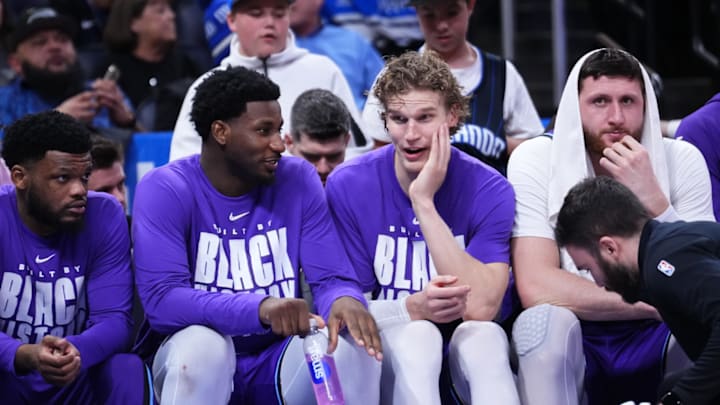
Such was the case last week, when the Jazz faced off against the Heat in Miami. When Utah took a three-point lead into the fourth quarter, starters Lauri Markkanen, Jaren Jackson Jr. and Jusuf Nurkić remained on the bench. But they weren’t just catching an extended breather before returning to the court—they were done for the night. While the Jazz actually held on to win the game, it was pretty clear that wasn’t the team’s intention.
Two nights before that outing, the Jazz again left several starters out for the entirety of the fourth quarter against the Magic, allowing a seven-point lead to dissolve into a three-point loss over the final frame.
The NBA took action on Thursday, issuing the Jazz a $500,000 fine for conduct detrimental to the league relating to both contests.
“During those games, the Jazz removed two of the team’s top players, Lauri Markkanen and Jaren Jackson Jr., before the beginning of the fourth quarter and did not return them to the game, even though these players were otherwise able to continue to play and the outcomes of the games were thereafter in doubt,” the league said in a statement announcing the fine.
The Jazz were not alone in their punishment. The Pacers also got docked $100,000 for their decision to sit Pascal Siakam for a game the league believed he could have otherwise played in—though Indiana was fined for violating the league’s Player Participation Policy, rather than the harsher conduct detrimental to the league penalty the Jazz received.
“Overt behavior like this that prioritizes draft position overt winning undermines the foundation of NBA competition and we will respond accordingly to any further actions that compromise the integrity of our games,” said NBA commissioner Adam Silver in the statement regarding both fines, while adding that the league was looking to implement new measures to “root out this type of conduct.”
Fines are a fine place to start, but it’s clearly not going to be enough to solve the NBA’s tanking issue
First, the lightest credit where credit is due: The league fining the Jazz $500,000 is at least something, and an indicator that more punishments could be on the way if they don’t start trying a bit harder to field a winning basketball team night in and night out—or at the very least, if they don’t start covering their tracks a bit better.
But it’s obvious to anyone who follows the league that fines won’t be enough to solve the issue, just as the lottery system was not enough to solve the issue. Before the lottery, you could not put a conceivable monetary price on the value of the No. 1 pick. In the post-lottery world, you still can’t really put a price on the value of having the best chance of winning the No. 1 pick, even if it’s only a 14% chance. If the price of having a 14% slice of the draft lottery pie was just $500,000, all 30 teams in the league would pay it up front, with gratuity.
So where does that leave us? There is one, extremely obvious punishment that would be effective in the quest to stop tanking. “It’s got to be about the pick,” one team executive told Sports Illustrated’s Chris Mannix earlier this week. “Fines don’t matter.”
What could such a punishment look like? Maybe after a second or third violation, a team is literally docked entries into the lottery, thus actively lowering its chances of landing a high-value pick. Any more violations and those penalties can continue to be applied to future years. If tanking is going to make a team’s draft pick less valuable rather than more valuable, it stands to reason that the tanking would end.
But it’s also not hard to see why the league would be hesitant to enforce such a harsh penalty against perceived tankers, as it is difficult to define where the line would be in applying the punishment. Sure, anyone with eyes knows that the Jazz have a better chance at winning with Markkanen on the floor in the fourth quarter of a close game, but in the era of load management, there are stars who miss games every week because teams believe it gives them the best chance to contend for a title in the long run.
If the NBA went after a team’s pick position in response to tanking, that team would undoubtedly have an endless list of “whataboutisms” to point to where other teams also appeared quite disinterested in winning.
The Jazz are already showing as much. After the fine was levied against them, Jazz owner Ryan Smith responded on social media with an eye-rolling emoji. “Agree to disagree,” he wrote. “Also, we won the game in Miami and got fined? That makes sense …”
🙄 agree to disagree … Also, we won the game in Miami and got fined? That makes sense … https://t.co/sHQrggB2Xa
— Ryan Smith (@RyanQualtrics) February 13, 2026
The league needs both teams in a game to be legitimately trying to win on any given night. It also doesn’t want to put itself in the position of telling teams what exactly it looks like to be legitimately trying to win. “Agree to disagree,” is a pretty fair response if taken at face value, even if it shouldn’t be.
The Jazz will pay the $500,000, and while no one likes to lose a half-million dollars, it’s a rounding error in a league where teams are regularly paying millions in the luxury tax. If they land the top pick this spring, it will be the best money they spend all year.
More NBA on Sports Illustrated
 Add us as a preferred source on Google
Tyler Lauletta was a staff writer for the Breaking and Trending News team at Sports Illustrated. Before joining SI, he covered sports for nearly a decade at Business Insider, and helped design and launch the OffBall newsletter. He is a graduate of Temple University in Philadelphia, and remains an Eagles and Phillies sicko. When not watching or blogging about sports, Tyler can be found scratching his dog behind the ears.
Follow tylerlauletta