%22%3E%0A%3Cpath%20d%3D%22M0%2016.4033V16.3466C0%2010.8189%204.54495%206.40625%2010.4317%206.40625C16.3184%206.40625%2020.8066%2010.7622%2020.8066%2016.2899V16.3466C20.8066%2021.8742%2016.2617%2026.2869%2010.375%2026.2869C4.48826%2026.2869%200%2021.9309%200%2016.4033ZM14.3813%2016.4033V16.3466C14.3813%2014.0883%2012.8317%2012.0473%2010.375%2012.0473C7.91823%2012.0473%206.4253%2014.0599%206.4253%2016.2993V16.356C6.4253%2018.6143%207.97493%2020.6553%2010.4317%2020.6553C12.8884%2020.6553%2014.3813%2018.6427%2014.3813%2016.4033Z%22%20fill%3D%22white%22%2F%3E%0A%3Cpath%20d%3D%22M22.498%2011.0081H28.6777V14.0034C29.5186%2011.9908%2030.8793%2010.6774%2033.336%2010.7907V17.3578H32.684C30.0667%2017.3578%2028.6777%2018.8035%2028.6777%2022.1012V25.8902H22.498V11.0175V11.0081Z%22%20fill%3D%22white%22%2F%3E%0A%3Cpath%20d%3D%22M34.5645%206H40.7441V25.8806H34.5645V6Z%22%20fill%3D%22white%22%2F%3E%0A%3Cpath%20d%3D%22M42.1992%2021.6569V21.6002C42.1992%2018.6332%2044.4008%2016.9702%2047.8686%2016.9702C49.1253%2016.9702%2050.7316%2017.2442%2051.3836%2017.5182V17.2725C51.3836%2015.9119%2050.5427%2015.1182%2048.634%2015.1182C47.1127%2015.1182%2045.8276%2015.4489%2044.5237%2015.9591L43.437%2011.8488C45.1567%2011.1969%2047.1127%2010.7622%2049.7017%2010.7622C52.7254%2010.7622%2054.6908%2011.3858%2055.9947%2012.6992C57.1097%2013.8142%2057.5443%2015.2599%2057.5443%2017.4143V25.8806H51.3647V24.3876C50.3253%2025.5026%2048.9363%2026.2396%2047.0843%2026.2396C44.2213%2026.2396%2042.2087%2024.6049%2042.2087%2021.6663L42.1992%2021.6569ZM51.4309%2020.3813V19.7576C51.0718%2019.6253%2050.5332%2019.5119%2050.0135%2019.5119C48.7851%2019.5119%2048.1048%2020.249%2048.1048%2021.175V21.2317C48.1048%2022.101%2048.7285%2022.6774%2049.5222%2022.6774C50.6088%2022.6774%2051.4309%2021.808%2051.4309%2020.3907V20.3813Z%22%20fill%3D%22white%22%2F%3E%0A%3Cpath%20d%3D%22M59.3867%2011.008H65.5663V13.0773C66.5207%2011.8489%2068.0136%2010.6489%2070.1113%2010.6489C73.2389%2010.6489%2075.2043%2012.7182%2075.2043%2016.0726V25.8807H69.0247V18.0664C69.0247%2016.7908%2068.2593%2016.0537%2067.3333%2016.0537C66.4073%2016.0537%2065.5663%2016.7908%2065.5663%2018.0664V25.8807H59.3867V11.008Z%22%20fill%3D%22white%22%2F%3E%0A%3Cpath%20d%3D%22M76.6221%2018.5577V18.501C76.6221%2013.7859%2079.4568%2010.6583%2082.9718%2010.6583C85.2301%2010.6583%2086.4868%2011.641%2087.4411%2012.6993V6H93.6208V25.8806H87.4411V24.057C86.4301%2025.1436%2085.2868%2026.2397%2083.0285%2026.2397C79.4284%2026.2397%2076.6315%2023.1026%2076.6315%2018.5577H76.6221ZM87.5734%2018.4726V18.4159C87.5734%2016.9419%2086.5151%2015.7419%2085.0978%2015.7419C83.6804%2015.7419%2082.6222%2016.9136%2082.6222%2018.4159V18.4726C82.6222%2019.9656%2083.6804%2021.1467%2085.0978%2021.1467C86.5151%2021.1467%2087.5734%2019.975%2087.5734%2018.4726Z%22%20fill%3D%22white%22%2F%3E%0A%3Cpath%20d%3D%22M95.123%2018.5011V18.4444C95.123%2014.2491%2098.6097%2010.6584%20103.514%2010.6584C108.418%2010.6584%20111.848%2014.2018%20111.848%2018.3972V18.4538C111.848%2022.6492%20108.361%2026.2492%20103.457%2026.2492C98.553%2026.2492%2095.123%2022.7059%2095.123%2018.5105V18.5011ZM105.904%2018.5011V18.4444C105.904%2016.9704%20104.818%2015.7987%20103.457%2015.7987C102.096%2015.7987%20101.057%2016.9704%20101.057%2018.3877V18.4444C101.057%2019.9184%20102.144%2021.0901%20103.504%2021.0901C104.865%2021.0901%20105.904%2019.9184%20105.904%2018.5011Z%22%20fill%3D%22white%22%2F%3E%0A%3Cpath%20d%3D%22M120.532%206.8125H127.174L131.256%2013.5118L135.338%206.8125H141.981V25.8805H135.631V16.4315L131.247%2023.2159H131.133L126.749%2016.4315V25.8805H120.513V6.8125H120.532Z%22%20fill%3D%22white%22%2F%3E%0A%3Cpath%20d%3D%22M143.549%2021.6569V21.6002C143.549%2018.6332%20145.75%2016.9702%20149.218%2016.9702C150.465%2016.9702%20152.081%2017.2442%20152.733%2017.5182V17.2725C152.733%2015.9119%20151.892%2015.1182%20149.984%2015.1182C148.462%2015.1182%20147.177%2015.4489%20145.873%2015.9591L144.787%2011.8488C146.506%2011.1969%20148.462%2010.7622%20151.051%2010.7622C154.075%2010.7622%20156.031%2011.3858%20157.344%2012.6992C158.459%2013.8142%20158.894%2015.2599%20158.894%2017.4143V25.8806H152.714V24.3876C151.675%2025.5026%20150.286%2026.2396%20148.434%2026.2396C145.571%2026.2396%20143.558%2024.6049%20143.558%2021.6663L143.549%2021.6569ZM152.78%2020.3813V19.7576C152.421%2019.6253%20151.883%2019.5119%20151.363%2019.5119C150.135%2019.5119%20149.454%2020.249%20149.454%2021.175V21.2317C149.454%2022.101%20150.078%2022.6774%20150.872%2022.6774C151.958%2022.6774%20152.78%2021.808%20152.78%2020.3907V20.3813Z%22%20fill%3D%22white%22%2F%3E%0A%3Cpath%20d%3D%22M160.415%2028.4413L162.323%2024.709C163.987%2025.5783%20165.65%2026.1263%20167.69%2026.1263C170.005%2026.1263%20171.234%2024.9263%20171.234%2022.857V22.4223C170.393%2023.3767%20169.004%2024.4633%20166.935%2024.4633C163.098%2024.4633%20160.32%2021.742%20160.32%2017.6223V17.5656C160.32%2013.3986%20163.155%2010.6489%20166.585%2010.6489C168.768%2010.6489%20170.043%2011.4615%20171.13%2012.586V11.008H177.31V22.12C177.31%2024.8696%20176.733%2026.75%20175.373%2028.1106C174.04%2029.4429%20171.99%2030.2933%20168.673%2030.2933C165.357%2030.2933%20162.815%2029.6413%20160.424%2028.4413H160.415ZM171.253%2017.6034V17.5467C171.253%2016.2711%20170.27%2015.2317%20168.777%2015.2317C167.284%2015.2317%20166.302%2016.29%20166.302%2017.6034V17.6601C166.302%2018.9357%20167.284%2019.9467%20168.777%2019.9467C170.27%2019.9467%20171.253%2018.9073%20171.253%2017.6034Z%22%20fill%3D%22white%22%2F%3E%0A%3Cpath%20d%3D%22M179.209%206H185.606V9.94967H179.209V6ZM179.313%2011.008H185.493V25.8806H179.313V11.008Z%22%20fill%3D%22white%22%2F%3E%0A%3Cpath%20d%3D%22M187.052%2018.5294V18.4727C187.052%2014.3057%20190.321%2010.6868%20195.168%2010.6868C198.438%2010.6868%20200.753%2012.3781%20201.896%2014.7971L197.455%2017.301C196.935%2016.3467%20196.283%2015.8081%20195.272%2015.8081C193.968%2015.8081%20192.986%2016.9514%20192.986%2018.4255V18.4822C192.986%2020.0318%20193.968%2021.1562%20195.187%2021.1562C196.274%2021.1562%20196.898%2020.6082%20197.502%2019.6538L202%2022.2145C200.668%2024.6901%20198.409%2026.2776%20194.866%2026.2776C190.34%2026.2776%20187.052%2022.7059%20187.052%2018.5389V18.5294Z%22%20fill%3D%22white%22%2F%3E%0A%3Cpath%20fill-rule%3D%22evenodd%22%20clip-rule%3D%22evenodd%22%20d%3D%22M211.368%204.36764C217.191%20-1.45588%20226.632%20-1.45588%20232.456%204.36764C238.279%2010.1912%20238.279%2019.6324%20232.456%2025.4559L221.912%2036L211.368%2025.4559C205.544%2019.6324%20205.544%2010.1912%20211.368%204.36764ZM214.009%207.55761C213.948%207.86849%20213.916%208.39718%20213.916%209.14566V10.4189C213.916%2011.1832%20213.948%2011.7198%20214.013%2012.0267C214.078%2012.3317%20214.278%2012.6168%20214.617%2012.8762C214.956%2013.1376%20215.403%2013.3316%20215.958%2013.4623C216.512%2013.593%20217.1%2013.6584%20217.837%2013.6584C218.573%2013.6584%20219.217%2013.591%20219.769%2013.4524C220.322%2013.3158%20220.761%2013.1178%20221.086%2012.8604C221.411%2012.6029%20221.605%2012.3178%20221.666%2012.0069C221.728%2011.6961%20221.759%2011.1674%20221.759%2010.4189V9.14566C221.759%208.38134%20221.728%207.84473%20221.662%207.53781C221.597%207.23287%20221.397%206.94971%20221.058%206.68834C220.72%206.42696%20220.272%206.23291%20219.718%206.10223C219.163%205.97154%20218.536%205.90619%20217.839%205.90619C217.102%205.90619%20216.459%205.97352%20215.906%206.11213C215.352%206.24875%20214.914%206.44677%20214.589%206.70418C214.265%206.9616%20214.071%207.24673%20214.009%207.55761ZM219.276%2024.8638C222.876%2024.8638%20224.557%2024.2064%20224.557%2021.862V21.858V21.3155C224.557%2019.6581%20223.516%2018.971%20220.252%2018.3136C219.278%2018.1136%20218.908%2017.9136%20218.908%2017.3136V16.9414C218.908%2016.6543%20219.177%2016.5117%20219.413%2016.5117C219.749%2016.5117%20219.918%2016.7137%20219.918%2016.9414V18.1136H224.391V17.3988C224.391%2015.4563%20223.347%2014.4266%20219.177%2014.4266C216.15%2014.4266%20213.896%2015.3414%20213.896%2017.3711V17.7433C213.896%2019.5155%20214.805%2020.3155%20218.201%2021.0303C218.28%2021.0472%20218.355%2021.063%20218.427%2021.0781C219.329%2021.2674%20219.647%2021.3341%20219.647%2021.9174V22.2897C219.647%2022.6619%20219.546%2022.8045%20219.142%2022.8045C218.67%2022.8045%20218.637%2022.5471%20218.637%2022.262V21.2897H213.894V21.7471C213.894%2024.149%20215.476%2024.8638%20219.276%2024.8638ZM225.424%2024.5569H229.925V14.7355H225.424V24.5569ZM226.955%2013.5019H229.925V6.06064H227.092V9.411L225.193%206.06064H222.359V13.5019H225.193V10.1199L226.955%2013.5019ZM218.269%2012.152C218.204%2012.2688%20218.055%2012.3262%20217.825%2012.3262L217.827%2012.3282C217.604%2012.3282%20217.459%2012.2767%20217.398%2012.1758C217.336%2012.0748%20217.305%2011.8074%20217.305%2011.3758V7.90068C217.305%207.51852%20217.352%207.28684%20217.445%207.20962C217.538%207.13239%20217.675%207.09279%20217.851%207.09279C218.059%207.09279%20218.198%207.14031%20218.265%207.23734C218.332%207.33239%20218.366%207.55416%20218.366%207.90068V11.3203C218.366%2011.7579%20218.334%2012.0352%20218.269%2012.152Z%22%20fill%3D%22white%22%2F%3E%0A%3C%2Fg%3E%0A%3Cdefs%3E%0A%3CclipPath%20id%3D%22clip0_15229_1822%22%3E%0A%3Crect%20width%3D%22237%22%20height%3D%2236%22%20fill%3D%22white%22%2F%3E%0A%3C%2FclipPath%3E%0A%3C%2Fdefs%3E%0A%3C%2Fsvg%3E%0A)
Sorry, but the Magic are not a better team without Paolo Banchero
In this story:
Yes, the Magic are playing great without Paolo Banchero; no, they're not a better team without him.
You fools.
It's been 10 games without their superstar, yet the sports world is already demanding the Magic to move on from its best player, as if all the team's problems are suddenly solved after a hot three-week stretch in November.
The team playing well today shouldn't break up the potential of how great this team could become tomorrow.
The Orlando Magic are sleeping giants

Maybe you haven't noticed, but the Orlando Magic are sleeping giants:
Three young All-Star-level 20+ PPG scorers (Banchero, Wagner, Bane), all of whom could make an All-NBA case any given season.
Three young All-Defense-level perimeter players (Suggs, Wagner, Black) combined with elite rebounding rim-protectors creating a turnover-creating havoc-wreaking force that generates a perennially elite Top-2 defense.
A team already drawing more free throws than any other team, the most efficient shot in basketball.
There are eight stats called Four Factors that are generally accepted as the best indicators for evaluating how well basketball teams are playing; Orlando rates Top-9 in four and Top-20 in all eight of these metrics, falling between average to elite in every aspect on the court, meaning this team has very few holes to pick on and is good-if-not-great at just about every aspect of team basketball.
This Magic team rates so highly in so many areas, that if ever solves its issues from beyond the arc, there quite literally won't be many other ways the team can improve.
So, why is it that when the Magic starts off the season a little slow, everyone is firing the coach, yet when the team starts to click, the next reaction is to trade the team's best player because he hasn't been a part of the team's last month of success? The recency bias is getting louder by the day.
Could the media simply credit the coach and team for doing well without trying to break up the team?
Could the media eventually see that adding an injured star to a loaded competitive roster could actually make the team even better, rather than assume a subtraction by addition?
Enough of you have said the thing, so now the Orlando Magic GM feels the need to weigh in when asked about the idea that the Magic are somehow better without their superstar:
You hear the chatter, the idea that this 6-foot 10-inch do-it-all forward would take away from the team is crazy.Orlando GM Anthony Parker
He does everything on the court; not many players can defend him on their own; and his best basketball is ahead of him.
Paolo Isn’t Going Anywhere!
— Huncho Hoops (@HunchoHoops) December 2, 2025
“You hear the chatter, the idea that this 6’10 Do It All Forward, would take away from the team is crazy
He does everything on the court, not many players can defend him on their own, and his best basketball is ahead of him”
-Orlando Magic GM,… pic.twitter.com/DTwQ9yHk2h
The Magic playing well without their superstar is a good thing, not a bad thing

As Will Ferrell once screamed in the movie Zoolander, "I feel like I’m taking crazy pills!"
Are we still talking about NBA Baskteball? The game where you have to put the ball in the hoop and stop the other team from putting the ball in the hoop? Does anyone watch the games anymore?
Analytics are a vital part of decisionmaking in sports, revealing indicators of odds that tell you what has happened so far, what is happening right now, and what could happen in the future based on the odds and likelihood of everything that's happened on the court before happening again.
Some numbers are more statistically significant than other numbers for predictive success.
By just about any metric, the Magic have played better basketball in the ten or so games as a team without Paolo Banchero then they did with him so far this season.
Orlando rating Top-15 in Point Differential and Top-12 in both Offense and Defense are all promising signs for this team becoming a contender and winning basketball games for the foreseeable future.
Still, it's a 10-game sample size with many other moving factors at play; for example, Orlando was still finding its rhythm with moving pieces those first 10 games, Desmond Bane wasn't yet hitting his normal rate of threes, bench units were struggling to survive.
Are we collectively skipping over the stats that show how great Paolo was with Orlando this season, like the Magic having the best starting lineup in the NBA by net rating when Banchero was healthy?
No lineup this season was beating opponents as badly as the Magic when they roll out their starting unit of Suggs - Bane - Wagner - Banchero - Carter, posting a +19 Net Rating in 101 minutes on the court together, the most effective lineup in the league, full stop.
Did critics also forget that this hot stretch for Orlando started with the Magic going 5-2 with Paolo Banchero in the lineup before getting injured on his birthday marquee matchup in New York?
One big turning point for this Magic season was when that 5-2 win streak began, after losing to Detroit, Orlando’s elite defense finally woke up and turned on the turnover-forcing jets to finish off a long road trip in Washington and Charlotte with wins. Banchero bringing more helpside shot-blocking energy this season on top of his size and positional versatility means his return doesn’t take away from the team’s elite defense, but only add to it.
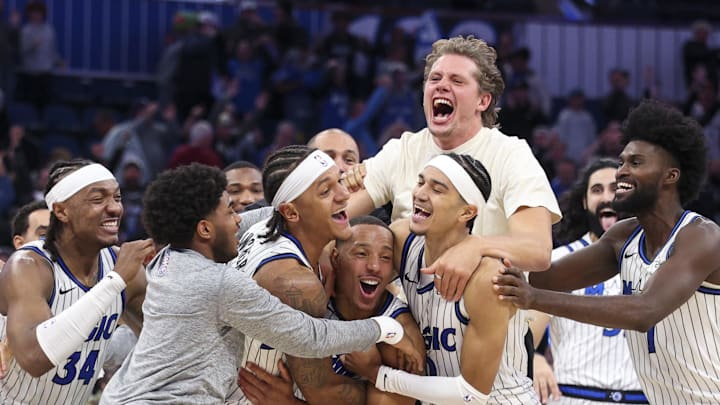
If we're pinpointing one moment that turned this season around for the Magic after a slow start, it wasn't the team rallying together after losing their best player to injury, it was the momentum built off the game before that, after Desmond Bane's buzzer-beater opened the floodgates for this offense, eased the pressure on the newcomers, and built comradery and confidence in the collective.
This is noteworthy because these two events occurred one game apart; the group suddenly feels comfortable, and then the next game a new opportunity arises where the primary option leaves the equation, requiring the rest of the group to step up and fill out needed production in the mean time.
There will be less shots to spread around once Banchero is back, but these reps should lead to better efficiency and decision making for each individual's development over the long run, ideally building chemistry and lineup combo options to rely on in the 15mpg where Banchero is on the bench.
While critics can highlight a handful of questionable decisions from games that require hundreds of instantaneous ones, Banchero was not hurting Orlando's chances of winning basketball games.
Multiple things can be true at once; this version of the Magic's roster has allowed the available players to establish a more defined role, and knowing what the team needs from you and where they need you to be generally helps players find a rhythm.
Franz Wagner and Desmond Bane are the clear top scoring options and primary offensive creators for the team. Jalen Suggs, Anthony Black, and Tristan da Silva are getting more looks as connective secondary creators, keeping the ball moving while running through drive-and-kick handoff actions, initiating more against second units, and attacking closeouts more against starters.
Naturally, fans and viewers see not just a working product, but the clear vision of Jamahl Mosley's system playing out – the epitome of endless drive-and-kick basketball built off handoffs, pick-and-rolls, and finding the best shot for the team.
The role hierarchy is clear, the star production is happening, the results speak for themselves. The idea that the team is winning games, rating Top-10 on both sides of the ball, and doing all that without Banchero (let alone also doing it without the 3-ball even being a factor) is being noticed.
Where this conversation goes awry is viewing the absence of Banchero as a negative mark on him as opposed to a positive mark of the rest of this roster, and an even more promising sign for the longterm potential ceiling of this team.
The Banchero-less Magic are already a great two-way team built on defense and drive-and-kick basketball around two NBA stars and a bevy of playfinishers and playmakers thriving in their roles that one could argue is a contender on its own as currently stated in the East.
Now imagine how much more dynamic that contender can become with a proven all-star, a potential All-NBA superstar, entering the fold who brings things to the table that no one else on the team does.
Yes, everyone would like to see Paolo's efficiency on his pull-up jumper rise, but simply possessing the ability to self-create and take a makeable shot is incredibly value in and of itself; no one else on Orlando scores consistently without the help of a ball screen or handoff to create half a step opening.
One could argue the Magic could have doubled-down on their defensive drive-and-kick identity going back to picking Banchero 1st overall to begin with; the Thunder just won a title with #2 pick Chet Holmgren anchoring the defense, popping for threes, and scoring against middy mismatches.
Orlando's front office bucked their own trend of lanky two-way D&3 player archetype draft choices and instead pivoted to Banchero for a reason – the tall toughshotmaking, playmaking, downhill force talent was too unstoppable to deny, and the potential offensive system that could be built through such a strong one man scoring hub was too enticing to pass on.
Now, the Magic have another opportunity to prove why that choice was the right one; while Holmgren looks to be the best #2 super-play-finisher in the league for years to come, when you have a chance to build around a true #1 offensive engine one-man offense matchup-proof scoring creator, you do it.
Paolo Banchero's self-creation becomes even more invaluable for Orlando in the Playoffs

The biggest issue that critics seem to forget in demanding the Magic trade their superstar is come playoff time– how do you expect Orlando to score and create good shots consistently?
Orlando's current system of endless pick-and-rolls and handoffs to create advantages works great in the regular season, but could the Magic's offense get bogged down in the playoffs as defenses intensify?
A player who can create his own shot is rare when the lights are brightest as the defenses get tougher and tougher; Banchero is big, strong, and agile enough to be matchup-proof against single coverage, and capable of getting his shot up even over multiple defenders in any situation.
Are midrange jumpers good shots? Yes, for highly efficient specialists; no, for average players on the aggregate. Banchero is far from average on volume and talent, yet he's also not quite highly efficient.
One thing is clear though, Paolo can take and make tough shots from any spot on the court.
Orlando having a confident 6'10" self-creating tough shotmaker makes their offense incredibly tougher to guard.
Simply having the option to run a variety of actions capitalizing on the strengths of Banchero makes this offense more versatile, able to rapidly shift strategies based on mismatches and matchups.
The ideal version of this Magic offense will not only unlock Desmond Bane as a 3pt sniper 3-level scorer and Franz Wagner as a drive-and-kick pick-and-roll maestro, but also involve the downhill force short-roll playmaking tough-shot hitting skill-set of Paolo Banchero to a degree that the scoring gravity of all three stars builds a system greater than the sum of its parts.
Throw in the connective playmaking, explosive two-way athleticism, and 3pt spacing of Jalen Suggs, Anthony Black, and emerging prospects like Tristan da Silva and Noah Penda, and the team just gets deeper with two-way team-first players who 1) guard their yard, 2) can switch onto multiple positions, 3) force turnovers via steals or blocks, 4) spread the floor from deep, 5) can dribble and drive, 6) have team-first feel to pass the rock, cut off ball, and trust their teammates on both sides of the floor.
Winter Park hoops legend and former NBA pro Austin Rivers made his opinion clear on the matter, calling out the 'uneducated basketball fans saying the Magic should Trade Paolo":
"I need you to stop doing drugs... You're out of your f*cking mind."
Austin Rivers gives his two cents surrounding the recent Paolo Banchero chatter.
— Stanley Swanson (@StanleySwanson0) November 28, 2025
🎥:@NBAonNBC pic.twitter.com/DPnTOYbUqE
Could it take time to reintegrate a player who generally plays at a slower pace than the style the team is playing without him on the court, a decisive ball-movement drive-and-kick style that the rest oof the team is currently thriving in? Sure, like it would for any good basketball team integrating key talent into a new system with moving pieces.
On the flip side, critics should remember that while ball-movement and quick decisions can lead to an open shot for the team, an open shot isn't necessarily always better than a tougher one; it depends who is shooting it.
Would the Magic rather leave the fate of their possession on open threes from an iffy outside shooter, or trust a superstar shot-creator in Paolo Banchero with the ball in his hands?
Banchero self-creating a good look for the Magic at his own pace can be just as if not more effective than the team moving the ball quickly around the perimeter without ever bending the defense hoping to find the open man before the clock expires.
Critics should give Banchero more benefit of the doubt. The team saw first hand that Banchero is willing to play in different roles, accepting the idea of setting screens and playing off Orlando's other skilled creators, thriving as a heads-up short-roll playmaker in P&R, a strong tank playfinisher any time he gets downhill with a head of steam, and even an off-ball movement shooter spacing the floor for catch-and-shoots and running off screens to throw off the defense.
Paolo Banchero was scoring at the most efficient rate of his career before going down to injury, generating his highest True Shooting Percentage yet not just because of his own offseason development, but because his shot selection and decision making had become more efficient on the aggregate – Banchero was taking more free throws and shots at the rim (efficient looks) and fewer deep twos and threes (less efficient looks) than ever before.
This Magic's offense final frontier is finding the ideal balance between keeping the drive-and-kick ball-movement pace of the rest of the team while best utilizing Banchero to get the most out of his incredibly versatile skillset and ultimately create the best consistent offensive system for the team.
Between Bane's electric shooting, Wagner's savvy P&R skills, Banchero's self-creation, and the 3pt connective playmaking of everyone else, the Magic no longer need Paolo to score everything every single night.
Both sides may need time to adjust to new expectations, yet both should be relieved that no one player has to do everything anymore. Instead, by joining forces, all players can now contribute more specifically to their strengths and collectively make up for their weakenesses, which should maximize everyone's impact within their role while minimizing usage and conserving energy on both ends.
Yeah, the Magic are playing great basketball in this stretch while missing their injured superstar.
Shouldn't the reaction be that this team could be even better once their best player returns, adding an elite talent without sacrificing team identity?
Normally when a team combines three complementary All-Stars with multiple All-Defensive caliber players, all with minimal holes in their game, it's not just a great team that forms, but a super team.
Maybe the critics should wait and see how many Magicians can go super-saiyan on any given night, rather than try to break up a team from a far by talking up problems that don't exist.
Orlando deserves to see greatness on the hardwood, and this team's greatness is built to last.
Stop trying to run great Magic players out of town because the team is playing well, you fools.
 Add us as a preferred source on Google
Ryan is a basketball scout data analyst who has been covering the Orlando Magic, NBA, and NBA Draft with a focus on roster building strategy, data analytics, film breakdowns, and player development since 2017. He is credentialed media for the Orlando Magic along with top high schools in Central Florida where he scouts talent in marquee matchups at Montverde Academy, IMG Academy, Oak Ridge, and the NBPA Top-100 Camp. He generates basketball data visualizations, formerly with The BBall Index. He has two B.A.s from Florida State University in Business Management and Business Marketing. Twitter/YouTube/Substack: @BeyondTheRK