%20%20--%3E%0A%3Csvg%20version%3D%221.1%22%20id%3D%22Layer_1%22%20xmlns%3D%22http%3A%2F%2Fwww.w3.org%2F2000%2Fsvg%22%20xmlns%3Axlink%3D%22http%3A%2F%2Fwww.w3.org%2F1999%2Fxlink%22%20x%3D%220px%22%20y%3D%220px%22%0A%09%20width%3D%2239px%22%20height%3D%2240px%22%20viewBox%3D%220%200%2039%2040%22%20enable-background%3D%22new%200%200%2039%2040%22%20xml%3Aspace%3D%22preserve%22%3E%0A%3Cpath%20fill%3D%22%23FFFFFF%22%20d%3D%22M38.5%2C7H28.2v26h10.3V7z%22%2F%3E%0A%3Cpath%20fill-rule%3D%22evenodd%22%20clip-rule%3D%22evenodd%22%20fill%3D%22%23FFFFFF%22%20d%3D%22M26.1%2C25.5c0%2C5.8-4.1%2C7.5-12.9%2C7.5C3.9%2C33%2C0%2C31.2%2C0%2C25.2v-1.1h11.6%0A%09v2.4c0%2C0.7%2C0.1%2C1.4%2C1.2%2C1.4c1%2C0%2C1.2-0.4%2C1.2-1.3v-0.9c0-1.6-0.9-1.6-3.5-2.2C2.2%2C21.7%2C0%2C19.7%2C0%2C15.3v-0.9C0%2C9.3%2C5.5%2C7%2C12.9%2C7%0A%09c10.2%2C0%2C12.8%2C2.6%2C12.8%2C7.4v1.8h-11v-2.9c0-0.6-0.4-1.1-1.2-1.1c-0.6%2C0-1.2%2C0.4-1.2%2C1.1v0.9c0%2C1.5%2C0.9%2C2%2C3.3%2C2.5%0A%09c8%2C1.6%2C10.5%2C3.3%2C10.5%2C7.5V25.5z%22%2F%3E%0A%3C%2Fsvg%3E%0A)
NBA MVP Award: Our Case for Each of the Three Finalists for Basketball’s Most Prestigious Award
The time has finally come for the NBA to announce the MVP award winner for the 2025–26 season.
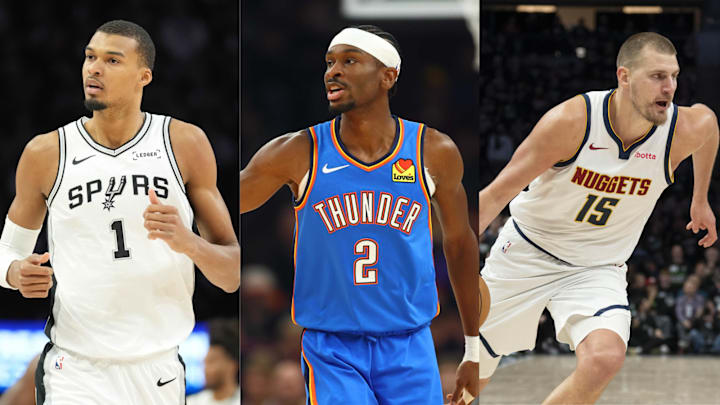
Right after the regular season concluded, the league revealed the three finalists for basketball’s most prestigious award: reigning MVP and Thunder cornerstone Shai Gilgeous-Alexander, Nuggets superstar Nikola Jokić and the up-and-coming Victor Wembanyama. While Luka Dončić stood out immediately as an obvious snub for the final three (after he went to great lengths to make himself eligible), it was largely agreed that was a consequence of an exceptionally strong field for this year’s Most Valuable Player rather than an underserving candidate getting the nod instead.
Each of the three finalists boasts a great case to take home this year. As Sports Illustrated’s Chris Mannix said in his column explaining how he voted on his ballot (which you can read below), there is no wrong answer with this group. Every superstar named is deserving of consideration and it will be absolutely fascinating to see how the voting shakes out across the NBA media members who will name this year’s MVP.
READ: Chris Mannix’s NBA MVP Ballot: The Shai Gilgeous-Alexander, Victor Wembanyama and Nikola Jokić Debate
Ahead of the ceremony on Sunday night at 7:30 p.m. ET, we wanted to break down the case for each MVP finalist. It’s been a while since the regular season concluded and it would be understandable if a refresher is needed.
Before we get started, a reminder that the MVP is, indeed, a regular season award, with votes cast before the playoffs start. So the fact that Jokić’s team flamed out early in the postseason while his two fellow finalists will play for a spot in the NBA Finals next week will be irrelevant to this conversation.
So let’s get into it. Here’s the MVP case for each of this year’s finalists, as well as a few reasons why they won’t take home the trophy on Sunday night.
Shai Gilgeous-Alexander, Oklahoma City Thunder

Season stats: 31.1 points, 6.6 assists, 4.3 rebounds per game on 55.3/38.6/87.9% shooting splits
Why he should win: Gilgeous-Alexander has the most complete case among the final three. He ranked second in the NBA in points per game and led the league in two-point field goals made. The superstar drove his team to wins in great quantity, leading the Thunder to 64 wins despite a variety of injuries to various members of the supporting cast that often left SGA as the lone offensive threat on the floor. And, finally, from the narrative view Gilgeous-Alexander is widely respected as the second-best player in the world (at worst) whose foul-hunting is irritating but makes for the only unappealing aspect of an otherwise slippery-smooth game. The fact that he’s a good-to-great defender helps round out the case.
SGA won MVP last year and put up a better campaign as a sequel. He scored a touch fewer points year-over-year but was much more efficient and OKC’s injuries meant the team was involved in a bunch of close games that showed off Gilgeous-Alexander’s incredible ability to close out wins; he won Clutch Player of the Year as a result. From highlights to raw numbers, Gilgeous-Alexander checks every box.
Why he won’t win: Because he won MVP last year. That is the only reason voters might consider slotting him below another finalist. Only a handful of players in NBA history have won back-to-back MVPs . SGA is deserving of joining that group but voter fatigue is an undeniable part of this process and some members might feel his last MVP season was a mite more impressive than this one.
Nikola Jokić, Denver Nuggets

Season stats: 27.7 points, 12.9 rebounds, 10.7 assists per game on 56.9/38.0/83.1% shooting splits
Why he should win: No player has ever led the league in rebounds and assists per game in the stat-tracking era—until Jokić this season. Such a ridiculous achievement would make him a shoo-in for MVP any other year. But this year he has fierce enough competition that it isn’t automatic. Still, he was a singular offensive force throughout the campaign, finishing with a league-leading 34 triple-doubles (miles beyond Jalen Johnson’s 17 in second) and recording seven games with 15 or more assists. Jokić led the Nuggets to 54 wins and a top-three seed in the West while the basketball world was blown away, again, at his historic ability to rack up eye-popping numbers.
This campaign serves as a sort of official recognition that Jokić is one of the greatest offensive talents to ever grace an NBA floor. The way he can post such ridiculous statlines every night while still playing team-oriented basketball as the sun around which the Denver roster revolves continues to impress year over year. And, in the old-fashioned spirit of the most valuable player argument, the Nuggets would be significantly worse without Jokić providing all that he does.
Why he won’t: Jokić’s lack of defensive prowess didn’t stop him from winning three previous MVP awards but might be enough to stop a fourth, especially since this year was particularly subpar on that end by his standards. His legendary durability also came into question this year as Jokić missed a career-high 17 games. And for how good those numbers are he didn’t accumulate them with the same level of near-unreal efficiency we’ve seen out of the superstar center in the past. But more than anything a three-time MVP award winner has to really outperform the competition to earn a fourth trophy. This group of finalists is strong enough that we can’t say that for certain when it comes to this past season from “The Joker.”
Victor Wembanyama, San Antonio Spurs

Season stats: 25.0 points, 11.5 rebounds, 3.1 blocks per game on 51.2/34.9/82.7% shooting splits
Why he should win: Should the MVP award go to the most dominant player in the NBA on a minute-to-minute basis? That is the backbone of Wembanyama’s case. The young Spurs star is basically incapable of having a bad night because of his defensive abilities. Even when his shot isn’t falling Wembanyama can completely control the flow of the game by forcing teams away from the paint to a degree we haven’t seen in decades from an NBA big man. And when his shot is falling, the 22-year-old is a dangerous three-level scorer who warps opposing defenses due to the simple fact that he can (and will) just dunk the ball if he gets within five feet of the bucket. There is no player whose talents cause more problems for opponents than Wemby and there’s a good case to be made that means there’s no player more impactful than the big man.
From a more standard viewpoint: his offensive numbers aren’t wildly impressive but are much more meaningful when paired with Defensive Player of the Year-caliber play and a league-leading 3.1 blocks per game on the other end. He was the undeniable lynchpin of a Spurs team that won 60 games and regularly gave the defending champs all they can handle. Wembanyama is quickly becoming a household name on par with the true greats of the NBA. All that might prove enough to overcome the statistical gap in his counting numbers compared to the above candidates.
Why he won’t win: You can make the case otherwise but the fact remains: MVP is very much a statistical award. Wemby didn’t even finish within shouting distance of SGA and Jokić from a points and assists standpoint. He also came off the bench for a stretch mid-season while recovering from an injury, which kept his minutes count shockingly low for an MVP candidate as Wembanyama averaged 29.4 minutes per game—no MVP winner has ever played less than 30 minutes per night, with Giannis Antetokounmpo setting a record for winning the award while clocking in at 30.4 mpg back in 2019–20. Between that, his low scoring output and the fact that he’d be the youngest MVP of all time means there’s quite a bit of history Wemby has to overcome in order to see this through.
Voters might be able to overlook one of those factors but all of them combined? A bit of a tough sell. That’s why Wembanyama has the “weakest” case of these three stars, even if his season was outstanding in every regard.
More NBA playoffs on Sports Illustrated
Listen to SI’s NBA podcast, Open Floor, below or on Apple and Spotify. Watch the show on SI’s YouTube channel.
 Add us as a preferred source on Google
Liam McKeone is a senior news writer for the NBA team at Sports Illustrated. He has been in the industry covering the NBA and other sports as a content creator starting in 2017. Prior to joining SI, McKeone worked for NBC Sports Boston and The Big Lead. In addition to his work as a writer, he has hosted the Press Pass Podcast covering sports media and The Big Stream covering pop culture. A graduate of Fordham University, he is always up for a good debate and enjoys loudly arguing about sports, rap music, books and video games. McKeone has been a member of the National Sports Media Association since 2020.
Follow liam_mckeone