
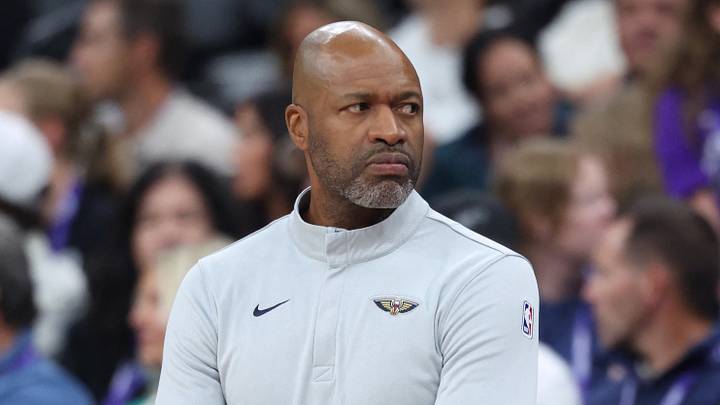
Have the Pelicans Set Jamahl Mosley Up to Fail?
In this story:
Joe Dumars wanted the New Orleans Pelicans to be as defense-minded as his legendary "Bad Boys." That was a major reason he hired Jamahl Mosley. Their roster suggests it was less of a priority when he chose his players.
Through three games, opponents have scored at least 30 points in nine of 12 quarters in regulation. They've scored 108 points in the fourth quarter alone, turning three Pelicans leads into three losses.
Mosley needs time to establish his system. He also needs combinations capable of executing it.
That was the concern well before opening night. New Orleans had several players who needed offensive opportunities, young players who needed developmental minutes, and a limited supply of established defenders to hold everything together.
The early results have exposed those competing demands.
Mosley has adjustments to make: his starting backcourt and Herb Jones' minutes to start with. But Joe Dumars and Troy Weaver assembled the roster. Their decisions deserve as much scrutiny as the coach's substitutions.
Hiring someone to fix the defense doesn't finish the job of building it.
The front office hasn't earned a pass
Dumars built a championship team in Detroit. That accomplishment deserves respect. His record since those successful Pistons teams deserves attention, too.
His last winning season leading a team's basketball operations was 2007-08, when Detroit finished 59-23. That was the season Kevin Garnett, Paul Pierce, and Ray Allen won their championship in Boston. Jeremiah Fears hadn't reached his second birthday.
Dumars' remaining Pistons squads finished below .500. His first Pelicans team went 26-56.
Weaver's four seasons as Detroit's general manager produced 20, 23, 17 and 14 wins, good for a combined 74-244 record. Last season's 26 wins in New Orleans exceeded his best season running the Pistons. Now, the two have combined forces.
Those records don't make every transaction wrong. They should keep the front office's judgement from being accepted on reputation alone.
The Pelicans' problems involve more than learning a new defense. They involve whether the players chosen for that defense fit together.
The starting backcourt needs a change
Dejounte Murray and Jeremiah Fears have shared 50 minutes with a minus-16.5 net rating. Their offensive rating i a meager 110.1. Their defensive rating is 126.6.
Where's the payoff?
The Pelicans are accepting defensive problems without getting enough offense in return.
Fears is shooting 29% overall and 18.2% from three, with only four assists against six turnovers. Murray has produced more, but having them on the court together hasn't made things easier for the younger guard.
Both need the ball in their hands. Playing together requires one to contribute away from the ball while both handle defensive responsibilities they haven't consistently met. That puts more pressure on the players around them.
Murray and Trey Murphy III, the team's most-used pairing at 88 minutes, have a 126.4 defensive rating. This goes beyond Fears learning how to defend NBA guards.
Mosley has to separate his starting guards more often. Give Fears possessions he can direct and learn from. Put Murray in groups with better defensive support.
Their partnership can continue developing without occupying so much of the rotation.
Fears' development matters. So does giving him a role that makes productive use of his strengths. Sharing the floor with another point guard may not be the best way to get that done.
The front office created this balancing act. Mosley has to recognize when the arrangement isn't working and change it.
Mathurin added to the overlap
Bennedict Mathurin's arrival made the fit harder to explain.
The Pelicans moved Jordan Hawkins and Micah Peavy in the deal that cleared room to sign him. Peavy was a young defensive prospect on a team that needed more perimeter defense.
He wasn't a guaranteed answer. But New Orleans gave up the chance to develop him while accomodating another scoring guard. What need did that address?
Mathurin shot 31.5% from three last season and arrived as a career 33.6% shooter. His offensive and defensive Box Plus/Minus estimates were negative in each of his four seasons.
By any measure it was difficult to present him as an established solution at either end.
Mathurin can score. He averaged 17.6 points last season, drew 6.2 free throws per game, and made 86.9%. His ability to attack and get to the line has value.
But New Orleans already had players who wanted to attack the paint. It needed reliable shooting and defense around them. Mathurin hadn't established himself as either.
His first three games have produced eight points per game and one make in nine three-point attempts. That shooting stretch won't define his season. The concerns about his fit existed before it.
He is better than Hawkins. But being an upgrade there doesn't make him the right addition to this team. His combinations show how much defensive support matters.
Mathurin and Queen have a 127.9 defensive rating in 38 shared minutes. Mathurin's 33 minutes alongside Jones have produced a much better 114.1.
Those groups include three other teammates, but the difference should give Mosley a reason to reconsider how he distributes his better defenders.
It also gives Dumars and Weaver a question to answer: How many players can need the same help before there isn't enough to go around?
Why is Herb watching?
Jones is averaging 17.1 minutes per game. Why would a coach as smart as Mosley keep his best defender tied to the bench while the Pelicans struggle this badly to get stops?
Foul trouble explains some of it. Jones picked up five against Denver. It's on him to stay available. But that doesn't end the discussion.
According to Basketball-Reference's on/off figures, the Pelicans' defensive rating improves from 130.5 to 106.3 when Jones plays. The offense has been better during his minutes, too.
As he's shown in previous seasons, the idea that playing Jones requires too much offensive sacrifice is far-fetched.
His partnership with Jordan Poole, someone not known for his defense, has produced a 93.2 defensive rating in 37 minutes.
Poole has made only three of his first 18 shots, a disappointing start after last season's catastrophe. Some of his combinations have nevertheless helped the team, and that should matter when Mosley decides whose minutes to protect.
Jones makes other players more effective. His value has never depended on scoring 15 points.
The Pelicans should be finding ways to tap into that value more often. Instead, they're spending most of their games without it.
That is Mosley's most immediate correction. He can't solve every weakness in this roster, but he can make better use of its strongest defender.
Queen has given them something to build on
The frontcourt offers evidence that Mosley has workable options.
Queen is averaging 13 points and 8.3 rebounds while shooting 52.2%. His partnership with Poole has a 105.4 defensive rating in 41 minutes.
Queen and Zion Williamson have been better still, at 91.1 across 35 minutes.
Their defensive fit was a major question. Their early results deserve acknowledgement and a longer look.
None of these pairings have played enough to establish a lasting answer. They have played enough relative to the alternatives to influence some changes in the rotation.
Queen still has work to do. Despite his individual rebounding production, New Orleans has rebounded worse defensively during his minutes. He needs to help the entire group finish possessions.
Yves Missi's injury had made that responsibility more urgent.
Without him the Pelicans are relying on Queen, Karlo Matkovic, and DeAndre Jordan. Matkovic has played about 17 total minutes. Jordan, 38, grabbed nine boards in his first appearance against Denver.
Each can contribute. How much responsibility they can handle from night-to-night remains to be seen.
Mosley is going to have to ask more of a pair of inexperienced post defenders and an aging veteran.
Queen's progress should expand the rotation's possibilities. It shouldn't have to compensate for every weakness one injury exposes.
Zion has to set the standard
Zion belongs in this discussion as more than a player the Pelicans need to surround correctly on offense.
Their best player has to help establish how they defend.
New Orleans has defended better with him playing than sitting. His production with Queen is more evidence against the idea that he causes every problem. That doesn't excuse one rebound in more than 32 minutes against Denver, though.
Missi was unavailable. The Pelicans needed their starting power forward to take on more. Zion's team-worst 6.7% defensive rebound rate through three games illustrates how big a concern that should be.
He can make a steal or block that changes a possession. New Orleans needs him involved through the end of the ordinary possessions, too. Get the rebound. Complete the rotation. Stay engaged when the ball goes somewhere else.
Those are reasonable expectations for the team's most talented player. They become more important when someone like Missi is missing.
Fears and Queen are learning what consistent NBA responsibility requires. Zion should be demonstrating it.
Mosley has to demand that standard. Zion has to meet it.
The construction matters as much as the coaching
The Pelicans do have some promising combinations. Mosley needs to give them more opportunity.
Jones deserves a larger role. Queen's productive partnerships deserve further testing. Murray and Fears should spend a bit more time apart. Those are decisions the coach can make now.
But the need for those changes brings us back to the roster's construction.
Dumars and Weaver wanted better defense, then added another scorer with an inconsistent outside shot and defensive questions. They retained overlapping offensive roles and left Mosley to find enough support around them.
Missi's injury has increased the demands on a frontcourt with little established depth.
Solving one problem keeps exposing another.
Have the Pelicans set Mosley up to fail? They have made success harder than necessary.
Mosley should be judged on whether he identifies and uses the combinations that work. Dumars and Weaver should be judged on whether their roster gives those combinations enough support to hold up over a season.
The front office chose a coach with a clear defensive priority. It needed to build a team with the same clarity.
Changing the coach didn't finish that work.
 Add us as a preferred source on Google
