
Pelicans' Zion Williamson Problem Keeps Evolving in Year 8
In this story:
For years, the New Orleans Pelicans have tried to build a roster around Zion Williamson. Now, they face a different challenge. They must find the best way to use him on a team that isn't built to maximize his strengths.
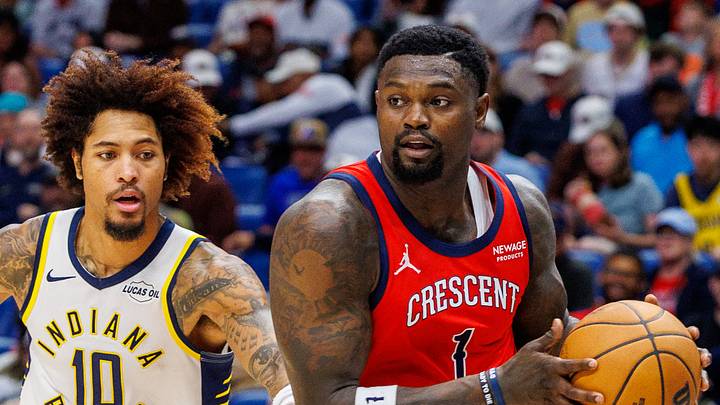
Wednesday's 123-120 season-opening loss to Indiana illustrated the problem.
Williamson finished with 22 points on 7-of-16 shooting, but his offensive involvement fluctuated throughout the night. He attempted two shots in the first quarter, seven in the second, three in the third, and four in the fourth.
Those numbers don't tell the entire story of his performance. They do raise a familiar question about how consistently New Orleans can feature its most dangerous interior scorer.
For first-year coach Jamahl Mosley, the answer may require changing Williamson's role rather than continuing to adjust everything around him.
The formula that once showed promise isn't around anymore
The Pelicans have already seen what Williamson can accomplish when he's a central part of the offense.
In 2020-21, he averaged 27 points on 61.1% shooting and earned his first All-Star selection. His combination of strength, quickness, and touch made him one of the NBA's most difficult individual matchups.
Three seasons later, New Orleans found a more balanced approach. Williamson averaged 22.9 points and five assists in 2023-24, appearing in a career-high 70 games as the Pelicans won 49. He remained a primary offensive weapon, but the roster provided more complementary talent, particularly on defense.
Herb Jones, Dyson Daniels, Naji Marshall, and Larry Nance Jr. gave New Orleans the versatility to support Williamson without sacrificing as much defensive resistance. That group didn't win a playoff series, and Williamson's play-in injury prevented him from participating in the postseason. But 49 victories proved that the Pelicans could build a competitive team with him playing a prominent role.
The current roster presents a different challenge.
New Orleans has more players who need opportunities to create offense, fewer established perimeter defenders, and frontcourt combinations that complicate spacing.
Mosley can't recreate the previous formula without the personnel that made it work.
Missi is changing the equation again
Any discussion about Williamson's role has to account for the growing importance of Yves Missi.
The third-year center finished Wednesday's loss with 13 points, 14 rebounds, two steals, and three blocked shots. Seven of his rebounds came on the offensive glass, creating second chances for a team that rarely generates efficient offense. Those extra possessions matter when missed shots are a recurring problem.
Missi's defensive responsibilities are equally important. New Orleans struggled to contain dribble penetration against Indiana, repeatedly exposing its interior defense. With limited alternatives at center, the Pelicans need Missi's ability to challenge shots, rebound, and provide a presence around the basket.
Mosley has challenged him to enter the Defensive Player of the Year conversation. That reflects the responsibility the coaching staff expects him to carry.
Missi isn't a temporary solution or someone whose minutes should be cut simply to accomodate Williamson. He's an essential part of what New Orleans needs to function. And that makes finding the right combination around the two players critical.
The numbers offer some encouragement
On paper, Williamson and Missi present legitimate spacing concerns. Neither is a conventional perimeter threat, and both are most effective near the basket.
But Wednesday's lineup data suggests they can coexist offensively under the right circumstances.
According to NBA Advanced Lineups data, the Pelicans posted a 118.3 offensive rating in the 27 minutes Williamson and Missi shared the floor. Their defensive rating was a disastrous 130.5, but the offense wasn't the primary concern.
A five-man combination featuring Dejounte Murray, Williamson, Saddiq Bey, Trey Murphy III, and Missi was pretty solid, producing a 143.8 offensive rating and a plus-37.9 net rating in eight minutes.
The additional perimeter shooting provided by Bey and Murphy offered a more favorable offensive arrangement, giving Zion room to attack while Missi remained available to finish plays and pursue rebounds. Eight minutes is hardly definitive evidence, but the results challenge the idea that the two big men are inherently incompatible.
The Pelicans also struggled in several combinations involving Jeremiah Fears. His pairing with Williamson produced a minus-37.5 net rating in 18 minutes, highlighting the need to look at how the surrounding personnel affects each lineup.
The issue isn't simply whether Williamson and Missi can play together. It's whether Mosley can consistently put the right players around them.
Is a reserve role worth considering?
One possibility Mosley shouldn't dismiss is bringing Williamson off the bench.
That wouldn't necessarily mean reducing his minutes or removing him from closing lineups. It could give New Orleans more flexibility to feature him as the primary offensive option in staggered rotations.
Williamson has show he can put up numbers in that role. In seven appearances off the bench last season, he averaged 21.1 points, six rebounds, and 2.7 assists on 58.6% shooting in just around 25 minutes per game.
Those numbers don't prove that New Orleans would be better with Williamson as a reserve. But they demonstrate that he can be really productive without starting.
Mosley could stagger Williamson's minutes with Murray, surround him with additional shooting, and create more possessions designed around his ability to attack the paint.
A reserve role would require separating Williamson from Missi altogether. Their minutes together could remain substantial, primarily when the Pelicans have enough shooting on the floor to support them.
The objective would be to maximize Williamson's impact while preserving the rebounding and rim protection New Orleans needs from its starting center.
The challenge ahead
There are limits to what Mosley can accomplish through lineup changes.
The Pelicans aren't one substitution away from becoming a good team. Their shortcomings in perimeter defense, shooting, and roster balance will ultimately require personnel changes. But Williamson remains their most distinctive offensive talent, and New Orleans can't afford to let that advantage disappear for long stretches.
His 22 points against Indiana were respectable. His three rebounds and three assists in 32 minutes, however, underscored the importance of maximizing his scoring when his contributions elsewhere are limited.
Missi, meanwhile, provides essential production in areas where the Pelicans have few alternatives. That creates a different kind of challenge than New Orleans faces when it was building around Williamson several years ago.
Mosley must decide which combinations allow Zion to attack consistently without compromising the defense, rebounding, or spacing around him. That could mean changing his starting partners, staggering his minutes more aggressively, or experimenting with a reserve role.
The Pelicans have already seen what Williamson can accomplish with the right supporting cast. They don't have that roster anymore.
Now they have to find a way to maximize Zion Williamson without comprimising the players they can least afford to take off the floor.
 Add us as a preferred source on Google
