%20%20--%3E%0A%3Csvg%20version%3D%221.1%22%20id%3D%22Layer_1%22%20xmlns%3D%22http%3A%2F%2Fwww.w3.org%2F2000%2Fsvg%22%20xmlns%3Axlink%3D%22http%3A%2F%2Fwww.w3.org%2F1999%2Fxlink%22%20x%3D%220px%22%20y%3D%220px%22%0A%09%20width%3D%2239px%22%20height%3D%2240px%22%20viewBox%3D%220%200%2039%2040%22%20enable-background%3D%22new%200%200%2039%2040%22%20xml%3Aspace%3D%22preserve%22%3E%0A%3Cpath%20fill%3D%22%23FFFFFF%22%20d%3D%22M38.5%2C7H28.2v26h10.3V7z%22%2F%3E%0A%3Cpath%20fill-rule%3D%22evenodd%22%20clip-rule%3D%22evenodd%22%20fill%3D%22%23FFFFFF%22%20d%3D%22M26.1%2C25.5c0%2C5.8-4.1%2C7.5-12.9%2C7.5C3.9%2C33%2C0%2C31.2%2C0%2C25.2v-1.1h11.6%0A%09v2.4c0%2C0.7%2C0.1%2C1.4%2C1.2%2C1.4c1%2C0%2C1.2-0.4%2C1.2-1.3v-0.9c0-1.6-0.9-1.6-3.5-2.2C2.2%2C21.7%2C0%2C19.7%2C0%2C15.3v-0.9C0%2C9.3%2C5.5%2C7%2C12.9%2C7%0A%09c10.2%2C0%2C12.8%2C2.6%2C12.8%2C7.4v1.8h-11v-2.9c0-0.6-0.4-1.1-1.2-1.1c-0.6%2C0-1.2%2C0.4-1.2%2C1.1v0.9c0%2C1.5%2C0.9%2C2%2C3.3%2C2.5%0A%09c8%2C1.6%2C10.5%2C3.3%2C10.5%2C7.5V25.5z%22%2F%3E%0A%3C%2Fsvg%3E%0A)
The Secret Behind Jalen Brunson’s Rise to NBA Champion
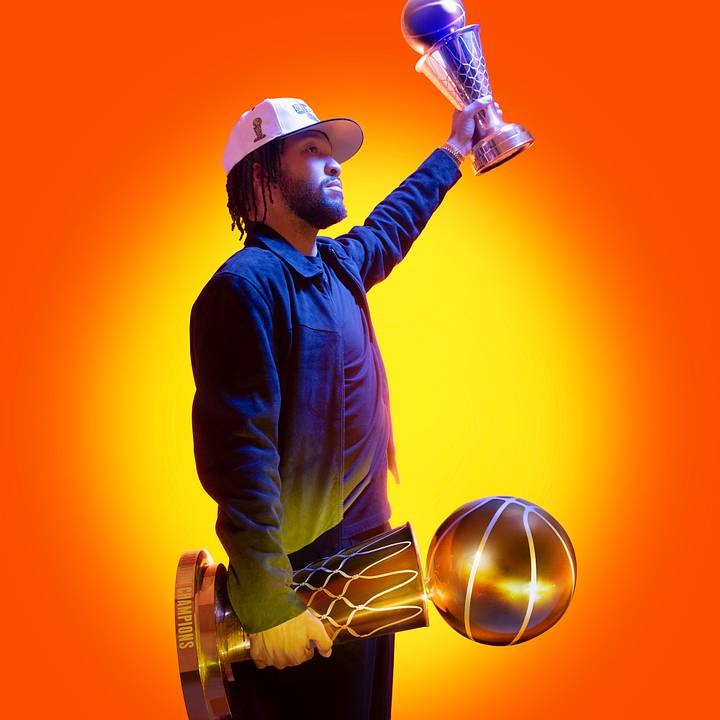
Winning excuses a lot, which for Mikal Bridges includes a tequila-fueled Instagram Live 48 hours after the NBA Finals. In a now infamous stream Bridges serenaded his dog, bleated like a goat in reverence for Jalen Brunson, needed five tries to pronounce Jeremy Sochan’s name and called Knicks owner James Dolan a “savage” for suggesting the team abstain from sex during its playoff run. At one point, Brunson fired up his seldom-used X account to plead with someone to “take Mikal’s phone.”
Of Brunson, Bridges urged the Knicks to “build that little big-headed ass a statue.” He thanked Becky Hammon, the Hall of Famer who in 2023 suggested the Knicks would never win a title being led by someone Brunson’s size. “He ain’t going to tell y’all,” said Bridges. “He knows what she said. And it fueled him to go be great.”
A few days later, Brunson was asked to confirm Bridges’s agave-soaked assertion. “I said this after we won,” says Brunson. “I didn’t respond then, and I damn sure am not going to respond now. So you guys can take that and do what you want.”
Brunson is sitting in an empty room adjacent to the suburban studio outside New York City where he records his podcast, Roommates Show, which he cohosts with teammate Josh Hart. Ben Stiller has just dropped by, revealing plans to produce a documentary on the Knicks’ 2025–26 season. Outside a crowd grows as word of Brunson’s presence spreads. A pair of police SUVs block off both ends of the street. A blue-clad fan pleads with someone entering the building to tell Brunson “that he’s the f---ing man.”

Championships in New York, a city with a population of nearly nine million, hit different. A Knicks championship really hits different. In other sports, two teams divide the fan base. The Yankees and Mets. The Giants and Jets. Even the Rangers have some competition from Islanders fans in the outer boroughs. The Knicks have none. They play in Manhattan but the team’s tentacles reach from the Bronx to Staten Island. The incursion of the Nets into Brooklyn in 2012 barely made a dent. “They represent us,” said director Spike Lee, the most famous Knicks fan. “We see ourselves in them.”
For players who end 53-year title droughts with one of the most clutch Finals efforts in NBA history, the air is more rarefied. Brunson averaged 32.6 points over five games, connecting on 38.9% of his threes. Drill down and the numbers are even more impressive: He averaged 14.2 points on 39.7% shooting in the first two quarters of games in the series, with a plus-minus ratio of −6.8. In the fourth quarter, he put up 11.2 points on 51.4% shooting and was +7. In the Game 5 clincher, Brunson scored 45 of the Knicks’ 94 points. “He’s a heck of a player,” a dejected Spurs coach Mitch Johnson said after the series. “He deserves everything he’s got.”
Rick Brunson has seen more of his son’s clutch performances than anyone. In state championships, NCAA tournaments, NBA playoff games. Yet from his seat on the bench, even Rick, a Knicks assistant, struggled to process what he was watching. The fallaway jumpers. The finger-roll layups. The triple move he put on the 7' 4" Victor Wembanyama to create the inch of space needed to get the ball on the backboard. At one point during Jalen’s 15-point fourth quarter in Game 5, Rick felt himself literally on the edge of his cushioned seat. “I couldn’t even comprehend it,” says Rick. “I was as in awe as everybody else.”
Ask Jalen what comes over him in these moments and he won’t bury you in hyperbole. He credits the work. “When I’m in the gym by myself in the summertime, those are the moments I’m thinking about,” says Brunson. “Where everything, every detail has to matter.”
He doesn’t fear failure. “I don’t care about losing,” says Brunson. Pausing, he corrects himself. “I do care about losing,” Brunson says. “I just know how I work and I feel like if my mind is right and everything is right, then I’m not afraid to fail. I’m not afraid to lose in those situations. So it allows me just to be the best I can be and not care about the end result as long as the process is right.”
In this case, the end result was a championship, one that pushed Brunson into never-ending debates. The greatest Knick of all time? Walt Frazier and Patrick Ewing have strong arguments, but Brunson has a case. On the short list—no pun intended—of the NBA’s greatest small guards? Depends on your definition, but along with Tiny Archibald, Isiah Thomas and Allen Iverson, the (maybe) 6' 2" Brunson is in the conversation. Brunson’s rise, from second-round pick to the Mavericks’ second unit, from starter to superstar, has been among the most improbable.
In New York, it’s catapulted Brunson into another tier of celebrity. Days after the Finals clincher, a mural on Manhattan’s Lower East Side was updated with Brunson holding the Finals MVP trophy. Dozens of Brunson doppelgängers—or at least those who considered themselves ones—showed up at Washington Square Park for a lookalike contest. (The winner, a cornrowed 5-year-old, earned a FaceTime from Brunson, not to mention a $5,000 prize.) An online petition to change the name of the Hudson River to Brunson River has picked up hundreds of signatures.
“Honestly, I’m just really thankful that this organization, this city, this fan base took me in and I was able to achieve a goal that we all had,” says Brunson. “That comes before anything.”
During the Finals, Brunson was asked how it was that a player with his accomplishments—McDonald’s All-American, two-time NCAA champion, consensus college basketball player of the year—could have been so overlooked. What was it that teams, with their bottomless well of scouting resources, missed? In the middle of the question, Brunson cracks a grin, as if knowing his answer would be unsatisfying.
Says Brunson, “Everything.”
Later, when asked to expound on that, Brunson is diplomatic. “Obviously when it comes to drafting, or drafting in the first round, drafting in the lottery, the way it’s gone about is you’re trying to hit the jackpot,” he says. “So if you swing and miss, you swing and miss. But if you make contact, you could hit a home run.
“I feel like drafting me was kind of like hitting a single. You know what you’re going to get. And maybe that wasn’t worth swinging for the fences early. So if that’s the thought process, that’s on them. I can’t control that. The only thing I can control was everything that I did. I thought I put myself in the best position possible and I still was drafted in the second round.”
Rick Brunson wasn’t surprised. In fact, he predicted it. “He said I was going second round, to Dallas,” Jalen recalls his father telling him days before the draft. Rick had seen all the projections. Too small. Not athletic enough. A solid backup. He knew many front offices would buy into them. “You have to know Jalen, understand Jalen,” says Rick. “And if you don’t and you just try to evaluate him from afar, you’re going to be wrong.”
Rick knew Jalen. And he knew the NBA. A sturdy playmaker during four years at Temple, Rick played for eight teams in a nine-year NBA career, including two separate stints with the Knicks. In 2006, Rick was cut by the 76ers before the start of the season. At 34, he knew it was over. “I didn’t have the desire to work as hard as I needed to,” says Rick. On a car ride home one day, he told Jalen he was retiring. In the backseat, the 10-year-old fought back tears.
For Rick, the NBA door had closed. But another one opened. To be a more present father to Jalen and his sister, Erica. And to be a coach. Not immediately. Rick knew Jalen loved the game. But he didn’t want him to live the game. Not yet, anyway. Soccer, baseball, football—he put Jalen in everything. “Kids should enjoy sports when they are little,” says Rick. “Not be forced into them.”

There was another reason. With basketball, Rick could see the talent. And the success that came with it. But he wanted Jalen to experience failure. “You just can’t always be the best at something,” says Rick. “Because once failure hits, then how are you going to overcome that?” Jalen’s Pop Warner football coach was Vince Papale, the ex-Philadelphia Eagle of Invincible fame. Papale made every player play every position. “So no one could say they were the best at anything,” says Rick. The team went 1–11. Rick loved every minute of it.
“It was great for Jalen,” says Rick. “He learned how to be in different positions, to be a good teammate. And he learned how to lose. The feeling of losing. And how much it makes you want to win.”
Eventually, Jalen’s focus narrowed. With basketball, Rick saw the passion early. When Jalen was 8, Rick picked him up at a summer camp. Jalen was in tears. Each day, camp ended with a game of knockout, a shooting drill. That day, Jalen had been the last knocked out. Rick was puzzled. Stop being a baby, he said. A camp coach pulled Rick aside. “I was told, ‘He’s crying because he cares,’ ” says Rick. The moment stuck. “I just remember thinking, Wow, it’s just a game,” says Rick. “But it meant so much to him.”
In between, Rick watched. “I needed him to do it on his own,” says Rick. “I told him, ‘I’m not always going to be around. So you have to have self-motivation.’ ” When Jalen missed shots, Rick accused him of not putting in the work. “It would frustrate him because I knew he was,” says Rick, “but I would just put it in his head that he wasn’t.”

In 2007, Rick took a job as basketball operations manager at Virginia. The family moved to Charlottesville. The work got harder. Pick-and-roll drills. Shooting drills. Anything Rick struggled with at the NBA level he made sure Jalen perfected. At UVA, Rick had access to a state-of-the-art facility. “I wouldn’t let him in there,” says Rick. Most days they would train outside, on the cracked asphalt of a nearby high school. “I wanted to teach mental toughness,” says Rick. “Why would we be in air conditioning? Why can’t we go out in the hot sun?”
The work was tough. Tense. Clashes could play out publicly. Once, Rick interrupted a pickup game because he thought Jalen was playing too selfishly. After a high school game Rick chewed him out for the same reason. All along, Rick told him, ‘If you want me to stop, I’ll stop.’ Jalen never did.
“He was testing me, seeing if I was going to break,” says Jalen. “He was going to see if I was going to crack. It was mental warfare to see how I could push myself, because you can always get yourself to another gear.”
In Game 5, as Brunson wove his way through the Spurs’ defense, Pat Ambrose felt a twinge of déjà vu. For 22 years Ambrose served as head coach at Stevenson High in Lincolnshire, Ill. Four of those seasons were spent with Brunson, who moved to the Chicago suburb in 2010, when Rick landed an assistant coaching job with the Bulls. As a junior, Brunson scored 56 points against Whitney Young High, a team led by Jahlil Okafor, a towering future NBA lottery pick. “Okafor wasn’t Wemby,” says Ambrose. “But he was gigantic for a high school kid. And Jalen couldn’t be stopped.”
NBA superstars have superpowers. Giannis Antetokounmpo’s explosiveness. Shai Gilgeous-Alexander’s body control. Nikola Jokić’s soft touch. Brunson has two. There’s his footwork, a balletic blend of Floyd Mayweather Jr. and Mikhail Baryshnikov. At Temple, Rick played for John Chaney, who had a saying: The longer you stay on the floor, the longer you stay in the game. As the game evolved to be played more above the rim, Chaney coached players to perfect playing beneath it.
Rick hammered that mindset into Jalen. He showed him tape of Michael Jordan. He had him study Kobe Bryant. How did Jordan eventually get past the Pistons in the playoffs? “Playing off two feet,” says Rick. How did Bryant take his game to a championship level? Playing off two feet. Brunson’s coach at Villanova, Jay Wright, shared a similar philosophy. Practices began and ended with footwork drills. “He knew there would be people who are more athletic than we were,” says Jalen. “But we could overcome that with footwork.”

Brunson’s other superpower is more intangible. “Persistence,” is how veteran coach turned TV analyst Stan Van Gundy describes it. Mike Breen, the Knicks’ longtime broadcaster, calls it “an iron will.” Early in Brunson’s New York tenure, Breen likened Brunson to Bryant. The remark drew criticism.
“It was blasphemy,” Breen jokes. He stands by it. “Nothing affects what he wants to do, good or bad,” says Breen. “We don’t have stats to measure that stuff and he clearly has a mental strength and a will that’s stronger than most.”
Brunson’s relationship with Bryant was brief but memorable. He crossed paths with him in high school, when he scored a pair of tickets to a Lakers-Bulls game. Afterward, the two shook hands. Bryant handed Brunson a pair of his red Kobe 9s. Something Bryant said stuck with Brunson: Why work if you don’t want to be the best?
“Things weren’t going to be given to me,” says Brunson. “I had to earn everything. But anything was possible.”

He showed flashes of excellence in Dallas, rising from reliable rookie to top sixth man to Luka Dončić’s sidekick during the Mavericks’ run to the conference finals in 2022. Brunson averaged 21.6 points per game during those playoffs, proving, to the Knicks, at least, that he was ready for something bigger.
The end of Brunson’s time in Dallas has been well-chronicled. In 2021, he wanted a four-year, $55 million extension. The Mavericks didn’t offer it. When they did, it was too late. Dallas could have beaten the four-year, $104 million contract New York gave Brunson in July 2022 but passed. It worked out. Brunson has earned three All-NBA nods since then and now a Finals MVP. The Knicks, Brunson says, “gave me the opportunity to seize the moment.” Still, he insists if it had gone another way, he would have made it work.
“If I stayed in Dallas, I feel like that team, I would have made the best of it as much as I can,” says Brunson. “I would have been a star [in] my role as best I could.”
Would he have been happy playing second fiddle to Dončić?
“Absolutely,” says Brunson. “Understanding the player that he is and what he brought to the table, you were going to be on TV 30, 40 times just because of the level of player he was. So there was going to be opportunity for you to grow as a player as well. Being able to play with him and understand him and just help him out. It was the opportunity that I was ready for. It was the opportunity that I enjoyed and the role that I enjoyed because of the person he is and the player he is. So, yes, absolutely.”
Before Game 3 against the Spurs, as Brunson wrapped up a practice-day press conference, a voice rose up from the back. Fat Joe, the Bronx-born rapper, had snuck into the room for a question. Minutes earlier, Joe had engaged with Knicks coach Mike Brown, getting Brown to agree to hand over an autographed pair of his signature PF Flyers. Catching Brunson’s attention proved more difficult. “Hey Jalen,” Joe shouted. Brunson turned. “Hey Joe,” he said, and then stepped off the dais.
“Damn,” Joe muttered. “I got treated like media.”
That’s Brunson. He isn’t easily impressed. He’s more Jeter than Broadway Joe. When Brunson scans celebrity row at Madison Square Garden, his eyes skip past Chris Rock and Jerry Seinfeld and settle on Mariska Hargitay, the star of Law & Order: Special Victims Unit, the long-running NBC procedural. “Love Mariska Hargitay,” says Brunson. The feeling is mutual. The actor is a fixture courtside at Knicks games. (Brunson later said he would like to make a guest appearance on the show.)
“I think the amazing thing about watching Jalen play is that he has this quiet, deep knowledge that he was made for this moment,” says Hargitay. “Or not that he was made, but that he built himself, piece by piece, day by day, hour by hour, for this moment. Whatever the moment may be, he knows he did the work to meet it.”

Brunson isn’t uncomfortable in the spotlight. But he doesn’t seek it. In interviews, he routinely deflects credit to his teammates. When he earns it, he doesn’t lean into it. Consider: In 2024, Brunson signed a four-year, $156.5 million contract extension. Great money—but $113 million less than he could have signed for a year later. That decision created the flexibility the Knicks needed to reshape the roster around him.
Pundits praised his selflessness. Brunson, though, points out it wasn’t really selfless. “I signed for the most amount of money that was in front of me at that time,” he says. Sure, waiting a year could have been more lucrative. But that came with risk. In some ways, Brunson is still the second-round pick looking to scratch out a 10-year career.
“People always say, ‘Yeah, you can bet on yourself,’ but if things go wrong, it can quickly go away,” says Brunson. “So being able to play with a free mind knowing that I had secured a good amount of money, it allowed me to play free as well. Besides, no matter how much money I would sign for, I don’t think my life changes that much day-to-day.”

That trophy will change things for a franchise that had been steeped in frustration. In one series, Brunson has erased the ghosts of ’94 and the disappointment of ’99. He has papered over the sub-20-win seasons, the countless coaching changes and more than two decades of failing to escape the second round. He has erased the memory of John Starks’s blocked three, Patrick Ewing’s torn Achilles and Carmelo Anthony’s failed return.
And he did it, to paraphrase another adopted New Yorker, his way. At City Hall, the last stop of the Knicks’ victory parade, Brunson offered a rare public rebuttal to his critics. “There are people who have a lot of opinions out there, negative things,” he said. “But when you’re proving them wrong, you really don’t have to say s--- to them.”
Many interpreted that as a response to Hammon.
Maybe. For sure, Brunson will never tell.
More NBA From Sports Illustrated
Listen to SI’s NBA podcast, Open Floor, below or on Apple and Spotify. Watch the show on SI’s YouTube channel.
 Add us as a preferred source on Google
Chris Mannix is a senior writer at Sports Illustrated covering the NBA and boxing beats. He joined the SI staff in 2003 following his graduation from Boston College. Mannix is the host of SI’s “Open Floor” podcast and serves as a ringside analyst and reporter for DAZN Boxing. He is also a frequent contributor to NBC Sports Boston as an NBA analyst. A nominee for National Sportswriter of the Year in 2022, Mannix has won writing awards from the Boxing Writers Association of America and the Pro Basketball Writers Association, and is a longtime member of both organizations.
Follow sichrismannix