%20%20--%3E%0A%3Csvg%20version%3D%221.1%22%20id%3D%22Layer_1%22%20xmlns%3D%22http%3A%2F%2Fwww.w3.org%2F2000%2Fsvg%22%20xmlns%3Axlink%3D%22http%3A%2F%2Fwww.w3.org%2F1999%2Fxlink%22%20x%3D%220px%22%20y%3D%220px%22%0A%09%20width%3D%2239px%22%20height%3D%2240px%22%20viewBox%3D%220%200%2039%2040%22%20enable-background%3D%22new%200%200%2039%2040%22%20xml%3Aspace%3D%22preserve%22%3E%0A%3Cpath%20fill%3D%22%23FFFFFF%22%20d%3D%22M38.5%2C7H28.2v26h10.3V7z%22%2F%3E%0A%3Cpath%20fill-rule%3D%22evenodd%22%20clip-rule%3D%22evenodd%22%20fill%3D%22%23FFFFFF%22%20d%3D%22M26.1%2C25.5c0%2C5.8-4.1%2C7.5-12.9%2C7.5C3.9%2C33%2C0%2C31.2%2C0%2C25.2v-1.1h11.6%0A%09v2.4c0%2C0.7%2C0.1%2C1.4%2C1.2%2C1.4c1%2C0%2C1.2-0.4%2C1.2-1.3v-0.9c0-1.6-0.9-1.6-3.5-2.2C2.2%2C21.7%2C0%2C19.7%2C0%2C15.3v-0.9C0%2C9.3%2C5.5%2C7%2C12.9%2C7%0A%09c10.2%2C0%2C12.8%2C2.6%2C12.8%2C7.4v1.8h-11v-2.9c0-0.6-0.4-1.1-1.2-1.1c-0.6%2C0-1.2%2C0.4-1.2%2C1.1v0.9c0%2C1.5%2C0.9%2C2%2C3.3%2C2.5%0A%09c8%2C1.6%2C10.5%2C3.3%2C10.5%2C7.5V25.5z%22%2F%3E%0A%3C%2Fsvg%3E%0A)
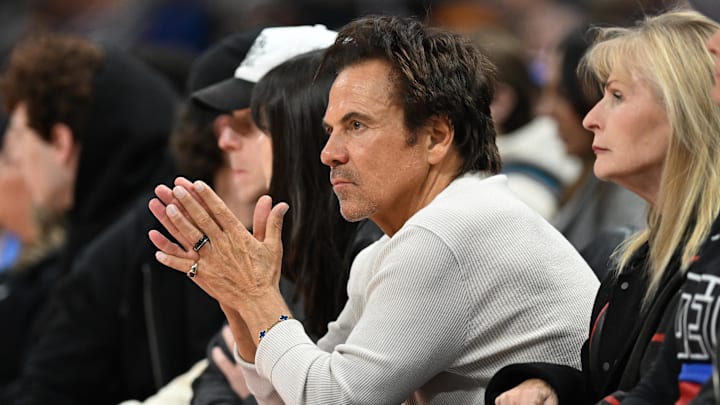
Tom Gores on How Hitting Bottom Fueled the Pistons’ Revival
In this story:
In December 2023, Pistons owner Tom Gores held an impromptu news conference to address a frustrated Detroit fan base. “We do have a plan,” Gores insisted, though anyone listening would be justified to be skeptical. The Pistons were 2–26 at the time, at the tail end of a historic 28-game losing streak and barreling toward a fifth straight sub-24-win season. “It’s not going well,” Gores said. “We have to figure out how to right the ship.”
Two years later, the Pistons have righted the ship. And strapped a jet engine to it. Detroit is 41–13 after Thursday night’s win over New York. The Pistons have the NBA’s best record—not the conference, the NBA—and the franchise’s best winning percentage since the 2005–06 season. Not bad for a team just two years removed from a 14-win season.
Last month, Gores sat down with Sports Illustrated for a wide-ranging interview about the Pistons’ turnaround.
(The conversation has been lightly edited for brevity and clarity.)
Sports Illustrated: You won 14 games less than two seasons ago. Where do you trace this turnaround back to?
Tom Gores: It started with [president of basketball operations] Trajan [Langdon]. I’ve spent the last 30 years turning businesses around. And I really approached this like a turnaround when we were looking for our president of basketball. Honestly, I was looking for more than just a basketball guy. I was looking for an executive. And that’s the way it ended up.
We had an exhaustive search and a lot of known names for the president position. And I had promised myself I would approach it like I have approached [Platinum Equity] my whole life. With the fundamentals, doing a full search, an exhaustive search. It was a lot of work, but I looked for in Trajan what I looked for in executives and CEOs in different fields. And that’s really how we landed on Trajan.

I probably saw 20 different people, a lot of known names. And Trajan was not necessarily one of the known names. He had a good reputation. But I saw a real CEO and an executive in him. He went through a lot to get [the job], honestly. We had talked about him being known as one of the best executives in the league. And at the time, we were hoping something could happen within five years or something. His execution skills, like a CEO, are excellent, his strategy and analytic skills, excellent. He’s very execution oriented. And to me, I’ve never gotten anywhere in my life just with vision. We have to execute and he’s very execution oriented, and of course has a vision.
And one of the things that I’ve seen him do is he’s able to adapt really well. So even in our case with the Pistons, most people told me, “Hey, you got to break it up and you got to do this. You got to do that.” All the pain we had in some of our losing and stuff. And obviously, these young players, I knew them well actually, a little more than Trajan but Trajan’s ability to adapt has been really amazing.
SI: Did you think this team needed radical changes? Because ultimately you have built on the foundation that has been here for years.
TG: Through the tough times we had, I got to really know our young players, met with them several times, including Cade [Cunningham], Beef Stew [Isaiah Stewart], and JD [Jalen Duren], [Jaden] Ivey, and Ausar [Thompson]. And just seeing the fabric of those guys and how they handled losing said a lot to me. And I saw more than just a losing team there. I saw great men with character.
And one of the things, I said this about Cade, but I’d say the other guys were the same, those young guys, they didn’t blame anybody. It tells you a lot when you’re down and they don’t throw blame around.
With Cade, I got to understand Cade’s fabric. And for as much losing as we did, he didn’t blink. That’s why I didn’t hesitate giving him his big deal because I’ve seen the man’s character. Sometimes in life, you can see the best at the bottom. So having gotten to know those young guys personally and then watching them respond to a very tough time, and none of them losing sight of taking the accountability, they took accountability even when I think it was our fault. It told me a lot. And so I felt like we needed change, and I thought that there was more behind these guys than what they showed in their record.
SI: You mentioned Trajan’s vision. Was there anything that stood out about it during the interview process?
TG: I guess a couple things. One, I mentioned it, just his ability to execute all the little things. He does so many little things well. Just even watching him work, getting the team together and little things that you might not even think a president would do, caring about all those little things, but he really checks a lot of boxes.
He also did something interesting because my first round of those 20 interviews and stuff, the first round was on Zoom, and he just wanted to see me right away. So he flew out. I said, “No, it’s O.K. You can Zoom because we were going to narrow it down to 12 or something like that.” But I said, “O.K., great. You want to come out?” And he did. So it showed me that he likes to go live, put a real personal touch on things. And that didn’t win me over completely, but I remember being like, “O.K., I like this guy. He wants it. He knows how to go after it.”
And then I guess the third thing was when I asked him about his game plan, I got about a 15-to-20-page document and that’s how I started to really lean in. I like work product, just like you’re going to run a company. I mean, it’s as complicated as running a multibillion-dollar company and I wanted to see somebody who had that kind of leadership.

SI: J.B. Bickerstaff has had a huge, significant impact on this team’s success. Did you see similar things in him?
TG: I would say [it] would be his ability to just communicate in a raw way. And at the time, I felt like our players needed a lot of communication. They’re so young. To me, communication is the beginning of building trust. So I felt the way J.B. communicated, his thoughts were very real. I think it’s really hard to build trust without heavy communication.
And I have to say, I didn’t realize he was as good a communicator as he is. We just spoke a few times [before he was hired] because we didn’t have much time either. We made some other moves and we didn’t have much time. We had to move quickly. But I loved the way he was able to communicate in a raw way. And our players are smart people, and I think they want to be communicated to and they get it. So I felt his ability to just build trust in the organization with the players. As much as we’ve got to coach teams, we’ve got to build individual relationships. So I felt like J.B. was able to do that.
He is a very affable guy. His communication isn’t one-way. It’s very two-way. And as I said, I think our players these days are really, really smart people. And if you communicate clearly, I think they get the right messages and so on. So that’s the thing that I saw with J.B., and I felt like we, as an organization, needed to build trust and communicate heavily.
SI: A 30-win improvement like you had last season, that’s pretty remarkable. What stood out to you about it?
TG: I was surprised how fast we developed. Cade immediately took the leap. Stew became a different player, a completely different player. Individually, they all progressed a little bit faster than I thought they would. And I thought we would have another rebuilding year, not a playoff year, quite honestly. And I was O.K. with that because I feel really strong about the characters of the guys we had. I mean, obviously I’m biased, but the character of these guys just continues to amaze me. I was surprised probably mostly about just their individual development.
SI: This team has leaned pretty heavily into the Bad Boys’ legacy. Was that something that was discussed internally? Was it a conscious decision?
TG: I wouldn’t say it was directly conscious. I’d love to say that we dreamed that up and it came true, but I think J.B. brought the mentality of defense in that we play defense all the time. And he has done a great job threading the needle between having emotions, play with emotions, but then have discipline. That’s kind of the biggest needle I feel like J.B. threaded with this team.
My thing is we should be emotional. We just need to organize our feelings. It’s a beautiful thing to be emotional. And so one of the things I’ve seen the team do is have that ability to be emotional, to put passion on the floor, but then to have discipline. And it is a lot of some of the Bad Boy stuff that we had and the tightness we had in the Bad Boys, but these guys have created their own identity. And it does come very close to the Bad Boys, but it really started with, I think, fundamentals of playing defense, having a system, teamwork.
What’s amazing to me about what J.B. is doing is that he’s winning with a lot of different lineups. So it’s not that the team just believes in each other, they believe in the system. So whatever the system it is that J.B. is putting on the floor, they believe in that system and it’s allowed him to kind of plug and play. So I think it’s a version, certainly maybe a version of the Bad Boys, but these guys kind of created it on their own.

SI: This team was a mess just over two years ago. Now you’re in a position to contend for a championship. How have you seen the city, the community respond?
TG: To me, it’s full circle because it was really rough [before] and it didn’t matter. We’ve been very engaged with the community since our ownership, and even when we’re losing, we did everything we could for the community. But that only gets you so far. That’s what you learn is that you’re only going to gain the community so far. And then you just got to give them a product that they believe in and that wins. And the response has been incredible. I mean, it’s surreal.
Honestly, when I get there and I’m able to spend time with the fans, it’s one of these things you pinch yourself a little bit like between the front office, our coaching, the players and the community, we’re doing a lot of stuff out there. It’s really threaded together. It’s taken a lot of pain, but I feel like it’s running at all cylinders and people are very happy, very happy. And I’m happy that we were able to give them a product. It’s die-hard folks and fans. And so it’s been great to watch. That’s probably one of the more satisfying things about winning is how it’s impacting a lot of folks in the community.
More NBA from Sports Illustrated
Listen to SI’s NBA podcast, Open Floor, below or on Apple and Spotify. Watch the show on SI’s YouTube channel.
 Add us as a preferred source on Google
Chris Mannix is a senior writer at Sports Illustrated covering the NBA and boxing beats. He joined the SI staff in 2003 following his graduation from Boston College. Mannix is the host of SI’s “Open Floor” podcast and serves as a ringside analyst and reporter for DAZN Boxing. He is also a frequent contributor to NBC Sports Boston as an NBA analyst. A nominee for National Sportswriter of the Year in 2022, Mannix has won writing awards from the Boxing Writers Association of America and the Pro Basketball Writers Association, and is a longtime member of both organizations.
Follow sichrismannix