%20%20--%3E%0A%3Csvg%20version%3D%221.1%22%20id%3D%22Layer_1%22%20xmlns%3D%22http%3A%2F%2Fwww.w3.org%2F2000%2Fsvg%22%20xmlns%3Axlink%3D%22http%3A%2F%2Fwww.w3.org%2F1999%2Fxlink%22%20x%3D%220px%22%20y%3D%220px%22%0A%09%20width%3D%2239px%22%20height%3D%2240px%22%20viewBox%3D%220%200%2039%2040%22%20enable-background%3D%22new%200%200%2039%2040%22%20xml%3Aspace%3D%22preserve%22%3E%0A%3Cpath%20fill%3D%22%23FFFFFF%22%20d%3D%22M38.5%2C7H28.2v26h10.3V7z%22%2F%3E%0A%3Cpath%20fill-rule%3D%22evenodd%22%20clip-rule%3D%22evenodd%22%20fill%3D%22%23FFFFFF%22%20d%3D%22M26.1%2C25.5c0%2C5.8-4.1%2C7.5-12.9%2C7.5C3.9%2C33%2C0%2C31.2%2C0%2C25.2v-1.1h11.6%0A%09v2.4c0%2C0.7%2C0.1%2C1.4%2C1.2%2C1.4c1%2C0%2C1.2-0.4%2C1.2-1.3v-0.9c0-1.6-0.9-1.6-3.5-2.2C2.2%2C21.7%2C0%2C19.7%2C0%2C15.3v-0.9C0%2C9.3%2C5.5%2C7%2C12.9%2C7%0A%09c10.2%2C0%2C12.8%2C2.6%2C12.8%2C7.4v1.8h-11v-2.9c0-0.6-0.4-1.1-1.2-1.1c-0.6%2C0-1.2%2C0.4-1.2%2C1.1v0.9c0%2C1.5%2C0.9%2C2%2C3.3%2C2.5%0A%09c8%2C1.6%2C10.5%2C3.3%2C10.5%2C7.5V25.5z%22%2F%3E%0A%3C%2Fsvg%3E%0A)
Albert Breer’s Takeaways: How the Raiders Landed on Klint Kubiak As Head Coach
In this story:
Jump to a topic
- Las Vegas Raiders
- Buffalo Bills
- Super Bowl impact
- New York Giants
- Jim Schwartz
- Philadelphia Eagles
- Rooney Rule
- Travis Hunter
- New York Jets
- Quick-hitters
The MMQB Takeaways are rolling into the NFL in 2026 (though the league year is still a month or so away) …
Las Vegas Raiders
The Raiders wanted someone who wanted them. That sounds simple, of course. But there’s more to this than just that—there was a real self-awareness to it. The Vegas brass knew their job wasn’t, at this point anyway, the Buffalo or Baltimore job. The franchise has made the playoffs just twice in the past 23 seasons, and this would be their fourth coaching search in five cycles. So, yes, it’s one of 32. But the Raiders wanted more than just that.
In short, they wanted someone who’d embrace the challenge and the history of the team, rather than looking at this as the Yeah, I’ll take it, I guess assignment.
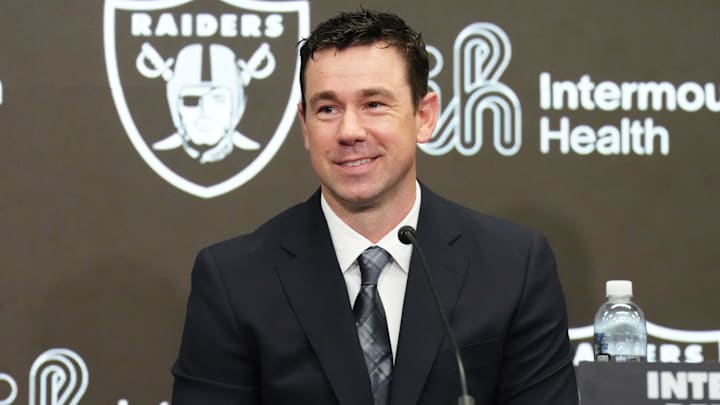
Klint Kubiak, the eventual choice, definitely gave them that, as a 38-year-old who quite literally grew up in the AFC West with his dad, first a Broncos player, then a coach. He told them he wanted to be a part of turning a storied franchise around, and that he loved the idea of taking the first pick and making that selection a turning point for the team. But interestingly enough, there was a juxtaposition to it that really drew in the Raiders brass.
Kubiak was, simultaneously, incredibly conflicted about being there interviewing, first over Zoom, and then in a ballroom at the Hyatt Regency in Renton, Wash. He relayed to the Raiders folks that he felt like he should be preparing for the 49ers during the Zoom interview, one of five he took that weekend (he also met with the Falcons, Giants, Ravens and Cardinals). During his second interview, in person, he flat-out told the Raiders, “I owe everything to these players. All I want is to make sure they get the result they deserve.”
In the end, the Seahawks players did, Kubiak got the Raiders job, and that sort of principled commitment to—to borrow a phrase—excellence is a big piece of the puzzle. Here, then, is some more on how the Raiders wound up picking Kubiak from a big group of contenders …
• The process started for Vegas by forming the committee. SVP of football operations and strategy Mark Thewes, who was with GM John Spytek years ago in Denver, could bring experience, know-how, compliance background, and the good and bad from Bronco searches that ended with the hires of John Fox, Gary Kubiak, Vance Joseph, Vic Fangio, Nathaniel Hackett and Sean Payton. Assistant GM Brian Stark cut his teeth as a coach and knew the coaching world well (he actually coached Kevin O’Connell in college). And VP of player personnel Brandon Hunt’s years in Philly and Pittsburgh would be a great resource.
• Spytek’s own experience with Kubiak, while not any sort of deciding factor, certainly didn’t hurt. The two were together for a single year, the Broncos’ championship year of 2015, and formed a relationship in which, in the years since, Spytek has periodically leaned on the elder Kubiak as a sounding board. Meanwhile, Spytek also had interviewed the younger Kubiak before—for the Buccaneers OC job in 2023 (Tampa hired Dave Canales)—but didn’t know him well enough to have his cell phone number before all this.
• Yes, ownership was involved, and ownership beyond just Mark Davis. Big-money limited partners Egon Durban and Michael Meldman had voices, too, as did Tom Brady, who worked hand in hand with Spytek throughout the search.
• The first round of interviews, the Zooms, were two hours in length, and included Spytek, Brady, Thewes, Stark and Hunt. Interestingly enough, a lot of qualities they looked for in those interviews mirrored Brady’s qualities—they wanted someone hard-working, who’d created a high level of accountability and discipline, and could lead. And the leadership part didn’t necessarily mean the guy had to be a wake-up-the-echoes speaker. Guys like Brady (Bill Belichick, Bruce Arians, Todd Bowles), Spytek (Andy Reid, Gary Kubiak, Arians, Bowles) and Hunt (Nick Sirianni, Mike Tomlin) had seen it manifested in different ways.
• The Raiders narrowed the list to seven from the initial 15 for the final round. Now-Ravens coach Jesse Minter, Panthers DC Ejiro Evero and ex-Dolphins coach Mike McDaniel did second interviews in Brady’s Miami neighborhood, Broncos OC Davis Webb, ex-Giants coach Brian Daboll, and now-Bills coach Joe Brady came to Vegas. And, as the rules dictated, the Raiders traveled to the Seattle area to see Kubiak, since the Seahawks were still playing.
• Kubiak’s second interview was the final one—and he interviewed with Arizona the same day. The Hyatt they chose was less than three miles from the Seahawks facility. At that point, the Raiders had gotten comfortable with Kubiak’s stoic demeanor and cool-under-pressure style of leading. So they were looking for something a little different ahead of this interview. It was more team-specific, focusing on what Kubiak would need, and what he’d be looking for, to lead the rebuild.
• The other piece was getting to see Kubiak’s comfort level with Davis and vice versa in a face-to-face setting. Durban and Meldman were also there to help vet the potential hire. And by the end of it, the Raiders made it clear they were comfortable waiting for Kubiak until after the Super Bowl, which was a tacit job offer. Kubiak would mull his options overnight. Davis, Meldman, Durban, Spytek, Thewes, Stark and Hunt had dinner at the hotel bar afterward, hopeful Kubiak would say yes, while discussing their plan if he didn’t.
• Sunday morning, word got to the Raiders, via Seattle GM John Schneider, that Kubiak would accept their job—but he wanted the opportunity to give those players he was still trying to prioritize word first, before the news got out. The Raiders obliged.
And as to that focus that the Raiders liked so much in Kubiak, the day after the Super Bowl, after the new Vegas coach had gotten the lay of the land, he was headed back to his hotel with his family and preparing for a week full of staff building when Spytek made one last demand: He told Kubiak he had to go to the Seahawks parade. Kubiak initially didn’t want to lose the day of work. The GM said he’d never regret spending that Wednesday in Seattle.
So Kubiak went—and the Raiders felt pretty good that they got this one right.

Buffalo Bills
While we’re there, we never got the chance to dive all the way in on the Bills’ hire of Joe Brady, which figures to be the most impactful of all these. I say this mostly because the fate of perhaps the NFL’s best player, Josh Allen, in the prime of his career hangs in the balance. And that puts a good amount of pressure on everyone involved.
Squarely in the crosshairs of all that is GM Brandon Beane, who was promoted and empowered in the aftermath of Sean McDermott’s dismissal. Beane, of course, knew going in that he had to get this one right. So I figured it’d be good to go through a timeline of how he landed on the guy who was working right down the hall the whole time …
• Beane’s initial list included around 25 names, so the first order of business was to narrow the list to a manageable number. Time was of the essence because the Bills were essentially victims of their own success—two weeks behind most teams after advancing to the divisional round.
• McDermott was let go on the third Monday in January. That night, Beane and his top two lieutenants, Terrance Gray and Brian Gaine, started pouring over the list, and Tuesday was spent doing research and making reference calls around the league. They were categorized in definites for interviews, maybes, and nos. Brady was the first one, and Beane told him Tuesday afternoon that his interview would be the next day. Their old OC Brian Daboll and Colts DC Lou Anarumo were both in the New York City area, so they’d be close enough to come and interview on Thursday.
• With a winter storm coming, the Bills made the call that they’d leave for Florida, and do the next phase near owner Terry Pegula’s Boca Raton home starting on Friday. Around that time, Philip Rivers’s name popped up, so Beane called Rivers’s agents, who communicated that Rivers would only interview with two or three teams, and the Bills were one. So his interview was Friday in Florida. Then-Dolphins DC Anthony Weaver and Commanders running backs coach Anthony Lynn interviewed in Boca on Saturday, and Jaguars OC Grant Udinski’s interview wrapped there during the AFC title game.
• Beane, Gray, Gaine, Pegula and Allen watched the rest of that one, painful as it was, and then reached out to Webb’s people to try and get him to Florida. Webb was already committed to go to Vegas, but agreed to Zoom that Monday morning. The Bills then waited on Rams pass-game coordinator Nathan Scheelhaase, who’d coached in the NFC title game, to finish his interview in L.A. with the Browns before Zooming with him Monday night.
• The Bills also had an interest in Kubiak, but figured it’d be unfair to everyone to wait until after the Super Bowl to interview him—by rule, because the Bills missed the first window to interview him, they couldn’t talk to him until after the Seahawks’ season ended.
• And at that point, as they worked to narrow the list, the Bills kept coming back to Brady. They’d asked him, in the first interview, to go over the roster “like you’ve been coaching for the Green Bay Packers.” They loved his knowledge of their defensive players. They loved his insight on where defenses were going, and how he’d use his experience coaching against those that gave him (and Allen) the most trouble to find a DC to build something similar. They loved the staff lists, which included Jim Leonhard prominently, he gave the Ravens and Raiders. And they loved his vision for being team CEO.
• One line from his interview that stuck out to those in the room, in assessing defenses: “This actually stresses me out, seeing this in the box, and it’s actually this. You can see it in Josh.” Allen, of course, was in the room for that. And, interestingly enough, the coordinator he picked for his defense, Jim Leonhard, would come from the team that ousted Buffalo.
• There was also perspective there from Brady, and not just from his time with McDermott, but also Joe Burrow and Ed Orgeron at LSU, and Sean Payton before that in New Orleans, that showed the Bills would be hiring a whole lot more than just a play-caller. And that’s just what Beane & Co. were looking for. They hardly asked him anything about his offense in the interview, because they felt like doing that would be wasting everyone’s time.
• From there, logistics had to be worked out. Brady was in Vegas to interview with the Raiders that Monday, and had flown back to Buffalo and landed around 11:30 p.m. local time. The Ravens were looking hard at hiring him to be Minter’s first OC. And weather had come into play, too, as the Bills looked to get Brady back down to Florida for his second interview. In the end, Beane made the call to do it over Zoom. And since Brady has two young kids at home, he did the interview from the offensive coordinator’s office at the Bills facility.
• Allen, for what it’s worth, wasn’t in on the second interview. Pegula didn’t want to make the hire Allen’s—but did want to make sure the quarterback was on board with whoever the Bills brass chose. Allen chose to be in the interviews, but was mostly an observer. He took notes. He asked granular questions like when coaches would schedule practices, or meals, and added in what the players in Buffalo like. Beane told Allen that if he thought a coach didn’t fit, he should speak up. On the three-hour flight to Florida, he gave his take on Brady, Daboll and Anarumo, but was intentional in not trying to sway opinion. In the end, he found out Brady was the pick after Brady had already accepted the job.
And when it was over, the Bills bosses had just one request of Brady, and that was to bring in an experienced ex-head coach as a sounding board. Luckily enough, Beane had John Fox, with whom he’d worked for nine seasons in Carolina, on speed dial, and Brady met with him and decided to hire him (Fox has been on the job for a week already).
In the end, Brady may have gone in with a small edge in this race in that everyone knew him—which can work against a coach too, in that the team will know all your warts. But it wasn’t what the Bills knew about him that won him the job. It was all the things they didn’t, that were fleshed out through the two interviews.
And now all Brady has to do is go win a championship.
Super Bowl impact
There’s always an impact the Super Bowl teams have on the rest of the league. So, with the big game in the books, here are five quick things from the Seahawks’ and Patriots’ runs to Santa Clara, Calif., that I think will reverberate through the NFL in 2026 …
1) Sam Darnold’s success only bolsters the idea that high-end quarterback talents can be redeemed later in their careers—and the Seahawks have actually pulled off that trick twice, having had Geno Smith in the hopper when they moved on from Russell Wilson. Likewise, the Buccaneers’ reimagination of Baker Mayfield smoothed the landing on the departure of Tom Brady, and the Colts’ gamble on Daniel Jones settled their turbulent quarterbacking waters (at least until he was injured) and brought alive the young offensive talent on their roster. All of this shows that hope may not be lost for Kyler Murray, Tua Tagovailoa and Mac Jones. Which should create options for quarterback-hungry teams with a draft class coming that may have Fernando Mendoza and not a whole lot else at the position.
2) Defensive coaches can be difference-makers as head coaches. Both Mike Vrabel and Mike Macdonald showed it in creating well-defined, well-crafted identities for their teams. Each was smart, well-conceived, tough and physical. And the impact that’s had on the rest of the NFL is already being felt with Jeff Hafley (Dolphins) and Macdonald’s old running mate Minter (Ravens) landing jobs. There are more good names out there, too, on the frontier, with Evero, Weaver, Jags DC Anthony Campanile and Texans DC Matt Burke all promising coaches to watch in 2026.
3) Quick turnarounds are attainable through good drafting and smart free-agent hauls. What Vrabel, Eliot Wolf and the Patriots did in stocking their roster in 2025 was much like what the Commanders did in 2024—leaning on players coming in from the outside that had background with their coaches, guys like Stefon Diggs, Morgan Moses, Harold Landry III, Carlton Davis III, Robert Spillane and Jack Gibbens. Of those names, only Diggs got a high-end deal. But in the case of all those guys, the team knew exactly what it was getting. And in many cases, the incoming free agents wound up being torch-bearers for the program.
4) The Packers’ scouting pipeline is worth examining. Seahawks GM John Schneider might be headed for the Hall of Fame after winning a second championship with a completely different team than he had for his first, and he did it by beating his old staffmate Wolf in the Super Bowl. Miami tapped into the Packer pipeline this offseason by hiring Jon-Eric Sullivan as GM, and there are certainly others still there, guys like Milt Hendrickson and Richmond Williams, who should get looks for GM openings in the very near future.
5) Investment in the lines of scrimmage is paramount. The Seahawks paid big to acquire DeMarcus Lawrence and Leonard Williams on defense, and have a first-round pick alongside them in Byron Murphy; on offense they have two homegrown first-round picks, in Charles Cross and Grey Zabel, on the line. Meanwhile, the Patriots spent the fourth pick to land left tackle Will Campbell, a third-rounder on guard Jared Wilson, traded for Garrett Bradbury and signed Moses, to play alongside big-money guard Mike Onwenu, on offense; and on defense, gave Milton Williams a blockbuster contract while having Christian Barmore on one, and went out and got Landry and K’Lavon Chaisson to man the edges. Bottom line, for both teams, the trenches were the number one priority. And just as it paid off for the Eagles and Chiefs over the past few years, the Seahawks’ and Patriots’ emphasis in that area was a difference-maker.

New York Giants
On paper, the Giants’ staff looks outstanding. John Harbaugh has assembled a group that has four guys with play-calling experience on the offensive side, and three guys with play-calling experience on the defensive side, while importing his existing special teams coaching infrastructure from Baltimore. And, yup, that all looks phenomenal.
But these all-star staffs don’t always work in practice the way they shine on paper.
So there are questions about bringing guys with different ideas together. How will Brian Callahan’s ideas in the pass game mesh with Greg Roman’s run game, and how will those elements flow into OC Matt Nagy’s system? How does tight ends coach Tim Kelly fit into that tapestry? And on the other side, how will Frank Bush’s experience and Charlie Bullen’s institutional knowledge of the roster help DC Dennard Wilson be his best?
Being able to manage all that should be one of the advantages Harbaugh brings to the Giants. When I think of Nagy with Jaxson Dart, I think of the spectacular season the new OC helped Alex Smith put together in 2017, with so many spread-offense elements baked in not just to maximize Smith but to develop Patrick Mahomes. All the movement stuff the Chiefs were doing that year, in theory, should apply organically to Dart’s physical skill.
On defense, similarly, having versatile rushers like Abdul Carter, Brian Burns, and Kayvon Thibodeaux should translate easily into the Giants’ new Ravens-style scheme. Bobby Okereke could be the Roquan Smith, and Dexter Lawrence the Nnamdi Madubuike.
Bottom line, I love the way all of this looks, and the way the roster looks as it relates to the schemes coming is one reason Harbaugh was attracted to New York.
The hard part—making the vision a reality—comes next.
Jim Schwartz
Jim Schwartz is set up to be the belle of the defensive coaches’ ball in 2027. The Raiders sniffed around on Schwartz and saw him as an ideal coordinator to sit opposite Klint Kubiak, given his five years of head coaching experience. Others certainly had interest.
But in the end, with every defensive coordinator job spoken for, save for the one he just left, Schwartz is set to follow through on the idea of taking a year off and returning in 2027.
It makes sense. And first and foremost, it makes sense because there’s a really good chance that the best defensive coordinator opening next year will be in the old home where Schwartz won a title eight years ago. Eagles DC Vic Fangio considered walking away after Philly won it all last year, almost did it this year, and that, of course, leaves him very much year-to-year going forward.
So if Schwartz were to, say, take the Raiders’ job now, he’d first have to get out of his deal in Cleveland (which has a year and a team option for 2027 left on it), and he’d likely be doing a two- or three-year deal that could make it tough for him to go to Philly, if he so desired, after the 2026 season. Sitting out, on the other hand, would be much cleaner, and give him a better chance of landing what could be the best assistant-coach job of the ’27 market.
Ultimately, Schwartz’s goal is to become a head coach again. The best path to getting there is to coach another elite defense. The best way to make that happen is to get with the best talent possible, and Philly would be a good place to find that, with Schwartz’s standing relationships there, and in particular with GM Howie Roseman, a nice bonus.
At 58, as an older defensive coach, good as he’s been, Schwartz will really have to thread the needle to get another shot at running his own show. So he has to be strategic in how he goes about it. And I’d say, based on what I know, he is being strategic with all this, even if emotion played a role in his initial decision to move on from the Browns.
Philadelphia Eagles
Speaking of the Eagles, I’d maintain that Jeff Stoutland will be one of the toughest coaches for any team to replace this offseason (and that includes head coaches). Maybe that sounds like a little much. I promise you, it’s not.
Stoutland was imported to Philly from Alabama by Chip Kelly in 2013. Since …
• The Eagles have had four linemen make first-team All-Pro (Jason Kelce, Jason Peters, Evan Mathis, Lane Johnson), with Kelce making it six times and Johnson making it twice. They’ve also had a second-team All-Pro (Jordan Mailata). He’s had a Pro Bowler in all 13 of his seasons.
• In the midst of all that, he replaced Hall of Fame candidates at left tackle (Peters) and center (Kelce) with seventh- and second-round picks (Mailata, Cam Jurgens).
• And one of those guys, Mailata, was his masterpiece—an Australian rugby player with freakish athleticism that Stoutland transformed into a dominant lineman, and one who essentially erased the team’s 2019 first-round miss on Washington State OT Andre Dillard.
So why did this end when it did? Stoutland has now worked with three head coaches and a staggering seven offensive coordinators. How his role would be set up under an eighth coordinator, 32-year-old Sean Mannion, was up for debate, and with moving parts around him again, my sense is his spot as the team’s run-game coordinator was part of this.
Now, the Eagles will move forward with former NFL lineman Chris Kuper, who was let go by Minnesota, as line coach, and with 38-year-old tight ends coach Ryan Mahaffey, who is coming over from Green Bay with Mannion, coordinating the run game.
It’s more change for Nick Sirianni, and he’s endured a lot over his five years in charge for a coach who’s been to two Super Bowls and won one.
I’d say this one probably stings a little more.
Rooney Rule
The Rooney Rule will get a hard look this offseason. I’ll say this—I do believe that Roger Goodell earnestly wants to, and has tried to, address the league’s diversity imbalance in its coaching ranks. Canceling the league’s accelerator seminars in 2025 wasn’t a great look and was taken by some as tiptoeing around the current presidential administration’s DEI stance (as part of trying to get the ESPN merger approved by the Justice Department). But overall, those on Park Avenue have made a real effort in recent years to do what they can.
So, to me, there are two things to look at here.
One is, quite simply, that this really isn’t up to the suits at 345 Park Avenue. It’s up to the ones doing the hiring, and no one can force an owner’s hand to make a hire they don’t want to make.
Two, efforts to try to pump the pipeline with young talent haven’t worked, at least yet. Per USA Today data, the NFL filled 29 offensive coordinator positions with 29 white men over the 2024 and 2025 offseasons. This year, with 12 OC jobs open, two were filled by minority candidates—the Chiefs tabbed Eric Bieniemy and the Chargers hired Mike McDaniel—but neither guy was a first-timer, leaving open the question on where the young talent is.
I do think there are guys who will eventually get there, for what it’s worth. New Ravens quarterbacks coach Israel Woolfork is one, having come over from the Cardinals to join Jesse Minter’s first Baltimore staff. Patriots quarterbacks coach Ashton Grant is another, and one who turned down coordinator interviews. And Rams pass-game coordinator Nathan Scheelhaase, who got head-coach interviews, is a third.
Which is all evidence that maybe, just maybe, with a little patience all of this will work out.
A lot of people (including some who work closely with Goodell) are hoping it does, too, because things don’t look so great right now.

Travis Hunter
Travis Hunter being a defense-first player always made the most sense. I do have a theory on this, for what it’s worth, to explain why the Jaguars handled the burgeoning young star the way they did, before injury ended his rookie season.
GM James Gladstone and coach Liam Coen share a Rams background, and in recent years that organization has taken a really interesting turn in assessing positional value. If you look closely, you’ll see an over-the-top investment in spending draft picks on offensive skill-position players and defensive front players. Why? In the Rams’ estimation, those are guys who create points and prevent points from being scored.
Corners, as part of this equation, have been a bit devalued, which you can see in how the Rams put together their roster the past couple years.
And if you follow the bouncing ball here, you can see where the Rams-centric Jaguars would look at Hunter, in trading up for the No. 2 pick, and see a player who could make a bigger impact on the team as a full-time offensive player first. Even if most of the rest of the league thought the right way to deploy Hunter would be as Colorado did, on defense first.
So why did Colorado do it that way? It’s much more difficult to “package” a defensive player than it is an offensive player, given all that a defensive player needs to know about the offense he’s facing before a game. So Deion Sanders’s staff saw the best path to getting the most from Hunter this way: He practiced mostly on defense, he met with the defense during the week, and they put together packages to use him on offense and signal in routes to him from the sidelines as needed. Hunter, of course, won a Heisman Trophy doing it like that.
The dynamics at work there were apparent in Hunter’s final four games before getting hurt, where he played 203 snaps on defense and 70 snaps on offense. Simply put, as the season wore on, it became harder, not easier, to moonlight Hunter on defense.
And conversely, as I see it, with the offense entrenched next year, and other pieces in place (and maybe a bounceback from Brian Thomas Jr.), Hunter will be well-positioned to make a difference on that side of the ball without spending as much time there, while being given the opportunity to grow into a top-flight corner.
Now, I still don’t know if the full-time, two-way thing will work out.
But I do think doing it this way gives them their best shot at it.
New York Jets
There’s a lot of pressure on Aaron Glenn to guide the Jets out of the wilderness next year. January was a weird month for the franchise. For the offensive coaches, it was a roller coaster, where some thought they were safe and wound up fired, and it took three weeks to let coordinator Tanner Engstrand go. On defense, Aaron Glenn interviewed eight coordinator candidates, compiling a list of accomplished coaches, and, after the team released that list, wound up hiring someone less experienced, Brian Duker, who wasn’t on it.
So what in the name of Rex Ryan is going on over there?
Clearly, there was an emphasis from ownership on trying to create the right environment for whoever plays quarterback for the team next year, whether Engstrand (who came over from Detroit with Glenn) was a part of that or not. Ultimately, the Jets wound up spending to get Frank Reich to lead that effort. This was all after the Jets went down the line with Wink Martindale specifically, then pivoted back to Glenn being the de facto coordinator instead, which necessitated having a more experienced hand leading the offense.
It would be easy, from there, to piece this together, as the team decided that, with Glenn, it was better to stock an experienced offensive staff while handing more defensive responsibility to a head coach whose background is entirely on that side of the ball. The problem, to me, is that it doesn’t square with Glenn’s initial vision for his staff, which mirrored Dan Campbell’s setup in Detroit, with the head coach as CEO.
Maybe, in the end, all this will work out. Reich will fix the offense, Glenn will fix the defense and everyone wins. But I’d just say it’s not how a lot of folks saw this going back in early January. And maybe, in going 3–14, the guys on the Jets’ staff, Glenn included, didn’t earn the right to have it the way they wanted.
You’d just have to hope from here, with a very important offseason looming, that everyone is fully bought in on doing it this way.
Quick-hitters
Our first quick-hitting takeaways of the 2026 offseason start now, with a quick ski getaway coming for me this week. But we’ll be back next Monday, on our way to Indianapolis for the combine …
• Because I love stories like this: Seahawks assistant special teams coach Devin Fitzsimmons wore a suit that belonged to his late brother Brendan, to the Super Bowl last Sunday. Brendan died suddenly at 51 in 2022, and his three brothers got his suits, and Devin has worn one (which he had tailored to fit) to every Seahawks away game the past two years. He also, for what it’s worth, wore his maternal grandfather’s watch to the Super Bowl. Pretty cool, and it is one of those windows into what the day means to people who get there.
• Mike Macdonald had Zach Orr pegged for his 2026 staff before the Seahawks even made it to the Super Bowl. To me, it’s a sharp hire in that he’s bringing in a rising star with coordinator experience, and one who gives the team insurance for the potential loss of defensive coordinator Aden Durde in 2027. Durde interviewed with the Browns and Falcons in January, and left a very solid impression. Atlanta had him as a young coach when Matt Ryan was still a player, and was really impressed with his growth since then.
• I’ll allow for the fact that the NFLPA report cards may have violated the CBA. Still, they were effective. In fact, two teams that did poorly on them, the Patriots and Cardinals, went to the lengths of planning to build entirely new practice facilities in the aftermath of the bad publicity they brought. So you can’t say they didn’t make a difference.
• My guess would also be that this year’s results, with the PA claiming they’ll be disseminated in full to the players, will become public anyway. Which means the owners are only making themselves look bad with this action.
• The more I dig, the more I think the free agent that should be getting more attention is the Colts’ Alec Pierce. He’s got a 1,000-yard season under his belt, and has averaged better than 20 yards per catch in each of the past two years. If the Colts wind up having to tag Daniel Jones, then Pierce would hit the market. And with big contracts already committed to Michael Pittman Jr. and Jonathan Taylor, it may be tough to tag Pierce even if Jones doesn’t wind up being franchised.
• Another interesting name: Ravens C Tyler Linderbaum. I’d be pretty stunned if Baltimore tags him. And it’s not because they don’t love him. They do. It’s more the quirks of the tag. Because offensive linemen are grouped together, and not split up by position like defensive linemen or defensive backs, tagging a center or guard means doing it at a tackle number. Which isn’t happening.
• I always regarded Derek Carr’s decision to walk away last spring as a “soft” retirement. And I think, given that there should be more quarterback suitors out there in March than available starting quarterbacks, he’d have a market. Now, the next question would be how hard a bargain the Saints may drive in a trade.
• That same supply/demand dynamic should really help Malik Willis, too, for whatever it’s worth. Willis, by the way, has the same agent as Justin Fields, and Fields wound up getting $20 million on last year’s market.
• I wouldn’t dismiss the idea that quarterbacks coach Dave Ragone becomes the Rams’ OC.
• I like the decision of Mike LaFleur to keep Nick Rallis aboard as defensive coordinator in Arizona. Despite a dip last year in his unit’s play, there are a lot of young players on that side of the ball with the Cardinals who’ll benefit from the continuity, and Rallis is generally regarded as a really good young coach.
More NFL on Sports Illustrated
 Add us as a preferred source on Google
Albert Breer is a senior writer covering the NFL for Sports Illustrated, delivering the biggest stories and breaking news from across the league. He has been on the NFL beat since 2005 and joined SI in 2016. Breer began his career covering the New England Patriots for the MetroWest Daily News and the Boston Herald from 2005 to ’07, then covered the Dallas Cowboys for the Dallas Morning News from 2007 to ’08. He worked for The Sporting News from 2008 to ’09 before returning to Massachusetts as The Boston Globe’s national NFL writer in 2009. From 2010 to 2016, Breer served as a national reporter for NFL Network. In addition to his work at Sports Illustrated, Breer regularly appears on NBC Sports Boston, 98.5 The Sports Hub in Boston, FS1 with Colin Cowherd, The Rich Eisen Show and The Dan Patrick Show. A 2002 graduate of Ohio State, Breer lives near Boston with his wife, a cardiac ICU nurse at Boston Children’s Hospital, and their three children.
Follow AlbertBreer