%20%20--%3E%0A%3Csvg%20version%3D%221.1%22%20id%3D%22Layer_1%22%20xmlns%3D%22http%3A%2F%2Fwww.w3.org%2F2000%2Fsvg%22%20xmlns%3Axlink%3D%22http%3A%2F%2Fwww.w3.org%2F1999%2Fxlink%22%20x%3D%220px%22%20y%3D%220px%22%0A%09%20width%3D%2239px%22%20height%3D%2240px%22%20viewBox%3D%220%200%2039%2040%22%20enable-background%3D%22new%200%200%2039%2040%22%20xml%3Aspace%3D%22preserve%22%3E%0A%3Cpath%20fill%3D%22%23FFFFFF%22%20d%3D%22M38.5%2C7H28.2v26h10.3V7z%22%2F%3E%0A%3Cpath%20fill-rule%3D%22evenodd%22%20clip-rule%3D%22evenodd%22%20fill%3D%22%23FFFFFF%22%20d%3D%22M26.1%2C25.5c0%2C5.8-4.1%2C7.5-12.9%2C7.5C3.9%2C33%2C0%2C31.2%2C0%2C25.2v-1.1h11.6%0A%09v2.4c0%2C0.7%2C0.1%2C1.4%2C1.2%2C1.4c1%2C0%2C1.2-0.4%2C1.2-1.3v-0.9c0-1.6-0.9-1.6-3.5-2.2C2.2%2C21.7%2C0%2C19.7%2C0%2C15.3v-0.9C0%2C9.3%2C5.5%2C7%2C12.9%2C7%0A%09c10.2%2C0%2C12.8%2C2.6%2C12.8%2C7.4v1.8h-11v-2.9c0-0.6-0.4-1.1-1.2-1.1c-0.6%2C0-1.2%2C0.4-1.2%2C1.1v0.9c0%2C1.5%2C0.9%2C2%2C3.3%2C2.5%0A%09c8%2C1.6%2C10.5%2C3.3%2C10.5%2C7.5V25.5z%22%2F%3E%0A%3C%2Fsvg%3E%0A)
John Harbaugh’s Specialty Will Help Him Wherever He Lands
In this story:
The Ravens were coming off a soul-crushing, season-ending loss to the Bengals that kept them out of the 2017 playoffs, and John Harbaugh knew it was time to shake things up. Dean Pees was retiring as a defensive coordinator for the first time—later that offseason he’d go to work for Mike Vrabel in Tennessee—and Harbaugh was promoting Wink Martindale to run the defense.
The promotion came with a provision: We need to change.
That didn’t mean change in the normal football sense. In Baltimore, it meant the Ravens needed to evolve, and become something they hadn’t been, and maybe something that no one in football had been. And Harbaugh didn’t just push Martindale and his room full of football lab rats to do it. He rolled up his sleeves and got into the science with them.
The head coach’s idea was, in a nutshell, to play defense like an offense. An offense, the reasoning went, could run four verts out of a variety of different personnel groupings and formations. Why, he’d ask, couldn’t a defense be the same, with pressures and coverages that were available out of every look they gave an offense, giving the coaches and players a shot to adjust things on the fly? Why couldn’t they, with Eric Weddle, C.J. Mosley and Terrell Suggs at the three levels on the defense, move and morph right until the snap?
And if they could do all that, wouldn’t it make things infinitely more difficult on an offense that would spend every second between the break of the huddle and snap of the ball trying to get a bead on what they were doing?
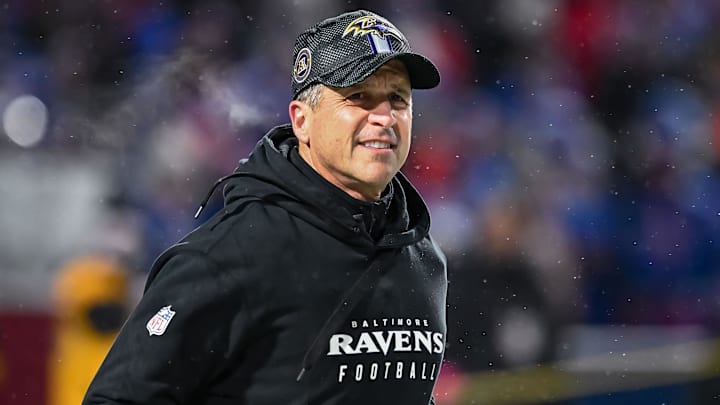
That’s John Harbaugh, the football coach.
He was fired Tuesday, after meeting with Ravens owner Steve Bisciotti on the future of the team, after 18 seasons running the show in Baltimore. He followed a Super Bowl–winning head coach in 2008, and has lapped the accomplishments of his predecessor, Brian Billick, with a 180–113 regular season mark, 13 playoff wins, six AFC North titles, 12 playoff appearances, four trips to the AFC title game and one Lombardi Trophy.
And if you want to know why Harbaugh lasted as long as he did, winning with a completely new generation of players now than he had back in his first year—when he went to the AFC conference championship with a grizzled, veteran defense and a rookie quarterback in Joe Flacco—what was happening in those rooms and on the practice field in 2018 explains it perfectly. It also shows why he won’t have to wait very long to get another crack at being a head coach.
He wanted input, yes, and had ideas, but more than that, he wanted what was best for the team, and so everyone would have a hand in it. He trusted Martindale to take the baton and build the scheme. He allowed, even pushed, for Martindale to incorporate the thoughts of his bright crew of young assistants including Mike Macdonald, Jesse Minter, Zach Orr, Drew Wilkins and Brian Duker, while also leaning on coaching vets like Joe Cullen.
What resulted was a defense that allowed different players to execute different rush and cover elements from different positions. It allowed for Weddle and Mosley, on a called pressure, to yell “swap” at each other, and switch responsibilities as the offense adjusted to what the Ravens were showing them. And the ideas would be carried on to, and evolved in, places like Michigan and Vanderbilt, and with the Chargers and Seahawks over the years.
That’s also just one example.

On offense, it was having the gumption, in 2012, to hand the keys over to Jim Caldwell in December, which sparked a historic run. It was also, in 2019, knowing the right thing for Lamar Jackson was to move creative run-game guru Greg Roman into the coordinator’s seat, to maximize Jackson as a runner and then, four years later, turn to Todd Monken to push the throw game forward and Jackson to another level as a passer. In both cases, Jackson won league MVP in his first year with the new play-caller.
Then, there was the way he handled the team. There was an October 2012 team meeting, after a loss to the Texans, where Ed Reed loudly pushed back against Harbaugh’s decision to stage a full-pads practice with a beat-up crew of players—a meeting that evolved into a therapy session and became the precursor for the group coming together for a championship run.
“He was just a guy that really relied on his leaders—and really listened to us,” Weddle told me Tuesday night. “There were times, I’d come in, and I was an early guy in the building, first one in, 5 a.m., and I’d be in, Harbs would be in, he does his workouts, and we’re just talking—talking life, talking ball, talking about the team. And there’d be times where I’d be like, The guys are pretty beat up, this may be a day where we just go helmets only just to get the guys back. Or, Hey, I think we need to go full gear, I think we need to bang.”
The coach would listen. And the Ravens, more often than not, wound up better for it.
The uniqueness of Harbaugh as a head coach has often been seen through the lens of his unusual path. He spent a decade running the Eagles’ special teams, nine of those years under Andy Reid, prior to landing the job in Baltimore. It was a different hire when it happened, after more well-known names (at the time) like Josh McDaniels and Jason Garrett pulled their names out of the search.
But that was, really, why it worked. Harbaugh wasn’t a specialist. He saw the big picture, the schemes, the team, the program, and how all of it fit together, like the son of a coach would.
And as for the conclusion of that 2018 story—that season, the Ravens finished first in total defense and second in scoring defense, as a ferocious, edgy group helped lead a team with a rookie quarterback finding his way into the playoffs. Just like in Harbaugh’s first year.
“He changed the way he approached the team, how he approached the players,” Weddle said. “The standard is always the standard of what you are, the demand of excellence and how we win football games. It’s never gonna change how you win—you dominate the line of scrimmage, you play technically and fundamentally sound, you play a physical brand of football. That’s never going to change with the Ravens or across the board in football. But how you get that done has evolved. And I feel like … You can almost say swallowing your pride, being willing to change for the betterment of the team, he’s like that.”
Eventually, the clock runs out on coaches, and it did on Harbaugh. Some felt like his message wasn’t reaching players the same way it had. Others thought the makeup of the Ravens’ roster wasn’t like it had been in the past. Clearly, Jackson’s lukewarm response to a question on whether Harbaugh should return got a response.
Regardless of how it ended, 18 years is 18 years, and the adaptability Weddle described is how a coach like him—tough, demanding, and principled—sticks around as long as he did.
It’s also why Harbaugh’s probably got a few really good chapters left.
More NFL From Sports Illustrated
 Add us as a preferred source on Google
Albert Breer is a senior writer covering the NFL for Sports Illustrated, delivering the biggest stories and breaking news from across the league. He has been on the NFL beat since 2005 and joined SI in 2016. Breer began his career covering the New England Patriots for the MetroWest Daily News and the Boston Herald from 2005 to ’07, then covered the Dallas Cowboys for the Dallas Morning News from 2007 to ’08. He worked for The Sporting News from 2008 to ’09 before returning to Massachusetts as The Boston Globe’s national NFL writer in 2009. From 2010 to 2016, Breer served as a national reporter for NFL Network. In addition to his work at Sports Illustrated, Breer regularly appears on NBC Sports Boston, 98.5 The Sports Hub in Boston, FS1 with Colin Cowherd, The Rich Eisen Show and The Dan Patrick Show. A 2002 graduate of Ohio State, Breer lives near Boston with his wife, a cardiac ICU nurse at Boston Children’s Hospital, and their three children.
Follow AlbertBreer