%20%20--%3E%0A%3Csvg%20version%3D%221.1%22%20id%3D%22Layer_1%22%20xmlns%3D%22http%3A%2F%2Fwww.w3.org%2F2000%2Fsvg%22%20xmlns%3Axlink%3D%22http%3A%2F%2Fwww.w3.org%2F1999%2Fxlink%22%20x%3D%220px%22%20y%3D%220px%22%0A%09%20width%3D%2239px%22%20height%3D%2240px%22%20viewBox%3D%220%200%2039%2040%22%20enable-background%3D%22new%200%200%2039%2040%22%20xml%3Aspace%3D%22preserve%22%3E%0A%3Cpath%20fill%3D%22%23FFFFFF%22%20d%3D%22M38.5%2C7H28.2v26h10.3V7z%22%2F%3E%0A%3Cpath%20fill-rule%3D%22evenodd%22%20clip-rule%3D%22evenodd%22%20fill%3D%22%23FFFFFF%22%20d%3D%22M26.1%2C25.5c0%2C5.8-4.1%2C7.5-12.9%2C7.5C3.9%2C33%2C0%2C31.2%2C0%2C25.2v-1.1h11.6%0A%09v2.4c0%2C0.7%2C0.1%2C1.4%2C1.2%2C1.4c1%2C0%2C1.2-0.4%2C1.2-1.3v-0.9c0-1.6-0.9-1.6-3.5-2.2C2.2%2C21.7%2C0%2C19.7%2C0%2C15.3v-0.9C0%2C9.3%2C5.5%2C7%2C12.9%2C7%0A%09c10.2%2C0%2C12.8%2C2.6%2C12.8%2C7.4v1.8h-11v-2.9c0-0.6-0.4-1.1-1.2-1.1c-0.6%2C0-1.2%2C0.4-1.2%2C1.1v0.9c0%2C1.5%2C0.9%2C2%2C3.3%2C2.5%0A%09c8%2C1.6%2C10.5%2C3.3%2C10.5%2C7.5V25.5z%22%2F%3E%0A%3C%2Fsvg%3E%0A)
The Origins of Mack Hollins’s Decision to Go Barefoot
In this story:
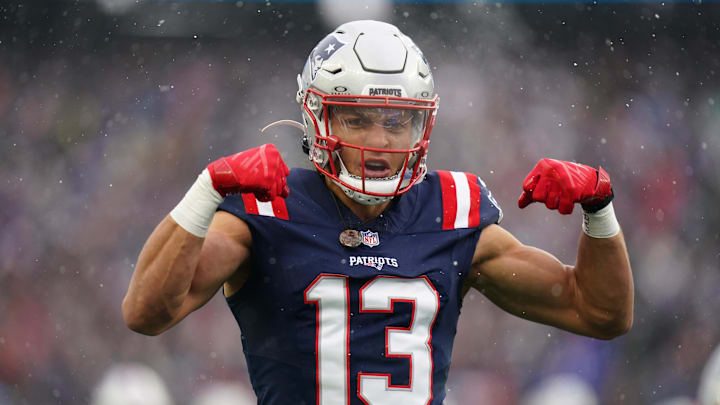
SAN FRANCISCO — As he settles into a chair outside a café in Union Square, Aaron Kiegaldie is wearing … shoes. This might not sound unusual. But, for him—and for the Patriots wide receiver whose career he helped resurrect—it is.
Kiegaldie is the director of Melbourne Muscular Therapies. As in, Australia. Mack Hollins is among his most famous clients. Both, Kiegaldie says, own no more than five pairs of shoes. Even then, they’re “barefoot shoes,” meaning they’re made so wearers feel like they’re walking without shoes even when they’re on. Kiegaldie hasn’t worn shoes—typical, barefoot or otherwise—to work in about 10 years. He drives barefoot, shops barefoot and works out barefoot.
“I want to get the dogs out for sure here,” he says, meaning both feet.
Forget no shirt, no shoes, no service. Hollins reached out to Melbourne Muscular Therapies via direct message on Instagram in 2019. Kiegaldie thought someone might be setting up a scam. He was outside when the missive landed, mowing his lawn, his feet, well, bare.
This wasn’t a scam, it wasn’t a prank. Hollins wanted to play without pain. He had missed the entire previous season, in Philadelphia, to a groin injury that’s most often described as nagging. It was more than that. It was debilitating. It wouldn’t heal. He tore one groin muscle. It healed. Then he tore another. Before reaching out to Kiegaldie, Hollins underwent a successful sports hernia surgery. Even that didn’t heal what ailed him.
“He still couldn’t walk,” Kiegaldie says. “He was pretty disillusioned. He was contemplating retirement, and he took healing into his own hands.”
Or feet.
Hollins typed “groin treatments” into YouTube and came across Kiegaldie and his business partner, Marcus Sinfield, who goes by Ninja, on their widely popular YouTube channel. Sinfield developed many of the massage techniques that are central to their work. “It’s deep bodywork,” Kiegaldie says, “like massage on steroids.”
What Hollins had tried hadn’t worked. So he flew these Australian healers to Philadelphia, telling confidants he’d either dismiss them almost immediately or do everything that they instructed. Right away, they blindfolded Hollins and coaxed him into a trust fall. They spoke his language and signed their first NFL client.
They started with a reeducation, focusing on the quality of Hollins’s movement, not the quantity. They explained the magic—consistency, monotony, repeatability—and it didn’t sound magical at all. “And that’s what Mack personified,” Kiegaldie says. “Just so regimented. And consistent.”
Feet, Kiegaldie notes, are made up of 30 joints and 30 bones. They must communicate and move over one another in order for a human being to move. Which is how Kiegaldie and Ninja taught Hollins the barefoot lifestyle, where shoes are considered prisons. “The feet just need to express and spread,” Kiegaldie says. “Normal shoes, man, it just crushes them—and everything north of that.”
Sure, the barefoot lifestyle comes with downsides. Kiegaldie admits his feet stink; “pretty rank, man.” They’re covered in callouses and cracks. They’re often so dirty, the bottoms turn black. Small price, he says, for the benefits. Hence, why he seeks out beaches with the most barnacles and rocks.
Those benefits: Bare feet, Kiegaldie says, connect to the ground and allow feet to spread, giving those who go full Joe Jackson a stronger, more stable foundation. This allows feet to transfer energy from the body to the ground and vice versa. Scientific studies have proved that the shoeless increase blood flow, reduce inflammation and rid the body of excess temperature.
Kiegaldie and Ninja work with all types of human beings—younger and older, athletes and their antitheses. Hollins stood out, immediately. “We knew there was something raw and talented and magical about him,” Kiegaldie says. “We’re into energy and intuition, and we both felt there was something amazing there.”
They tried eye gazing on Hollins. “It’s about connection,” Kiegaldie says. When staring into Hollins’s eyes, they saw “some deep ancestral power behind them.”
On the visit to Philly, they spied one wall at Eagles headquarters that featured all of the team’s Pro Bowl players. One slot was empty; they replaced it with a picture of their new client, who didn’t send them home and who visited them frequently in theirs. Hollins began flying to Australia for regular treatments every offseason. He stopped wearing shoes and started waxing poetic about how bare feet made him feel more connected to the earth and, thus, to the world around him.
Kiegaldie and Ninja perform a deep, intense massage. To heal groin injuries, they target tendons, because most people who get injured there feel the harshest pain in their joints. But many healers don’t spend much time there; probably because of its proximity to areas physical therapists don’t touch. They’ll spend 10 minutes, even more, holding pressure on that spot, which, Kiegaldie says, “melts” scarred soft tissues and stimulates healing.
Hollins, well, he melted—and during his very first treatment. He scheduled their next visit that day. They laid out their methodology in two simple steps: clean first and build second. When Kiegaldie and Ninja flew to the United States, they performed body work on Hollins for 11 consecutive days. Then they added strength training and sprint work. They taught him concepts such as load tolerances, energy principles and enforced rest. Hollins actually needed to work less.
He stopped wearing shoes, for the most part. His feet were out of their prisons. And his career, well, it took off. In 2022, while playing for the Raiders, Hollins snagged 57 receptions. In ’24, while playing for the Bills, he did everything, as Buffalo contended for a championship.
His therapists are struck by all that Hollins can recall. He’s brilliant in that way; complex and tatted and smart enough to embrace what makes him different. “He’s like an elephant,” Kiegaldie says. “Remembers everything.”
They kept adding to his routines, injecting unconscious mind work, hypnosis, meditation, breath work. For all of 2024, they tailored his treatments and routines specifically toward a Super Bowl run. Buffalo lost again in Kansas City, in the AFC championship game, but Hollins caught three passes for 73 yards and scored a touchdown.
This past offseason, after Hollins signed with the Patriots, they adapted once again. Perhaps they’d become too focused on outcomes. They dialed that back and focused on Hollins, the human being. They didn’t set even one goal related to football or this season. And the combination of these tweaks lowered his mental stress. It also fixed the stress fracture in one of Hollins’s toes. He didn’t run while in Australia, until the last day of this season’s preparation, when he sprinted, full out.
“He was doing all the Mack stuff; like, talking s--- to us,” Kiegaldie says.
Ninja turned to his business partner.
“O.K.,” he said. “He’s back.”
“That balance,” Kiegaldie says, “was key to this season.”
Speaking of, Hollins made the Super Bowl anyway. “The energy,” Kiegaldie says, “is flowing.”

Q&A: Charles Cross
Today’s conversation is with the Seahawks’ fourth-year left tackle.
The 6–7 craze: “I’ve been wearing No. 67 since high school. My coaches just gave me [it]. It’s pretty cool that the kids know and recognize 6–7 and do a little hand movement. I hope it gets picked up more.”
Not a center: “I grew up outside a lot, just playing football, basketball, keeping myself busy. I started playing football in sixth grade. I actually started out at center. It did not turn out well for me. I’ve been playing left tackle ever since. I told that story during draft interviews.”
The Seahawks: “I did not think I was going to Seattle.” (The Seahawks selected him with the No. 9 pick in 2022.) “I talked to them maybe one time during the draft process. I was shocked.”
Seattle: “I was adjusting to being in a different place, being so far from home [Mississippi]. But over time, I adjusted. Just embracing the rainy days.”
Sam Darnold: “He’s the same guy every day. He’s the most even-keeled person I’ve ever been around.”
This season: “Went exactly as it was supposed to go.”
The Dark Side: “I’m kind of glad we don’t have to play against them on Sunday.”
Safety Nick Emmanwori: “Just so athletic and technically sound. He’s able to win his matchups and win in coverage and win at the line of scrimmage and fill holes and make tackles.” (Note: He was injured in practice Wednesday and we are awaiting updates about how serious it is.)
Cohesion: “It starts with Mike [Macdonald]. We believe in his message.”
Future seasons: “This is the best team I’ve been on since I started playing football. It would be really cool to keep this group together for next year.”
Super Bowl XLIX Revisited
Both teams have spent much of this week shifting around comparisons to the last time these franchises played in a Super Bowl. To their collective point, yes, it’s 11 years later. Only the Seahawks general manager and New England’s offensive coordinator participated in XLIX. Even then, man, there’s so much déjà vu.
In both Super Bowls, there were/are:
- Two defensive-minded head coaches.
- An MVP candidate playing quarterback for New England.
- An all-time Seahawks defense with an elite nickname.
- The Patriots set to embark on a new era. (Last time, it was ending the decade-long championship gap.)
- A critical young Seahawk wearing No. 3. (Emmanwori now wears Russell Wilson’s old number.)
- A critical offseason decision that jettisoned a star Seahawks wideout. (Then: Percy Harvin. Now: DK Metcalf.)
- A smaller-ish receiver starring for Seattle. (Then: Doug Baldwin. Now: Jaxon Smith-Njigba.)
- Talk of a dynasty forming in the Emerald City, with so many young, ahem, gems. (I’ll see myself out.)
The night before the 2024 draft
Typically, when CAA agent Patrick Collins hears from a prospect right before the draft begins, it’s a logistical inquiry. To rent out a place to celebrate. Or find something needed to be camera-ready. Not with Drake Maye.
On the night before he went third in the 2024 draft, Maye wanted to play basketball. And not just shoot but play basketball, inviting friends and family for two hours of pick-up hoops. Collins set this up—securing a court at the Detroit Athletic Club—then reconsidered, almost immediately. Maye was so prized, his pro career not even started, that it seemed like an unnecessary risk. His father, Mark, didn’t want anyone to play. His four sons, he reasoned, might kill each other.
Drake called Collins after hearing his father’s concerns. “I’ll handle my dad,” the prospect told his agent. The games started at 8 p.m. They featured the prospect, his three brothers—Luke, who played basketball and won a national championship at North Carolina; Cole, who pitched for Florida and also won a natty; and Beau, who walked on to the basketball team at UNC.
Hold back, they did not. Drake drove toward the rim. Drake peppered his brothers with typical smack talk. Bodies crunched. They played for two hours—on the night before the draft. No injuries, fortunately. And a window into Maye that’s applicable to this season and Super Bowl LX.
What Mike Vrabel didn’t say
Those who know Mike Vrabel best noticed what he didn’t say, and what he didn’t do, in Week 7 of this season. He didn’t lambast Tennessee for firing him before the Patriots played the Titans in the stadium Vrabel once called home. He didn’t say they were wrong. He didn’t build a revenge narrative. He simply coached. New England won, easily, 31–13, to improve to 5–2.
And those who know Vrabel best saw the clips on television of the aftermath. There he was, standing outside the locker room, greeting his players, first, same as always. Only this time, they were pumping him up, saying what he never said. That Tennessee had made a mistake. Right then, only seven weeks into a season where few considered the Patriots a Super Bowl contender, those same confidants saw where this might lead.
To here, more or less.
On background
Speaking of that crushing defeat in Super Bowl XLIX, two Seahawks, both offensive players who were on the field when Malcolm Butler intercepted Russell Wilson at the goal line, will attend this game together. Marshawn Lynch didn’t get the handoff. Ricardo Lockette didn’t catch Wilson’s pass. Neither should be blamed for that loss. But maybe there’ll be some healing Sunday, too.
Only at the Super Bowl
Seahawks general manager John Schneider won Executive of the Year this season. He’s the first GM, ever, to construct two teams that made the Super Bowl and featured a different head coach and none of the same players. Overheard, on a morning walk Wednesday, through downtown San Francisco: “Who’s the Seahawks’ GM? He really did a good job!”
Quote without context
“I’d say he’s a tolerable a------.”
Context
Four Vrabel confidents agree. He is, all say, “a loveable a------.” Tolerable, clarifies Luke Fickell, his longtime friend and Wisconsin’s head coach. “There’s a consistency, a genuineness he has,” Fickle says. “Whether you like it or not, whether it’s being an a------ or not, that’s there. That’s a natural quality he always possessed.”
More NFL From Sports Illustrated
 Add us as a preferred source on Google
Greg Bishop was a senior writer for Sports Illustrated and has covered every kind of sport and every major event across six continents for more than two decades. He previously worked for The Seattle Times and The New York Times. He is the co-author of two books: Jim Gray’s memoir, “Talking to GOATs”; and Laurent Duvernay Tardif’s “Red Zone”. Bishop has written for Showtime Sports, Prime Video and DAZN, and has been nominated for eight sports Emmys, winning two, both for production. He has completed more than a dozen documentary film projects, with a wide range of duties. Bishop, who graduated from the Newhouse School at Syracuse University, is based in Seattle.
Follow GregBishopSI