%20%20--%3E%0A%3Csvg%20version%3D%221.1%22%20id%3D%22Layer_1%22%20xmlns%3D%22http%3A%2F%2Fwww.w3.org%2F2000%2Fsvg%22%20xmlns%3Axlink%3D%22http%3A%2F%2Fwww.w3.org%2F1999%2Fxlink%22%20x%3D%220px%22%20y%3D%220px%22%0A%09%20width%3D%2239px%22%20height%3D%2240px%22%20viewBox%3D%220%200%2039%2040%22%20enable-background%3D%22new%200%200%2039%2040%22%20xml%3Aspace%3D%22preserve%22%3E%0A%3Cpath%20fill%3D%22%23FFFFFF%22%20d%3D%22M38.5%2C7H28.2v26h10.3V7z%22%2F%3E%0A%3Cpath%20fill-rule%3D%22evenodd%22%20clip-rule%3D%22evenodd%22%20fill%3D%22%23FFFFFF%22%20d%3D%22M26.1%2C25.5c0%2C5.8-4.1%2C7.5-12.9%2C7.5C3.9%2C33%2C0%2C31.2%2C0%2C25.2v-1.1h11.6%0A%09v2.4c0%2C0.7%2C0.1%2C1.4%2C1.2%2C1.4c1%2C0%2C1.2-0.4%2C1.2-1.3v-0.9c0-1.6-0.9-1.6-3.5-2.2C2.2%2C21.7%2C0%2C19.7%2C0%2C15.3v-0.9C0%2C9.3%2C5.5%2C7%2C12.9%2C7%0A%09c10.2%2C0%2C12.8%2C2.6%2C12.8%2C7.4v1.8h-11v-2.9c0-0.6-0.4-1.1-1.2-1.1c-0.6%2C0-1.2%2C0.4-1.2%2C1.1v0.9c0%2C1.5%2C0.9%2C2%2C3.3%2C2.5%0A%09c8%2C1.6%2C10.5%2C3.3%2C10.5%2C7.5V25.5z%22%2F%3E%0A%3C%2Fsvg%3E%0A)
How the Seahawks Embraced the ‘Dark Side’ and Became Super Bowl Favorites
In this story:
SEATTLE — The Seahawks, considered a middling team by so-called experts when the season started, 3–2 after five weeks, doubted and daring and powered by the “Dark Side” slowly and surely and without much advanced warning, became inevitable, anyway.
Funny how that worked. In an NFL season with no favorites, parity absent any parody, Seattle found its formula: Believe in Sam Darnold, run the ball, minimize his mistakes and imprint, with physicality, creativity and verve, an elite defense and the best special teams unit in pro football. The result was surprising—and not surprising at all.
The Seahawks are headed back to the Super Bowl for the first time since their last potential dynasty fell apart on that specific stage. Almost everything—and everyone—is different now. And it sure looks like another potential dynasty is on the verge of forming.
On Sunday, two rivals who had played to a near standstill all season clashed for a third time. Darnold threw for 346 yards and three touchdowns, Kenneth Walker III pummeled defenders attempting to pummel him, Seattle’s punter made his case for game MVP. Any lingering concerns over Darnold’s play in big games should be over. In this game, almost as big as it gets, he avoided any turnovers. Darnold, his coach said afterward, “Shut a lot of people up tonight.”
This answer, the final one for the 2025 iteration of their rivalry, featured another pair of strong arguments, this game, the NFC championship, nearly as even as the first two meetings. And this answer, the one delivered by these new-look, new-age Seahawks, was definitive. Not permanent. Not even predictive for another Super Bowl featuring the Seahawks and the Patriots.
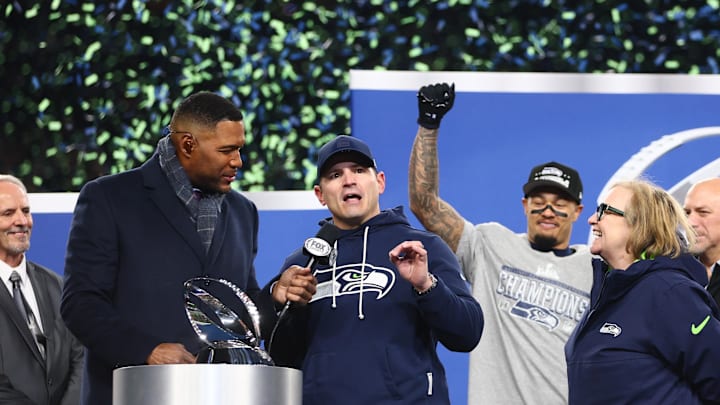
The scoreboard read 31–27 when it ended, but it said much more. These Seahawks, in their second season under head coach Mike Macdonald, have been and remain ahead of any schedule except their own. It said that their elite defense, powered by a wizard who specializes in defense, sent to counter an era of explosive offenses, will be known as the “Dark Side” for a long time. It said that general manager John Schneider deserved to win Executive of the Year a long time before this season. And it said, it screamed, that Seattle will be favored in the season’s final game.
Lights flashed between sections of the stadium. Smoke billowed overhead. The stage for the conference champions was wheeled onto Lumen Field, where the roar continued, intensifying, with Marshawn Lynch and so many luminaries from their last run on hand. They wanted to see history. Macdonald. The “Dark Side”. And they would see all that, see everything, because this game lacked, precisely, exactly … nothing.
In a sport that has manufactured stakes since the very first NFL Films voiceover, Sunday featured those, showcased that, except everything seemed magnified.
Only 34 previous times in NFL history has the league’s No. 1 scoring offense and No. 1 scoring defense met in the postseason. The Rams finished first in scoring (30.5 points per game). The Hawks were first in limiting scoring (17.2). Winnow even further. Seahawks-Rams 3.0 marked the third conference championship game to feature No. 1 vs. No. 1. In both cases, defense, in fact, won (conference) championships.
Stakes: A berth in Super Bowl LX, scheduled for two weeks from tonight in Santa Clara, Calif., to be held in an NFC West stadium, in a season where the division, formerly derided as pro football’s hinterlands, dominated.
Stakes: The NFL’s two best receivers from 2025 (Puka Nacua and Jaxon Smith-Njigba) hunting receptions on the same field.
Stakes: Two wizards on opposite sidelines and two teams that leave bruises. Brainpower and brute strength. Not versus. Both. For both teams.
Sean McVay still presents as a wunderkind. His 40s started Saturday night. He’s also tied with longtime friend Kyle Shanahan for second-longest-tenured NFL head coach. McVay catapulted the Rams into a Super Bowl in his second season as their head coach. Just like Macdonald would on Sunday with the Seahawks. He’s not even 40 yet. He needed to out-wizard the wizard. He did.
Stakes: Davante Adams, Rams wideout, the offseason acquisition that changed their offense, played in his fifth conference championship game Sunday. To reach five, he needed to play 13 total seasons. Needed to leave Green Bay, New York and Las Vegas. Needed the hamstring he strained in Week 15 to recover over the regular season’s final three weeks, including that OT loss in Seattle.
Stakes on top of stakes on top of stakes: The winner would be favored, in all likelihood, in the actual Super Bowl. I’d argue that the Seahawks, Rams and 49ers were the NFL’s three best teams. Each won at least 12 games—and each played the others four separate times. All from the same division, based on or near the West Coast, the overlooked and the drenched (in sun or in rain). They waxed over biases and disrespect or how “they” would find out what the NFC West pulsated with all season. To represent not just the conference but the NFL’s best division, one of those three teams was likely to have to go through the others first.
Which is precisely what happened.
All that swirled around as kickoff drew closer. There was Richard Sherman, retired Seahawks legend, on the field before the game started, hyping up the crowd until the decibel meter hanging above the south end zone rose to 112. Leonard Williams, current Seahawks legend, was introduced last, and his eyes bulged and his thumb jerked as he bound out of the home tunnel.
As the national anthem played, Macdonald leaned his head back, ever so slightly, and closed his eyes. As if he needed a moment of mindfulness or meditation. Maybe they all did.
The Seahawks opened this third Rams clash playing like a team that hadn’t lost in more than two months. The “Dark Side” forced a Rams punt before the sun went down. The offense fed Walker, the running back who romped, mostly forward, right at a defensive line as feared as any in pro football.
Rashid Shaheed hadn’t opened this game up yet with one of his patented returns, the kind he made routine ever since Schneider snagged his catalyst in a midseason trade. Instead, Walker’s early pounding allowed Shaheed to sneak past L.A.’s defense, where Darnold found him deep downfield and where Shaheed almost scored, tripped up by his neon spikes.
Then: right back to Walker, who met another wall of white jerseys. This time, he shifted right, around right end and right into the end zone. Another installment of a rivalry that explains a significant amount of NFL history this century had started.

Seattle just kept coming, aimed directly at Los Angeles, no ducking, no dodging, never taking a step back. The Seahawks led 10–3 (first quarter), 17–13 (second) and 31–20 (third). Complementary football staked them.
Start with that defense, where the best comparison isn’t from sports but from nature. 100 Foot Wave, which HBO released almost five years ago, follows big-wave surfers who head to Portugal, in search of waves so high and so powerful that they weren’t previously believed to exist. The series is filmed in Nazaré, where an underwater canyon, 5,000 meters or so wide, ensures maximum heights and froth and danger.
These waves are Seattle’s defense, now and perhaps forever known as the “Dark Side”. Ocean waves transport energy, drive erosion and shape landscapes. The Hawks’ D transports energy from player to player, everyone tethered and connected. The Hawks’ D drives erosion of offensive game plans. And the Hawks’ D shaped the landscape of this NFL season.
There’s an inevitability to both. In either case, the how of each inevitable force is hard to determine before it unspools. But massive ocean waves and Hawks defenders share another trait. They’re not if. They’re when.
Seattle allowed a league-low average of 17.2 points per game in 2025, which hadn’t happened since those Boom years (in this case, 2015). Only two teams put up more than 22 points against the Darkness all season before Sunday. Just ask San Francisco, where a talent-laden offense and the smartest offensive mind in football squared off against the Seahawks in the regular-season finale and the divisional round of the postseason. That offense, with Brock Purdy at quarterback and Christian McCaffrey behind him, scored nine points, combined, in the two games.
Cornerback Riq Woolen could not pinpoint the precise moment this defense got its nickname. He can recall discussions centered around their collective identity that formed over this season’s second half. He noticed when the sun went down Sunday. “Hey, that’s the “Dark Side,” man,” he said. “That’s the power. That’s how we’re relentless.”
Since Week 13, only six touchdowns had slipped by Seattle’s D until Sunday. The Rams scored four of those in their Week 16 loss. Since that game, the Seahawks had given up one touchdown. Period. They finished first in DVOA and first in EPA per play, two advanced measures that are considered the strongest indicators of defensive success. They also terrorized opposing quarterbacks, despite the lowest blitz percentage in pro football (21%). But when they do blitz, they generate pressure at the best rate in the NFL (56%). In that eight-game winning streak, five opponents put 10 or fewer points up against those Seahawks.
The Rams would make another run at them.
The rivalry all but dictated this would be so.

Rams-Hawks ranks among the more recent rivalries in pro football. They weren’t true foes for most of either franchise’s respective history. They played in different conferences, with Seattle in the AFC West until 2002, when realignment forced the Seahawks into the Rams’ division and guaranteed at least two games between them every season.
Hawks-Rams only grew broader, more spectacular, stakes heightening in lockstep with their shared history, most of it zero-sum. Like Seahawks quarterback Matt Hasselbeck shifting Seattle toward its first Super Bowl run in 2005, toppling the Rams with a masterpiece in Week 5. Like Shaun Alexander cementing his MVP campaign in the rematch that season.
Without Rams-Hawks, there’d be no Beast Quake. Seattle, in the first year of its John Schneider–Pete Carroll pairing (2010), won the NFC West, despite its losing record (7–9), the title secured with a Week 17 victory over the Rams.
There’d be no second consecutive Super Bowl appearance in Seattle (the 2014 season) without a 20–6 stomping of the Rams that December, part of a six-game winning streak to close the regular season.
Those hideous action green uniforms? Seattle debuted them against the Rams (2016). That COVID-19 season? Seattle clinched the NFC West in the regular season finale (’20) with a win over the Rams, who still toppled the Seahawks, on the road, in the quietest playoff game ever hosted at Luman Field the very next week. This set the Jared Goff–Matthew Stafford trade in motion. That led to the Rams’ Super Bowl triumph the next season.
That’s Hawks-Rams: NFC West history and NFL history; made in St. Louis, Los Angeles and Seattle; made by Alexander, Hasselbeck, Lofa Tatupu and Walter Jones; by Isaac Bruce, Torry Holt, Marshall Faulk and Orlando Pace. It’s Marshawn Lynch, Russell Wilson, Doug Baldwin, the Legion and its booms. And Goff, Cooper Kupp (both ways), Aaron Donald and Andrew Whitworth. It’s horns and hawks. Colorful uniforms. Even more colorful characters.
The Seahawks can legitimately and without reservation claim divisional supremacy since that realignment 24 seasons ago. They’ve made the most postseason appearances (15), won the most conference titles (four, breaking a tie with San Francisco on Sunday) and tied the Rams for the most championships, with one each.
Seattle cannot as easily claim supremacy against the Rams, though. Before Sunday, these franchises had clashed 57 times. The Seahawks held an edge that could not have been smaller: 29 wins, 28 losses. In those 57 games, Seattle had scored 1,223 points, to the Rams’ 1,222.
In two games this season, eight quarters and one overtime period, L.A. had outscored and outgained Seattle.
By one point.
And one yard.
In Round 1, the Seahawks limited Stafford, playing more man coverage than in any other game this season (39.6%). In Round 2, Macdonald dialed that percentage way back (19.6%) and Stafford threw for a season-high 457 yards.
In Round 1, the Rams ran the ball with efficiency (7.8 yards per carry) and effectiveness (109 rushing yards; four rushes gained at least 18 yards)—in part, because the Seahawks missed 31.8% of their tackle attempts on run plays. In Round 2, Macdonald changed his defensive fronts, the gap responsibilities of those linemen and how he spaced the defenders in coverage behind them. Seattle’s missed tackle rate plummeted (10.3%)—and, while the Rams gained more rushing yards in that game compared to Week 11, L.A. needed 39 carries to gain five additional yards. The Rams didn’t register a single double-digit run that night.
The Rams won Round 1.
The Seahawks won Round 2.
The difference, then, wasn’t Stafford or Darnold or Nacua or Smith-Njigba. Not exactly.
The difference in Round 1 was McVay.
The difference in Round 2 was Macdonald—and that includes his decision to try for a two-point conversion and a walk-off win in overtime. This courage yielded an NFL first, a walk-off overtime win via one of the rarest ways to score in football.
In a season like this one, favorites bubbling and bumbling and sometimes in the same week, there were many favorites (Buffalo, Kansas City, Philadelphia, Chicago, Denver, New England, Jacksonville and these Rams, from Week 11 until they played in Seattle) and that meant there really wasn’t one at all.
Seattle, meanwhile, didn’t reveal the fullness of its dominance until after Week 11. Since then, the Seahawks have done what the teams above them failed to do when they had their respective chances. The Seahawks have won, consistently and for long enough now—eight in a row since their last loss—to give the NFL something it didn’t really have all season.
A true favorite.
The Seahawks have steamrolled defenses at times this season, but not for a long while. They’ve shut out offenses. They’ve won games with special teams as the primary driver, either way. Round 1 against L.A. ended with a 61-yard field goal attempt that Seattle kicker Jason Meyers missed on the final play. In Round 2, the Rams missed a field goal, and Shaheed returned a punt 58 yards. At which point McVay fired his special teams coordinator.
That unit staked Seattle its advantages throughout Sunday. One of those stakeholders, Shaheed, made sure to note the rarity: a season this special spurred by Seattle’s special teams.
This game’s only turnover resulted from a punt return that the Rams muffed. The Seahawks converted that into a 24–13 late-third-quarter lead. Their punter, the All-Pro Michael Dickson, consistently shifted the field in Seattle’s favor.
The end came slowly, then suddenly, the Rams perpetually on another drive, both fan bases crying about the officiating, hope raising and dwindling and elevating once more. These Seahawks just moved forward, straight on, following their formula to the same place it has led for nine consecutive games now—another win.
The Super Bowl, versatile defender Nick Emmanwori said, is “still our destiny as a team.” He doesn’t mean just showing up.
In a season where no team seemed inevitable, the Seahawks became just that. They didn’t need to whine about the refs, the most challenging division in pro football or anything else. They filled their victorious locker room with cigar smoke and conference champions hats and T-shirts, which is, essentially, how they became inevitable to begin with.
Editors’ note, Jan. 26 at 2:00 p.m. ET: This post has been updated to reflect the correct nickname for the Seahawks’ defense, which is the Dark Side, not the Darkness.
More NFL From Sports Illustrated
 Add us as a preferred source on Google
Greg Bishop was a senior writer for Sports Illustrated and has covered every kind of sport and every major event across six continents for more than two decades. He previously worked for The Seattle Times and The New York Times. He is the co-author of two books: Jim Gray’s memoir, “Talking to GOATs”; and Laurent Duvernay Tardif’s “Red Zone”. Bishop has written for Showtime Sports, Prime Video and DAZN, and has been nominated for eight sports Emmys, winning two, both for production. He has completed more than a dozen documentary film projects, with a wide range of duties. Bishop, who graduated from the Newhouse School at Syracuse University, is based in Seattle.
Follow GregBishopSI