%20%20--%3E%0A%3Csvg%20version%3D%221.1%22%20id%3D%22Layer_1%22%20xmlns%3D%22http%3A%2F%2Fwww.w3.org%2F2000%2Fsvg%22%20xmlns%3Axlink%3D%22http%3A%2F%2Fwww.w3.org%2F1999%2Fxlink%22%20x%3D%220px%22%20y%3D%220px%22%0A%09%20width%3D%2239px%22%20height%3D%2240px%22%20viewBox%3D%220%200%2039%2040%22%20enable-background%3D%22new%200%200%2039%2040%22%20xml%3Aspace%3D%22preserve%22%3E%0A%3Cpath%20fill%3D%22%23FFFFFF%22%20d%3D%22M38.5%2C7H28.2v26h10.3V7z%22%2F%3E%0A%3Cpath%20fill-rule%3D%22evenodd%22%20clip-rule%3D%22evenodd%22%20fill%3D%22%23FFFFFF%22%20d%3D%22M26.1%2C25.5c0%2C5.8-4.1%2C7.5-12.9%2C7.5C3.9%2C33%2C0%2C31.2%2C0%2C25.2v-1.1h11.6%0A%09v2.4c0%2C0.7%2C0.1%2C1.4%2C1.2%2C1.4c1%2C0%2C1.2-0.4%2C1.2-1.3v-0.9c0-1.6-0.9-1.6-3.5-2.2C2.2%2C21.7%2C0%2C19.7%2C0%2C15.3v-0.9C0%2C9.3%2C5.5%2C7%2C12.9%2C7%0A%09c10.2%2C0%2C12.8%2C2.6%2C12.8%2C7.4v1.8h-11v-2.9c0-0.6-0.4-1.1-1.2-1.1c-0.6%2C0-1.2%2C0.4-1.2%2C1.1v0.9c0%2C1.5%2C0.9%2C2%2C3.3%2C2.5%0A%09c8%2C1.6%2C10.5%2C3.3%2C10.5%2C7.5V25.5z%22%2F%3E%0A%3C%2Fsvg%3E%0A)
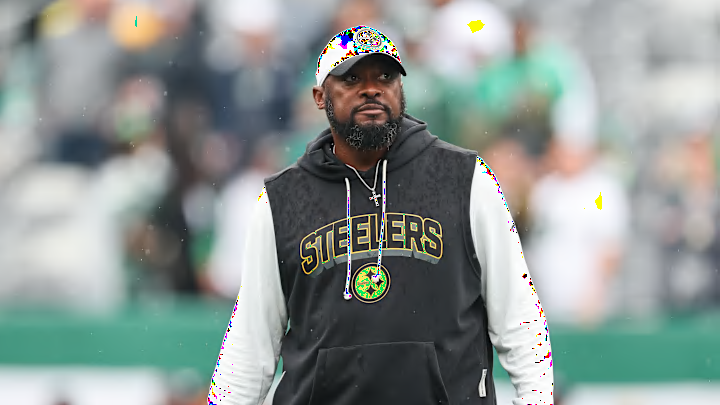
Mike Tomlin’s Secret Power Was Relationship Building
In this story:
On Friday afternoons, the Steelers’ offensive coordinator knew it was coming—and Todd Haley had been in the role long enough to the point where, by the end, he’d actually ask the question, preemptively, rather than wait for Mike Tomlin to spit out the answer.
How many points do we need this week, Mike?
In a world built on complicated and coded work and jargon, the Steelers’ coach wanted to boil it down, just before the game, into simple terms. He knew it’d help the OC do his job.
And that, after 19 years, is perhaps the lasting mark Tomlin leaves, as he steps away from the coaching job he won (in a huge upset) a generation ago. The ex-college receiver, and ex-Buccaneers and Vikings assistant, always knew what his players needed, and what his team needed. Give that to them consistently, he trusted, and you’d keep folks on board, and harvest the best from them all.
It sounds simple, and easy, but it also illustrates how often fans, and even teams, get what they should be looking for in a head coach so dreadfully wrong. What Tomlin did best could never be measured on a spreadsheet, or broken down by an in-house analyst, or judged by where a playsheet might take him.
It was in how he knew how to, over and over again, get the most out of the human beings he worked with. Tomlin won with the people he got the most of every day.
That was illustrated on every roster that he and GMs Kevin Colbert and Omar Khan ever built, in that the Steelers were able to sprinkle in guys such as Antonio Brown, Martavis Bryant, Le’Veon Bell, Mike Wallace, Joey Porter, Santonio Holmes, James Harrison, George Pickens and even (early on) Ben Roethlisberger, with captain types like Ryan Clark, Troy Polamalu, James Farrior, Heath Miller, Hines Ward, Brett Keisel and Cam Heyward.
Pittsburgh could always cast a wide net for talent because Tomlin could work with anyone.
“When I got to Pittsburgh and A.B. would do something frustrating—and I’d be frustrated, whether he’s late to a meeting, whatever it was—Mike T would come in and shut the door and say, Hey, relax, it’s gonna be O.K., I’ll handle it,” said Haley, Tomlin’s OC from 2012 to ’18. “I really learned how to have more patience with players, and with some of those off-the-field-type things, not let that affect me. He would say, Just coach the player.
“At that time, I probably needed to hear that. But you’re exactly right. I mean, his ability to manage people, I think, is incredible. And that doesn’t just mean players. I think everybody involved, with the little conversations he’d have.”
But it wasn’t just having the conversations. It was reaching people when he had them. And while part of that was Tomlin’s unmistakable charisma, he also really worked at it.
One way he went about it was apparent to everyone who’d travel the pro-day circuit with the Steelers in the spring. When Tomlin would get to the building in the morning at Georgia or Clemson or wherever, he’d ask to see the football program’s social media manager, who’d oftentimes be a 21- or 22-year-old student. He’d ask what the players were looking at. He’d inquire on what was pulling in teenagers in recruiting.
He once even conceded to me that he’d mine his own kids for similar information.
All of it was done with a purpose.
“I got a bunch of relationships,” Tomlin said. “Those [schools] are consistently in the mix for a reason, and they got guys coming into the draft every year, so they become routine stops. And in the midst of those routine stops, you got time to do some side projects and gain some understanding. … I stay connected to college football coaches. I learn a lot from them. When I’m evaluating in the spring, and going out and preparing for the draft, I’m also studying programs and coaches and seeing what’s important to them, and the lives of the people they work with. Because invariably those are gonna be some of the people that I work with.
“That’s a process that I start anew every year. Got good relationships with guys that coach in college, so, Hey, take me to your social media coordinator, let me spend five minutes with them and see the points of emphasis they’re making to the 18-year-olds.”
Then, later in those days, Steelers scouts and coaches would see Tomlin with a prospect’s mom and dad on the sideline, preparing for the chance the son would play for him.
And by then, the reality was Tomlin would already be kneedeep in the work. Routinely, he’d wow his coaches at the combine when they’d get into formal interviews, and Tomlin would ask every prospect specific, detailed, personal questions, at a time of year when they were all scrambling to catch up on the basics of the kids they were in front of. He wasn’t trying to prove anything to anyone in those moments—it simply showed what he’d already done.
It helped, of course, inform the Steelers’ draft process. But it also allowed Tomlin to have a foundation for a bond with the players Pittsburgh drafted, before the card was even turned in.
From there, he’d keep working at it, knowing each relationship was different than the next.
“It just came down to this—he had his own unique relationship with every player and every coach,” said his current OC, Arthur Smith, on Tuesday night. “He’s just a very approachable person. And then he’s got a lot of empathy, and I think he took everybody on, and he saw that person as an individual. And that’s why he had his own relationship with them. “
So how he’d push a Farrior or a Polamalu would, to be sure, how he’d try and motivate a Brown or a Pickens. The commonality was, far more often than not, he’d pull the most out of whoever was on the other end of that unique relationship.

Why Tomlin was awesome for so long
There was a line Tomlin used on Haley years ago that Haley will never forget.
“What you have, Todd,” he said, “I’d pay a million dollars for.”
“What do you mean, what do I have?” Haley responded.
“People, before they even know, think you’re an a------,” Tomlin deadpanned. “That’s priceless. You don’t even have to do anything.”
Haley still laughs because he knew where it was coming from—Tomlin was well aware of the perception of his assistant coach, and the dig was meant, in a way, as a compliment, and an acknowledgment that he saw him differently.
It was also to add energy to the practice field, which was another of Tomlin’s specialties.
His passion for football and people was unending.
On the football side, it would manifest in how, on a week-to-week basis, he’d retreat to his office, which he affectionately called, “The Hole,” and emerge with cutups to bring to his coaches—never telling them what to do, but giving them information that would help in his weekly quest to, as he’d term it, “engineer a victory.”
His background was in defense. But he’d been an offensive player. And when asked what his strength was, as a technical football coach, Haley responded, “Everything.” This was reflected in what he gave his staff each week.
“He did that with all three phases—where he would talk through what he saw and give you his opinion for, defensively, how they were built and stuff that we’re doing schematically,” Smith said. “He did a good job of kind of setting the table for the entire team. And it carried over in his team meetings.”
And in those team meetings, his passion for getting the most from people came through, too, as he worked to ensure the players shared his energy he had for the task ahead.
“He knew how to create it,” Haley said. “It might be two guys trying to get in pads on a Sunday—one was gonna have to sit out and not play, and one was gonna be the last roster spot. And he’d put their pictures up to the whole team, and he’d say, Two dogs, one bone. And there’d be a picture of a bone and a picture of each player. Doing that in front of the whole team, you’d be out at practice, and the players they’re watching, they wanna see who’s gonna get the bone. And it just created an energy within the group.
“He found so many different ways to do that.”
And because he had the relationships, he could pull those strings with his coaches or his players. Everyone knew where his heart and where his intentions were.
So when the talent on the roster was good, the Steelers played for championships.
When it was lacking, they were still competitive.
Routinely, and so consistently, he knew what we had, and what his team needed, and he’d pull out every stop to give it to them. Which is why, on those Friday afternoons, he was so capable of telling his offensive coordinator exactly how much he needed from that unit.
“Some weeks he’d say 17, some weeks he’d say 30-plus,” Haley said. “And that’s not the way it is everywhere. I think he just had such a good feel for what the game could look like. And he was able to communicate that with me, then trust I’d find my own way to pass it along to our offense. It was usually exactly what we needed to do to have the best chance to win. And I always thought that was awesome.”
And it was one of the many reasons why Tomlin was able to stay awesome for so long—and probably will be, when the time comes, again.
 Add us as a preferred source on Google
Albert Breer is a senior writer covering the NFL for Sports Illustrated, delivering the biggest stories and breaking news from across the league. He has been on the NFL beat since 2005 and joined SI in 2016. Breer began his career covering the New England Patriots for the MetroWest Daily News and the Boston Herald from 2005 to ’07, then covered the Dallas Cowboys for the Dallas Morning News from 2007 to ’08. He worked for The Sporting News from 2008 to ’09 before returning to Massachusetts as The Boston Globe’s national NFL writer in 2009. From 2010 to 2016, Breer served as a national reporter for NFL Network. In addition to his work at Sports Illustrated, Breer regularly appears on NBC Sports Boston, 98.5 The Sports Hub in Boston, FS1 with Colin Cowherd, The Rich Eisen Show and The Dan Patrick Show. A 2002 graduate of Ohio State, Breer lives near Boston with his wife, a cardiac ICU nurse at Boston Children’s Hospital, and their three children.
Follow AlbertBreer